A motor or casing eye may be intended only for that component. Establish the current entire assembly and load path through designated package points, rigging and lifting appliance; the presence of an eye is not permission.
AI-generated reference material; not professionally verified or approved. Before use, a qualified person must review and adapt it to Singapore requirements, the actual equipment/site and approved safe work procedures.
Stop before starting
Hold for unknown package mass, centre or points, unverified support/rigging, pad or anchor interference, tilt, handling damage, lost signals or route change. Do not release rigging before the specified stable condition.
1. Legal and technical scope
| Basis | Scope and limits |
|---|---|
| MOM: Risk management | Assess package changes, transport, landing, support release and installation interfaces. Official explanation of statutory duties; linked SSO text was not independently read for this item. This is not a legal opinion. |
| WSH Council: Planning a Lift | Prepare the actual lifting plan, roles, signals, ground and exclusion. Official practical guidance. No assertion that every activity is a crane operation or that this page itself establishes a universal statutory permit. |
| MOM: Register Lifting Equipment | Verify lifting-equipment/gear identity, registration and examination status within scope. Official registration explanation; determine the actual equipment category and applicable exceptions. Registration is not approval of the individual lift. |
| WSH Council: Safe Loading and Unloading on Vehicles (2023) | Stabilise the delivered load before controlled restraint release and unloading. Guidance does not supply a device-specific ratchet release order, temporary support design or permission for crane operation. |
| WSH Council: Safe Use of Machinery | Control motor and other energy for adjustments or rework. Official guidance; cited paid Singapore Standards were not obtained. No universal wheel test duration or gap is inferred. |
| ITT Goulds Pumps 3610: transport and lifting | Distinguish a package lifting arrangement from a component-only lifting feature. Full PDF not retrieved; no sling angle, exact point arrangement, foundation dimension or product suitability inferred. Obtain the actual supplied package lifting drawing. |
Apply Singapore WSH risk management and the actual lifting plan, competent lifting-team roles and applicable permit process. Verify MOM registration and AE examination requirements for the selected lifting equipment and gear. The actual package lifting drawing, equipment configuration and engineered floor/foundation govern mass, lifting points and support reactions. A generic pump manual or a crane rating alone cannot approve the complete lift. Required electrical work and commissioning remain separate controlled stages.
2. Scope and required inputs
Included work
Receive, unload and move an identified pump, motor and baseplate assembly onto its reviewed foundation, provide specified temporary restraint and transfer it for separate grouting, alignment, piping and electrical work.
Separate assessment
Unapproved component-eye lifting, live piping disconnection, unreviewed pad/anchor modification, final grouting/alignment, electrical connection, rotation testing and commissioning require separate plans.
| Required input | Evidence to obtain |
|---|---|
| Confirm package and route | Package ID and components; Mass and balance basis; Route and support evidence; Foundation revision |
| Prepare unloading area | Crane and ground basis; Vehicle and load access; Exclusion and signals; Clearances and weather |
| Inspect rigging and base | Points and rigging IDs; Capacity and condition; Sling clearance; Pad and support readiness |
| Trial lift and transport | Trial lift response; Load path and clearance; Controlled guiding position; Stop signal understood |
No actual equipment model, site measurements, design calculations or signed approval was supplied. Check the applicable Singapore requirements and approved safe work procedures against the actual equipment and site before use. Statutory duties, official guidance and manufacturer limits serve different purposes; editorial checks do not establish legal or professional approval.
Singapore site application
Coordinate the Singapore site lifting supervisor, operator, rigger and signaller as required by the operation; confirm the receiving mechanical contractor and pad-design owner. In a congested plant room, verify floor reactions, route width/height and the controlled transition from crane to skates/rollers or jacks.
Record package mass in kg, dimensions and radius in m, components, centre of gravity and lift-point IDs. Sling geometry, base reactions, pad strength and restraint/curing criteria come from reviewed documents; no generic angle or curing period is assigned.
3. Eight-stage JSA
| Job stage | Hazards and effects | Failure factors | Technical and procedural controls | Site verification | P | S | R | A |
|---|---|---|---|---|---|---|---|---|
| 1. Confirm package and route | 1. Package drop2. Unbalanced rotation3. Route collapse4. Wrong foundation position | 1. Component mass used2. Accessories changed3. Support loads unknown4. Drawing revision wrong | 1. Confirm complete assembly2. Review actual centre of gravity3. Accept route and reactions4. Match foundation drawing | 1. Package ID and components2. Mass and balance basis3. Route and support evidence4. Foundation revision | ||||
| 2. Prepare unloading area | 1. Crane instability2. Vehicle movement3. Pedestrian strike4. Overhead collision | 1. Outrigger support unknown2. Vehicle not secured3. Exclusion incomplete4. Clearance overlooked | 1. Review setup configuration2. Secure unloading vehicle3. Separate lift and people4. Check overhead envelope | 1. Crane and ground basis2. Vehicle and load access3. Exclusion and signals4. Clearances and weather | ||||
| 3. Inspect rigging and base | 1. Lifting-point failure2. Sling overload3. Nozzle damage4. Unstable landing | 1. Driver eye used for package2. Angle capacity unchecked3. Sling touches accessories4. Support locations unready | 1. Use package lifting points2. Verify rigging geometry3. Protect vulnerable parts4. Prepare specified supports | 1. Points and rigging IDs2. Capacity and condition3. Sling clearance4. Pad and support readiness | ||||
| 4. Trial lift and transport | 1. Load rotation2. Suspended-load strike3. Package collision4. Loss of load control | 1. Balance not checked2. People enter travel path3. Changed clearance ignored4. Signals conflict | 1. Check balance at trial lift2. Maintain exclusion zone3. Stop for route changes4. Use designated signaller | 1. Trial lift response2. Load path and clearance3. Controlled guiding position4. Stop signal understood | ||||
| 5. Land and align position | 1. Hand crush2. Baseplate distortion3. Package shift4. Foundation damage | 1. Hands under base2. Support uneven3. Load released too early4. Improvised adjustment | 1. Use suitable alignment tools2. Check bearing locations3. Retain support as required4. Follow positioning method | 1. Base location and level2. Shim and bearing condition3. Hands outside crush zone4. Foundation condition | ||||
| 6. Restrain and release | 1. Package overturn2. Anchor damage3. Jack collapse exposure4. Premature sling removal | 1. Partial fastening accepted2. Anchor design unclear3. Hydraulics sole support4. Release owner absent | 1. Complete required restraint2. Verify fastening method3. Use accepted mechanical support4. Authorise lifting release | 1. Required restraint completed2. Anchor and support record3. Stable released condition4. Named release authority | ||||
| 7. Hold and reposition | 1. Repeated equipment damage2. Uncontrolled movement3. Nozzle overload4. Unsupported disassembly | 1. Impact ignored2. Support changed informally3. Piping used to pull pump4. Rework lift not reviewed | 1. Hold and inspect damage2. Reestablish safe support3. Reject forced pipe alignment4. Review revised lift plan | 1. Damage and cause record2. Current package configuration3. Support and lifting basis4. Rework acceptance | ||||
| 8. Transfer installation | 1. Premature startup2. Residual misalignment3. Pipe-strain damage4. Missing guard exposure | 1. Placement equals completion2. Grout and alignment omitted3. Flange load unreviewed4. Later work unassigned | 1. Define next installation stage2. Transfer alignment and grout holds3. Record piping restrictions4. Assign guarding and test checks | 1. As-landed condition2. Remaining installation steps3. Defects and retained holds4. Receiving owner acceptance |
P = likelihood; S = severity; R = risk under the site method; A = site-defined acceptance/authorization. These actual assessment cells are blank. A low score never overrides a missing safeguard or a legal or manufacturer restriction.
4. Fictional scenario and failure mechanisms
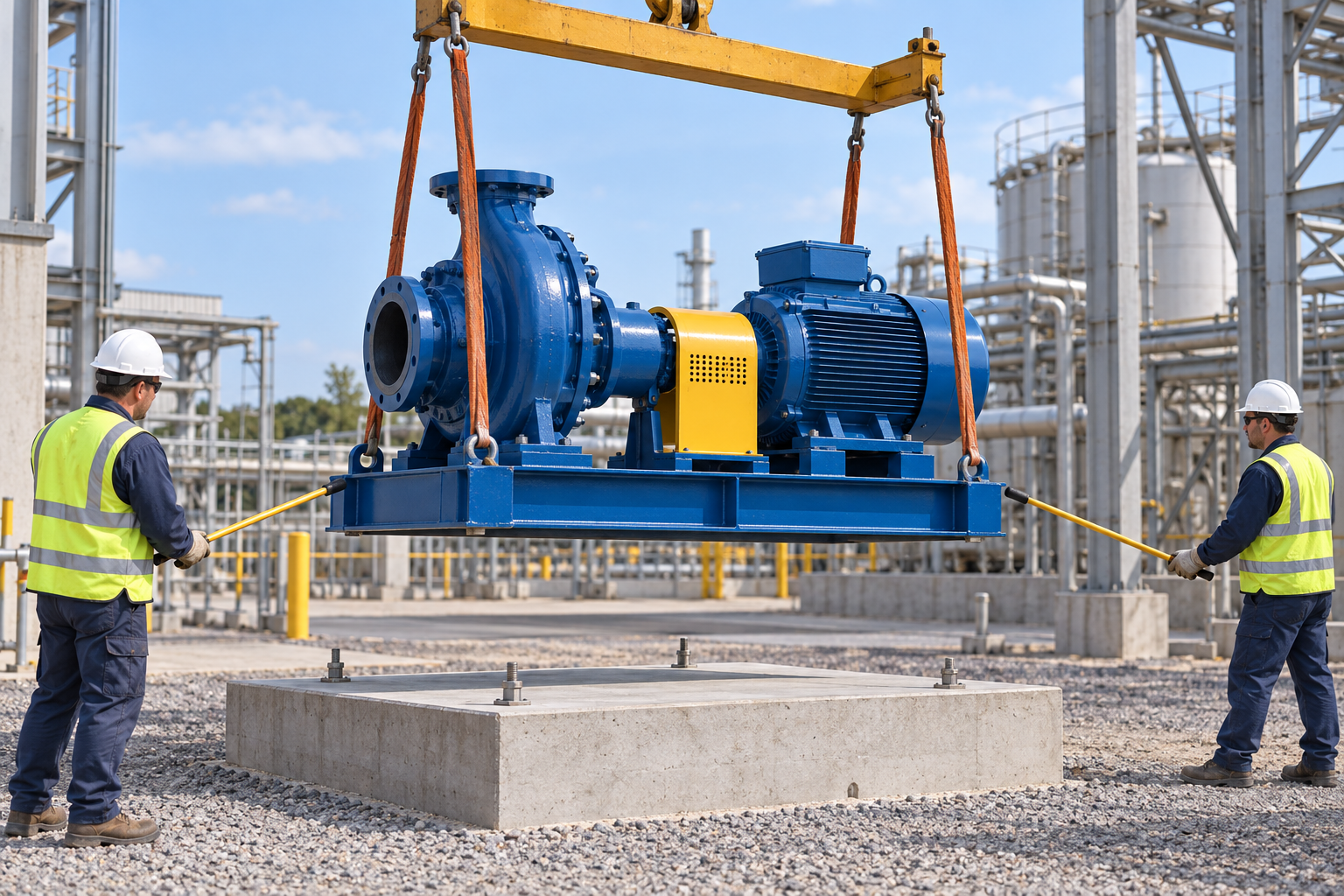
This illustration provides educational context. It is not an actual incident photograph or evidence of equipment suitability; any AI-generated depiction is illustrative only.
The scenario and record comparisons are fictional teaching examples, not records of real incidents, measurements, inspections, signatures or approvals.
| Stage | Fictional situation |
|---|---|
| Initial situation | A fictional pump/motor/base package is prepared for positioning. |
| Changed condition | The motor and accessories differ from the earlier lift information. |
| Failure path | The crew proposes using the motor eye and the old package mass. |
| Possible outcome | The eye or rigging could fail or rotate the changed assembly, causing a dropped load or crush injury. |
| Prevention barrier | Hold lifting and confirm current mass, balance and designated package points before revised rigging and a controlled trial lift. |
Failure mechanisms
A motor or casing eye may be intended only for that component. Establish the current entire assembly and load path through designated package points, rigging and lifting appliance; the presence of an eye is not permission.
Sling geometry changes individual tensions and may distort the base or contact nozzles, instruments and coupling parts. Equipment rated for total mass still needs actual radius, support and rigging configuration verified.
Touchdown is not stable release. Confirm specified bearing points, shim/mechanical-support condition, pad/anchor interference and required temporary restraint before reducing lifting support. Do not rely on hydraulic pressure alone to protect a crush zone.
Positioning precedes installation acceptance. Keep grout curing, anchoring, shaft alignment, pipe loads, electrical work, guards and tests as explicit later holds. Never pull piping into alignment through pump flange bolts.
Decision sequence
| Step | Decision |
|---|---|
| Known | The actual package includes a changed driver and accessories. |
| Unknown | Complete mass, balance, lifting-point suitability and rigging geometry are unresolved. |
| Hold | Do not lift through the component eye or use the old mass as the complete basis. |
| Evidence | Link component list, lifting drawing, load/radius, point capacities and route/support review. |
| Release | Accept the revised lift and trial balance; later verify stable landing and transfer remaining installation holds. |
Work sequence: Confirm package and route → Prepare unloading area → Inspect rigging and base → Trial lift and transport → Land and align position → Restrain and release → Hold and reposition → Transfer installation. This is a teaching flow, not a device drawing or a complete operating procedure.
5. Conditional decisions and common errors
| Situation | Required action | Evidence | Proceed when |
|---|---|---|---|
| Package changed | Hold and revise lift | Current mass/centre/points | Lift accepted |
| Anchor interference | Stop lowering | Pad and anchor survey | Reviewed correction |
| Support incomplete | Retain lifting support | Bearing and restraint evidence | Stable release accepted |
| Piping misaligned | Stop force fitting | Independent interface review | Alignment accepted |
Similar observations, different decisions
The scenario and record comparisons are fictional teaching examples, not records of real incidents, measurements, inspections, signatures or approvals.
| Observation | Insufficient conclusion | Required distinction |
|---|---|---|
| Crane rating adequate | The package lift is approved. | Verify points, slings, balance and support for the actual configuration. |
| Base touches pad | Rigging may be removed. | Confirm complete bearing and restraint after release. |
| Pump positioned | Commissioning may start. | Reconcile separate installation and testing holds. |
6. Roles and responsibilities
| Role | Responsibility |
|---|---|
| Lifting supervisor and lifting team | Execute the accepted plan with required competence, signals and exclusion. |
| Package supplier / qualified technical reviewer | Resolve current configuration, points, balance and allowable handling. |
| Foundation/temporary-support reviewer | Confirm pad/floor loads, bearing, restraint and release conditions. |
| Mechanical installation recipient | Accept as-landed condition and own remaining installation/commissioning holds. |
Supervision and handover focus
| Stage | Management action | Evidence |
|---|---|---|
| Confirm package and route | 1. Record package id and components2. Record mass and balance basis3. Record route and support evidence | 1. Package ID and components2. Mass and balance basis3. Route and support evidence |
| Prepare unloading area | 1. Record crane and ground basis2. Record vehicle and load access3. Record exclusion and signals | 1. Crane and ground basis2. Vehicle and load access3. Exclusion and signals |
| Trial lift and transport | 1. Record trial lift response2. Record load path and clearance3. Record controlled guiding position | 1. Trial lift response2. Load path and clearance3. Controlled guiding position |
| Land and align position | 1. Record base location and level2. Record shim and bearing condition3. Record hands outside crush zone | 1. Base location and level2. Shim and bearing condition3. Hands outside crush zone |
| Hold and reposition | 1. Record damage and cause record2. Record current package configuration3. Record support and lifting basis | 1. Damage and cause record2. Current package configuration3. Support and lifting basis |
| Transfer installation | 1. Record as-landed condition2. Record remaining installation steps3. Record defects and retained holds | 1. As-landed condition2. Remaining installation steps3. Defects and retained holds |
7. Hold points and record comparison
| Hold point | Evidence before release | Actual approval |
|---|---|---|
| HP-0 Scope | Receive, unload and move an identified pump, motor and baseplate assembly onto its reviewed foundation, provide specified temporary restraint and transfer it for separate grouting, alignment, piping and electrical work. | |
| HP-1 Inspect rigging and base | Points and rigging IDs; Capacity and condition; Sling clearance; Pad and support readiness | |
| HP-2 Trial lift and transport | Trial lift response; Load path and clearance; Controlled guiding position; Stop signal understood | |
| HP-3 Restrain and release | Required restraint completed; Anchor and support record; Stable released condition; Named release authority | |
| HP-4 Transfer installation | As-landed condition; Remaining installation steps; Defects and retained holds; Receiving owner acceptance |
Hold points are internal project checks. They are not universal statutory permits and do not grant work permission. Reassess after defects, changed conditions and shift changes.
Record comparison
The scenario and record comparisons are fictional teaching examples, not records of real incidents, measurements, inspections, signatures or approvals.
The boxes are static record prompts, not interactive or saved approvals. A tick does not establish suitability or permission to restart. Record the evidence, person, time and unresolved issues; retain the change history.
| Record | Insufficient record | Record checklist |
|---|---|---|
| Confirm package and route | Only marked “OK” | □ Package ID and components□ Mass and balance basis□ Route and support evidence□ Foundation revision |
| Trial lift and transport | Only marked “OK” | □ Trial lift response□ Load path and clearance□ Controlled guiding position□ Stop signal understood |
| Hold and reposition | Only marked “OK” | □ Damage and cause record□ Current package configuration□ Support and lifting basis□ Rework acceptance |
| Transfer installation | Only marked “OK” | □ As-landed condition□ Remaining installation steps□ Defects and retained holds□ Receiving owner acceptance |
8. Site checklist and emergency response
| Site check | Actual result | Person / action |
|---|---|---|
| Confirm package and route: Package ID and components; Mass and balance basis; Route and support evidence; Foundation revision | ||
| Prepare unloading area: Crane and ground basis; Vehicle and load access; Exclusion and signals; Clearances and weather | ||
| Inspect rigging and base: Points and rigging IDs; Capacity and condition; Sling clearance; Pad and support readiness | ||
| Trial lift and transport: Trial lift response; Load path and clearance; Controlled guiding position; Stop signal understood | ||
| Land and align position: Base location and level; Shim and bearing condition; Hands outside crush zone; Foundation condition | ||
| Restrain and release: Required restraint completed; Anchor and support record; Stable released condition; Named release authority | ||
| Hold and reposition: Damage and cause record; Current package configuration; Support and lifting basis; Rework acceptance | ||
| Transfer installation: As-landed condition; Remaining installation steps; Defects and retained holds; Receiving owner acceptance |
Stop work
Hold for unknown package mass, centre or points, unverified support/rigging, pad or anchor interference, tilt, handling damage, lost signals or route change. Do not release rigging before the specified stable condition.
Emergency response
Stop movement and clear fall/crush zones if the package shifts or support/rigging fails. Do not catch it or cut an interfering anchor. Activate the lifting emergency plan and call 995 for a medical emergency; recovery needs a reviewed stable-support and lifting method.
9. Sources and review limits
Public-source access/review: 2026-10-14.
| Official source | Reviewed scope and limits |
|---|---|
| MOM: Risk management | Assess package changes, transport, landing, support release and installation interfaces. Official explanation of statutory duties; linked SSO text was not independently read for this item. This is not a legal opinion. |
| WSH Council: Planning a Lift | Prepare the actual lifting plan, roles, signals, ground and exclusion. Official practical guidance. No assertion that every activity is a crane operation or that this page itself establishes a universal statutory permit. |
| MOM: Register Lifting Equipment | Verify lifting-equipment/gear identity, registration and examination status within scope. Official registration explanation; determine the actual equipment category and applicable exceptions. Registration is not approval of the individual lift. |
| WSH Council: Safe Loading and Unloading on Vehicles (2023) | Stabilise the delivered load before controlled restraint release and unloading. Guidance does not supply a device-specific ratchet release order, temporary support design or permission for crane operation. |
| WSH Council: Safe Use of Machinery | Control motor and other energy for adjustments or rework. Official guidance; cited paid Singapore Standards were not obtained. No universal wheel test duration or gap is inferred. |
| ITT Goulds Pumps 3610: transport and lifting | Distinguish a package lifting arrangement from a component-only lifting feature. Full PDF not retrieved; no sling angle, exact point arrangement, foundation dimension or product suitability inferred. Obtain the actual supplied package lifting drawing. |
No actual equipment model, site measurements, design calculations or signed approval was supplied. Check the applicable Singapore requirements and approved safe work procedures against the actual equipment and site before use. Statutory duties, official guidance and manufacturer limits serve different purposes; editorial checks do not establish legal or professional approval.
10. PDF guidance and FAQ
PDF A covers basic task controls; B focuses on technical failures; C covers supervision, records and handover. The article has eight stages with four items per main cell; each PDF has six key stages with three items per main cell. P/S/R/A, measurements, confirmations and signatures remain blank for actual site assessment.
PDFs are complementary six-stage extracts. Apply all eight body stages and the actual equipment/site procedure.
Can the motor eye lift the package?
Only if actual manufacturer documentation explicitly permits that complete configuration.
Does total mass below crane rating suffice?
No. Check configuration, radius, ground, rigging geometry, individual points and vulnerable components.
Can hydraulics alone support adjustment?
Do not rely on hydraulic pressure alone for exposed access; use the reviewed mechanical-support procedure.
What follows placement?
Transfer grout/curing, anchoring, alignment, piping strain, electrical, guard and test conditions to the responsible parties.
Has a professional verified or approved this document?
AI-generated reference material; not professionally verified or approved. Before use, a qualified person must review and adapt it to Singapore requirements, the actual equipment/site and approved safe work procedures.
11. Revision history and authorship
AI-generated reference material; not professionally verified or approved. Before use, a qualified person must review and adapt it to Singapore requirements, the actual equipment/site and approved safe work procedures.
| Date | Version | Change | Review status |
|---|---|---|---|
| 2026-10-14 | SG 1.0 | New Singapore edition from assigned Korean source; task decisions, records and PDFs localized. | AI editorial review; no professional technical approval |
Korean edition revision history: 2026-09-19 (v1.1): earlier published draft/version retained in the source history; 2026-09-26 (v1.2): task decisions, record checklist, JSA and three PDF variants revised. These are editorial records, not professional technical approval. Singapore v1.0 adapts the earlier edition to Singapore requirements and terminology.
Site reviewers must add their actual qualifications, scope, date and approval only after the review occurs.