Confirm the actual PVC system and cement before assembly. Protect the joint through its product-specific holding, handling and test-ready stages; a dry-looking surface or an outside cement patch cannot establish a sound joint.
AI-generated reference material. It has not been verified or approved by a professional. Before use, a qualified person must review and adapt it to applicable Singapore requirements, the actual equipment and site, and approved safe work procedures.
1. Singapore legal and technical basis
Singapore WSH controls address solvent exposure, ignition and handling. PUB requires Licensed Plumbers for regulated sanitary plumbing work, with specified simple-work exceptions; determine the actual system and task before assigning the work. New developments and building works also need the applicable QP plans and construction oversight. This JSA does not approve a drainage design or complete-system test.
| Source category | Task application and limit |
|---|---|
| MOM - Risk management | Assess solvent work, manual cuts, support and simultaneous trades. Official explanation of WSH Risk Management duties, not a complete consolidated statutory text. |
| PUB - Plumbing Works | Assign the applicable LP/QP arrangements from the actual regulated sanitary-work scope. Actual drainage system and work classification remain to be checked; not every pipe joint requires the same licence/submission. No complete sanitary code review is claimed. |
| MOM - Requirements for hygiene monitoring | Assess ingredients and competent monitoring where toxic substances are used or generated. Material-specific exposure and actual monitoring frequency have not been determined. No workplace measurement is supplied. |
| MOM - Safe storage of combustible materials in construction | Keep ignition and combustible interfaces controlled, including adjacent hot work. Construction circular explaining relevant duties and precautions. No universal fire-watch duration or blanket hot-work permit is inferred. |
Use Singapore requirements and SI units. Manufacturer limits apply to the actual model. Foreign technical examples do not establish Singapore statutory duties. A job safety analysis or completed checklist is not a permit or approval.
2. Scope and required inputs
Included: Manual cutting, preparation and solvent-weld assembly of identified new nonpressure PVC indoor drain pipe, followed by support, curing and handover for the specified separate leak test in a suitably ventilated area.
Separate review: CPVC or ABS substitution, pressure or fuel-gas systems, live sewer tie-ins, confined spaces, power cutting and compressed-air or gas testing are outside this workflow.
| Input | Required evidence |
|---|---|
| Identify system and product | Pipe fitting and size; Product label and SDS; Material compatibility; Scope and test method |
| Cut and prepare | Cut and end condition; Socket and pipe surfaces; Required engagement; Cutting tool condition |
| Assemble and hold | Assembly time and operator; Engagement and orientation; Required holding completed; Visible joint condition |
| Transfer test readiness | Joint map and cure basis; Defect and repair status; Product and waste closure; Named test owner |
Obtain pipe and fitting identity, size and fit, compatible primer and cement instructions, current SDS, product condition and environmental limits. Record assembly time, temperature and other required curing factors. Select chemical-resistant gloves and eye protection from the actual exposure assessment. Handling readiness and test readiness must each meet the product requirements.
Singapore application
Record whether this is regulated sanitary work or a listed simple-work exception. Identify the responsible LP and QP where applicable, and resolve the approved layout, gradient, support and testing interface before jointing. Do not assume a short length of pipe is exempt.
3. Eight-stage JSA
| Job stage | Hazards and effects | Failure factors | Controls | Site verification | P | S | R | A |
|---|---|---|---|---|---|---|---|---|
| 1. Identify system and product | 1. Joint separation2. Vapor exposure3. Chemical burns4. Wrong-system installation | 1. PVC identity uncertain2. SDS unavailable3. Protection guessed4. Pressure scope overlooked | 1. Confirm nonpressure PVC2. Match primer and cement3. Review product hazards4. Define test boundary | 1. Pipe fitting and size2. Product label and SDS3. Material compatibility4. PUB scope and test method | ||||
| 2. Prepare area and support | 1. Vapor accumulation2. Solvent ignition3. Pipe movement4. Trip injury | 1. Ventilation inadequate2. Ignition sources nearby3. Temporary support absent4. Materials block access | 1. Establish suitable ventilation2. Control ignition sources3. Support pipe independently4. Keep work route clear | 1. Ventilation and work area2. Ignition source review3. Support and alignment4. Clear access | ||||
| 3. Cut and prepare | 1. Hand cuts2. Poor socket engagement3. Contaminated joint4. Eye injury | 1. Pipe rolls during cutting2. Cut angled or burred3. Dirty or wet surfaces4. Chips uncontained | 1. Secure pipe for manual cut2. Deburr and prepare ends3. Clean as product requires4. Control chips and protection | 1. Cut and end condition2. Socket and pipe surfaces3. Required engagement4. Cutting tool condition | ||||
| 4. Check fit and readiness | 1. Weak bond2. Wrong joint orientation3. Cement skin formation4. Excess solvent pooling | 1. Fit not checked2. Marks absent3. Tools not ready4. Applicator unsuitable | 1. Check specified dry fit2. Mark alignment and depth3. Stage jointing materials4. Use correct applicator | 1. Fit and engagement basis2. Orientation marks3. Product working conditions4. Cement condition | ||||
| 5. Assemble and hold | 1. Joint pushout2. Skin and eye contact3. Misaligned branch4. Incomplete bond | 1. Holding released early2. Wet cement splashes3. Joint moved after set4. Dried cement reused | 1. Follow product assembly2. Maintain required holding3. Keep alignment stable4. Reject defective assembly | 1. Assembly time and operator2. Engagement and orientation3. Required holding completed4. Visible joint condition | ||||
| 6. Support and cure | 1. Joint distortion2. Premature leakage3. Vapor exposure4. Accidental disturbance | 1. Pipe left unsupported2. Handling equals test release3. Containers left open4. Cure area unmarked | 1. Maintain independent support2. Use correct cure criteria3. Close and control products4. Mark joint status | 1. Product size and conditions2. Handling and test readiness3. Support and protection4. Joint time record | ||||
| 7. Hold defective joint | 1. Hidden joint weakness2. Repeated separation3. Chemical exposure4. Unsafe test attempt | 1. Outside patch accepted2. Cause not corrected3. Wet work uncontrolled4. Air test proposed | 1. Hold affected section2. Use approved rework method3. Restore exposure controls4. Reject compressed-gas test | 1. Defect and affected joints2. Rework method and record3. New cure starting time4. Accepted test medium | ||||
| 8. Transfer test readiness | 1. Premature test release2. Untracked joint defect3. Solvent waste ignition4. Unsupported pipe loading | 1. Time record missing2. Held joint unmarked3. Waste left open4. Supports incomplete | 1. Transfer cure evidence2. Identify held sections3. Contain solvent waste4. Verify support completion | 1. Joint map and cure basis2. Defect and repair status3. Product and waste closure4. LP and test handover |
P/S/R/A and actual measurements, checks, names and signatures remain blank for the site assessment. A score cannot waive a required control.
4. Hypothetical scenario and failure mechanisms
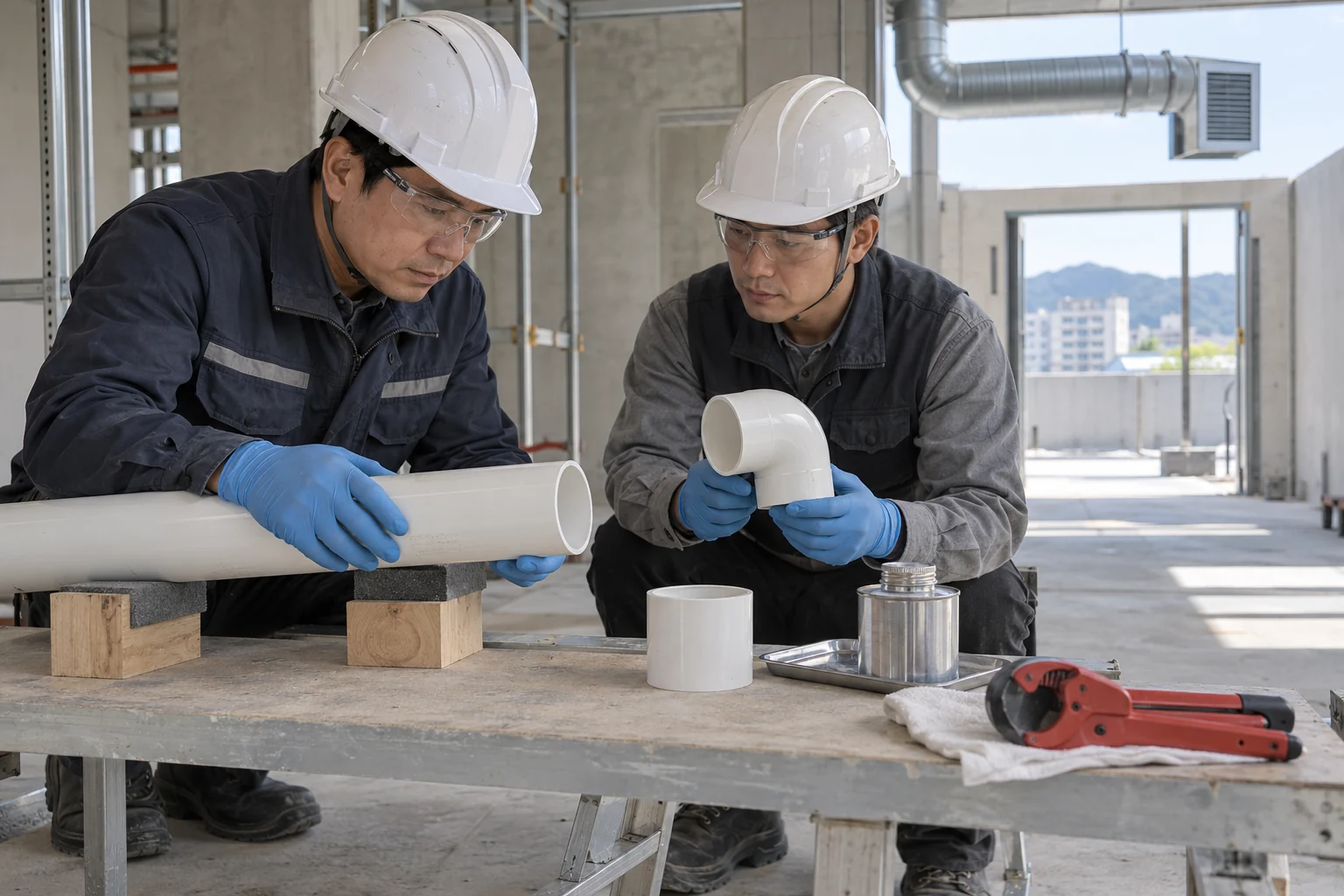
The following scenario, comparisons and example records are hypothetical teaching material. They do not reproduce actual incidents, measurements, signatures or approvals.
| Item | Hypothetical situation |
|---|---|
| Initial state | A newly assembled PVC drain joint is moved before its handling conditions are met. |
| Change | The pipe pushes partly out of the socket. |
| Failure path | A worker proposes brushing cement around the outside and testing immediately. |
| Possible harm | A surface coating can conceal an incomplete internal joint while movement disrupts the bond. |
| Barrier | Hold and identify the joint, follow the approved replacement or reassembly method, restore support and restart the applicable cure record before test release. |
Solvent welding depends on compatible surfaces, preparation and assembly while the cement remains workable. Matching colours or a dry-looking surface do not establish material compatibility or a sound internal bond.
Cut quality and fit affect engagement. Support the pipe during manual cutting, deburr and prepare it according to the product instructions, and establish alignment before cement application. Avoid using the wet joint to pull an unsupported pipe into position.
Holding, handling and test curing are different stages. Record the actual product, pipe size, joint time and environmental conditions so the correct limits can be applied. Do not turn an example cure time into a universal waiting period.
Solvent exposure and ignition risk continue while material evaporates. Control sources, ventilate the work area and close containers between uses. A particulate dust mask does not control solvent vapor, and absence of odor is not an exposure measurement.
| Decision | Reason and evidence |
|---|---|
| Known facts | The pipe pushes partly out of the socket. |
| Unresolved | A worker proposes brushing cement around the outside and testing immediately. |
| Hold reason | Hold for unknown pipe or cement compatibility, inadequate ventilation, ignition exposure, contaminated or poorly fitting parts, expired or gelled cement, joint pushout or uncertain cure conditions. |
| Evidence needed | Product size and conditions; Handling and test readiness; Support and protection; Joint time record. |
| Next decision | Hold and identify the joint, follow the approved replacement or reassembly method, restore support and restart the applicable cure record before test release. |
Singapore application
Record the actual work-area temperature and other manufacturer-required conditions. Warm ambient air does not justify shortening a cure period, and humid or wet joint surfaces need the product-specific preparation decision.
5. Hold and proceed decisions
| Condition | Action | Evidence | Proceed when |
|---|---|---|---|
| Product uncertain | Hold assembly and confirm compatibility. | Pipe, fitting and cement labels. | System matched. |
| Poor ventilation | Stop solvent use and resolve controls. | Exposure and ignition review. | Area accepted. |
| Joint moved | Hold and apply accepted rework. | Defect and replacement record. | New cure tracked. |
| Test requested | Check stage-specific cure evidence. | Joint time, size and conditions. | Test criteria met. |
| Comparison | Situation A | Situation B |
|---|---|---|
| Joint looks dry | Product-specific handling and test conditions are recorded. | Surface appearance is used as the cure timer. |
| Pipe remains aligned | Independent support protects the new joint. | The joint is loaded to pull the pipe into position. |
6. Roles and supervision
| Role | Responsibility |
|---|---|
| Work supervisor | Confirm scope, task sequence, exclusion and stop authority. Coordinate identify system and product with affected operations. |
| Technical reviewer | Resolve the actual design and equipment limits: Pipe fitting and size; Product label and SDS; Material compatibility; Scope and test method. |
| Work crew | Perform cut and prepare using the approved procedure; report any mismatch before proceeding. |
| Inspector / assessor | Verify Product size and conditions; Handling and test readiness; Support and protection; Joint time record. Record what was actually checked and what remains unresolved. |
| Release / receiving authority | Confirm Joint map and cure basis; Defect and repair status; Product and waste closure; Named test owner. Transfer restrictions and the next permitted stage. |
These are responsibility examples, not invented statutory credentials. Meet the actual training, competent-person, qualified-person and licensing requirements for the assigned work. Anyone may raise a hazard and request a stop; only the designated authority may release the affected stage after evidence is reviewed.
Singapore application
The jointing supervisor tracks product lots, joint times and held sections. The applicable LP/QP team controls sanitary acceptance and submissions. The separate test owner confirms cure evidence and permitted test medium before accepting the section.
7. Hold points and record quality
| Hold point | Evidence before release | Confirmation / approval |
|---|---|---|
| HP-0 Start | Scope, jurisdiction, equipment identity, responsible people and emergency arrangements. | |
| HP-1 Identify system and product | Pipe fitting and size; Product label and SDS; Material compatibility; Scope and test method | |
| HP-2 Prepare area and support | Ventilation and work area; Ignition source review; Support and alignment; Clear access | |
| HP-3 Support and cure | Product size and conditions; Handling and test readiness; Support and protection; Joint time record | |
| HP-4 Transfer test readiness | Joint map and cure basis; Defect and repair status; Product and waste closure; Named test owner |
Hold points are internal evidence gates. They do not replace statutory permits or actual signatures. Recheck affected gates after a change, abnormal event or shift transfer. The blank record must identify the evidence, person, time, limits and release scope.
| Record | Insufficient record | Record checklist |
|---|---|---|
| Materials | Same colour | □ Pipe fitting and size□ Product label and SDS□ Material compatibility□ Scope and test method |
| Preparation | Pipe fits | □ Fit and engagement basis□ Orientation marks□ Product working conditions□ Cement condition |
| Cure | Looks dry | □ Product size and conditions□ Handling and test readiness□ Support and protection□ Joint time record |
| Rework | Outside coated | □ Defect and affected joints□ Rework method and record□ New cure starting time□ Accepted test medium |
The □ boxes are static prompts, not saved or interactive approvals. Each checks one record element. A tick alone does not establish suitability or permission to restart. Link equipment IDs and supporting records; retain unresolved matters and the earlier record when conditions change.
8. Pre-work checks and emergency response
| Check item | Result | Person / action |
|---|---|---|
| Pipe fitting and size | ||
| Ventilation and work area | ||
| Cut and end condition | ||
| Fit and engagement basis | ||
| Assembly time and operator | ||
| Product size and conditions | ||
| Defect and affected joints | ||
| Joint map and cure basis | ||
| Emergency arrangements and unresolved restrictions communicated |
Stop work: Hold for unknown pipe or cement compatibility, inadequate ventilation, ignition exposure, contaminated or poorly fitting parts, expired or gelled cement, joint pushout or uncertain cure conditions.
Emergency response: Stop solvent use for significant exposure, eye splash or fire conditions. Move to a safe area, follow the actual product SDS and site emergency procedure, and contact the site emergency responders for severe symptoms or fire. Prevent ignition and unauthorised entry; do not improvise chemical neutralization.
9. Sources and review limits
Public-source review: 14 October 2026. Only the material and limits identified below were reviewed.
| Source | Reviewed material | Task application |
|---|---|---|
| MOM - Risk management | Responsibilities; routine and non-routine work; hierarchy of control and risk assessment team. Official explanation of WSH Risk Management duties, not a complete consolidated statutory text. | Assess solvent work, manual cuts, support and simultaneous trades. |
| PUB - Plumbing Works | Main scope, regulated-work licence requirement, simple-work exceptions, LP submissions and new-development QP note. Actual drainage system and work classification remain to be checked; not every pipe joint requires the same licence/submission. No complete sanitary code review is claimed. | Assign the applicable LP/QP arrangements from the actual regulated sanitary-work scope. |
| MOM - Requirements for hygiene monitoring | Main requirements: competent monitoring personnel, toxic substances, results and reporting, recommended frequency table and noise applicability. Material-specific exposure and actual monitoring frequency have not been determined. No workplace measurement is supplied. | Assess ingredients and competent monitoring where toxic substances are used or generated. |
| MOM - Safe storage of combustible materials in construction | Two-page 2016 circular: ignition separation, hot-work sparks above combustible materials, protective covers, storage quantities and safe procedures. Construction circular explaining relevant duties and precautions. No universal fire-watch duration or blanket hot-work permit is inferred. | Keep ignition and combustible interfaces controlled, including adjacent hot work. |
Selected public official sources were reviewed on 14 October 2026 within the recorded scope. No full consolidated legal audit, paid Singapore Standard, actual model manual, site inspection, engineering calculation or professional approval is claimed. Verify current detailed requirements and actual equipment/site records before use.
AI-generated reference material. It has not been verified or approved by a professional. Before use, a qualified person must review and adapt it to applicable Singapore requirements, the actual equipment and site, and approved safe work procedures.
10. PDF use and frequently asked questions
PDF A covers basic task controls; B examines technical failures; C focuses on supervision, evidence and handover. Each has six rows and three items per main cell. They are complementary extracts: apply all eight body stages and the applicable site procedure. An omitted stage is not permission to omit its controls. PDF HP-0 through HP-4 are worksheet labels; match the event, evidence and authority rather than assuming they match another permit by number.
P/S/R/A, actual measurements, confirmations and signatures remain blank. The PDFs are uncompleted reference worksheets, not issued work permits.
Content group ID: jsa-indoor-pvc-drain-solvent-joint
Can cement colour prove compatibility?
No. Match the pipe, fitting, primer and cement labels and their service limitations.
Can an outside cement patch repair a pushed-out joint?
Do not assume so. Hold the joint and use the manufacturer-approved rework or replacement method.
Is handling time the same as test cure time?
No. Apply the correct stage-specific criteria for the actual joint and conditions.
Can compressed air check the drain joints?
This workflow excludes compressed-air and gas testing. Use the accepted system test method and manufacturer restrictions.
Has a professional verified or approved this document?
No. This is AI-assisted reference material. Editorial and layout checks are not a physical inspection or professional technical approval. Obtain qualified professional review and required site approval before use.
Singapore application
Read A, B and C together with all eight JSA stages and the approved work procedure. The sheets are complementary extracts, not separate work authorisations.
11. Authorship and revision history
AI-generated reference material. It has not been verified or approved by a professional. Before use, a qualified person must review and adapt it to applicable Singapore requirements, the actual equipment and site, and approved safe work procedures.
| Date / edition | Authorship and scope | Professional approval |
|---|---|---|
| 2026-10-08 / Korean source | Original topic and educational illustration retained as references. Source content is unchanged. | Not asserted |
| 14 October 2026 / Singapore 1.0 | Added Singapore PUB work classification and LP/QP handover, exposure controls and actual local temperature/humidity cure evidence. | Not performed |
Source topic: https://smartjsabridge.com/ko/case-study/jsa-indoor-pvc-drain-solvent-joint