Receive, lift and move identified de-energised switchgear shipping groups, land and secure them, mechanically join the lineup and transfer installation status to the appointed electrical team.
Hold for uncertain shipping mass or lifting provisions, route changes, unverified pit-cover capacity, unstable support, cabinet distortion, electrical-boundary uncertainty or missing connection criteria.
AI-generated reference material. It has not been professionally verified or approved. Before use, a suitably qualified person must review and adapt it to applicable Singapore requirements, the actual equipment and site, and approved safe work procedures.
1. Legal and technical scope
Apply Singapore lifting-plan and risk-management arrangements to the shipping groups and the actual transport route. Coordinate isolation, adjacent live equipment and electrical installation with an appropriately licensed LEW; verify licence scope against the actual voltage and duties. An electrician or technician licence is not authority for high-voltage work beyond its limits. The owner and LEW must address the applicable installation licence and testing before use. Mechanical handling completion does not release electrical commissioning.
Assess the actual activity under the applicable Singapore WSH requirements. Statutory duties, official guidance, manufacturer instructions and approved project documents have distinct roles. A site hold point is not automatically a statutory permit. Use competent local review to resolve the applicable industry, installation, access and permit requirements.
| Basis | Application and limits |
|---|---|
| MOM risk management | Official explanation: risk assessment, control, monitoring and communication for routine and non-routine work, including maintenance; reviewed 14 October 2026. |
| WSHC Planning a Lift | Official lifting guidance: risk-supported lift plan, safe work procedure, permit arrangements, load/equipment/crew/environment details and stop when conditions differ. Confirm the applicable statutory permit scope separately. |
| EMA worker licences | Official explanation of licensed electrical work, supervision and the distinction where equipment work involves no wiring. Actual electrical duties require the appropriate licence class. |
| EMA Electrical/Supply Installation Licences | Official distinction between grid and generator supply installations; construction/hazardous-trade and non-domestic supply installations require licensing regardless of approved load. Appropriate-class LEW responsibility, inspection and fitness before use reviewed; no installation standard read in full. |
| WSHC electrical safety | Official guidance: maintenance energy isolation, stored-energy control, verification and reinstatement; electrical scope still requires applicable EMA authorisation. |
| Eaton IB022014EN, October 2025 | Selected receiving/handling section 4, storage and installation sections 6.1–6.2: actual shipping-group drawings and mass, lifting provisions, alignment and model-dependent lifting-angle removal. Numerical limits and these product sequences are not universal; full electrical commissioning was not reviewed. |
| SCDF emergency medical services | Official 995 emergency ambulance service information; use emergency services for actual emergencies. |
2. Scope and required inputs
Included: Receive, lift and move identified de-energised switchgear shipping groups, land and secure them, mechanically join the lineup and transfer installation status to the appointed electrical team.
Separate review: Moving energised equipment, undocumented shipping-group separation, altered lifting points, buswork, dielectric or protection testing and energisation need separate authorised procedures.
| Input | Required evidence |
|---|---|
| Identify shipping group | Group ID and mass; Lifting points and geometry; Isolation and adjacent limits; Internal restraint condition |
| Inspect lift arrangement | Rigging condition and ID; Point and model match; Planned lift geometry; Doors and loose items |
| Land and secure | Base seating and level; Anchor and temporary support; Stable released condition; Named release authority |
| Transfer installation | Mechanical inspection; Remaining electrical work; Access and cover condition; LEW and receiving-team acceptance |
Confirm the actual shipping-group drawing, mass, centre of gravity, lifting geometry, permitted handling method, route reactions, foundation level and anchor details. Review wheel point loads and pit-cover bearing if rolling transport is permitted. Obtain the model-specific sequence for shipping braces and lifting-bracket removal; do not transfer example dimensions or angles between products.
3. Eight-stage JSA
P = likelihood; S = severity; R = risk under the site method; A = acceptance or authorization as defined by the site. Leave these blank until actual assessment and control verification. A low score does not override a legal requirement, product limit or unreleased hold point.
| Job stage | Hazards and effects | Failure factors | Required controls | Site verification | P | S | R | A |
|---|---|---|---|---|---|---|---|---|
| 1. Identify shipping group | 1. Cabinet overturn2. Wrong lifting load3. Electrical exposure4. Internal-part movement | 1. Mass excludes equipment2. Group boundary unclear3. Adjacent live gear ignored4. Shipping restraint altered | 1. Match shipping drawings2. Confirm mass and balance3. Define electrical boundary4. Preserve required restraints | 1. Group ID and mass2. Lifting points and geometry3. Isolation and adjacent limits4. Internal restraint condition | ||||
| 2. Prepare route and base | 1. Pit-cover collapse2. Transport overturn3. Pedestrian strike4. Foundation distortion | 1. Wheel load unchecked2. Uneven route accepted3. Shared access uncontrolled4. Base level unverified | 1. Review concentrated loads2. Accept full transport route3. Separate people and movement4. Verify foundation geometry | 1. Cover and bearing basis2. Wheel path and clearances3. Exclusion and signals4. Foundation and anchors | ||||
| 3. Inspect lift arrangement | 1. Rigging rupture2. Cabinet roof damage3. Load rotation4. Dropped loose parts | 1. Angle capacity unknown2. Unapproved point used3. Balance unreviewed4. Doors unsecured | 1. Verify rated configuration2. Use designated provisions3. Control shipping balance4. Secure movable parts | 1. Rigging condition and ID2. Point and model match3. Planned lift geometry4. Doors and loose items | ||||
| 4. Trial lift and move | 1. Suspended-load strike2. Cabinet tilt3. Crush at obstruction4. Uncontrolled travel | 1. People enter load zone2. Centre of gravity wrong3. Clearance changes4. Conflicting signals | 1. Check balance at trial lift2. Keep exclusion effective3. Stop for route change4. Use designated signalman | 1. Stable trial lift2. Route and overhead clearance3. People outside crush zone4. Signals and stop response | ||||
| 5. Land and secure | 1. Cabinet overturn2. Finger crush3. Anchor failure4. Premature sling release | 1. Support partly seated2. Hands placed under base3. Anchor detail wrong4. Ground contact accepted alone | 1. Use safe alignment tools2. Verify full support3. Complete required restraints4. Authorise sling release | 1. Base seating and level2. Anchor and temporary support3. Stable released condition4. Named release authority | ||||
| 6. Join lineup | 1. Cabinet distortion2. Pinch between groups3. Lost electrical continuity4. Bracket interference | 1. Bolts force misalignment2. Hands guide cabinet gap3. Earthing status assumed4. Wrong removal sequence | 1. Correct base and alignment2. Keep hands clear of gaps3. Record earthing work status4. Follow model bracket sequence | 1. Lineup and joint geometry2. Specified fastening record3. LEW earthing handover status4. Braces and bracket status | ||||
| 7. Hold and reposition | 1. Repeated handling damage2. Unstable disconnected base3. Adjacent circuit exposure4. Unexpected load shift | 1. Shock damage overlooked2. Restraints removed early3. Boundary changes4. Lift points no longer valid | 1. Hold damaged equipment2. Reestablish lifting support3. Review changed surroundings4. Recheck handling arrangement | 1. Damage and model review2. Current support condition3. Revised electrical boundary4. Accepted rework sequence | ||||
| 8. Transfer installation | 1. Unsafe energisation2. Tools left inside3. Open-floor fall4. Hidden handling damage | 1. Mechanical finish overstated2. Compartment check missed3. Pit cover not restored4. Defect record missing | 1. Separate electrical release2. Account for tools and parts3. Restore accepted floor covers4. Transfer defects and limits | 1. Mechanical inspection2. Remaining electrical work3. Access and cover condition4. LEW and receiving-team acceptance |
4. Hypothetical scenario and failure mechanisms
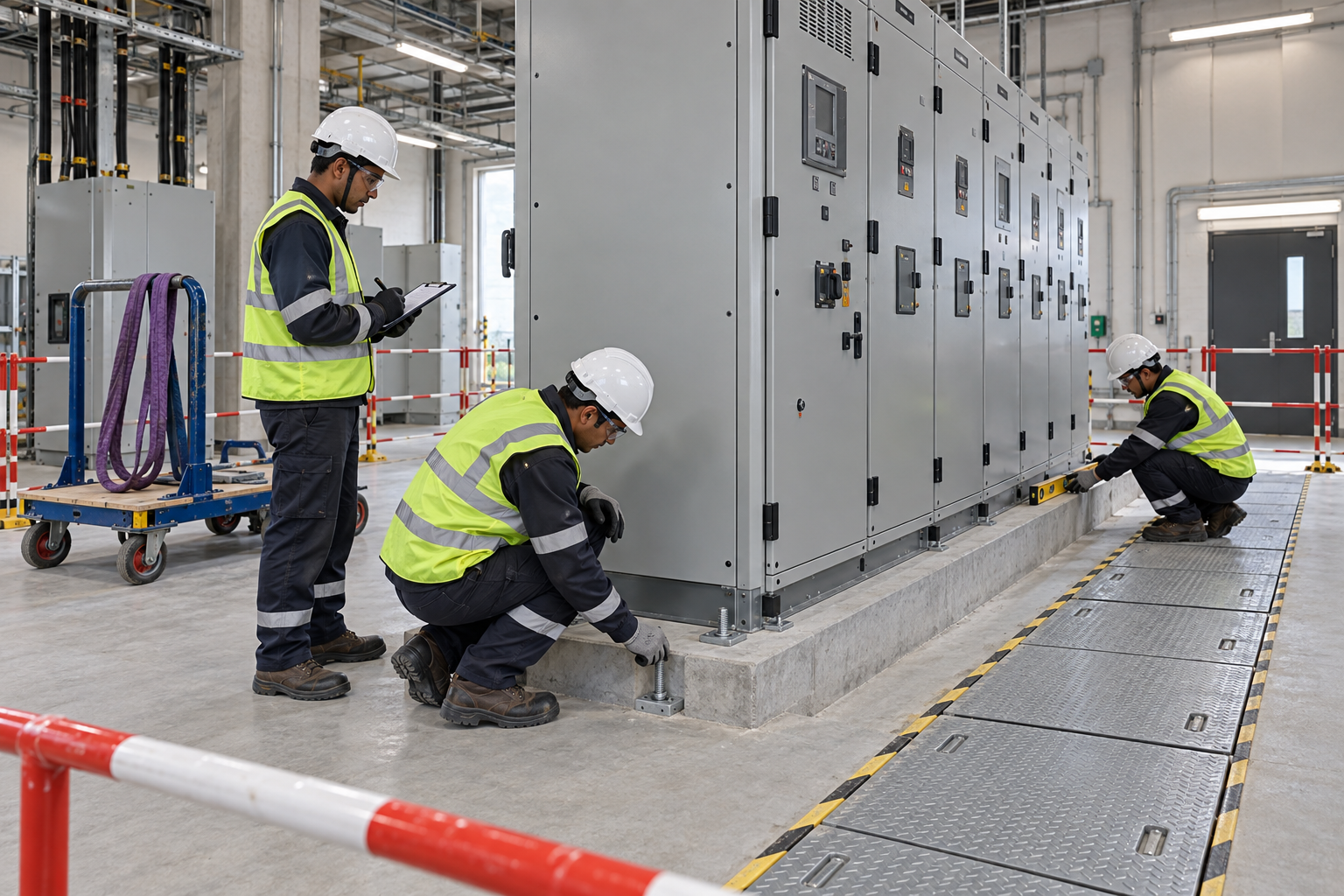 Retained source illustration: an AI-generated educational concept, not a real incident photograph or evidence of equipment suitability.
The following scenario, comparisons and example records are hypothetical teaching material. They do not reproduce actual incidents, measurements, signatures or approvals.
| Item | Hypothetical situation |
|---|---|
| Initial state | A tall switchgear shipping group is being moved toward its foundation. |
| Change | The route is changed to cross a pedestrian pit cover. |
| Failure path | Previous pedestrian use is treated as proof that loaded transport wheels can cross. |
| Possible harm | A concentrated wheel reaction can exceed the cover or its bearing capacity and overturn the cabinet. |
| Barrier | Stop the move, verify the complete route and structural reactions or use an accepted alternate route, then repeat the movement briefing. |
The load is the actual shipping group, including retained internal equipment and packing that travels with it. Moving or opening parts can change its balance. Use its specified lifting arrangement and keep people outside the possible overturn and suspended-load zones.
Route acceptance must address the load where it actually contacts the structure. A total floor-load figure or a history of pedestrian traffic does not establish capacity for transport wheels at a pit edge. An improvised plate needs its own structural and stability review.
Landing, disconnecting slings and removing product lifting brackets are separate decisions. Confirm stable support before releasing the lifting appliance. Follow the particular model sequence for brackets and shipping restraints; different switchgear families may require different removal timing.
Correct foundation geometry supports lineup fit. Do not use tie bolts to force a distorted cabinet into alignment. Inspect any handling shock or deformation and transfer grounding, buswork, protection and commissioning status explicitly; door closure alone cannot demonstrate electrical readiness.
In Singapore, match the appointed LEW scope to the actual installation voltage and electrical duties. Record adjacent live boundaries, any temporary auxiliary supply and retained electrical holds. The mechanical team must not infer energisation permission from anchoring, earthing appearance or door closure.
| Decision | Reason and evidence |
|---|---|
| Known facts | The route is changed to cross a pedestrian pit cover. |
| Unresolved | Previous pedestrian use is treated as proof that loaded transport wheels can cross. |
| Hold reason | Hold for uncertain shipping mass or lifting provisions, route changes, unverified pit-cover capacity, unstable support, cabinet distortion, electrical-boundary uncertainty or missing connection criteria. |
| Evidence needed | Base seating and level; Anchor and temporary support; Stable released condition; Named release authority. |
| Next decision | Stop the move, verify the complete route and structural reactions or use an accepted alternate route, then repeat the movement briefing. |
5. Conditional decisions and common errors
| Condition | Action | Evidence | Proceed when |
|---|---|---|---|
| Route changed | Hold movement and review changed support. | Wheel reactions and structural basis. | Route accepted. |
| Unstable touchdown | Retain lifting support. | Seating and required restraints. | Stable release confirmed. |
| Lineup will not fit | Hold forced bolting; correct geometry. | Foundation and cabinet inspection. | Alignment accepted. |
| Mechanical work complete | Transfer retained electrical holds. | Installation and remaining-work record. | Next stage authorised. |
| Comparison | Situation A | Situation B |
|---|---|---|
| Route used before | Wheel reactions, covers and supporting structure are verified. | Pedestrians previously crossed the same cover. |
| Cabinet landed | Support and required restraints permit sling release. | The base touches down but temporary stability is unverified. |
6. Roles and responsibilities
| Role | Responsibility |
|---|---|
| Work supervisor | Confirm scope, task sequence, exclusion and stop authority. Coordinate identify shipping group with affected operations. |
| Technical reviewer | Resolve the actual design and equipment limits: Group ID and mass; Lifting points and geometry; Isolation and adjacent limits; Internal restraint condition. |
| Work crew | Perform inspect lift arrangement using the approved procedure; report any mismatch before proceeding. |
| Inspector / assessor | Verify Lineup and joint geometry; Specified fastening record; LEW earthing handover status; Braces and bracket status. Record what was actually checked and what remains unresolved. |
| Release / receiving authority | Confirm Mechanical inspection; Remaining electrical work; Access and cover condition; LEW and receiving-team acceptance. Transfer restrictions and the next permitted stage. |
These are responsibility examples, not invented statutory credentials. Meet the actual training, competent-person, qualified-person and licensing requirements for the assigned work. Anyone may raise a hazard and request a stop; only the designated authority may release the affected stage after evidence is reviewed.
7. Hold points and record comparison
| Hold point | Evidence before release | Confirmation / approval |
|---|---|---|
| HP-0 Start | Scope, jurisdiction, equipment identity, responsible people and emergency arrangements. | |
| HP-1 Prepare route and base | Cover and bearing basis; Wheel path and clearances; Exclusion and signals; Foundation and anchors | |
| HP-2 Inspect lift arrangement | Rigging condition and ID; Point and model match; Planned lift geometry; Doors and loose items | |
| HP-3 Land and secure | Base seating and level; Anchor and temporary support; Stable released condition; Named release authority | |
| HP-4 Transfer installation | Mechanical inspection; Remaining electrical work; Access and cover condition; LEW and receiving-team acceptance |
Hold points are internal evidence gates. They do not replace statutory permits or actual signatures. Recheck affected gates after a change, abnormal event or shift transfer. The blank record must identify the evidence, person, time, limits and release scope.
| Record | Insufficient record | Record checklist |
|---|---|---|
| Route | People crossed | □ Cover and bearing basis□ Wheel path and clearances□ Exclusion and signals□ Foundation and anchors |
| Lift | Crane rated | □ Rigging condition and ID□ Point and model match□ Planned lift geometry□ Doors and loose items |
| Landing | Base on floor | □ Base seating and level□ Anchor and temporary support□ Stable released condition□ Named release authority |
| Handover | Doors close | □ Mechanical inspection□ Remaining electrical work□ Access and cover condition□ LEW and receiving-team acceptance |
The □ boxes are static prompts, not saved or interactive approvals. Each checks one record element. A tick alone does not establish suitability or permission to restart. Link equipment IDs and supporting records; retain unresolved matters and the earlier record when conditions change.
8. Site checklist and emergency response
| Check item | Result | Person / action |
|---|---|---|
| Group ID and mass | ||
| Cover and bearing basis | ||
| Rigging condition and ID | ||
| Stable trial lift | ||
| Base seating and level | ||
| Lineup and joint geometry | ||
| Damage and model review | ||
| Mechanical inspection | ||
| Emergency arrangements and unresolved restrictions communicated |
Stop work: Hold for uncertain shipping mass or lifting provisions, route changes, unverified pit-cover capacity, unstable support, cabinet distortion, electrical-boundary uncertainty or missing connection criteria.
Emergency response: For tilt, cover movement or lost load control, stop and clear the fall and crush zone. Do not hold a cabinet by hand. Alert the lifting supervisor and appointed electrical team if electrical boundaries are affected. Call SCDF 995 for serious injury or urgent rescue; stabilise the equipment only under an authorised recovery plan.
9. Sources and review limits
Official-source review date: October 14, 2026. The following review is limited to the public provisions or selected manufacturer material identified below. It does not establish that any authority approved this article or the actual installation.
- MOM risk management: Official explanation: risk assessment, control, monitoring and communication for routine and non-routine work, including maintenance; reviewed 14 October 2026.
- WSHC Planning a Lift: Official lifting guidance: risk-supported lift plan, safe work procedure, permit arrangements, load/equipment/crew/environment details and stop when conditions differ. Confirm the applicable statutory permit scope separately.
- EMA worker licences: Official explanation of licensed electrical work, supervision and the distinction where equipment work involves no wiring. Actual electrical duties require the appropriate licence class.
- EMA Electrical/Supply Installation Licences: Official distinction between grid and generator supply installations; construction/hazardous-trade and non-domestic supply installations require licensing regardless of approved load. Appropriate-class LEW responsibility, inspection and fitness before use reviewed; no installation standard read in full.
- WSHC electrical safety: Official guidance: maintenance energy isolation, stored-energy control, verification and reinstatement; electrical scope still requires applicable EMA authorisation.
- Eaton IB022014EN, October 2025: Selected receiving/handling section 4, storage and installation sections 6.1–6.2: actual shipping-group drawings and mass, lifting provisions, alignment and model-dependent lifting-angle removal. Numerical limits and these product sequences are not universal; full electrical commissioning was not reviewed.
- SCDF emergency medical services: Official 995 emergency ambulance service information; use emergency services for actual emergencies.
Paid consensus standards and site-specific calculations, manuals, inspection records and product certificates were not independently obtained or verified unless specifically identified. Korean and overseas legal references are source history, not Singapore statutory duties. Singapore Standards and model-specific limits were not read in full unless expressly identified.
10. PDF guidance and FAQ
PDF A covers basic task controls; B examines technical failures; C focuses on supervision, evidence and handover. Each has six rows and three items per main cell. They are complementary extracts: apply all eight body stages and the applicable site procedure. An omitted stage is not permission to omit its controls. PDF HP-0 through HP-4 are worksheet labels; match the event, evidence and authority rather than assuming they match another permit by number.
P/S/R/A, actual measurements, confirmations and signatures remain blank. The PDFs are uncompleted reference worksheets, not issued work permits.
Content group ID: jsa-hvswitchgear-positioning
Does a pedestrian cover rating prove the route is safe?
No. Check transport-wheel reactions, cover bearing and the underlying structure.
Can tie bolts pull a cabinet straight?
Correct the support and alignment using the accepted installation method; do not force distorted equipment into place.
Are lifting brackets removed when slings are released?
Not automatically. Sling release requires stability; product bracket removal follows the specific model sequence.
Does mechanical completion permit energisation?
No. Electrical installation, inspection, testing and operating authorisation remain separate.
Has a professional verified or approved this document?
AI-generated reference material. It has not been professionally verified or approved. Before use, a suitably qualified person must review and adapt it to applicable Singapore requirements, the actual equipment and site, and approved safe work procedures.
11. Revision history and authorship
AI-generated reference material. It has not been professionally verified or approved. Before use, a suitably qualified person must review and adapt it to applicable Singapore requirements, the actual equipment and site, and approved safe work procedures.
This system has not physically inspected the equipment, structures, ground, atmosphere or worksite. The document does not replace legal advice, manufacturer procedures, engineering design, inspection certificates, qualification evidence, the site risk assessment or an actual work permit.
Before use, a suitably qualified and authorized person must review the actual equipment, loads, methods, protection, inspection and emergency arrangements and resolve open issues. Record the real reviewer, organization, qualifications, delegated authority, reviewed documents, date, signature, exclusions and conditions of approval separately.
| Date | Version | Change | Review status |
|---|---|---|---|
| 2026-09-19 | 1.1 | Korean source revision retained in the source snapshot. | Historical editorial status; not Singapore professional approval. |
| 2026-09-26 | 1.2 | Korean source revision retained in the source snapshot. | Historical editorial status; not Singapore professional approval. |
| 2026-10-14 | SG 1.0 | Singapore localisation of the Korean source with its assigned US technical reference; local applicability, task controls and sources reviewed. | AI-assisted editorial work; professional approval not performed. |