Container weight is only part of the problem. Liquid shifts during starts, stops and turns, so choose fill amount, closure and trolley restraint for the actual route. Two-person handling does not correct a damaged handle or collision path.
This reference material was written and reviced with AI. It has not been verified or approved by a professional. Review by a suitably qualified professional and required site approval are necessary before field use.
Stop before proceeding
Stop for defective handles, lids or trolley restraints, swaying containers, overfill, blocked view, wet floors or crowding. Do not handle hot containers with wet/damaged protection or try to catch a falling hot load.
AI-generated reference material; not professionally verified or approved. Before use, a qualified person must review and adapt it to applicable Singapore requirements, the actual equipment/site and approved safe work procedures.
1. Legal and technical scope
Apply Singapore workplace risk assessment to scalding, unstable liquid loads, manual handling and diner contact during same-floor food service. Keep worker protection coordinated with the establishment food-safety procedure. SFA guidance calls for cooked food intended for hot service to remain above 60°C after cooking and during delivery; it is not a safe-touch temperature.
| Basis | Singapore application |
|---|---|
| Risk management | The employer, self-employed person and principal assess and control work risks. Include preparation, abnormal conditions and maintenance. Coordinate affected trades and communicate controls. |
| Activity-specific guidance | Use WSHC ergonomics guidance for load size, unstable contents, route and handling aids, and the SFA hot-food poster for the food-temperature interface. Actual measured temperatures, trolley suitability and handover remain site records. |
| Permits and authority | Select permit requirements for the actual sector and activity. Site hold points and contractor role labels do not create statutory permits or qualifications. |
| Equipment and design | The SFA poster identifies a mandatory four-hour control for catering establishments; it is not permission to ignore the actual establishment time/temperature procedure. No universal container fill percentage, handling weight or glove temperature rating is supplied. Pressure vessels and heated-equipment servicing are excluded. |
2. Scope and required inputs
Included scope
Transfer cooked soup and food into suitable containers, move them on a manual trolley along a level same-floor route, place them on a stable serving station, serve and recover remaining food and containers.
Separate assessment
Fryer oil draining, tilting kettles, pressurised vessels, stairs or steep ramps, powered trolleys and servicing heated serving equipment require separate procedures. Do not lower required food-holding conditions to solve a worker burn hazard.
| Input | Evidence needed |
|---|---|
| Plan food and load | Menu and holding plan; Container and fill; Weight and route; Assigned roles. |
| Prepare route | Floor and turns; Diner separation; Station support; Door and threshold. |
| Move and receive | Load sway; Route and clearance; Brake at destination; Receiver confirmation. |
| Recover and handoff | Residual heat and amount; Return handling method; Food disposition; Container and trolley limits. |
No site measurements, equipment manuals for the actual installation, inspection records or signed technical approvals were supplied. Confirm the applicable requirements and actual product instructions before use; record each criterion with its units, source and equipment or work-area ID.
Singapore site planning
The food-service employer must coordinate preparation, trolley movement and the receiving station before loading. Record actual load mass in kg, container limits and temperatures in °C using the applicable food-safety process. Assess sloshing, grip, dry thermal protection, trolley brakes, thresholds and diner separation. Use manageable loads and suitable handling aids. Do not lower holding requirements to reduce scald risk; correct the container and handling method. Record the time/temperature and disposition of affected food separately from the decision to reopen a spill route.
3. Eight-stage JSA
| Job stage | Hazards and effects | Failure factors | Technical and procedural controls | Site verification | P | S | R | A |
|---|---|---|---|---|---|---|---|---|
| 1. Plan food and load | 1. Hot contents contact2. Handling strain3. Food condition lost4. Crowded handoff | 1. Container unknown2. Excess quantity3. Holding plan ignored4. No receiving lead | 1. Match food and container2. Plan manageable loads3. Maintain food procedure4. Assign transport and receiver | 1. Food time/temperature plan2. Container and fill3. Load mass/kg and route4. Assigned roles | ||||
| 2. Inspect trolley and PPE | 1. Handle breaks2. Trolley overturns3. Scalded hands4. Lid leakage | 1. Damaged handle2. Wheel defect3. Wet mitts4. Wrong lid | 1. Inspect container handles2. Check wheels and brakes3. Use dry thermal protection4. Match lid and container | 1. Handles and body2. Wheel and brake state3. PPE rating and dryness4. Lid fit and condition | ||||
| 3. Prepare route | 1. Pedestrian collision2. Slip and spill3. No landing space4. Threshold jolt | 1. Shared busy path2. Wet floor3. Station clutter4. Door not planned | 1. Separate movement route2. Correct floor hazards3. Clear receiving surface4. Plan doors and thresholds | 1. Floor and turns2. Diner separation3. Station support4. Door and threshold | ||||
| 4. Fill and load | 1. Liquid splash2. Back strain3. Unbalanced trolley4. Hand burn | 1. Overfilling2. Poor lift method3. Brake not set4. Hot body grasped | 1. Use planned fill2. Use handling assistance3. Stabilise trolley4. Hold designated handles | 1. Amount and grip2. Lift signal and aid3. Lid and weight position4. Trolley restraint | ||||
| 5. Move and receive | 1. Food spills2. Person struck3. Hand trapped4. Container slides | 1. Sudden turn2. View blocked3. Narrow gap4. Receiver unprepared | 1. Move with clear view2. Use controlled motion3. Keep hands clear4. Stop and secure to handoff | 1. Load sway2. Route and clearance3. Brake at destination4. Receiver confirmation | ||||
| 6. Open and serve | 1. Steam burn2. Hot-food splash3. Container tips4. Reaching strain | 1. Face above lid2. Abrupt opening3. Unstable support4. Utensil too short | 1. Open away from exposure2. Control lid movement3. Keep container supported4. Serve within easy reach | 1. Lid and steam path2. Hands and face3. Serving support4. Utensil and people | ||||
| 7. Hold instability | 1. Scalding2. Secondary slip3. Repeated overturn4. Unsafe manual catch | 1. Spill crossed2. Area not guarded3. Temporary fix only4. Falling pan grabbed | 1. Stop movement and serving2. Keep people clear3. Correct defect safely4. Do not catch hot load | 1. Leak and contact zone2. Container fault3. Floor restored4. Restart conditions | ||||
| 8. Recover and handoff | 1. Residual burn2. Remaining food spills3. Hygiene error4. Defective reuse | 1. Empty assumed cool2. Contents ignored3. Disposition unclear4. Trolley fault unreported | 1. Check heat and contents2. Use planned recovery3. Follow food procedure4. Tag and transfer defects | 1. Residual heat/amount record2. Return handling method3. Food disposition4. Container and trolley limits |
P = likelihood; S = severity; R = risk using the site method; A = site acceptance/authorisation. Complete after actual assessment; no score overrides an unresolved hold point or equipment limit.
4. Fictional scenario and failure mechanisms
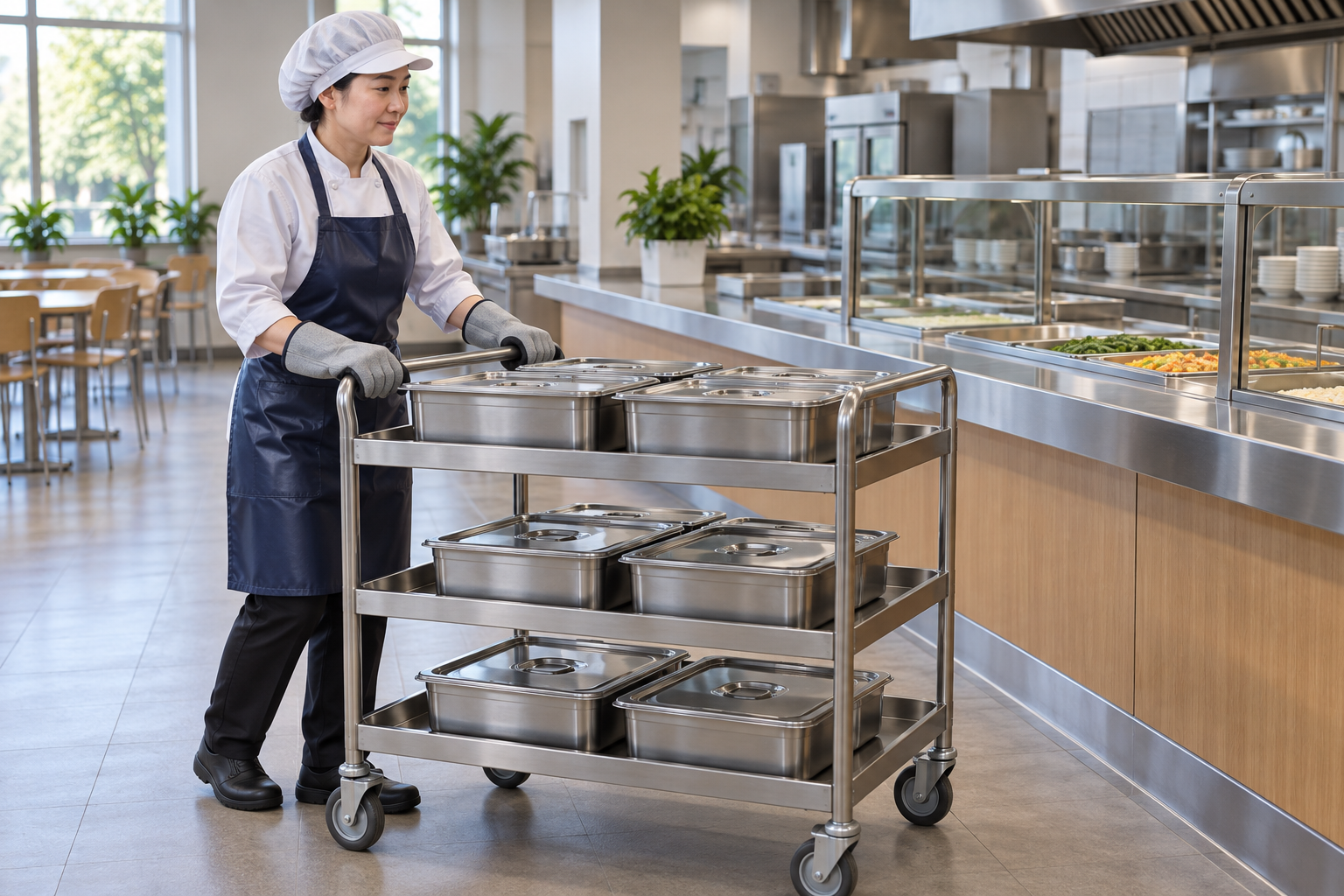
Retained AI-generated educational illustration from the source edition; not a real incident photograph, approved installation drawing or evidence of equipment suitability.
The scenario and record comparisons are fictional teaching examples, not records of real incidents, measurements, inspections, signatures or approvals.
| Item | Fictional scenario |
|---|---|
| Initial | A soup container is filled for cafeteria service. |
| Change | The trolley jolts at a threshold and liquid leaks through the lid while diners queue behind it. |
| Failure | Schedule pressure leads the worker to keep pushing across the spill. |
| Outcome | Scalding, a slip or trolley instability can expose workers and diners. |
| Barrier | Stop and separate people, then correct fill, closure, route and floor conditions before a coordinated transfer. |
Why the controls matter
Container weight is only part of the problem. Liquid shifts during starts, stops and turns, so choose fill amount, closure and trolley restraint for the actual route. Two-person handling does not correct a damaged handle or collision path.
Heat protection must be dry, undamaged and suitable for temperature, contact duration, grip and food hygiene. A wet towel is not a substitute. Check that protection does not cause the worker to lose a secure handle grip.
Prepare the receiving surface, trolley brake, lid position and handoff roles before moving food. Meet worker protection and food-holding requirements together; an acceptable food temperature does not mean the container surface or escaping steam is safe to touch.
Decision sequence
| Step | Decision |
|---|---|
| Known | The trolley jolts at a threshold and liquid leaks through the lid while diners queue behind it. |
| Unknown | Actual condition, extent of damage and suitability of load sway, route and clearance remain to be established. |
| Hold | Schedule pressure leads the worker to keep pushing across the spill. |
| Evidence | Link load sway, route and clearance, brake at destination, receiver confirmation, leak and contact zone, container fault to the affected equipment or work area. |
| Next | Stop and separate people, then correct fill, closure, route and floor conditions before a coordinated transfer. |
5. Conditional decisions and common errors
| Condition | Action | Evidence | Proceed when |
|---|---|---|---|
| Leak or sway | Stop and exclude people | Fill, lid and trolley inspection | Load stable |
| Wet protection | Replace before handling | Dry condition and thermal rating | Grip and protection verified |
| Route blocked | Hold movement | Door, threshold and floor | Route clear |
| Ready to serve | Secure and receive container | Brake, support and lid path | Serving station ready |
Similar appearance, different evidence
The scenario and record comparisons are fictional teaching examples, not records of real incidents, measurements, inspections, signatures or approvals.
| Comparison | Supported decision | Insufficient basis |
|---|---|---|
| Condition | Fill, lid and trolley inspection | Leak or sway has not been resolved. |
| Evidence | Door, threshold and floor | A photograph or a completed-looking task without the relevant inspection record. |
| Release | Serving station ready | Completion of one step does not release the excluded tasks in section 2. |
6. Roles and responsibilities
| Role | Responsibility |
|---|---|
| Work supervisor | Assign the task boundary, stop authority, interfaces and emergency communication for hot food container transport and serving. |
| Technical lead | Confirm Menu and holding plan; Container and fill; Weight and route; Assigned roles. Resolve design and manufacturer limits before work. |
| Authorised crew | Apply Floor and turns; Diner separation; Station support; Door and threshold. Stop when the working arrangement changes. |
| Inspector / receiving lead | Review Load sway; Route and clearance; Brake at destination; Receiver confirmation. Transfer Residual heat and amount; Return handling method; Food disposition; Container and trolley limits. |
Role labels allocate responsibilities; they do not confer a legal qualification. Verify the competence, training and authority required for the actual task.
The principal and employers coordinate the risk assessment and safe work procedures. These role labels allocate work; verify any qualifications and statutory appointments required for the actual Singapore activity. The receiving person must be given restrictions and unresolved defects before handover.
Record and handover perspective
| Stage | Record controls | Verification |
|---|---|---|
| Plan food and load | 1. Record food time/temperature plan2. Record container and fill3. Record load mass/kg and route | 1. Container and fill2. Load mass/kg and route3. Assigned roles |
| Prepare route | 1. Record floor and turns2. Record diner separation3. Record station support | 1. Diner separation2. Station support3. Door and threshold |
| Fill and load | 1. Record amount and grip2. Record lift signal and aid3. Record lid and weight position | 1. Lift signal and aid2. Lid and weight position3. Trolley restraint |
| Move and receive | 1. Record load sway2. Record route and clearance3. Record brake at destination | 1. Route and clearance2. Brake at destination3. Receiver confirmation |
| Hold instability | 1. Record leak and contact zone2. Record container fault3. Record floor restored | 1. Container fault2. Floor restored3. Restart conditions |
| Recover and handoff | 1. Record residual heat/amount record2. Record return handling method3. Record food disposition | 1. Return handling method2. Food disposition3. Container and trolley limits |
7. Hold points and record comparison
| Hold point | Evidence before release | Actual record |
|---|---|---|
| HP-0 Start | Task boundary, site RA, SWP, responsibilities and emergency arrangements | |
| HP-1 Inspect trolley and PPE | Handles and body; Wheel and brake state; PPE rating and dryness; Lid fit and condition | |
| HP-2 Prepare route | Floor and turns; Diner separation; Station support; Door and threshold | |
| HP-3 Open and serve | Lid and steam path; Hands and face; Serving support; Utensil and people | |
| HP-4 Recover and handoff | Residual heat/amount record; Return handling method; Food disposition; Container and trolley limits |
These are internal hold points, not issued permits. Recheck affected points after a change, fault or shift handoff; link the actual approval record.
Record comparison
The scenario and record comparisons are fictional teaching examples, not records of real incidents, measurements, inspections, signatures or approvals.
The boxes are static record prompts, not interactive or saved approvals. A tick does not establish suitability or permission to restart. Record the evidence, person, time and unresolved issues; retain the change history.
| Record | Insufficient | Record checklist |
|---|---|---|
| Plan food and load | "Checked" without target, criteria or result | □ Menu and holding plan□ Container and fill□ Weight and route□ Assigned roles |
| Prepare route | "Checked" without target, criteria or result | □ Floor and turns□ Diner separation□ Station support□ Door and threshold |
| Move and receive | "Checked" without target, criteria or result | □ Load sway□ Route and clearance□ Brake at destination□ Receiver confirmation |
| Recover and handoff | "Checked" without target, criteria or result | □ Residual heat and amount□ Return handling method□ Food disposition□ Container and trolley limits |
Hold points are internal checks. Determine separately whether Singapore statutory or site permit requirements apply to this work. Leave confirmation, measurements and approval records blank until the authorised site process is completed.
8. Site checklist and emergency response
| Check | Result | Person / action |
|---|---|---|
| □ Plan food and load: Menu and holding plan | ||
| □ Inspect trolley and PPE: Handles and body | ||
| □ Prepare route: Floor and turns | ||
| □ Fill and load: Amount and grip | ||
| □ Move and receive: Load sway | ||
| □ Open and serve: Lid and steam path | ||
| □ Hold instability: Leak and contact zone | ||
| □ Recover and handoff: Residual heat and amount | ||
| □ Emergency access and handoff restrictions |
Stop work
Stop for defective handles, lids or trolley restraints, swaying containers, overfill, blocked view, wet floors or crowding. Do not handle hot containers with wet/damaged protection or try to catch a falling hot load.
Emergency response
Stop serving and trolley movement and exclude the spill area. Activate trained first aid and the site response; call the site emergency service for serious injury or immediate danger. Do not approach hot spilled food or unstable containers until safe handling conditions are established.
9. Sources and review limits
Official public sources read for this Singapore edition on 2026-10-14. Guidance, statutory explanations and manufacturer limits have different roles; no source provider has approved this JSA.
| Source | Read scope and application limits |
|---|---|
| MOM — Risk management | Official explanation: employer, self-employed person and principal responsibilities; routine and non-routine risk assessment; hierarchy of controls; multidisciplinary assessment team. Official explanation of risk-management duties; no claim of reading the full linked statute. It does not specify task-specific equipment limits. Assess hot-food container transport and serving with employers, principal and affected contractors; resolve the inputs in section 2. |
| MOM — When should my company review its risk assessment? | Review every three years, after significant changes, new machinery/substances/procedures, hazard-related injury or incident, and when assessment is inadequate. General review guidance. A review interval does not permit continued operation after a known hazard or change. Reassess this operation after changes, defects, incidents or an inadequate assessment; do not wait for a scheduled review. |
| MOM — Permit-to-Work Systems | Formal work authorisation and coordination; OPEC tripartite guidance and competent permit authority with authority to reject work. OPEC-focused guidance page; not evidence of a blanket statutory permit requirement for every task. Determine permits for this actual activity and workplace; distinguish the section 7 internal hold points from statutory or site permits. |
| WSH Council — Improving Ergonomics in the Workplace (2014) | Introduction and section 4.1 excerpts: force, duration, repetition/posture, bulky and unstable loads, smaller packages, dry clear paths, coordinated handling and suitable mechanical aids. Selected guidance sections only, not a universal lifting-weight rule or current statutory audit. Actual task, worker capability, route and frequency must be assessed. Use WSHC ergonomics guidance for load size, unstable contents, route and handling aids, and the SFA hot-food poster for the food-temperature interface. Actual measured temperatures, trolley suitability and handover remain site records. |
| SFA — Proper Temperature for Hot Foods | Complete one-page poster: hot service/delivery above 60°C, catering four-hour control, cooling/reheating and preheated holding equipment. Public food-safety guidance with a catering-specific mandatory condition; not a worker safe-touch temperature or a replacement for the establishment food-safety procedure. No actual food temperature or disposition is certified. Use WSHC ergonomics guidance for load size, unstable contents, route and handling aids, and the SFA hot-food poster for the food-temperature interface. Actual measured temperatures, trolley suitability and handover remain site records. |
The SFA poster identifies a mandatory four-hour control for catering establishments; it is not permission to ignore the actual establishment time/temperature procedure. No universal container fill percentage, handling weight or glove temperature rating is supplied. Pressure vessels and heated-equipment servicing are excluded.
Actual site measurements, equipment instructions, engineering checks and signed approval records were not supplied. A qualified person must resolve these before use.
10. PDF guidance and FAQ
PDF A covers basic task controls; B focuses on technical failures; C covers supervision, records and handover. The article has eight stages with four items per main cell; each PDF has six key stages with three items per main cell. P/S/R/A, measurements, confirmations and signatures remain blank for actual site assessment.
Content group
jsa-hot-food-container-serving
What fill percentage is allowed?
Use the container instructions and actual liquid behaviour, closure and route; no universal percentage is supplied.
Can a wet towel hold a hot pan?
Use suitable dry, undamaged thermal protection and secure handles.
Can food be cooled below holding requirements to prevent burns?
No. Design container, handling and protection to satisfy both worker safety and the applicable food-safety procedure.
Is an empty container cool?
No. Check residual contents and heat before return or cleaning.
Has a professional approved this JSA?
This reference material was written and reviced with AI. It has not been verified or approved by a professional. Review by a suitably qualified professional and required site approval are necessary before field use.
11. Revision history and authorship
AI-generated reference material; not professionally verified or approved. Before use, a qualified person must review and adapt it to applicable Singapore requirements, the actual equipment/site and approved safe work procedures.
This Singapore edition was adapted from the Korean original and its assigned US technical reference. Earlier source revisions are archival editorial history, not Singapore technical approval.
| Date | Edition | Change | Review status |
|---|---|---|---|
| 2026-10-04 | Korean source v1.0 | Source editorial publication or revision; retained as provenance of the Korean edition. | Editorial record only; no professional technical approval recorded. |
| 2026-10-14 | 1.0 en-SG | Singapore legal scope, local planning, responsibility interfaces and SI terminology; new PDF A/B/C. | AI editorial and visual review only; no professional approval. |