Normal loading, washing and unloading of a commissioned single-rack hood-type commercial dishwasher by trained users with suitable racks, selected programme and verified automatic chemical supply.
Hold for faulty hood support, handle or interlock, water or chemical leaks, alarms, excess steam, unstable racks or broken dishes. Keep the hood closed until the actual model completion and opening conditions are satisfied; do not repeatedly reset an unexplained fault.
AI-generated reference material. It has not been professionally verified or approved. Before use, a suitably qualified person must review and adapt it to applicable Singapore requirements, the actual equipment and site, and approved safe work procedures.
1. Legal and technical scope
Apply Singapore risk management to routine rack handling and its fault and cleaning interfaces. WSHC kitchen guidance addresses wet floors, broken glass, hot objects and functioning safety devices. Chemical hazards require the actual product SDS, understandable labelling and briefing; automatic dosing does not eliminate leakage hazards. Have appropriate personnel assess repairs and any electrical work requiring a LEW. This worker-safety assessment does not certify food hygiene or convert a model temperature display into Singapore sanitation approval.
Assess the actual activity under the applicable Singapore WSH requirements. Statutory duties, official guidance, manufacturer instructions and approved project documents have distinct roles. A site hold point is not automatically a statutory permit. Use competent local review to resolve the applicable industry, installation, access and permit requirements.
| Basis | Application and limits |
|---|---|
| MOM risk management | Official explanation: risk assessment, control, monitoring and communication for routine and non-routine work, including maintenance; reviewed 14 October 2026. |
| WSHC Kitchen Good Practices handbook | English sections pages 1–4 reviewed: wet floors, broken glass/sharp objects, hot-liquid/contact controls and safety devices. Published August 2013; guidance does not certify dish hygiene or a model operating cycle. |
| WSHC preventing machine hazards | Official guidance: hierarchy of controls, guarding, competent operators and maintenance LOTO. It is not a model-specific isolation instruction. |
| WSHC Preventing Chemical Hazards | Official guidance on chemical risk assessment, safe work procedures, exposure routes, hazard communication and exposure-dependent monitoring; not product certification. |
| WSHC GHS chemical classification and labelling | Employer/occupier SDS access, container labelling, training and understandable hazard communication. Full SS 586 text was not obtained. |
| WSHC Work-related Musculoskeletal Disorders | Official ergonomics guidance covers forceful pushing/pulling, repeated loads and awkward postures, and mechanical handling aids. It supplies no universal drum mass or hand-force limit. |
| EMA worker licences | Official explanation of licensed electrical work, supervision and the distinction where equipment work involves no wiring. Actual electrical duties require the appropriate licence class. |
| Hobart AM16 instructions F41173, November 2021 | Selected preparation and dishwashing pages 22–25: rack arrangements, actual cycle indications and ventless condensation completion. Product temperatures, timings and overseas sanitation codes are not Singapore limits. |
| SCDF emergency medical services | Official 995 emergency ambulance service information; use emergency services for actual emergencies. |
2. Scope and required inputs
Included: Normal loading, washing and unloading of a commissioned single-rack hood-type commercial dishwasher by trained users with suitable racks, selected programme and verified automatic chemical supply.
Separate review: Concentrate replacement, dilution or mixing, descaling, hot-tank draining, internal cleaning and pump, heater, electrical or interlock repairs need separate procedures. Conveyor and domestic machines are excluded. Food-hygiene acceptance is a separate process.
| Input | Required evidence |
|---|---|
| Match machine and cycle | Model start and finish; Rack and programme; Opening conditions; Operator training |
| Arrange rack | Sharp and broken items; Rack loading pattern; Load stability; Transfer height |
| Observe complete cycle | Wash rinse condense state; Steam behaviour; Alarm display; Leaks and supply condition |
| Close and transfer | Shutdown and cleaning state; Hot-water restrictions; Held racks and checks; Recipient and service status |
Obtain the model instructions, start mode, wash/rinse/condense indications, permitted rack loading, opening method, hot-rack protection and actual chemical SDS. Establish a clear receiving table, drainage and ventilation. Do not transfer temperature or waiting-time values from another model.
3. Eight-stage JSA
P = likelihood; S = severity; R = risk under the site method; A = acceptance or authorization as defined by the site. Leave these blank until actual assessment and control verification. A low score does not override a legal requirement, product limit or unreleased hold point.
| Job stage | Hazards and effects | Failure factors | Required controls | Site verification | P | S | R | A |
|---|---|---|---|---|---|---|---|---|
| 1. Match machine and cycle | 1. Early-opening burn2. Dish breakage3. Wrong automatic start4. Incomplete wash | 1. Other model assumed2. Wrong rack3. Start mode unknown4. Programme mismatched | 1. Review model instructions2. Match rack and dishes3. Identify start behaviour4. Confirm complete cycle | 1. Model start and finish2. Rack and programme3. Opening conditions4. Operator training | ||||
| 2. Inspect hood and area | 1. Hood drop2. Finger pinch3. Chemical leak4. Floor slip | 1. Support defective2. Handle loose3. Hose leaking4. Drainage poor | 1. Check hood support2. Inspect handle and interlock3. Hold any leak4. Maintain drainage ventilation | 1. Hood and handle2. Interlock condition3. Chemical and water leaks4. Floor and exhaust | ||||
| 3. Arrange rack | 1. Broken-glass cut2. Heavy rack strain3. Dish fall4. Unstable load | 1. Damaged dish included2. Rack overloaded3. Stacking unsuitable4. Table height wrong | 1. Separate damaged dishes2. Use permitted loading3. Support dishes correctly4. Arrange handling height | 1. Sharp and broken items2. Rack loading pattern3. Load stability4. Transfer height | ||||
| 4. Load and close | 1. Hand crush2. Rack jam3. Unexpected cycle4. Hood damage | 1. Hand in guide2. Rack skewed3. Start mode ignored4. Hood forced | 1. Slide on stable guides2. Align without force3. Withdraw hands before close4. Use designated controls | 1. Rack guide position2. Hands and nearby people3. Hood closure4. Start response | ||||
| 5. Observe complete cycle | 1. Steam scald2. Hot-water exposure3. Chemical fault4. Electrical fault | 1. Hood opened midcycle2. Completion guessed3. Alarm repeatedly reset4. Leak ignored | 1. Keep hood closed as required2. Observe actual cycle phase3. Stop abnormal operation4. Report leaks and alarms | 1. Wash rinse condense state2. Steam behaviour3. Alarm display4. Leaks and supply condition | ||||
| 6. Open and unload | 1. Steam burn2. Hot-dish contact3. Rack drop4. Wrist strain | 1. Face over opening2. Protection unsuitable3. Landing occupied4. Rack unsupported | 1. Wait for permitted opening2. Keep clear of steam path3. Use suitable heat protection4. Support rack on clear table | 1. Completion and steam2. Opening method3. Protection and dish state4. Receiving support | ||||
| 7. Hold fault or jam | 1. Repeated burn2. Leak exposure3. Interlock bypass4. Unsafe dish use | 1. Reset without cause2. Leak continues3. Safety held defeated4. Affected rack unmarked | 1. Stop further loading2. Control access3. Use designated repair route4. Hold affected racks | 1. Error and leak details2. Hood and guard condition3. Repair and function result4. Rack identity and hold | ||||
| 8. Close and transfer | 1. Hot internal exposure2. Incomplete rack mixed3. Unexpected restart4. Lost service restriction | 1. Cleaning started immediately2. Cycle status missing3. Shutdown skipped4. Fault not handed over | 1. Use specified shutdown2. Switch to separate cleaning plan3. Identify held racks4. Transfer machine restrictions | 1. Shutdown and cleaning state2. Hot-water restrictions3. Held racks and checks4. Recipient and service status |
4. Hypothetical scenario and failure mechanisms
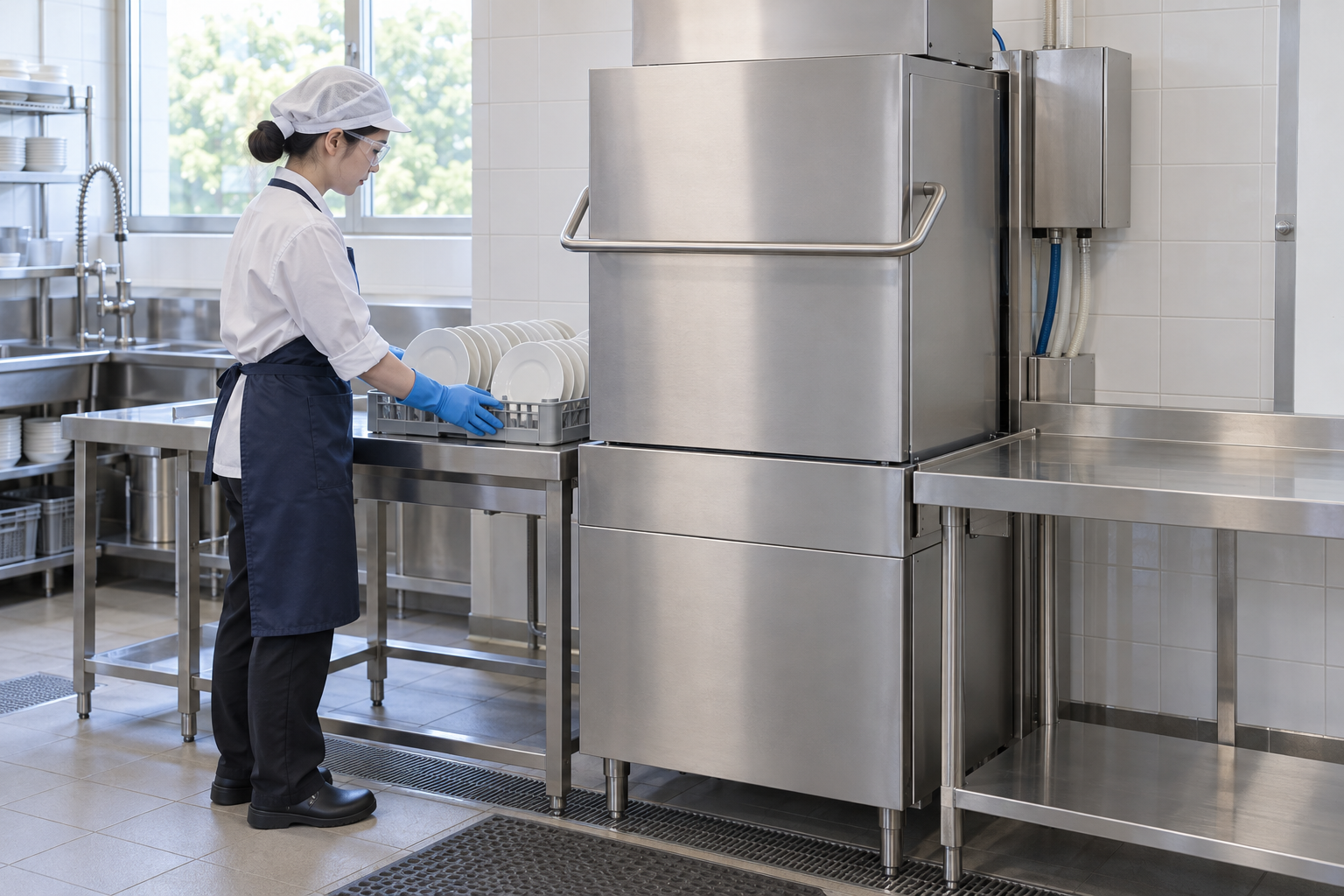 Retained source illustration: an AI-generated educational concept, not a real incident photograph or evidence of equipment suitability.
The following scenario, comparisons and example records are hypothetical teaching material. They do not reproduce actual incidents, measurements, signatures or approvals.
| Item | Hypothetical situation |
|---|---|
| Initial state | An operator hears the washing pump stop. |
| Change | The display still shows condensation and the receiving table holds the previous rack. |
| Failure path | The operator begins pulling the hood and intends to find landing space afterwards. |
| Possible harm | Steam exposure or unstable handling of hot dishes may occur. |
| Barrier | Wait for the actual completion and opening conditions, clear the receiving support and unload by the trained method. |
Pump silence is not cycle completion. Some machines still rinse or condense steam; confirm actual display meanings and opening instructions when the model or operator changes.
Prepare the receiving table before loading. Avoid holding a hot rack while seeking space, twisting around obstructions or supporting a faulty hood. Separate soiled and clean routes without inventing a universal safe rack mass.
Repair acceptance and dish hygiene are separate decisions. Mark interrupted racks for the responsible hygiene procedure even after the alarm clears. Record repair and functional checks separately from reprocessing disposition.
Chemical-resistant gloves do not automatically provide the required heat-contact protection. Match protection to both actual hazards and keep concentrate handling outside this normal-operation procedure.
| Decision | Reason and evidence |
|---|---|
| Known facts | The display still shows condensation and the receiving table holds the previous rack. |
| Unresolved | The operator begins pulling the hood and intends to find landing space afterwards. |
| Hold reason | Hold for faulty hood support, handle or interlock, water or chemical leaks, alarms, excess steam, unstable racks or broken dishes. Keep the hood closed until the actual model completion and opening conditions are satisfied; do not repeatedly reset an unexplained fault. |
| Evidence needed | Error and leak details; Hood and guard condition; Repair and function result; Rack identity and hold. |
| Next decision | Wait for the actual completion and opening conditions, clear the receiving support and unload by the trained method. |
5. Conditional decisions and common errors
| Condition | Action | Evidence | Proceed when |
|---|---|---|---|
| Cycle unclear | Keep hood closed. | Actual completion indication. | Opening conditions satisfied. |
| Table occupied | Delay unloading safely. | Stable clear receiving support. | Landing available. |
| Leak or hood defect | Stop further racks. | Cause repair and function evidence. | Machine released. |
| Interrupted rack looks clean | Hold for hygiene decision. | Cycle history and reprocessing criteria. | Rack disposition recorded. |
| Comparison | Situation A | Situation B |
|---|---|---|
| Pump quiet | One sound has stopped. | Rinse or condensation may remain. |
| Temperature displayed | Machine reports that indication. | Safe touch and hygiene acceptance are separate. |
| Fault reset | Alarm display clears. | Rack disposition and root cause remain unresolved. |
6. Roles and responsibilities
| Role | Responsibility |
|---|---|
| Work supervisor | Confirm scope, task sequence, exclusion and stop authority. Coordinate match machine and cycle with affected operations. |
| Technical reviewer | Resolve the actual design and equipment limits: Model start and finish; Rack and programme; Opening conditions; Operator training. |
| Work crew | Perform arrange rack using the approved procedure; report any mismatch before proceeding. |
| Inspector / assessor | Verify Completion and steam; Opening method; Protection and dish state; Receiving support. Record what was actually checked and what remains unresolved. |
| Release / receiving authority | Confirm Shutdown and cleaning state; Hot-water restrictions; Held racks and checks; Recipient and service status. Transfer restrictions and the next permitted stage. |
These are responsibility examples, not invented statutory credentials. Meet the actual training, competent-person, qualified-person and licensing requirements for the assigned work. Anyone may raise a hazard and request a stop; only the designated authority may release the affected stage after evidence is reviewed.
7. Hold points and record comparison
| Hold point | Evidence before release | Confirmation / approval |
|---|---|---|
| HP-0 Start | Scope, jurisdiction, equipment identity, responsible people and emergency arrangements. | |
| HP-1 Inspect hood and area | Hood and handle; Interlock condition; Chemical and water leaks; Floor and exhaust | |
| HP-2 Load and close | Rack guide position; Hands and nearby people; Hood closure; Start response | |
| HP-3 Hold fault or jam | Error and leak details; Hood and guard condition; Repair and function result; Rack identity and hold | |
| HP-4 Close and transfer | Shutdown and cleaning state; Hot-water restrictions; Held racks and checks; Recipient and service status |
Hold points are internal evidence gates. They do not replace statutory permits or actual signatures. Recheck affected gates after a change, abnormal event or shift transfer. The blank record must identify the evidence, person, time, limits and release scope.
| Record | Insufficient record | Record checklist |
|---|---|---|
| Cycle | Pump quiet | □ Model start and finish□ Rack and programme□ Opening conditions□ Operator training |
| Loading | Rack inserted | □ Rack guide position□ Hands and nearby people□ Hood closure□ Start response |
| Fault | Error reset | □ Error and leak details□ Hood and guard condition□ Repair and function result□ Rack identity and hold |
| Transfer | Machine off | □ Shutdown and cleaning state□ Hot-water restrictions□ Held racks and checks□ Recipient and service status |
The □ boxes are static prompts, not saved or interactive approvals. Each checks one record element. A tick alone does not establish suitability or permission to restart. Link equipment IDs and supporting records; retain unresolved matters and the earlier record when conditions change.
8. Site checklist and emergency response
| Check item | Result | Person / action |
|---|---|---|
| Model start and finish | ||
| Hood and handle | ||
| Sharp and broken items | ||
| Rack guide position | ||
| Wash rinse condense state | ||
| Completion and steam | ||
| Error and leak details | ||
| Shutdown and cleaning state | ||
| Emergency arrangements and unresolved restrictions communicated |
Stop work: Hold for faulty hood support, handle or interlock, water or chemical leaks, alarms, excess steam, unstable racks or broken dishes. Keep the hood closed until the actual model completion and opening conditions are satisfied; do not repeatedly reset an unexplained fault.
Emergency response: Stop further operation from a safe position and restrict access to hot liquid, steam or chemical leakage. Follow the site first-aid arrangements and actual SDS for exposure. Call SCDF 995 for serious burns, breathing difficulty or urgent rescue. Do not open hot tanks or electrical compartments to investigate; designated personnel arrange safe isolation and recovery.
9. Sources and review limits
Official-source review date: October 14, 2026. The following review is limited to the public provisions or selected manufacturer material identified below. It does not establish that any authority approved this article or the actual installation.
- MOM risk management: Official explanation: risk assessment, control, monitoring and communication for routine and non-routine work, including maintenance; reviewed 14 October 2026.
- WSHC Kitchen Good Practices handbook: English sections pages 1–4 reviewed: wet floors, broken glass/sharp objects, hot-liquid/contact controls and safety devices. Published August 2013; guidance does not certify dish hygiene or a model operating cycle.
- WSHC preventing machine hazards: Official guidance: hierarchy of controls, guarding, competent operators and maintenance LOTO. It is not a model-specific isolation instruction.
- WSHC Preventing Chemical Hazards: Official guidance on chemical risk assessment, safe work procedures, exposure routes, hazard communication and exposure-dependent monitoring; not product certification.
- WSHC GHS chemical classification and labelling: Employer/occupier SDS access, container labelling, training and understandable hazard communication. Full SS 586 text was not obtained.
- WSHC Work-related Musculoskeletal Disorders: Official ergonomics guidance covers forceful pushing/pulling, repeated loads and awkward postures, and mechanical handling aids. It supplies no universal drum mass or hand-force limit.
- EMA worker licences: Official explanation of licensed electrical work, supervision and the distinction where equipment work involves no wiring. Actual electrical duties require the appropriate licence class.
- Hobart AM16 instructions F41173, November 2021: Selected preparation and dishwashing pages 22–25: rack arrangements, actual cycle indications and ventless condensation completion. Product temperatures, timings and overseas sanitation codes are not Singapore limits.
- SCDF emergency medical services: Official 995 emergency ambulance service information; use emergency services for actual emergencies.
Paid consensus standards and site-specific calculations, manuals, inspection records and product certificates were not independently obtained or verified unless specifically identified. Korean and overseas legal references are source history, not Singapore statutory duties. Singapore Standards and model-specific limits were not read in full unless expressly identified.
10. PDF guidance and FAQ
PDF A covers basic task controls; B examines technical failures; C focuses on supervision, evidence and handover. Each has six rows and three items per main cell. They are complementary extracts: apply all eight body stages and the applicable site procedure. An omitted stage is not permission to omit its controls. PDF HP-0 through HP-4 are worksheet labels; match the event, evidence and authority rather than assuming they match another permit by number.
P/S/R/A, actual measurements, confirmations and signatures remain blank. The PDFs are uncompleted reference worksheets, not issued work permits.
Content group ID: jsa-hood-dishwasher-rack-operation
Can the hood open when the pump stops?
Use the actual model completion and opening indications, including condensation if fitted.
Can chemical gloves handle every hot rack?
No. Verify heat-contact protection for the actual task.
Can an interrupted rack be used because it looks clean?
Hold it for the responsible hygiene decision and required reprocessing.
Does this cover internal cleaning?
No. Change to a separate procedure addressing isolation, cooling, drainage and chemicals.
Has a professional verified or approved this document?
AI-generated reference material. It has not been professionally verified or approved. Before use, a suitably qualified person must review and adapt it to applicable Singapore requirements, the actual equipment and site, and approved safe work procedures.
11. Revision history and authorship
AI-generated reference material. It has not been professionally verified or approved. Before use, a suitably qualified person must review and adapt it to applicable Singapore requirements, the actual equipment and site, and approved safe work procedures.
This system has not physically inspected the equipment, structures, ground, atmosphere or worksite. The document does not replace legal advice, manufacturer procedures, engineering design, inspection certificates, qualification evidence, the site risk assessment or an actual work permit.
Before use, a suitably qualified and authorized person must review the actual equipment, loads, methods, protection, inspection and emergency arrangements and resolve open issues. Record the real reviewer, organization, qualifications, delegated authority, reviewed documents, date, signature, exclusions and conditions of approval separately.
| Date | Version | Change | Review status |
|---|---|---|---|
| 2026-10-08 | 1.0 | Korean source revision retained in the source snapshot. | Historical editorial status; not Singapore professional approval. |
| 2026-10-14 | SG 1.0 | Singapore localisation of the Korean source with its assigned US technical reference; local applicability, task controls and sources reviewed. | AI-assisted editorial work; professional approval not performed. |