Plan bit rotation, feed direction and clamp clearance on the actual workpiece. A clean test cut does not prove that the production piece remains supported through its final corner.
This is reference content written and reviced with AI. It has not been verified or approved by a professional. Review by a suitably qualified professional and required site authorisation are necessary before use.
Stop conditions first
Hold for uncertain bit speed/collet fit, insecure work, inadequate base support or clamp interference. Stop for self-feeding, a moving guide, loosening bit, vibration or burning; separate power before adjusting.
AI-generated reference material; not professionally verified or approved. Before use, a qualified person must review and adapt it to applicable Singapore requirements, the actual equipment/site and approved safe work procedures.
1. Singapore legal and technical basis
Apply Singapore risk assessment and machinery safeguarding to the portable two-handled router and its clamped external-edge work. Verify safe supply controls, bit/collet compatibility, effective dust capture and the actual manufacturer operating instructions. A foreign switch-design provision is not a Singapore approval of a particular tool.
| Basis | Singapore application |
|---|---|
| Risk management | The employer, self-employed person and principal assess and control work risks. Include preparation, abnormal conditions and maintenance. Coordinate affected trades and communicate controls. |
| Activity-specific guidance | Use machinery guidance for competent setup, safeguards, isolation and defect control; chemical guidance for material-specific dust exposure. Feed direction, cutter mounting and continuous base support require the actual router instructions. |
| Permits and authority | Select permit requirements for the actual sector and activity. Site hold points and contractor role labels do not create statutory permits or qualifications. |
| Equipment and design | No generic collet insertion, tightening torque, rotational speed or cut depth is prescribed. A switch that latches on requires assessment against actual tool design and applicable Singapore requirements; this page neither rejects nor approves it solely by switch type. |
2. Scope and required inputs
Included
Form external edges of securely clamped wood using a two-handled portable router, suitable bit/collet and a compatible guide with continuous base support.
Separate assessment
Router tables, CNC, plunge slots, metal/stone cutting, hand-held workpieces and electrical/spindle repair are excluded.
| Input | Evidence needed |
|---|---|
| Match wood and cutter | Material/cut line; Bit and model data; Defect/metal check; Cut limits |
| Isolate and mount | Power-separated state; Bit/collet fit; Condition/secure mounting; Instruction reference |
| Set and start | Setting basis/locks; Start position; Stop control/capture; Bit/work clearance |
| Clean and transfer | Tool/chip recovery; Bit and power state; Material-specific settings; Restrictions and receiver |
No actual equipment model, SDS, site measurements, design calculations or authorisation record was supplied. Verify actual product limits and applicable Singapore requirements before use. Manufacturer guidance is not government approval.
Select task-appropriate eye, hand, foot, skin and hearing protection from the exposure assessment. Where respiratory protection is necessary, use the applicable respiratory-protection program; PPE does not replace isolation, guarding, support or ventilation.
Singapore site planning
The workshop employer must assign a competent user and a stable work area separated from other people. Identify wood or composite material hazards from product information and assess dust, noise and eye exposure. Match exact shank/collet size, permissible speed and cutting depth; retain original inch product dimensions where necessary to prevent an unsafe metric substitution, while recording work dimensions in mm. Mark the actual feed direction and test the whole clamp/base path with power separated. A successful sample does not approve a different production fixture.
3. Eight-stage JSA
| Job stage | Hazards and effects | Failure factors | Technical and procedural controls | Site verification | P | S | R | A |
|---|---|---|---|---|---|---|---|---|
| 1. Match wood and cutter | 1. Bit breakup2. Material kick3. Hidden metal strike4. Wrong edge profile | 1. Speed/material mismatched2. Cracks ignored3. Nails missed4. Cut line unclear | 1. Match bit and router limits2. Inspect wood defects3. Check foreign objects4. Define permitted edge cut | 1. Material/cut line2. Exact bit/collet/model data3. Defect/metal check4. Cut limits | ||||
| 2. Isolate and mount | 1. Unexpected rotation2. Bit ejection3. Collet damage4. Wrong accessory | 1. Connected during change2. Shank/collet mismatch3. Dirty/worn collet4. Insertion improvised | 1. Disconnect power first2. Match exact collet/shank3. Inspect clean sound parts4. Follow mounting instructions | 1. Power-separated state2. Bit/collet fit3. Condition/secure mounting4. Instruction reference | ||||
| 3. Clamp and guide | 1. Tool self-feeds2. Workpiece flies3. Base tips4. Clamp collision | 1. Wood held by hand2. Fixture loose3. Narrow end support4. Path not checked | 1. Secure wood and guide2. Verify stable full-path support3. Check route without power4. Keep clamps clear of cutter/base | 1. Clamp security2. Guide/base support3. Complete travel route4. Interference check | ||||
| 4. Set and start | 1. Startup twist2. Flying chips3. Dust exposure4. Cutter grabs wood | 1. Bit touches at startup2. Setting unlocked3. Capture absent4. Cut too deep | 1. Set permitted speed/depth2. Lock adjustments3. Start with bit clearance4. Use capture and two-hand control | 1. Setting basis/locks2. Start position3. Stop control/capture4. Bit/work clearance | ||||
| 5. Feed external edge | 1. Self-feeding pull2. Hand contact3. Bit overload4. Burned wood | 1. Wrong direction2. One hand leaves grip3. Excess single pass4. Dull bit/poor feed | 1. Follow marked opposing feed2. Maintain two-hand control3. Use permitted staged cuts4. Stop abnormal loading | 1. Direction/contact edge2. Grip/base/guide3. Load and cut size/mm4. Burning/chatter signs | ||||
| 6. Stop and park | 1. Coasting-bit contact2. Tool walks on bench3. Cable snag4. Hot-bit burn | 1. Tool set down early2. Unstable rest3. Lead across path4. Bit handled hot | 1. Maintain control to standstill2. Use stable parking position3. Keep lead clear4. Allow safe cooling | 1. Complete bit stop2. Parking surface3. Cable route4. Residual heat | ||||
| 7. Hold pull or vibration | 1. Repeat loss of control2. Bit fragments3. Fixture movement4. Unresolved restart | 1. Vibration ignored2. Only nut retightened3. Guide fault missed4. Trial reused | 1. Stop and disconnect2. Check bit/collet damage3. Review feed and fixture4. Verify corrected full route | 1. Fault section/damage2. Collet/bit findings3. Guide/direction review4. Corrected setup trial | ||||
| 8. Clean and transfer | 1. Cutter contact2. Dust exposure3. Wrong copied setting4. Defect reused | 1. Cleaning while connected2. Chips blown at people3. New wood assumed same4. Damaged bit retained | 1. Disconnect and verify stop2. Use approved chip collection3. Identify setting limits4. Segregate defective cutter | 1. Tool/chip recovery2. Bit and power state3. Material-specific settings4. Restrictions and receiver |
P = likelihood; S = severity; R = risk using the site method; A = site acceptance/authorisation. Complete after actual assessment; no score overrides an unresolved hold point or equipment limit.
4. Failure mechanisms and hypothetical case
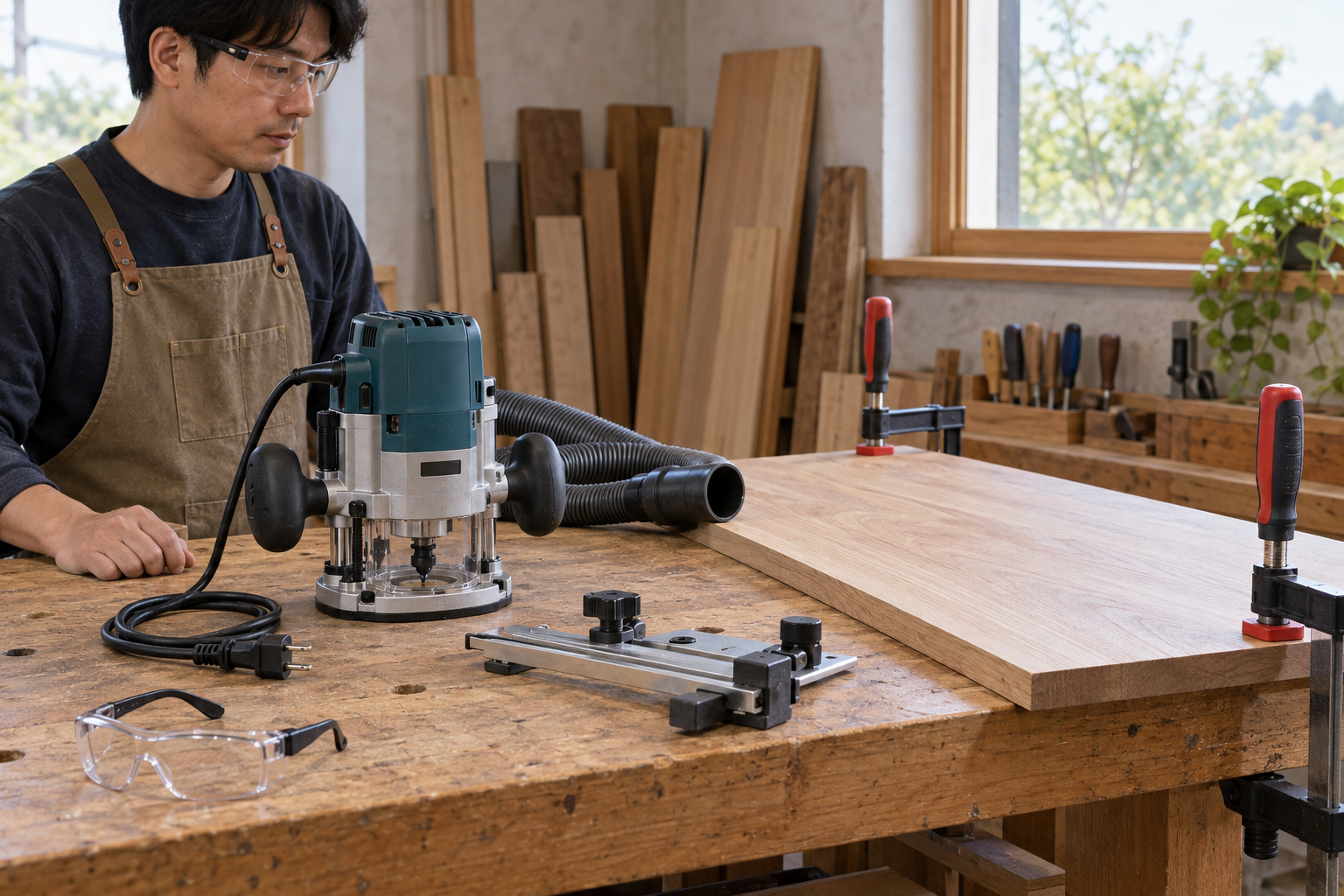
The retained illustration is an AI-generated educational image from the Korean source. It is not an actual incident photograph, approved drawing, equipment certification or proof that the depicted arrangement is safe.
Mark the start, travel direction and clamp positions together. The intended handheld feed opposes the cutting action at the contact point, avoiding a self-feeding climb cut. Reorienting the workpiece changes the route; do not apply a router-table direction rule to a handheld setup.
A shank fitting into a collet is not enough: match exact size, condition, insertion and tightening instructions, permissible cutter and speed. No generic tightening torque or insertion length is supplied.
Check the entire guided path with power separated before starting, including the last corner. If a clamp obstructs the base, stop and redesign the fixture; one-handed lifting of the router defeats the planned support.
Depth, feed and speed depend on bit, material and cut size. Use permitted staged cuts and stop abnormal load or burning to investigate; copying a prior setting is not authorisation for a new workpiece.
Hypothetical decision example
Hypothetical example: a test piece cuts well, but a clamp blocks the router base near the end of the production edge. The operator proposes lifting one side and finishing one-handed. Stop, disconnect and revice the fixture and full-path support.
The example is fictional; no incident, measurement, inspection or approval is asserted.
Task flow: Match wood and cutter → Isolate and mount → Clamp and guide → Set and start → Feed external edge → Stop and park → Hold pull or vibration → Clean and transfer
5. Hold and proceed decisions
| Condition | Action | Evidence | Proceed when |
|---|---|---|---|
| Collet mismatch | Do not start | Exact bit/collet compatibility | Fit verified |
| Clamp blocks base | Stop and redesign fixture | Unpowered full-path check | Path supported |
| Self-feeding or chatter | Stop and disconnect | Direction, depth, bit and guide review | Cause corrected |
| New material | Review settings and fixation | Material-specific plan and trial | New setup accepted |
Similar observation, different conclusion
| Observation | Supported conclusion | What remains unresolved |
|---|---|---|
| Shank enters collet | It can be inserted | Exact fit and secure mounting unverified |
| Test piece looks good | That test cut succeeded | Production clamps and end support unresolved |
6. Roles and supervision
| Role | Responsibility |
|---|---|
| Work supervisor | Coordinate match wood and cutter, affected operations, stop signals and stage transitions. |
| Technical/equipment reviewer | Verify Material/cut line, Bit and model data, actual instructions and unresolved technical limits. |
| Task crew | Apply the stated controls, report changes and keep actual checks and signatures factual. |
| Inspector/test lead | Connect Complete bit stop, Parking surface to the required acceptance criteria. |
| Receiving authority | Accept the recorded restrictions, Material-specific settings, Restrictions and receiver, and follow-up ownership. |
These are responsibility examples, not invented statutory credentials. Verify actual competence, training and authority for the assigned work.
The principal and employers coordinate the risk assessment and safe work procedures. These role labels allocate work; verify any qualifications and statutory appointments required for the actual Singapore activity. The receiving person must be given restrictions and unresolved defects before handover.
Record and handover perspective
| Stage | Record controls | Verification |
|---|---|---|
| Match wood and cutter | 1. Record material/cut line2. Record exact bit/collet/model data3. Record defect/metal check | 1. Exact bit/collet/model data2. Defect/metal check3. Cut limits |
| Clamp and guide | 1. Record clamp security2. Record guide/base support3. Record complete travel route | 1. Guide/base support2. Complete travel route3. Interference check |
| Set and start | 1. Record setting basis/locks2. Record start position3. Record stop control/capture | 1. Start position2. Stop control/capture3. Bit/work clearance |
| Feed external edge | 1. Record direction/contact edge2. Record grip/base/guide3. Record load and cut size/mm | 1. Grip/base/guide2. Load and cut size/mm3. Burning/chatter signs |
| Hold pull or vibration | 1. Record fault section/damage2. Record collet/bit findings3. Record guide/direction review | 1. Collet/bit findings2. Guide/direction review3. Corrected setup trial |
| Clean and transfer | 1. Record tool/chip recovery2. Record bit and power state3. Record material-specific settings | 1. Bit and power state2. Material-specific settings3. Restrictions and receiver |
7. Hold points and record quality
| Hold point | Evidence before release | Actual record |
|---|---|---|
| HP-0 Start | Task boundary, site RA, SWP, responsibilities and emergency arrangements | |
| HP-1 Isolate and mount | Power-separated state; Bit/collet fit; Condition/secure mounting; Instruction reference | |
| HP-2 Clamp and guide | Clamp security; Guide/base support; Complete travel route; Interference check | |
| HP-3 Stop and park | Complete bit stop; Parking surface; Cable route; Residual heat | |
| HP-4 Clean and transfer | Tool/chip recovery; Bit and power state; Material-specific settings; Restrictions and receiver |
Hold points are internal evidence gates. They do not establish that a statutory permit exists or has been approved. Recheck affected gates after changes, faults and shift handover.
Record comparison - hypothetical templates
The 16 boxes below identify record elements, not completed checks or approvals. They are static symbols. Link equipment/location, date, actual findings and the separate record reference; preserve unresolved items.
| Record | Insufficient entry | Required record elements |
|---|---|---|
| Match wood and cutter | "Checked" without supporting facts | □ Material/cut line□ Bit and model data□ Defect/metal check□ Cut limits |
| Clamp and guide | "Checked" without supporting facts | □ Clamp security□ Guide/base support□ Complete travel route□ Interference check |
| Feed external edge | "Checked" without supporting facts | □ Direction/contact edge□ Grip/base/guide□ Load and cut size□ Burning/chatter signs |
| Hold pull or vibration | "Checked" without supporting facts | □ Fault section/damage□ Collet/bit findings□ Guide/direction review□ Corrected setup trial |
Hold points are internal checks. Determine separately whether Singapore statutory or site permit requirements apply to this work. Leave confirmation, measurements and approval records blank until the authorised site process is completed.
8. Pre-work checks and emergency response
| Check required | Result | Checker/action |
|---|---|---|
| Match wood and cutter: Material/cut line | ||
| Isolate and mount: Power-separated state | ||
| Clamp and guide: Clamp security | ||
| Set and start: Setting basis/locks | ||
| Feed external edge: Direction/contact edge | ||
| Stop and park: Complete bit stop | ||
| Hold pull or vibration: Fault section/damage | ||
| Clean and transfer: Tool/chip recovery |
Stop work
Hold for uncertain bit speed/collet fit, insecure work, inadequate base support or clamp interference. Stop for self-feeding, a moving guide, loosening bit, vibration or burning; separate power before adjusting.
Emergency response
Stop while maintaining control of the router and keep hands clear until the bit stops. Control the power source before approaching a trapped part or making an adjustment. For severe cuts, flying-bit injury, electrical injury or fire, activate the site response and call the site emergency service as needed; provide the router, bit, location and power state. Do not catch an ejected part, touch a coasting cutter or restart to free material.
9. Official sources and review limits
Official public sources read for this Singapore edition on 2026-10-14. Guidance, statutory explanations and manufacturer limits have different roles; no source provider has approved this JSA.
| Source | Read scope and application limits |
|---|---|
| MOM — Risk management | Official explanation: employer, self-employed person and principal responsibilities; routine and non-routine risk assessment; hierarchy of controls; multidisciplinary assessment team. Official explanation of risk-management duties; no claim of reading the full linked statute. It does not specify task-specific equipment limits. Assess handheld wood-router edge forming with employers, principal and affected contractors; resolve the inputs in section 2. |
| MOM — When should my company review its risk assessment? | Review every three years, after significant changes, new machinery/substances/procedures, hazard-related injury or incident, and when assessment is inadequate. General review guidance. A review interval does not permit continued operation after a known hazard or change. Reassess this operation after changes, defects, incidents or an inadequate assessment; do not wait for a scheduled review. |
| MOM — Permit-to-Work Systems | Formal work authorisation and coordination; OPEC tripartite guidance and competent permit authority with authority to reject work. OPEC-focused guidance page; not evidence of a blanket statutory permit requirement for every task. Determine permits for this actual activity and workplace; distinguish the section 7 internal hold points from statutory or site permits. |
| WSH Council — Guidelines on Safe Use of Machinery | Sections 1.1 and 1.3: scope and explanation of safeguarding/LOTO duties. Sections 4.3–4.4.3: training, maintenance, specified replacement parts and isolation of all energy sources; commissioning safety-device checks. Official practical guidance and explanation; complete current subsidiary legislation and every annex were not read. Actual manufacturer isolation and restoration instructions remain necessary. Use machinery guidance for competent setup, safeguards, isolation and defect control; chemical guidance for material-specific dust exposure. Feed direction, cutter mounting and continuous base support require the actual router instructions. |
| WSH Council — Preventing Chemical Hazards | Chemical exposure routes, employer/employee roles, risk assessment, safe work procedures, communication, SDS, exposure monitoring and substance-dependent health surveillance. Official overview; linked exposure schedules and medical examination regulations were not read in full. Do not infer a numerical exposure limit or a universal medical examination duty. Use machinery guidance for competent setup, safeguards, isolation and defect control; chemical guidance for material-specific dust exposure. Feed direction, cutter mounting and continuous base support require the actual router instructions. |
No generic collet insertion, tightening torque, rotational speed or cut depth is prescribed. A switch that latches on requires assessment against actual tool design and applicable Singapore requirements; this page neither rejects nor approves it solely by switch type.
Actual site measurements, equipment instructions, engineering checks and signed approval records were not supplied. A qualified person must resolve these before use.
10. PDF use and frequently asked questions
PDF A summarizes core controls; B emphasizes technical failures; C covers supervision, records and handover. Each uses six stages from or aligned with the eight-stage body. All actual risk, measurement, check and signature fields are blank. Use a separate linked record where more space is needed.
Can someone hold the wood?
No. Secure it with a suitable fixture or clamps while preserving the entire base path.
Is feed always counterclockwise?
Use the actual bit rotation and contact edge with the handheld instructions. Inside cuts and table-mounted routers differ.
Can the tool be set down while coasting?
Maintain control until the bit fully stops, then place it in the planned stable position.
Does a positive on/off switch mean the router is defective?
The switch type alone does not decide suitability. Verify the actual tool instructions, applicable Singapore requirements and accessible, functioning controls before use; isolate the supply for setting or repair.
Has a professional approved this JSA?
This is reference content written and reviced with AI. It has not been verified or approved by a professional. Review by a suitably qualified professional and required site authorisation are necessary before use.
11. Authorship and revision history
AI-generated reference material; not professionally verified or approved. Before use, a qualified person must review and adapt it to applicable Singapore requirements, the actual equipment/site and approved safe work procedures.
This Singapore edition was adapted from the Korean original and its assigned US technical reference. Earlier source revisions are archival editorial history, not Singapore technical approval.
| Date | Edition | Change | Review status |
|---|---|---|---|
| 2026-09-26 | Korean source v1.0 | Source editorial publication or revision; retained as provenance of the Korean edition. | Editorial record only; no professional technical approval recorded. |
| 2026-10-14 | 1.0 en-SG | Singapore legal scope, local planning, responsibility interfaces and SI terminology; new PDF A/B/C. | AI editorial and visual review only; no professional approval. |