Reduce sanding through controlled coating, then verify capture during actual work. A connected hose or a worn respirator is not acceptance of a leaking extractor, and a hard compound surface is not proof of complete drying.
AI-generated reference material. It has not been verified or approved by a professional. Before use, a qualified person must review and adapt it to applicable Singapore requirements, the actual equipment and site, and approved safe work procedures.
1. Singapore legal and technical basis
Singapore WSH risk management covers dust generation, nearby trades, safe access and product handling. Apply MOM hygiene-monitoring requirements to the toxic substances actually used or generated; identify relevant exposure limits from the applicable Singapore schedule. Product composition, visible dust and measured exposure are different evidence.
| Source category | Task application and limit |
|---|---|
| MOM - Risk management | Assess compound mixing, sanding, bag changes and adjoining occupied areas. Official explanation of WSH Risk Management duties, not a complete consolidated statutory text. |
| MOM - Requirements for hygiene monitoring | Arrange competent exposure monitoring, results review and applicable reporting. Material-specific exposure and actual monitoring frequency have not been determined. No workplace measurement is supplied. |
| MOM - Permissible exposure levels | Select substance-specific Singapore exposure criteria; do not assume all joint compound has the same dust composition. Individual substance values and full current statutory schedule were not reviewed; do not infer a generic dust limit. |
| MOM - Work at Heights amendment factsheet | Select protected access without overreach. Official 2014 explanatory factsheet accessed now. Consolidated SSO fetch returned 403; full current statutory text not verified. Course names and detailed permit arrangements need current confirmation. |
Use Singapore requirements and SI units. Manufacturer limits apply to the actual model. Foreign technical examples do not establish Singapore statutory duties. A job safety analysis or completed checklist is not a permit or approval.
2. Scope and required inputs
Included: Taping and applying specified joint compound to accepted new gypsum-board joints and fastener heads, allowing required drying and lightly sanding with a compatible dust-extraction system before painting handover.
Separate review: Unknown existing coatings, suspected asbestos or lead-containing layers, board demolition or installation, concrete grinding, painting and access-platform erection require separate assessment.
| Input | Required evidence |
|---|---|
| Accept board and products | Board area and fixing record; Product and SDS identity; Joint and corner details; No unknown old layers |
| Mix and tape | Mix and product instruction; Batch time and identity; Tape coverage and bedding; Eye and skin protection |
| Sand with capture | Airflow and leakage; Abrasive and surface condition; Work duration and protection; Stable reach and stance |
| Handover for paint | Dry clean surface acceptance; Open repairs and limits; Clear area and waste record; Receiving painter identified |
Confirm board acceptance, compound and tape compatibility, product SDS, mixing and working time, drying criteria and required finish. Match abrasive, shroud, hose, filter and extraction flow to the actual tool. Select eye, skin and respiratory protection from the material and exposure assessment; a respirator does not repair failed extraction.
Singapore application
Coordinate the dust boundary with the building operator and adjoining trades, including return-air paths. Do not block fire exits or assume the general air-conditioning system is a dust extractor.
3. Eight-stage JSA
| Job stage | Hazards and effects | Failure factors | Controls | Site verification | P | S | R | A |
|---|---|---|---|---|---|---|---|---|
| 1. Accept board and products | 1. Unknown-dust exposure2. Loose-board movement3. Joint failure4. Chemical contact | 1. Old coating mixed in2. Board fixing unverified3. Tape mismatch4. SDS unavailable | 1. Confirm new substrate2. Review fixing acceptance3. Match compound and tape4. Review product hazards | 1. Board area and fixing record2. Product SDS and SG criteria3. Joint and corner details4. No unknown old layers | ||||
| 2. Prepare extraction | 1. Nearby-worker exposure2. Access fall3. Electrical shock4. Trip on hose | 1. Area shared without control2. Unstable platform3. Damaged supply lead4. Hose crosses walkway | 1. Separate affected area2. Use suitable access3. Check electrical protection4. Route hoses safely | 1. Boundaries and access2. Shroud hose filter and flow3. Supply and tool condition4. Clear work route | ||||
| 3. Mix and tape | 1. Powder inhalation2. Eye or skin irritation3. Weak tape bond4. Batch waste | 1. Powder dumped rapidly2. Protection unsuitable3. Wrong mix or tape4. Working time exceeded | 1. Use controlled mixing2. Apply SDS protection3. Embed compatible tape4. Track batch working time | 1. Mix and product instruction2. Batch time and identity3. Tape coverage and bedding4. Eye and skin protection | ||||
| 4. Coat and dry | 1. Wet-layer damage2. Excess sanding exposure3. Cracked thick coat4. Misidentified wet area | 1. Setting mistaken for drying2. Ridges left on coat3. Thickness unsuitable4. Area status unmarked | 1. Follow layer conditions2. Smooth before drying3. Use specified coat build4. Mark drying and held areas | 1. Coat timing and condition2. Drying acceptance3. Ridges cracks and separation4. Area status recorded | ||||
| 5. Sand with capture | 1. Dust inhalation2. Eye irritation3. Board-paper damage4. Repetitive strain | 1. Flow warning ignored2. Hose or filter leaks3. Abrasive too aggressive4. Overreach or long exposure | 1. Maintain source capture2. Stop on escaped dust3. Sand lightly with correct grit4. Plan posture and exposure | 1. Airflow and leakage2. Abrasive and surface condition3. Exposure controls and record4. Stable reach and stance | ||||
| 6. Clean and inspect | 1. Dust resuspension2. Poor paint adhesion3. Hidden joint defects4. Exposure during bag handling | 1. Dry sweeping used2. Residual dust retained3. Loose tape concealed4. Collection bag opened | 1. Use controlled dust cleanup2. Check clean dry surface3. Inspect cracks and bond4. Contain collected waste | 1. Cleaning and residual dust2. Dryness and surface finish3. Repair locations4. Closed waste handling | ||||
| 7. Hold on defect | 1. Continued dust exposure2. Damaged surface overcoated3. Unexpected tool start4. Repeated extraction failure | 1. Alarm reset without cause2. Repair hidden by sanding3. Power left connected4. Filter fault unresolved | 1. Stop and isolate tool2. Identify affected area3. Inspect capture and substrate4. Verify correction before use | 1. Warning and hose condition2. Filter or fault cause3. Repair and exposure response4. Restart checks | ||||
| 8. Handover for paint | 1. Wet surface decorated2. Repair area lost3. Trip on abandoned hose4. Waste dust release | 1. Completion status unclear2. Defect verbally passed3. Equipment left in access4. Waste container unsealed | 1. Mark accepted and held areas2. Transfer repair records3. Remove tools and hoses4. Close and remove dust waste | 1. Dry clean surface acceptance2. Open repairs and limits3. Clear area and waste record4. Receiving painter identified |
P/S/R/A and actual measurements, checks, names and signatures remain blank for the site assessment. A score cannot waive a required control.
4. Hypothetical scenario and failure mechanisms
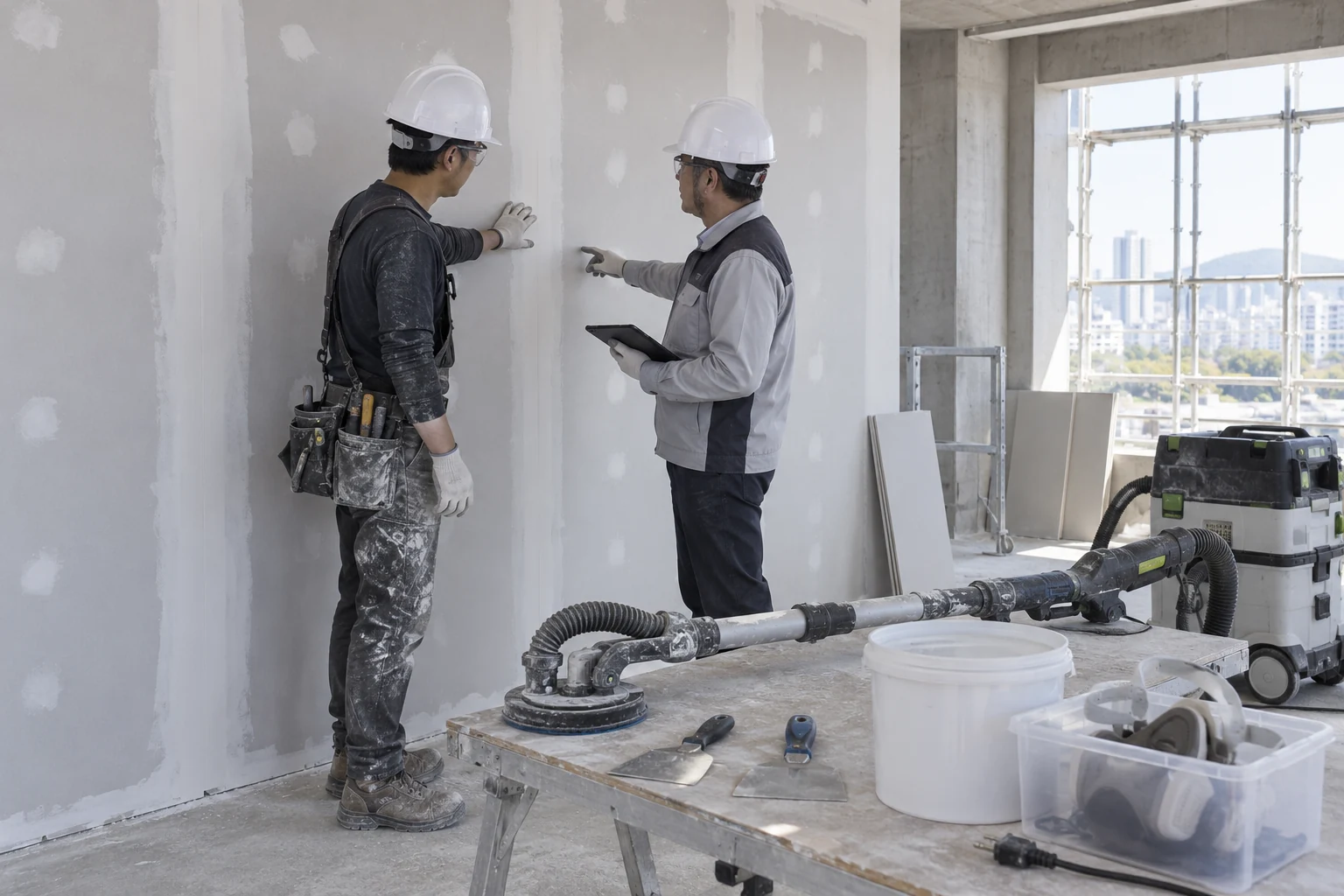
The following scenario, comparisons and example records are hypothetical teaching material. They do not reproduce actual incidents, measurements, signatures or approvals.
| Item | Hypothetical situation |
|---|---|
| Initial state | A finisher sands the last joint of a newly finished wall. |
| Change | The extractor warns of reduced flow and dust escapes at a hose connection. |
| Failure path | The operator proposes finishing the strip because a mask is being worn. |
| Possible harm | Loss of capture increases worker and nearby-trade exposure and spreads settled dust. |
| Barrier | Stop sanding, control the area, isolate equipment for inspection, repair the filter or hose fault and verify extraction and cleanup before restart. |
Better tape embedding and smoothing of each coat reduce the amount of material that later needs sanding. Setting and drying are different processes; a hard surface alone does not establish readiness for sanding or decoration. Use the instructions for the exact compound and board system.
A connected hose is only one part of effective capture. The shroud, connections, filter condition and actual airflow must work together. Check warning indicators and escaping dust during use; stop on a loss of control rather than relying on an unchanged respirator.
Unknown older layers can change the hazardous-material assessment. Keep this workflow on verified new board and specified compound. Use low-dust cleanup and controlled filter or bag handling; transfer dry-surface acceptance and remaining repairs to the painting crew.
| Decision | Reason and evidence |
|---|---|
| Known facts | The extractor warns of reduced flow and dust escapes at a hose connection. |
| Unresolved | The operator proposes finishing the strip because a mask is being worn. |
| Hold reason | Hold for unknown substrate composition, loose board, wet compound, extraction flow warnings, dust leakage, unsafe access or electrical defects. Stop when sanding reaches an unidentified existing layer. |
| Evidence needed | Airflow and leakage; Abrasive and surface condition; Work duration and protection; Stable reach and stance. |
| Next decision | Stop sanding, control the area, isolate equipment for inspection, repair the filter or hose fault and verify extraction and cleanup before restart. |
5. Hold and proceed decisions
| Condition | Action | Evidence | Proceed when |
|---|---|---|---|
| Unknown layer | Stop and establish material identity. | Substrate history and survey. | Scope confirmed. |
| Compound still wet | Hold sanding and decoration. | Product drying conditions. | Specified readiness met. |
| Flow warning | Stop and inspect isolated capture system. | Filter, hose and flow checks. | Capture restored. |
| Surface damaged | Mark area and complete approved repair. | Board, tape and finish inspection. | Repair accepted. |
| Comparison | Situation A | Situation B |
|---|---|---|
| Surface hard | Specified drying and finish conditions are confirmed. | Chemical setting is mistaken for complete drying. |
| Hose connected | Capture, filter and flow are verified during work. | A hose is attached but warnings and leakage persist. |
6. Roles and supervision
| Role | Responsibility |
|---|---|
| Work supervisor | Confirm scope, task sequence, exclusion and stop authority. Coordinate accept board and products with affected operations. |
| Technical reviewer | Resolve the actual design and equipment limits: Board area and fixing record; Product and SDS identity; Joint and corner details; No unknown old layers. |
| Work crew | Perform mix and tape using the approved procedure; report any mismatch before proceeding. |
| Inspector / assessor | Verify Cleaning and residual dust; Dryness and surface finish; Repair locations; Closed waste handling. Record what was actually checked and what remains unresolved. |
| Release / receiving authority | Confirm Dry clean surface acceptance; Open repairs and limits; Clear area and waste record; Receiving painter identified. Transfer restrictions and the next permitted stage. |
These are responsibility examples, not invented statutory credentials. Meet the actual training, competent-person, qualified-person and licensing requirements for the assigned work. Anyone may raise a hazard and request a stop; only the designated authority may release the affected stage after evidence is reviewed.
Singapore application
The finishing supervisor controls product identity, capture faults and held surfaces. The competent hygiene-monitoring person evaluates the actual exposure evidence where required. The receiving painter accepts dryness and repairs separately from dust-control checks.
7. Hold points and record quality
| Hold point | Evidence before release | Confirmation / approval |
|---|---|---|
| HP-0 Start | Scope, jurisdiction, equipment identity, responsible people and emergency arrangements. | |
| HP-1 Prepare extraction | Boundaries and access; Shroud hose filter and flow; Supply and tool condition; Clear work route | |
| HP-2 Coat and dry | Coat timing and condition; Drying acceptance; Ridges cracks and separation; Area status recorded | |
| HP-3 Hold on defect | Warning and hose condition; Filter or fault cause; Repair and exposure response; Restart checks | |
| HP-4 Handover for paint | Dry clean surface acceptance; Open repairs and limits; Clear area and waste record; Receiving painter identified |
Hold points are internal evidence gates. They do not replace statutory permits or actual signatures. Recheck affected gates after a change, abnormal event or shift transfer. The blank record must identify the evidence, person, time, limits and release scope.
| Record | Insufficient record | Record checklist |
|---|---|---|
| Materials | New wall | □ Board area and fixing record□ Product and SDS identity□ Joint and corner details□ No unknown old layers |
| Mixing | Batch ready | □ Mix and product instruction□ Batch time and identity□ Tape coverage and bedding□ Eye and skin protection |
| Capture | Hose attached | □ Airflow and leakage□ Abrasive and surface condition□ Work duration and protection□ Stable reach and stance |
| Recovery | Alarm cleared | □ Warning and hose condition□ Filter or fault cause□ Repair and exposure response□ Restart checks |
The □ boxes are static prompts, not saved or interactive approvals. Each checks one record element. A tick alone does not establish suitability or permission to restart. Link equipment IDs and supporting records; retain unresolved matters and the earlier record when conditions change.
8. Pre-work checks and emergency response
| Check item | Result | Person / action |
|---|---|---|
| Board area and fixing record | ||
| Boundaries and access | ||
| Mix and product instruction | ||
| Coat timing and condition | ||
| Airflow and leakage | ||
| Cleaning and residual dust | ||
| Warning and hose condition | ||
| Dry clean surface acceptance | ||
| Emergency arrangements and unresolved restrictions communicated |
Stop work: Hold for unknown substrate composition, loose board, wet compound, extraction flow warnings, dust leakage, unsafe access or electrical defects. Stop when sanding reaches an unidentified existing layer.
Emergency response: Stop the task and leave the dust source for significant breathing difficulty or eye injury. Follow the product SDS and site first-aid plan; contact the site emergency responders for severe symptoms. Prevent unprotected re-entry into the affected area and retain the fault and exposure details for the response team.
9. Sources and review limits
Public-source review: 14 October 2026. Only the material and limits identified below were reviewed.
| Source | Reviewed material | Task application |
|---|---|---|
| MOM - Risk management | Responsibilities; routine and non-routine work; hierarchy of control and risk assessment team. Official explanation of WSH Risk Management duties, not a complete consolidated statutory text. | Assess compound mixing, sanding, bag changes and adjoining occupied areas. |
| MOM - Requirements for hygiene monitoring | Main requirements: competent monitoring personnel, toxic substances, results and reporting, recommended frequency table and noise applicability. Material-specific exposure and actual monitoring frequency have not been determined. No workplace measurement is supplied. | Arrange competent exposure monitoring, results review and applicable reporting. |
| MOM - Permissible exposure levels | Full answer defining long-term and short-term toxic-substance exposure and referring to the General Provisions First Schedule. Individual substance values and full current statutory schedule were not reviewed; do not infer a generic dust limit. | Select substance-specific Singapore exposure criteria; do not assume all joint compound has the same dust composition. |
| MOM - Work at Heights amendment factsheet | Pages 1-4, particularly Annex A questions 1-3 on factories, hazardous height and effective protection; training/role explanations. Official 2014 explanatory factsheet accessed now. Consolidated SSO fetch returned 403; full current statutory text not verified. Course names and detailed permit arrangements need current confirmation. | Select protected access without overreach. |
Selected public official sources were reviewed on 14 October 2026 within the recorded scope. No full consolidated legal audit, paid Singapore Standard, actual model manual, site inspection, engineering calculation or professional approval is claimed. Verify current detailed requirements and actual equipment/site records before use.
AI-generated reference material. It has not been verified or approved by a professional. Before use, a qualified person must review and adapt it to applicable Singapore requirements, the actual equipment and site, and approved safe work procedures.
10. PDF use and frequently asked questions
PDF A covers basic task controls; B examines technical failures; C focuses on supervision, evidence and handover. Each has six rows and three items per main cell. They are complementary extracts: apply all eight body stages and the applicable site procedure. An omitted stage is not permission to omit its controls. PDF HP-0 through HP-4 are worksheet labels; match the event, evidence and authority rather than assuming they match another permit by number.
P/S/R/A, actual measurements, confirmations and signatures remain blank. The PDFs are uncompleted reference worksheets, not issued work permits.
Content group ID: jsa-gypsum-joint-compound-dust-sanding
Can hard compound be sanded immediately?
Use the exact product drying and sanding criteria. Chemical set and complete drying are not the same condition.
Is a connected vacuum enough?
No. Check compatibility, filters, seals and operating flow, and respond to warnings and leakage.
Does a mask allow work to continue with failed extraction?
No. Stop and correct the failed control; respiratory protection must follow the applicable exposure assessment and program.
Does this cover sanding an old painted wall?
No. Identify old coatings and potential hazardous constituents before a separately assessed task.
Has a professional verified or approved this document?
No. This is AI-assisted reference material. Editorial and layout checks are not a physical inspection or professional technical approval. Obtain qualified professional review and required site approval before use.
Singapore application
Read A, B and C together with all eight JSA stages and the approved work procedure. The sheets are complementary extracts, not separate work authorisations.
11. Authorship and revision history
AI-generated reference material. It has not been verified or approved by a professional. Before use, a qualified person must review and adapt it to applicable Singapore requirements, the actual equipment and site, and approved safe work procedures.
| Date / edition | Authorship and scope | Professional approval |
|---|---|---|
| 2026-10-08 / Korean source | Original topic and educational illustration retained as references. Source content is unchanged. | Not asserted |
| 14 October 2026 / Singapore 1.0 | Replaced the foreign silica/Table 1 framework with Singapore substance-specific assessment and monitoring; added occupied-area ventilation coordination and painting handover limits. | Not performed |
Source topic: https://smartjsabridge.com/ko/case-study/jsa-gypsum-joint-compound-dust-sanding