Prior drying and a dry exterior do not establish the current condition inside a mould or conductor. Moisture can return after storage or exposure. Distinguish preparation before material placement from a fault after material has been added; do not improvise heating, water addition or re-ignition.
This is reference content written and reviced with AI. It has not been verified or approved by a professional. Review by a suitably qualified professional and site authorisation are required before use.
Stop before starting
Stop excavation or rod driving for unknown utilities or unstable ground. Hold activation for moisture, contamination, mismatched components, poor mould closure or missing fire controls. Keep defective joints exposed and identified until disposition.
AI-generated reference material; not professionally verified or approved. Before use, a qualified person must review and adapt it to applicable Singapore requirements, the actual equipment/site and approved safe work procedures.
1. Legal and technical scope
Apply Singapore risk assessment to buried-service exposure, hot material, fumes and the electrical-system boundary. Earthing installation and testing must have the appropriate EMA Licensed Electrical Worker involvement. Product SDS and manufacturer instructions govern the actual mould, conductor and welding-material combination; a hot-work release does not approve an electrical alteration.
| Basis | Singapore application |
|---|---|
| Risk management | The employer, self-employed person and principal assess and control work risks. Include preparation, abnormal conditions and maintenance. Coordinate affected trades and communicate controls. |
| Activity-specific guidance | Use EMA guidance for electrical-work responsibility and licence scope, and chemical/GHS guidance for identified welding materials, SDS, exposure and emergency information. The actual product and site plans resolve ignition, underground-service and joint acceptance details. |
| Permits and authority | Select permit requirements for the actual sector and activity. Site hold points and contractor role labels do not create statutory permits or qualifications. |
| Equipment and design | No universal earthing resistance, drying temperature, cooling time, charge quantity or excavation clearance is supplied. The actual service-location, product and electrical design instructions were not provided. Testing cannot justify an unplanned interruption of protective earthing or heating a loaded damp mould. |
2. Scope and required inputs
Included work
Utility investigation, earthing electrode/conductor placement, approved exothermic connection, cooling, joint inspection, pre-burial records, planned backfill and earthing-system tests.
Separate assessment
Disconnecting operating protective earthing, driving rods near unlocated utilities, unapproved mould/material combinations and improvised reheating or re-ignition are excluded.
| Required input | Evidence to obtain |
|---|---|
| Review design and utilities | Utility evidence; Excavation and rod points; Operating ground state; Drawing and joint ID |
| Prepare hot-work area | Combustible zone; Material and SDS; Worker and ventilation; Alarm and fire response |
| Excavate and place | Location verification; Exposed installations; Ground and access; Electrode position |
| Check mould combination | Dryness evidence; Mould and conductor ID; Closure and clamp; Material condition |
No actual equipment model, SDS, site measurements, design calculations or authorisation record was supplied. Verify actual product limits and applicable Singapore requirements before use. Manufacturer guidance is not government approval.
Singapore site planning
The principal, excavation team and electrical contractor must reconcile service records with location verification before excavation or rod driving. Assign the LEW and approved earthing drawing, protect existing operating earthing paths, and identify the joint before it is buried. Set the applicable site hot-work controls, fire watch and safe cooling/opening method for the specific product. Record conductor dimensions in mm², positions and test results with units and circuit state. Inspect individual joints before concealment, then perform backfill and final system tests in the accepted inspection sequence.
3. Eight-stage JSA
| Job stage | Hazards and effects | Failure factors | Technical and procedural controls | Site verification | P | S | R | A |
|---|---|---|---|---|---|---|---|---|
| 1. Review design and utilities | 1. Power-line strike2. Pipe leak3. Earthing loss4. Wrong connection | 1. Utilities unlocated2. Survey incomplete3. Operating impact missed4. Drawing mismatch | 1. Investigate utilities2. Check survey extent3. Review ground boundary4. Identify connection points | 1. Utility evidence2. Excavation and rod points3. Operating ground state4. LEW drawing and joint ID | ||||
| 2. Prepare hot-work area | 1. Burn or fire2. Degraded material3. Fume exposure4. Delayed response | 1. Combustibles remain2. Storage improper3. Position unreviewed4. Response unclear | 1. Set fire controls2. Check stored materials3. Plan shielding and air4. Provide response means | 1. Combustible zone2. Material and SDS3. Worker and ventilation4. Alarm and fire response | ||||
| 3. Excavate and place | 1. Utility contact2. Excavation collapse3. Rod strike4. Unauthorised access | 1. Records not verified2. Ground unstable3. People in strike zone4. Opening unprotected | 1. Verify utility locations2. Apply excavation plan3. Control rod-work zone4. Protect open excavation | 1. Location verification2. Exposed installations3. Ground and access4. Electrode position | ||||
| 4. Check mould combination | 1. Hot-metal spatter2. Weak connection3. Mould separation4. Material misuse | 1. Moisture present2. Conductor mismatch3. Clamp loose4. Wrong material | 1. Follow current preparation2. Match approved combination3. Inspect mould closure4. Follow product storage | 1. Dryness evidence2. Mould and conductor ID3. Closure and clamp4. Material condition | ||||
| 5. Control heat cycle | 1. Thermal burn2. Spark fire3. Fume inhalation4. Early opening spatter | 1. People too close2. Fuel remains3. Breathing zone exposed4. Cooling omitted | 1. Use specified shielding2. Maintain fire controls3. Protect breathing zone4. Follow cooling procedure | 1. Worker position2. Fire watch conditions3. Air and wind4. Cooling and opening | ||||
| 6. Inspect before burial | 1. Poor continuity2. Conductor damage3. Joint concealed4. Test potential | 1. Defect ignored2. Corrosion mismatch3. Location unrecorded4. Test scope wrong | 1. Inspect joint criteria2. Check material condition3. Record photos and location4. Follow inspection sequence | 1. Joint acceptance2. Conductor condition3. Pre-burial record4. Test stage and boundary | ||||
| 7. Hold and rework | 1. Spatter recurrence2. Defect hidden3. Protective ground lost4. Repeat failure | 1. Condensation ignored2. Defect buried3. Ground removed casually4. Cause unresolved | 1. Hold activation2. Mark defective joint3. Preserve system boundary4. Verify accepted correction | 1. Current material state2. Joint hold identity3. Isolation and impact4. Cause and reinspection | ||||
| 8. Test and hand over | 1. Uninspected burial2. Wrong acceptance3. Backfill damage4. Unresolved system use | 1. Checks omitted2. Test setup missing3. Conductor disturbed4. Limits not passed on | 1. Reconcile joint records2. Record test conditions3. Inspect restoration4. Transfer use restrictions | 1. Photos and location2. Test units and circuit state3. Backfill and test stages4. Criteria and recipient |
P = likelihood; S = severity; R = risk using the site method; A = site acceptance/authorisation. Complete after actual assessment; no score overrides an unresolved hold point or equipment limit.
4. Fictional scenario and failure mechanisms
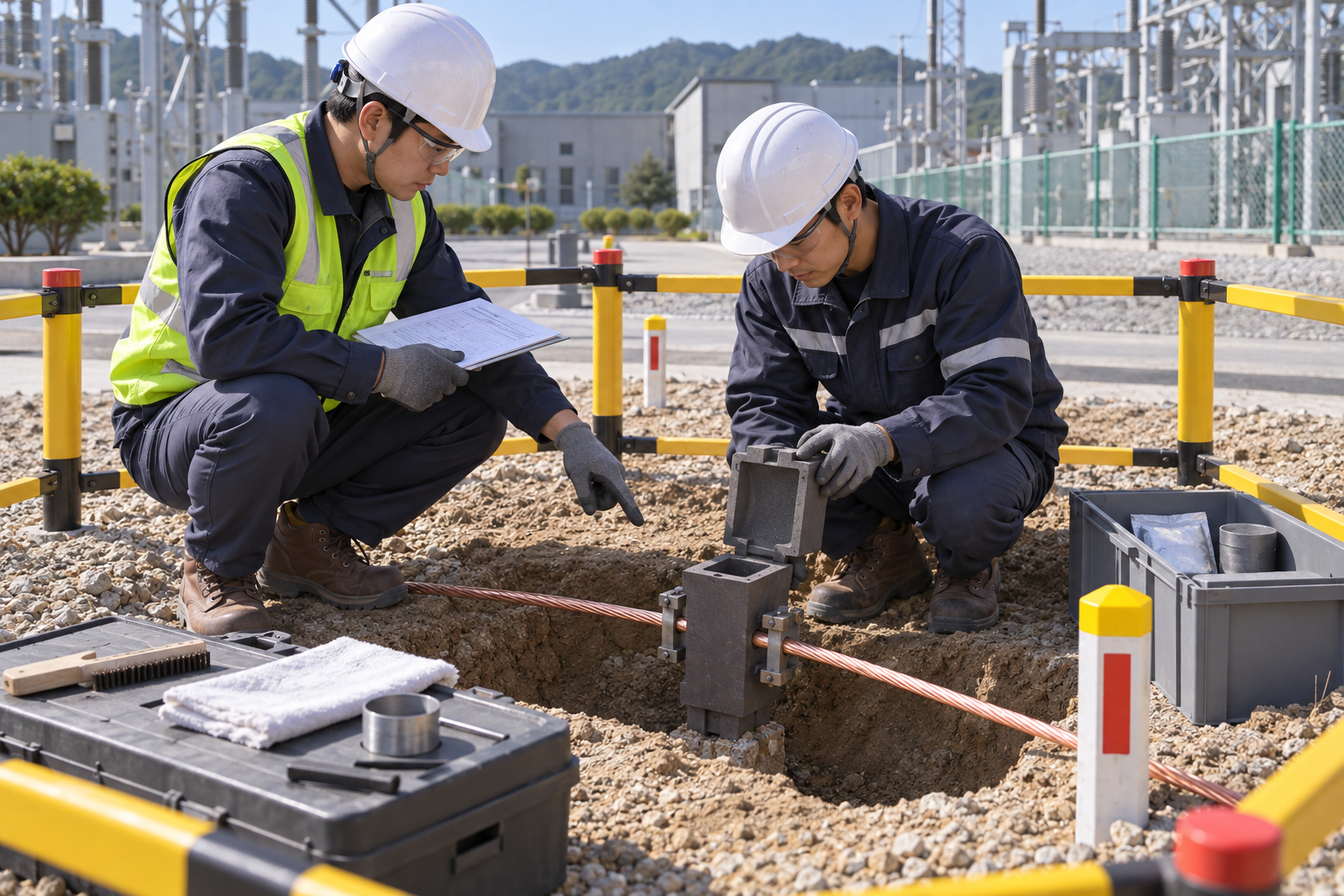
This illustration provides educational context. It is not an actual incident photograph or evidence of equipment suitability; any AI-generated depiction is illustrative only.
The scenario and record comparisons are fictional teaching examples, not records of real incidents, measurements, inspections, signatures or approvals.
| Stage | Fictional situation |
|---|---|
| Initial situation | A fictional crew prepares an exothermic earthing connection. |
| Changed condition | Condensation is observed inside a mould previously dried earlier in the day. |
| Failure path | The earlier record and dry exterior are treated as current proof. |
| Possible outcome | Contact between moisture and hot material could cause spatter, burns or a defective joint. |
| Prevention barrier | Hold activation; identify the present condition and whether material was already added, then obtain the exact manufacturer recovery procedure. |
Failure mechanisms
Prior drying and a dry exterior do not establish the current condition inside a mould or conductor. Moisture can return after storage or exposure. Distinguish preparation before material placement from a fault after material has been added; do not improvise heating, water addition or re-ignition.
A low measured earthing resistance does not prove every connection is sound. Joint compatibility, visual acceptance and conductor damage checks serve a different purpose from the system test. Record test arrangement, circuit state, parallel paths and applicable acceptance basis.
Burial hides the joint. Complete the required joint inspection, location and photographs before covering it, then follow the accepted sequence for backfill and final tests. This does not imply all earthing tests must occur before backfill.
Work sequence: Review design and utilities → Prepare hot-work area → Excavate and place → Check mould combination → Control heat cycle → Inspect before burial → Hold and rework → Test and hand over. This is a teaching flow, not a device drawing or a complete operating procedure.
5. Conditional decisions and common errors
| Situation | Required action | Evidence | Proceed when |
|---|---|---|---|
| Utility position unknown | Hold excavation or driving | Survey and safe-location evidence | Location resolved |
| Moisture observed | Hold activation | Current state and product procedure | Preparation accepted |
| Joint defect found | Do not bury | Joint ID and inspection criteria | Disposition verified |
| System test proposed | Review test boundary | Circuit state and measurement plan | Test authorised |
Similar observations, different decisions
The scenario and record comparisons are fictional teaching examples, not records of real incidents, measurements, inspections, signatures or approvals.
| Observation | Insufficient conclusion | Required distinction |
|---|---|---|
| Dried earlier | Past preparation | Current moisture may differ |
| Low resistance | System measurement | Not individual-joint proof |
| Backfill complete | Joint covered | Inspection cannot be assumed |
6. Roles and responsibilities
| Role | Responsibility |
|---|---|
| Work supervisor | Confirm utility evidence and the task scope, resources, interfaces and stop authority. |
| Qualified technical reviewer | Review combustible zone, model limits, compatibility and unresolved technical conditions within assigned competence. |
| Work crew | Apply the listed controls, report changes and stop when evidence or safeguards are missing. |
| Inspector / assessor | Record actual worker position and other relevant checks; do not mark unverified conditions as accepted. |
| Handover authority | Reconcile photos and location, restrictions and outstanding actions before the next task. Role labels do not establish a legal credential. |
The principal and employers coordinate the risk assessment and safe work procedures. These role labels allocate work; verify any qualifications and statutory appointments required for the actual Singapore activity. The receiving person must be given restrictions and unresolved defects before handover.
Record and handover perspective
| Stage | Record controls | Verification |
|---|---|---|
| Review design and utilities | 1. Record utility evidence2. Record excavation and rod points3. Record operating earthing connection state | 1. Excavation and rod points2. Operating ground state3. LEW drawing and joint ID |
| Excavate and place | 1. Record location verification2. Record exposed installations3. Record ground and access | 1. Exposed installations2. Ground and access3. Electrode position |
| Check mould combination | 1. Record dryness evidence2. Record mould and conductor id3. Record closure and clamp | 1. Mould and conductor ID2. Closure and clamp3. Material condition |
| Control heat cycle | 1. Record worker position2. Record fire watch conditions3. Record air and wind | 1. Fire watch conditions2. Air and wind3. Cooling and opening |
| Hold and rework | 1. Record current material state2. Record joint hold identity3. Record isolation and impact | 1. Joint hold identity2. Isolation and impact3. Cause and reinspection |
| Test and hand over | 1. Record photos and location2. Record test units and circuit state3. Record backfill and test stages | 1. Test units and circuit state2. Backfill and test stages3. Criteria and recipient |
7. Hold points and record comparison
| Hold point | Evidence before release | Actual record |
|---|---|---|
| HP-0 Start | Task boundary, site RA, SWP, responsibilities and emergency arrangements | |
| HP-1 Prepare hot-work area | Combustible zone; Material and SDS; Worker and ventilation; Alarm and fire response | |
| HP-2 Excavate and place | Location verification; Exposed installations; Ground and access; Electrode position | |
| HP-3 Inspect before burial | Joint acceptance; Conductor condition; Pre-burial record; Test stage and boundary | |
| HP-4 Test and hand over | Photos and location; Test units and circuit state; Backfill and test stages; Criteria and recipient |
Hold points are internal project checks. They are not universal statutory permits and do not grant work permission. Reassess after defects, changed conditions and shift changes.
Record comparison
The scenario and record comparisons are fictional teaching examples, not records of real incidents, measurements, inspections, signatures or approvals.
The boxes are static record prompts, not interactive or saved approvals. A tick does not establish suitability or permission to restart. Record the evidence, person, time and unresolved issues; retain the change history.
| Record | Insufficient record | Record checklist |
|---|---|---|
| Review design and utilities | Only marked “OK” | □ Utility evidence□ Excavation and rod points□ Operating ground state□ Drawing and joint ID |
| Check mould combination | Only marked “OK” | □ Dryness evidence□ Mould and conductor ID□ Closure and clamp□ Material condition |
| Hold and rework | Only marked “OK” | □ Current material state□ Joint hold identity□ Isolation and impact□ Cause and reinspection |
| Test and hand over | Only marked “OK” | □ Photos and location□ Measurement arrangement□ Backfill and test stages□ Criteria and recipient |
Hold points are internal checks. Determine separately whether Singapore statutory or site permit requirements apply to this work. Leave confirmation, measurements and approval records blank until the authorised site process is completed.
8. Site checklist and emergency response
| Site check | Actual result | Person / action |
|---|---|---|
| Review design and utilities: Utility evidence; Excavation and rod points; Operating ground state; Drawing and joint ID | ||
| Prepare hot-work area: Combustible zone; Material and SDS; Worker and ventilation; Alarm and fire response | ||
| Excavate and place: Location verification; Exposed installations; Ground and access; Electrode position | ||
| Check mould combination: Dryness evidence; Mould and conductor ID; Closure and clamp; Material condition | ||
| Control heat cycle: Worker position; Fire watch conditions; Air and wind; Cooling and opening | ||
| Inspect before burial: Joint acceptance; Conductor condition; Pre-burial record; Test stage and boundary | ||
| Hold and rework: Current material state; Joint hold identity; Isolation and impact; Cause and reinspection | ||
| Test and hand over: Photos and location; Measurement arrangement; Backfill and test stages; Criteria and recipient |
Stop work
Stop excavation or rod driving for unknown utilities or unstable ground. Hold activation for moisture, contamination, mismatched components, poor mould closure or missing fire controls. Keep defective joints exposed and identified until disposition.
Emergency response
Clear the hot-material and utility hazard area, activate site emergency response and obtain medical help for burns or electrical contact. Do not add water to reacting material or attempt improvised recovery. Qualified personnel establish the safe state and product-specific response.
9. Sources and review limits
Official public sources read for this Singapore edition on 2026-10-14. Guidance, statutory explanations and manufacturer limits have different roles; no source provider has approved this JSA.
| Source | Read scope and application limits |
|---|---|
| MOM — Risk management | Official explanation: employer, self-employed person and principal responsibilities; routine and non-routine risk assessment; hierarchy of controls; multidisciplinary assessment team. Official explanation of risk-management duties; no claim of reading the full linked statute. It does not specify task-specific equipment limits. Assess earthing electrode exothermic bonding with employers, principal and affected contractors; resolve the inputs in section 2. |
| MOM — When should my company review its risk assessment? | Review every three years, after significant changes, new machinery/substances/procedures, hazard-related injury or incident, and when assessment is inadequate. General review guidance. A review interval does not permit continued operation after a known hazard or change. Reassess this operation after changes, defects, incidents or an inadequate assessment; do not wait for a scheduled review. |
| MOM — Permit-to-Work Systems | Formal work authorisation and coordination; OPEC tripartite guidance and competent permit authority with authority to reject work. OPEC-focused guidance page; not evidence of a blanket statutory permit requirement for every task. Determine permits for this actual activity and workplace; distinguish the section 7 internal hold points from statutory or site permits. |
| EMA — Engaging Licensed Electrical Workers | Overview and licence-class table: electrical wiring, circuit breaker and control-unit work carried out or superviced by a Licensed Electrical Worker; check valid licence and class for installation load/voltage. Official consumer overview, not a detailed installation standard or design approval. The actual installation conditions and LEW licence restrictions remain to be verified. Use EMA guidance for electrical-work responsibility and licence scope, and chemical/GHS guidance for identified welding materials, SDS, exposure and emergency information. The actual product and site plans resolve ignition, underground-service and joint acceptance details. |
| WSH Council — Preventing Chemical Hazards | Chemical exposure routes, employer/employee roles, risk assessment, safe work procedures, communication, SDS, exposure monitoring and substance-dependent health surveillance. Official overview; linked exposure schedules and medical examination regulations were not read in full. Do not infer a numerical exposure limit or a universal medical examination duty. Use EMA guidance for electrical-work responsibility and licence scope, and chemical/GHS guidance for identified welding materials, SDS, exposure and emergency information. The actual product and site plans resolve ignition, underground-service and joint acceptance details. |
| WSH Council — GHS classification and labelling | GHS purpose and role table: suppliers provide product classification/labels/SDS; occupiers and employers obtain accessible SDS, label containers, train and inform workers. Official hazard-communication explanation, not approval of any product or proof of equipment material compatibility. Full SS 586 was not read. Use EMA guidance for electrical-work responsibility and licence scope, and chemical/GHS guidance for identified welding materials, SDS, exposure and emergency information. The actual product and site plans resolve ignition, underground-service and joint acceptance details. |
No universal earthing resistance, drying temperature, cooling time, charge quantity or excavation clearance is supplied. The actual service-location, product and electrical design instructions were not provided. Testing cannot justify an unplanned interruption of protective earthing or heating a loaded damp mould.
Actual site measurements, equipment instructions, engineering checks and signed approval records were not supplied. A qualified person must resolve these before use.
10. PDF guidance and FAQ
PDF A covers basic task controls; B focuses on technical failures; C covers supervision, records and handover. The article has eight stages with four items per main cell; each PDF has six key stages with three items per main cell. P/S/R/A, measurements, confirmations and signatures remain blank for actual site assessment.
PDFs are complementary six-stage extracts. Apply all eight body stages and the actual equipment/site procedure.
Can a loaded damp mould be heated as a quick fix?
Do not improvise. Keep the area controlled and follow the manufacturer procedure for the actual loaded condition.
Is one resistance limit valid for every earthing system?
No. Use the applicable design/code requirements and measurement conditions for that system.
May an operating earthing connection be disconnected for a test?
Only through a separately authorised electrical method that controls the consequences; this worksheet does not permit it.
Has a professional verified or approved this document?
No. Public sources and editorial, layout and consistency checks were reviewed using AI. No site inspection or professional technical approval has been performed. Obtain appropriate professional review before use.
Does a satisfactory system resistance prove every buried joint is sound?
No. Keep the individual joint identity, compatibility and inspection records. System resistance depends on the measurement arrangement and parallel paths and cannot replace joint acceptance before burial.
11. Revision history and authorship
AI-generated reference material; not professionally verified or approved. Before use, a qualified person must review and adapt it to applicable Singapore requirements, the actual equipment/site and approved safe work procedures.
This Singapore edition was adapted from the Korean original and its assigned US technical reference. Earlier source revisions are archival editorial history, not Singapore technical approval.
| Date | Edition | Change | Review status |
|---|---|---|---|
| 2026-09-20 | Korean source v1.0 | Source editorial publication or revision; retained as provenance of the Korean edition. | Editorial record only; no professional technical approval recorded. |
| 2026-09-23 | Korean source v1.1 | Source editorial publication or revision; retained as provenance of the Korean edition. | Editorial record only; no professional technical approval recorded. |
| 2026-10-14 | 1.0 en-SG | Singapore legal scope, local planning, responsibility interfaces and SI terminology; new PDF A/B/C. | AI editorial and visual review only; no professional approval. |