Check the accepted gondola location before each new sealing position. A level cradle and a previous operating test do not establish the strength of a different roof support, a clear rope route or permission to cut a structural glazing joint.
AI-generated reference material. It has not been verified or approved by a professional. Before use, a qualified person must review and adapt it to applicable Singapore requirements, the actual equipment and site, and approved safe work procedures.
1. Singapore legal and technical basis
Singapore suspended-scaffold controls include PE-designed overhead supports, the site-specific layout and inspection evidence, AE examination and installation or repositioning by the approved scaffold contractor. These equipment releases are separate from accepting the glass, sealant method and public exclusion for a particular facade position.
| Source category | Task application and limit |
|---|---|
| MOM - Risk management | Assess occupied building areas, old materials, exposure and rescue. Official explanation of WSH Risk Management duties, not a complete consolidated statutory text. |
| MOM/BCA - Suspended scaffold overhead supports, January 2025 | Match the PE support design, COI and PE/AE layout to the actual gondola location; use the ASC for rig changes. Annex photographs were not visually inspected. Paid SS 598 and actual layout/calculations were not reviewed. Later lifting-test changes are considered separately. |
| MOM - Lifting equipment examination FAQ | Check current examination and reassembly requirements instead of relying on a daily operating check. Removal of periodic overload tests does not remove examination, functional testing or required load tests. The actual altered crane needs AE determination. |
| MOM - Work at Heights amendment factsheet | Plan independent fall protection and practical rescue for the actual access method. Official 2014 explanatory factsheet accessed now. Consolidated SSO fetch returned 403; full current statutory text not verified. Course names and detailed permit arrangements need current confirmation. |
Use Singapore requirements and SI units. Manufacturer limits apply to the actual model. Foreign technical examples do not establish Singapore statutory duties. A job safety analysis or completed checklist is not a permit or approval.
2. Scope and required inputs
Included scope
Installation checks, safe access, removal of old non-structural sealant, primer and sealant application, fault response and safe parking of a suspended work platform.
Separate review
Structural glazing replacement, engineered structural-silicone design, rope access, public-road closure approval and dismantling of the suspension rig need their own plans. Do not cut a load-bearing glazing joint under this generic method.
| Required input | What to verify |
|---|---|
| Structure and plant | Identify roof supports, rig configuration, hoists, ropes, rated load and designed fall-protection attachments. |
| Task and environment | Identify joint type, existing hazardous material, glass condition, chemicals, occupied areas and local wind exposure. |
| People and recovery | Identify competent installers, trained operators, ground support, emergency communication and practical retrieval arrangements. |
The actual equipment manual, engineering drawings, glazing specification, chemical SDS and current local requirements govern. No universal wind speed, anchor strength, counterweight factor or exclusion radius is specified here. Site values and signatures remain blank.
Singapore application
Obtain the current PE/AE layout, support COI and examination record before accepting the cradle. Verify roof drawings against the actual structure, including any later rooftop installations. A rooftop service or solar-panel frame is not a convenient tie-back point.
3. Eight-stage JSA
| Job stage | Hazards and effects | Failure factors | Controls | Site verification | P | S | R | A |
|---|---|---|---|---|---|---|---|---|
| 1. Plan access | 1. Roof overload2. Public exposure3. Power line contact4. Delayed rescue | 1. Unknown roof strength2. Unplanned drop zone3. Uncontrolled services4. No retrieval method | 1. Approve rigging design2. Protect people below3. Control nearby services4. Prepare rescue and radios | 1. PE/AE layout and COI2. Exclusion layout3. Service clearance plan4. Rescue readiness | ||||
| 2. Rig suspension | 1. Roof-edge fall2. Beam displacement3. Rope abrasion4. Dropped counterweight | 1. Unprotected edge2. Loose improvised ballast3. Wrong rope path4. Unapproved tieback | 1. Protect roof access2. Secure specified weights3. Protect rope edges4. Fit designed tiebacks | 1. Roof access protection2. Weights and fixings3. Rope route inspection4. Independent anchor evidence | ||||
| 3. Test equipment | 1. Platform descent2. Hoist mismatch3. Electric shock4. Safety device failure | 1. Damaged suspension rope2. Incompatible hoists3. Damaged power cable4. Bypassed safety device | 1. Inspect ropes and hoists2. Test at safe low level3. Protect electrical supply4. Test safeguards per manual | 1. Rope/hoist identification2. Brake and limit test3. Electrical inspection4. Defects closed | ||||
| 4. Board platform | 1. Fall through access gap2. Fall with failed platform3. Uneven loading4. Harness suspension | 1. Unsafe window access2. Unapproved attachment3. Concentrated materials4. Incompatible fall system | 1. Use protected landing2. Use designed fall system3. Distribute rated load4. Check clearance and rescue | 1. Boarding arrangement2. Fall system inspection3. Total load calculation4. Rescue equipment | ||||
| 5. Remove sealant | 1. Blade cuts2. Glass fragments3. Falling debris4. Hazardous old material | 1. Exposed long blade2. Levering glass edge3. Loose tools and waste4. No material survey | 1. Use guarded cutting tools2. Protect eyes and hands3. Retain tools and debris4. Assess old joint material | 1. Blade and glass check2. Task PPE selection3. Rated tool retention4. Material assessment | ||||
| 6. Apply sealant | 1. Solvent inhalation2. Skin contamination3. Dropped applicator4. Fire or spill | 1. Wrong vapour protection2. Incompatible gloves3. Loose heavy tools4. Open solvent containers | 1. Use SDS exposure controls2. Select chemical protection3. Use rated tool retention4. Close containers promptly | 1. SDS and ventilation2. Glove compatibility3. Retention capacity4. Joint and cure conditions | ||||
| 7. Manage faults | 1. Wind-driven sway2. Platform collision3. Entrapment at snag4. Stranded workers | 1. Ignored local gusts2. Unplanned facade contact3. Driving against obstacle4. Repeated fault reset | 1. Stop at plan limits2. Use approved restraints3. Stop motion if snagged4. Activate retrieval plan | 1. Local weather check2. Clear travel route3. Fault isolation record4. Ground-team contact | ||||
| 8. Land and hand over | 1. Unexpected movement2. Falling residual waste3. Missed equipment defect4. Unsafe later access | 1. Unsecured parked cradle2. Uncontained offcuts3. No defect handover4. Premature barrier removal | 1. Land at approved position2. Isolate and secure cradle3. Quarantine faulty parts4. Close waste and handover | 1. Parked-state check2. Power isolation3. Defect register4. Location and defect handover |
P/S/R/A and actual measurements, checks, names and signatures remain blank for the site assessment. A score cannot waive a required control.
4. Hypothetical scenario and failure mechanisms
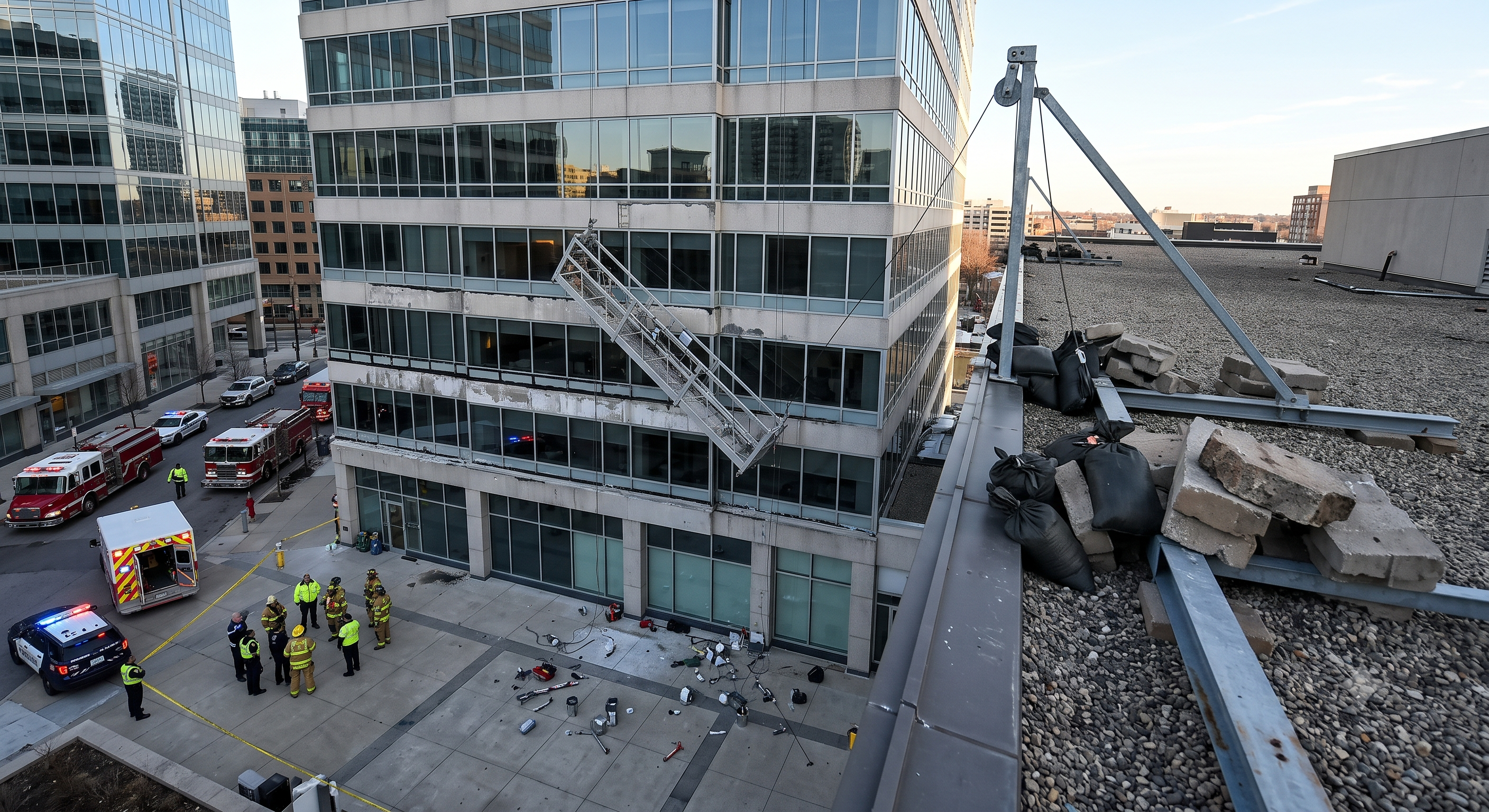
The original educational image is retained. It is not evidence of an actual incident or site suitability.
The scenario and record comparisons are fictional teaching examples, not records of real incidents, measurements, inspections, signatures or approvals.
| Item | Fictional scenario |
|---|---|
| Initial situation | A fictional team is resealing glazing from a suspended platform; the rig and independent fall system require documented acceptance. |
| Changed condition | A local gust starts sway while a roof support has been moved without design review. |
| Failure path | A loose support can shift the load path; a rail used as an unapproved fall attachment can share the same failure. These are possible mechanisms, not a reconstructed fatal accident. |
| Immediate response | Stop work, secure tools and inform the ground team. Use the planned safe landing or rescue method; do not drive through a snag or climb out across the façade. |
| Release condition | A competent person checks the rig, ropes, fall system, weather and changed design. Re-entry needs recorded release. |
Failure mechanisms
Roof supports transmit platform, people, materials and dynamic forces to the building. A parapet is not automatically an adequate bearing or a calculated fulcrum; its capacity and every tieback attachment need design verification.
A wrong rope construction, damaged edge route or incompatible hoist can compromise gripping and braking. A successful start button test does not demonstrate the independent protective device or all limit functions.
Fall arrest requires compatible components, the designed anchorage arrangement, adequate clearance and prompt rescue. Unapproved rail attachment can create a common failure; an independently designed arrangement must meet its local rules.
Wind and lateral movement change with height and surrounding buildings. Use the applicable legal, manufacturer and site limits, including gusts and observable instability; being below a number does not permit uncontrolled sway.
Cutting can damage glass edges; primer may cause exposure and affect rope materials. Select tools, retained waste, chemical controls and gloves for the actual product. Respiratory protection, if needed, requires exposure-based selection and fit checks, not a universal cartridge.
Decision sequence
| Decision stage | What to verify |
|---|---|
| Identify | Identify whether the signal is wind, a snag, hoist fault, damaged glass or chemical exposure. |
| Hold | Stop the affected work and prevent entry below; keep fall protection connected as planned. |
| Correct | Have the responsible person correct the cause without improvised ballast, bypassed devices or uncontrolled climbing. |
| Verify | Record inspection of the changed support, equipment, glass or chemical control and demonstrate rescue readiness. |
| Release | Resume only after the competent site authority records release and briefs the team. |
5. Hold and proceed decisions
| Condition | Action | Evidence | Proceed when |
|---|---|---|---|
| Gusts or sway | Stop; use safe landing or retrieval plan. | Local observations and applicable wind limits | Stable conditions verified |
| Rig moved or damaged | Quarantine and recheck the design. | Installation drawing and inspection record | Reinstallation accepted |
| Chemical change | Reassess exposure and compatibility. | Current SDS, gloves, ventilation and RPE decision | Controls ready |
| Glass edge damage | Stop cutting; obtain glazing assessment. | Location, condition and repair decision | Glazing method approved |
Similar situations, different decisions
The scenario and record comparisons are fictional teaching examples, not records of real incidents, measurements, inspections, signatures or approvals.
| Comparison | Situation A | Situation B |
|---|---|---|
| Wind | Forecast acceptable but local sway is uncontrolled: stop. | Local conditions and equipment limits checked; route stable: seek release. |
| Support | Same counterweight count after beam relocation is not proof. | Revised geometry, secured weights and support capacity documented. |
| Chemicals | A dust mask does not establish vapour protection. | SDS and exposure assessment determine the required controls. |
6. Roles and supervision
| Role | Responsibility |
|---|---|
| Designer / installer | Verify roof load path, installation drawing, suspension and changes within actual qualifications. |
| Operator / sealant worker | Perform pre-use checks, use the approved access and fall system, and stop for faults. |
| Ground / rescue team | Maintain exclusion, radio contact and practical retrieval capability. |
| Site release authority | Check outstanding defects and evidence before authorising operation or reopening the area. |
Supervision, records, handover
| Job stage | Technical and procedural controls | Site verification |
|---|---|---|
| Review Plan access | 1. Record: Roof design reference2. Record: Exclusion layout3. Record: Service clearance plan | 1. Rescue readiness2. Control nearby services3. Prepare rescue and radios |
| Review Rig suspension | 1. Record: Roof access protection2. Record: Weights and fixings3. Record: Rope route inspection | 1. Tieback anchorage2. Protect rope edges3. Fit designed tiebacks |
| Review Board platform | 1. Record: Boarding arrangement2. Record: Fall system inspection3. Record: Total load calculation | 1. Rescue equipment2. Distribute rated load3. Check clearance and rescue |
| Review Remove sealant | 1. Record: Blade and glass check2. Record: Task PPE selection3. Record: Rated tool retention | 1. Material assessment2. Retain tools and debris3. Assess old joint material |
| Review Manage faults | 1. Record: Local weather check2. Record: Clear travel route3. Record: Fault isolation record | 1. Ground-team contact2. Stop motion if snagged3. Activate retrieval plan |
| Review Land and hand over | 1. Record: Parked-state check2. Record: Power isolation3. Record: Defect register | 1. Area release approval2. Quarantine faulty parts3. Close waste and handover |
Singapore application
The ASC controls installation, alteration and repositioning with its competent team. The PE addresses support design and inspection; the AE addresses examination within the actual permitted locations. The facade supervisor separately confirms non-structural joint scope, product compatibility and the exclusion area.
7. Hold points and record quality
| Hold point | Evidence before release | Confirmation / approval |
|---|---|---|
| Start | Installation checks, safe access, removal of old non-structural sealant, primer and sealant application, fault response and safe parking of a suspended work platform. | |
| HP-1 Rig suspension | Roof access protection · Weights and fixings · Rope route inspection · Tieback anchorage | |
| HP-2 Test equipment | Rope/hoist identification · Brake and limit test · Electrical inspection · Defects closed | |
| HP-3 Board platform | Boarding arrangement · Fall system inspection · Total load calculation · Rescue equipment | |
| HP-4 Manage faults | Local weather check · Clear travel route · Fault isolation record · Ground-team contact |
Complete after actual checks. Recheck after changes, defects or shift handover.
Record comparison examples
The scenario and record comparisons are fictional teaching examples, not records of real incidents, measurements, inspections, signatures or approvals.
The boxes are static record prompts, not interactive or saved approvals. A tick does not establish suitability or permission to restart. Record the evidence, person, time and unresolved issues; retain the change history.
| Record type | Insufficient record | Record checklist |
|---|---|---|
| Plan access | Unidentified tick with no equipment or location | □ Roof design reference□ Exclusion layout□ Service clearance plan□ Rescue readiness |
| Test equipment | Unidentified tick with no equipment or location | □ Rope/hoist identification□ Brake and limit test□ Electrical inspection□ Defects closed |
| Board platform | Unidentified tick with no equipment or location | □ Boarding arrangement□ Fall system inspection□ Total load calculation□ Rescue equipment |
| Manage faults | Unidentified tick with no equipment or location | □ Local weather check□ Clear travel route□ Fault isolation record□ Ground-team contact |
8. Pre-work checks and emergency response
| Check item | Result | Person / action |
|---|---|---|
| □ Plan access: Roof design reference | ||
| □ Rig suspension: Roof access protection | ||
| □ Test equipment: Rope/hoist identification | ||
| □ Board platform: Boarding arrangement | ||
| □ Remove sealant: Blade and glass check | ||
| □ Apply sealant: SDS and ventilation | ||
| □ Manage faults: Local weather check | ||
| □ Land and hand over: Parked-state check | ||
| □ Release / handover authority |
Stop work
Stop for uncontrolled sway, changed or loose rigging, damaged ropes, failed safety devices, unavailable rescue, people entering the drop zone, unsafe glass or uncontrolled chemical exposure.
Emergency response
Call site emergency support, secure the area below and follow the prepared rescue procedure. Do not bypass a safety device, repeatedly reset a tripped hoist or improvise a transfer through a window. A snag may make lowering unsafe; use the assessed recovery method.
9. Sources and review limits
Public-source review: 14 October 2026. Only the material and limits identified below were reviewed.
| Source | Reviewed material | Task application |
|---|---|---|
| MOM - Risk management | Responsibilities; routine and non-routine work; hierarchy of control and risk assessment team. Official explanation of WSH Risk Management duties, not a complete consolidated statutory text. | Assess occupied building areas, old materials, exposure and rescue. |
| MOM/BCA - Suspended scaffold overhead supports, January 2025 | Paragraphs 1-16, PDF pages 1-5: PE design, existing structure, independent anchorage, site layout, COI, AE and ASC roles. Annex photographs were not visually inspected. Paid SS 598 and actual layout/calculations were not reviewed. Later lifting-test changes are considered separately. | Match the PE support design, COI and PE/AE layout to the actual gondola location; use the ASC for rig changes. |
| MOM - Lifting equipment examination FAQ | Questions 1-6 and 15: overload versus load/functional tests, changed requirements and Authorised Examiner discretion. Removal of periodic overload tests does not remove examination, functional testing or required load tests. The actual altered crane needs AE determination. | Check current examination and reassembly requirements instead of relying on a daily operating check. |
| MOM - Work at Heights amendment factsheet | Pages 1-4, particularly Annex A questions 1-3 on factories, hazardous height and effective protection; training/role explanations. Official 2014 explanatory factsheet accessed now. Consolidated SSO fetch returned 403; full current statutory text not verified. Course names and detailed permit arrangements need current confirmation. | Plan independent fall protection and practical rescue for the actual access method. |
Selected public official sources were reviewed on 14 October 2026 within the recorded scope. No full consolidated legal audit, paid Singapore Standard, actual model manual, site inspection, engineering calculation or professional approval is claimed. Verify current detailed requirements and actual equipment/site records before use.
AI-generated reference material. It has not been verified or approved by a professional. Before use, a qualified person must review and adapt it to applicable Singapore requirements, the actual equipment and site, and approved safe work procedures.
10. PDF use and frequently asked questions
PDF A covers basic task controls; B focuses on technical failures; C covers supervision, records and handover. The article has eight stages with four items per main cell; each PDF has six key stages with three items per main cell. P/S/R/A, measurements, confirmations and signatures remain blank for actual site assessment.
Content group ID
jsa-gondola-caulking
Can the guardrail be used as an anchor?
Only an attachment arrangement specifically designed and permitted for the fall system may be used. An ordinary rail is not assumed to be an anchor; confirm independent support requirements and clearance.
Is one wind speed valid for every platform?
No. Apply the equipment and site limits with applicable local rules, local gusts and actual stability. Stop earlier if conditions are unsafe.
Is the daily check the entire inspection regime?
No. Pre-use checks do not replace installation acceptance, statutory examinations or maintenance required for the actual equipment and jurisdiction.
Does this method approve a structural glazing repair?
No. Identify whether the joint supports glass. Structural glazing design and repair need the glazing specialist and separate approval.
Has a professional verified or approved this document?
No. Public sources and editorial, layout and consistency checks were reviewed using AI. No site inspection or professional technical approval has been performed. Obtain appropriate professional review before use.
Singapore application
Moving the suspension rig is not an operator adjustment under this sealing method. Refer the change to the ASC and the applicable PE/AE process before reuse. Read A, B and C together with all eight JSA stages and the approved work procedure. The sheets are complementary extracts, not separate work authorisations.
11. Authorship and revision history
AI-generated reference material. It has not been verified or approved by a professional. Before use, a qualified person must review and adapt it to applicable Singapore requirements, the actual equipment and site, and approved safe work procedures.
| Date / edition | Authorship and scope | Professional approval |
|---|---|---|
| 2026-09-16 / Korean source | Original topic and educational illustration retained as references. Source content is unchanged. | Not asserted |
| 14 October 2026 / Singapore 1.0 | Added Singapore PE/AE/ASC equipment responsibilities and approved-location evidence; retained separate glazing and chemical acceptance, local wind response and no improvised rescue. | Not performed |
Source topic: https://smartjsabridge.com/ko/case-study/jsa-gondola-caulking