Delivery, panel erection, falsework and deck installation, pre-pour inspection, placement monitoring, controlled stripping and reshoring, and material recovery for conventional cast-in-place construction.
Hold for missing bracing, uncertain base support, damaged or unidentified components, settlement, displaced ties, unreviewed loading or absent stripping evidence. Stop placement and clear the danger area when stability is in doubt.
AI-generated reference material. It has not been professionally verified or approved. Before use, a suitably qualified person must review and adapt it to applicable Singapore requirements, the actual equipment and site, and approved safe work procedures.
1. Legal and technical scope
Appoint an adequately trained formwork supervisor for immediate supervision of erection, alteration and dismantling. Singapore Construction Regulations require completion inspection, an inspection register and notification of unsafe conditions to the occupier. Check the applicable PE design and certification requirements; PE-designed formwork, including alterations, must be inspected and certified by the PE before placement. The formwork supervisor monitors the structure during placement and records reshoring inspections. Apply the 2024 MOM/SCAL guidance on component traceability, documentation and suitability for reuse.
Assess the actual activity under the applicable Singapore WSH requirements. Statutory duties, official guidance, manufacturer instructions and approved project documents have distinct roles. A site hold point is not automatically a statutory permit. Use competent local review to resolve the applicable industry, installation, access and permit requirements.
| Basis | Application and limits |
|---|---|
| MOM risk management | Official explanation: risk assessment, control, monitoring and communication for routine and non-routine work, including maintenance; reviewed 14 October 2026. |
| Singapore WSH Construction Regulations, formwork | Selected official indexed provisions 60–65 and 68: formwork supervisor appointment, immediate supervision, completion inspection/register, applicable PE design and certification, placement monitoring and reshoring inspection. Retrieved current-version banner was October 2026; verify the consolidated requirements for actual use. |
| MOM and SCAL traceability and reusability circular, 22 November 2024 | All three pages reviewed: manufacturer/supplier documentation, traceability, inspection and reuse criteria; contractor verification and competent oversight; occupier responsibility assignment. Referenced standards were not obtained in full. |
| WSHC Planning a Lift | Official lifting guidance: risk-supported lift plan, safe work procedure, permit arrangements, load/equipment/crew/environment details and stop when conditions differ. Confirm the applicable statutory permit scope separately. |
| WSHC Preventing Falls from Heights | Official explanation of access, fall-prevention plans, hazardous-WAH permits in factories and supervisor/assessor/authorised-manager roles. General fall controls are not limited to the permit threshold. |
| SCDF emergency medical services | Official 995 emergency ambulance service information; use emergency services for actual emergencies. |
2. Scope and required inputs
Included: Delivery, panel erection, falsework and deck installation, pre-pour inspection, placement monitoring, controlled stripping and reshoring, and material recovery for conventional cast-in-place construction.
Separate review: Climbing and slipform systems, tall or suspended falsework, post-tensioning and structural alterations require separate engineered methods. This assessment does not design a support system.
| Input | Required evidence |
|---|---|
| Design and method | Drawing revision; Load assumptions; System details; Component identity and reuse basis |
| Wall form erection | Brace connections; Anchor evidence; Release check; Access protection |
| Pre-pour release | Inspection record; Tie arrangement; Pour parameters; Supervisor register and PE evidence |
| Recover and hand over | Clear access; Remaining supports; Storage loads; Handover record |
Use the actual formwork design, component capacity and reuse evidence, base and lower-floor support, concrete mix and placement rate, strength results, upper-floor construction loads, stripping sequence and reshoring arrangement. Elapsed days or one concrete strength result cannot establish safe release for every loading stage.
3. Eight-stage JSA
P = likelihood; S = severity; R = risk under the site method; A = acceptance or authorization as defined by the site. Leave these blank until actual assessment and control verification. A low score does not override a legal requirement, product limit or unreleased hold point.
| Job stage | Hazards and effects | Failure factors | Required controls | Site verification | P | S | R | A |
|---|---|---|---|---|---|---|---|---|
| 1. Design and method | 1. Collapse2. Falls3. Falling panels4. Load transfer failure | 1. Old drawings2. Unknown loads3. Mixed components4. Unplanned sequence | 1. Verify current design2. Plan staged stability3. Select compatible parts4. Define release points | 1. Drawing revision2. Load assumptions3. System details4. Component identity and reuse basis | ||||
| 2. Delivery and storage | 1. Dropped bundle2. Crushing3. Stack collapse4. Deck overload | 1. Wrong lifting points2. Damaged rigging3. Weak dunnage4. Excess stock | 1. Use specified points2. Check lifting gear3. Secure stable stacks4. Control stored loads | 1. Lift plan2. Gear condition3. Stack support4. Storage position | ||||
| 3. Wall form erection | 1. Panel overturn2. Edge fall3. Hand crushing4. Falling fittings | 1. Brace omitted2. Anchor uncertain3. Early hook release4. Unsafe access | 1. Install designed braces2. Verify base anchors3. Check before release4. Protect work platforms | 1. Brace connections2. Anchor evidence3. Release check4. Access protection | ||||
| 4. Falsework and deck | 1. Prop buckling2. Base settlement3. Fall through opening4. Load redistribution | 1. Excess extension2. Missing bracing3. Damaged pins4. Weak supporting slab | 1. Follow support design2. Fit specified bracing3. Guard edges and holes4. Check lower load path | 1. Bases and heads2. Pins and extensions3. Bracing layout4. Supporting structure | ||||
| 5. Pre-pour release | 1. Form blowout2. Tie rupture3. Access failure4. Unplanned load | 1. Missing ties2. Unlocked clamps3. Mix change4. Incomplete inspection | 1. Inspect installed work2. Check ties and clamps3. Confirm mix and rate4. Resolve defects first | 1. Inspection record2. Tie arrangement3. Pour parameters4. Supervisor register and PE evidence | ||||
| 6. Placement watch | 1. Moving falsework2. Panel blowout3. Wet concrete burns4. Hose impact | 1. Excess pour rate2. Local heap3. Unsafe observer4. Poor stop signal | 1. Control placement rate2. Avoid local overload3. Watch from safe place4. Supervisor monitors stability | 1. Rate and sequence2. Support movement3. Communication4. Safe observation | ||||
| 7. Strip and reshore | 1. Slab collapse2. Panel drop3. Unstable reshores4. Falling debris | 1. Strength unknown2. Wrong removal order3. Loads above ignored4. Uncontrolled release | 1. Verify strength basis2. Follow removal plan3. Maintain needed shores4. Lower panels safely | 1. Strength evidence2. Load assessment3. Reshore arrangement4. Reshoring inspection record | ||||
| 8. Recover and hand over | 1. Puncture wounds2. Trip and fall3. Edge overload4. Premature reloading | 1. Protruding nails2. Loose fittings3. Unplanned stacks4. Restrictions lost | 1. Remove or guard points2. Sort and secure parts3. Use planned storage4. Hand over load limits | 1. Clear access2. Remaining supports3. Storage loads4. Handover record |
4. Hypothetical scenario and failure mechanisms
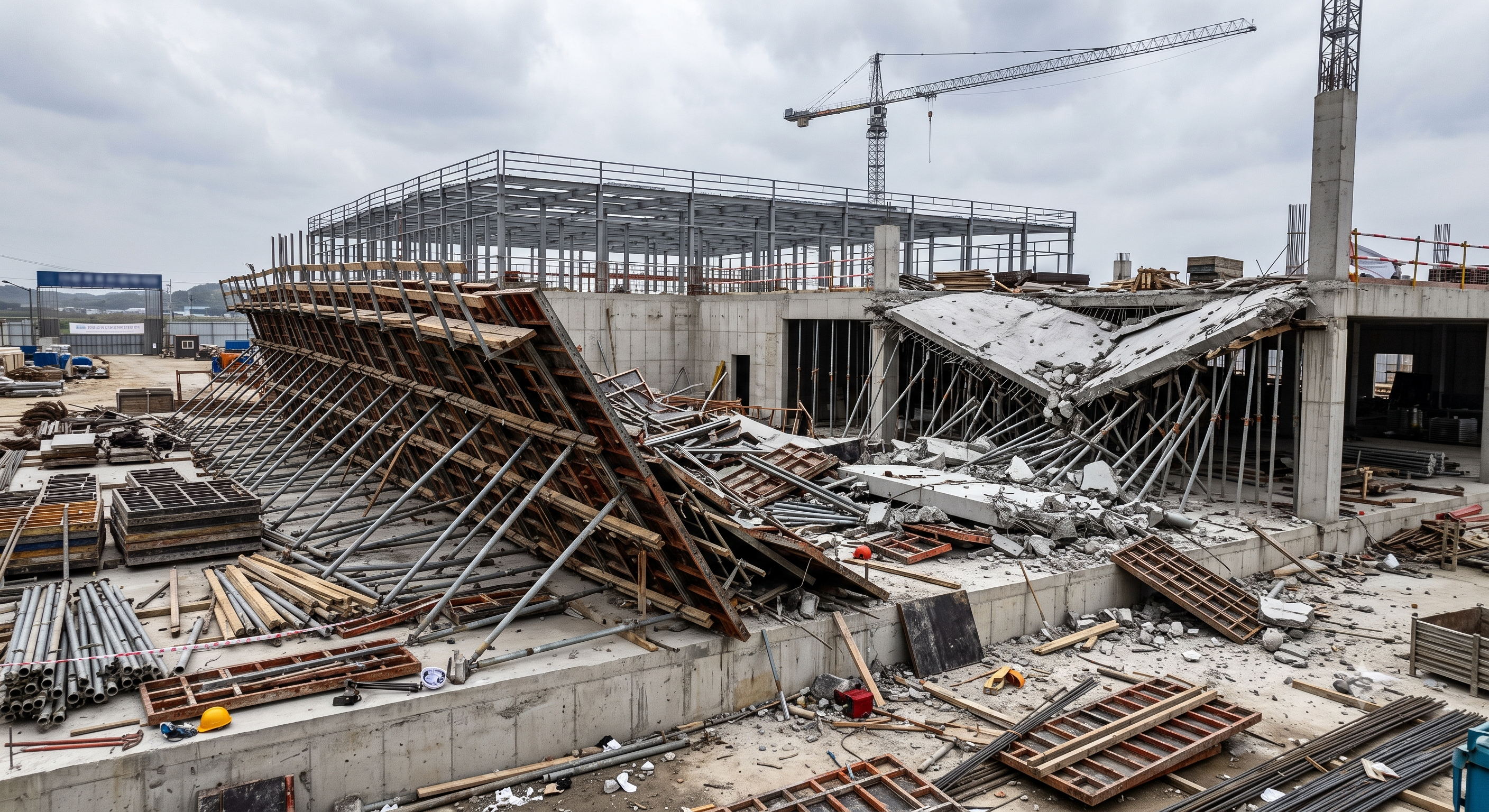 Retained source illustration: an AI-generated educational concept, not a real incident photograph or evidence of equipment suitability.
The following scenario, comparisons and example records are hypothetical teaching material. They do not reproduce actual incidents, measurements, signatures or approvals.
| Item | Hypothetical situation |
|---|---|
| Initial state | A slab has a concrete strength test result available. |
| Change | The crew proposes removing all props while upper-floor materials and the next pour load have not been reviewed. |
| Failure path | Concrete strength is treated as proof that every temporary load path can be removed. |
| Possible harm | Abrupt load transfer may produce cracking, excessive deflection or progressive failure. |
| Barrier | Hold stripping and have the responsible technical team verify actual loads, removal stages and required reshores before the supervisor releases the planned work. |
Wall braces provide temporary stability, form ties resist fresh-concrete pressure and falsework bracing stabilises the support system. One cannot substitute for another. Confirm anchors and braces before releasing the lifting support.
Trace the load from concrete through decking, joists, bearers, props and bases to the ground or lower floors. A base-plate photograph does not prove bearing capacity or the lower slab load path.
Fresh-concrete pressure depends on the actual mix, temperature, placement rate and vibration. Self-compacting concrete and changed pour methods require design review rather than a universal rate rule.
Strength evidence must be considered with upper-floor stock, next-stage pours and remaining supports. Removing props and then replacing them is a distinct load-transfer event; it is not continuous support.
Reused components require identity, compatible system details, physical inspection and applicable reuse criteria. A familiar brand or an earlier satisfactory pour does not establish current capacity. Assign the competent person overseeing verification and retain the supporting records.
| Decision | Reason and evidence |
|---|---|
| Known facts | The crew proposes removing all props while upper-floor materials and the next pour load have not been reviewed. |
| Unresolved | Concrete strength is treated as proof that every temporary load path can be removed. |
| Hold reason | Hold for missing bracing, uncertain base support, damaged or unidentified components, settlement, displaced ties, unreviewed loading or absent stripping evidence. Stop placement and clear the danger area when stability is in doubt. |
| Evidence needed | Strength evidence; Load assessment; Reshore arrangement; Reshoring inspection record. |
| Next decision | Hold stripping and have the responsible technical team verify actual loads, removal stages and required reshores before the supervisor releases the planned work. |
5. Conditional decisions and common errors
| Condition | Action | Evidence | Proceed when |
|---|---|---|---|
| Brace missing | Hold erection transfer or pour. | Current drawings and connection checks. | Required stability verified. |
| Movement during placement | Stop and clear danger area. | Supervisor and technical investigation. | Corrected stage formally released. |
| Stripping requested | Verify load-transfer plan. | Strength upper loads and retained supports. | Planned removal accepted. |
| Component reused | Verify suitability before assembly. | Identity condition and reuse criteria. | Acceptable system evidence recorded. |
| Comparison | Situation A | Situation B |
|---|---|---|
| Strength result available | Actual construction loads and staged reshores reviewed. | All props removed on strength alone. |
| Panel upright | Designed braces and anchors accepted. | Crane still provides unrecognised restraint. |
6. Roles and responsibilities
| Role | Responsibility |
|---|---|
| Work supervisor | Confirm scope, task sequence, exclusion and stop authority. Coordinate design and method with affected operations. |
| Technical reviewer | Resolve the actual design and equipment limits: Drawing revision; Load assumptions; System details; Component identity and reuse basis. |
| Work crew | Perform wall form erection using the approved procedure; report any mismatch before proceeding. |
| Inspector / assessor | Verify Rate and sequence; Support movement; Communication; Safe observation. Record what was actually checked and what remains unresolved. |
| Release / receiving authority | Confirm Clear access; Remaining supports; Storage loads; Handover record. Transfer restrictions and the next permitted stage. |
These are responsibility examples, not invented statutory credentials. Meet the actual training, competent-person, qualified-person and licensing requirements for the assigned work. Anyone may raise a hazard and request a stop; only the designated authority may release the affected stage after evidence is reviewed.
7. Hold points and record comparison
| Hold point | Evidence before release | Confirmation / approval |
|---|---|---|
| HP-0 Start | Scope, jurisdiction, equipment identity, responsible people and emergency arrangements. | |
| HP-1 Wall form erection | Brace connections; Anchor evidence; Release check; Access protection | |
| HP-2 Pre-pour release | Inspection record; Tie arrangement; Pour parameters; Supervisor register and PE evidence | |
| HP-3 Placement watch | Rate and sequence; Support movement; Communication; Safe observation | |
| HP-4 Strip and reshore | Strength evidence; Load assessment; Reshore arrangement; Reshoring inspection record |
Hold points are internal evidence gates. They do not replace statutory permits or actual signatures. Recheck affected gates after a change, abnormal event or shift transfer. The blank record must identify the evidence, person, time, limits and release scope.
| Record | Insufficient record | Record checklist |
|---|---|---|
| Design and reuse | System familiar | □ Drawing revision□ Load assumptions□ System details□ Component identity and reuse basis |
| Pre-pour | Forms complete | □ Inspection record□ Tie arrangement□ Pour parameters□ Supervisor register and PE evidence |
| Stripping | Strength passed | □ Strength evidence□ Load assessment□ Reshore arrangement□ Reshoring inspection record |
| Transfer | Deck cleared | □ Clear access□ Remaining supports□ Storage loads□ Handover record |
The □ boxes are static prompts, not saved or interactive approvals. Each checks one record element. A tick alone does not establish suitability or permission to restart. Link equipment IDs and supporting records; retain unresolved matters and the earlier record when conditions change.
8. Site checklist and emergency response
| Check item | Result | Person / action |
|---|---|---|
| Drawing revision | ||
| Lift plan | ||
| Brace connections | ||
| Bases and heads | ||
| Inspection record | ||
| Rate and sequence | ||
| Strength evidence | ||
| Clear access | ||
| Emergency arrangements and unresolved restrictions communicated |
Stop work: Hold for missing bracing, uncertain base support, damaged or unidentified components, settlement, displaced ties, unreviewed loading or absent stripping evidence. Stop placement and clear the danger area when stability is in doubt.
Emergency response: Stop pumping and movement, raise the alarm and evacuate the potential collapse zone. Do not enter beneath unstable formwork to tighten a prop or retrieve equipment. Call SCDF 995 for serious injury or urgent rescue and provide the pour stage, support condition and access restrictions. Stabilisation requires the responsible technical team and planned access.
9. Sources and review limits
Official-source review date: October 14, 2026. The following review is limited to the public provisions or selected manufacturer material identified below. It does not establish that any authority approved this article or the actual installation.
- MOM risk management: Official explanation: risk assessment, control, monitoring and communication for routine and non-routine work, including maintenance; reviewed 14 October 2026.
- Singapore WSH Construction Regulations, formwork: Selected official indexed provisions 60–65 and 68: formwork supervisor appointment, immediate supervision, completion inspection/register, applicable PE design and certification, placement monitoring and reshoring inspection. Retrieved current-version banner was October 2026; verify the consolidated requirements for actual use.
- MOM and SCAL traceability and reusability circular, 22 November 2024: All three pages reviewed: manufacturer/supplier documentation, traceability, inspection and reuse criteria; contractor verification and competent oversight; occupier responsibility assignment. Referenced standards were not obtained in full.
- WSHC Planning a Lift: Official lifting guidance: risk-supported lift plan, safe work procedure, permit arrangements, load/equipment/crew/environment details and stop when conditions differ. Confirm the applicable statutory permit scope separately.
- WSHC Preventing Falls from Heights: Official explanation of access, fall-prevention plans, hazardous-WAH permits in factories and supervisor/assessor/authorised-manager roles. General fall controls are not limited to the permit threshold.
- SCDF emergency medical services: Official 995 emergency ambulance service information; use emergency services for actual emergencies.
Paid consensus standards and site-specific calculations, manuals, inspection records and product certificates were not independently obtained or verified unless specifically identified. Korean and overseas legal references are source history, not Singapore statutory duties. Singapore Standards and model-specific limits were not read in full unless expressly identified.
10. PDF guidance and FAQ
PDF A covers basic task controls; B examines technical failures; C focuses on supervision, evidence and handover. Each has six rows and three items per main cell. They are complementary extracts: apply all eight body stages and the applicable site procedure. An omitted stage is not permission to omit its controls. PDF HP-0 through HP-4 are worksheet labels; match the event, evidence and authority rather than assuming they match another permit by number.
P/S/R/A, actual measurements, confirmations and signatures remain blank. The PDFs are uncompleted reference worksheets, not issued work permits.
Content group ID: jsa-form-work
Does a strength result alone allow stripping?
No. Review actual loads, the removal sequence and any required reshoring.
Can ties replace wall braces?
No. They perform different functions; follow the designed temporary stability arrangement.
Does a prior pour prove components safe to reuse?
No. Verify identity, condition, compatibility and the applicable reuse criteria.
Does an internal pour checklist replace PE certification?
No. Obtain the applicable PE inspection and certification separately.
Has a professional verified or approved this document?
AI-generated reference material. It has not been professionally verified or approved. Before use, a suitably qualified person must review and adapt it to applicable Singapore requirements, the actual equipment and site, and approved safe work procedures.
11. Revision history and authorship
AI-generated reference material. It has not been professionally verified or approved. Before use, a suitably qualified person must review and adapt it to applicable Singapore requirements, the actual equipment and site, and approved safe work procedures.
This system has not physically inspected the equipment, structures, ground, atmosphere or worksite. The document does not replace legal advice, manufacturer procedures, engineering design, inspection certificates, qualification evidence, the site risk assessment or an actual work permit.
Before use, a suitably qualified and authorized person must review the actual equipment, loads, methods, protection, inspection and emergency arrangements and resolve open issues. Record the real reviewer, organization, qualifications, delegated authority, reviewed documents, date, signature, exclusions and conditions of approval separately.
| Date | Version | Change | Review status |
|---|---|---|---|
| 2026-07-22 | Unmarked | Korean source revision retained in the source snapshot. | Historical editorial status; not Singapore professional approval. |
| 2026-10-04 | 1.1 | Korean source revision retained in the source snapshot. | Historical editorial status; not Singapore professional approval. |
| 2026-10-14 | SG 1.0 | Singapore localisation of the Korean source with its assigned US technical reference; local applicability, task controls and sources reviewed. | AI-assisted editorial work; professional approval not performed. |