Switching off the charger does not remove battery energy. Prevent tools, jewellery or other conductors from bridging terminals; routine charging does not authorise disassembly or live connector repair.
AI-generated reference material; not professionally verified or approved. Before use, a qualified person must review and adapt it to Singapore requirements, the actual equipment/site and approved safe work procedures.
Stop before starting
Hold for uncertain chemistry, compatibility or on-truck ventilation, leakage, cracks, damaged/hot connectors, failed ventilation, smoke or abnormal charging indications. Do not reset and reconnect without verified correction.
1. Legal and technical scope
| Basis | Scope and limits |
|---|---|
| MOM: Risk management | Assess gas accumulation, short-circuit energy, acid exposure and abnormal shutdown. Official explanation of statutory duties; linked SSO text was not independently read for this item. This is not a legal opinion. |
| WSH Council: Safe Operation of Forklift Trucks | Establish the designated charging bay, competent personnel, parking, ventilation, ignition exclusion and eyewash. Guidance includes changing batteries and acid handling, which are excluded from this routine on-truck charging scope. It supplies no actual charger profile or ventilation design. |
| WSH Council: Operating Forklifts Safely | Transfer charge status and restrictions to a trained authorised operator for pre-use checks. Official safe-operation guidance; charging completion does not establish vehicle operating condition. |
| MOM/NEA/SCDF: Revised SS 586 adoption | Verify electrolyte identification and the relevant Singapore-appropriate SDS. Official adoption circular, not full paid SS 586 text or a classification of the actual product; verify current supplier label and SDS. |
| CCOHS: Forklift Trucks - Batteries | Plan prompt water flushing and medical response for acid contact, with controlled specialist fault response. Canadian technical reference; certification marks, code distances, electrical rules and emergency number are not adopted as Singapore requirements. Actual SDS and emergency plan remain necessary. |
| NEA: Toxic Waste Control | Classify acid-contaminated waste and arrange the appropriate disposal route. Apply only after classifying actual cleaner and removed contaminants; this does not classify every aqueous cleaning waste as TIW or authorise discharge. |
Use Singapore WSH risk management and WSH Council forklift guidance for competent charging personnel, secure parking, a designated ventilated charging area, ignition control and emergency eyewash. Confirm actual battery/charger compatibility, ventilation design and the supplier SDS. Guidance on battery changing or acid preparation does not extend this routine on-truck charging scope. Charging completion must be followed by the forklift’s separate pre-operational checks before use; it is not vehicle operating approval.
2. Scope and required inputs
Included work
Routine on-truck charging of an identified flooded lead-acid traction battery in a designated charging area, using a compatible charger only where the actual truck/battery instructions permit the on-truck ventilation arrangement.
Separate assessment
Lithium-ion/VRLA batteries, lifting/removal, electrolyte mixing or watering, equalisation, cell measurements and live connector repair require separate procedures.
| Required input | Evidence to obtain |
|---|---|
| Identify battery and charger | Battery chemistry and ID; Voltage capacity and profile; Approved connector pairing; Actual charging instructions |
| Park and prepare bay | Truck and parking state; Designated bay and protection; Flushing and spill provisions; Ignition-source control |
| Inspect before connection | Connector/cable condition; Covers and vent caps; Actual ventilation evidence; Leaks and metal objects |
| Connect with output off | Output state and sequence; Charger mode and pairing; Cable support and route; Sound complete connection |
No actual equipment model, site measurements, design calculations or signed approval was supplied. Check the applicable Singapore requirements and approved safe work procedures against the actual equipment and site before use. Statutory duties, official guidance and manufacturer limits serve different purposes; editorial checks do not establish legal or professional approval.
Singapore site application
In a Singapore warehouse charging bay, evaluate the number and type of batteries charging together and keep delivery traffic and hot work outside the designated boundary. Fan indication and an open roller shutter alone do not prove effective gas removal.
Record battery voltage in V, capacity in Ah, charging profile and the specified temperature criteria in °C from the actual instructions. Link the battery, truck and charger IDs, alarm times, ventilation checks and the receiving operator; do not invent current, cooling time or ventilation rates.
3. Eight-stage JSA
| Job stage | Hazards and effects | Failure factors | Technical and procedural controls | Site verification | P | S | R | A |
|---|---|---|---|---|---|---|---|---|
| 1. Identify battery and charger | 1. Wrong-profile overheating2. Connector arcing3. Battery damage4. Acid exposure | 1. Chemistry assumed2. Plug fit used as proof3. Capacity mismatched4. Instructions missing | 1. Identify flooded battery2. Match charger and profile3. Confirm on-truck permission4. Review battery hazards | 1. Battery chemistry and ID2. Voltage capacity and profile3. Approved connector pairing4. Actual charging instructions | ||||
| 2. Park and prepare bay | 1. Truck movement2. Ignition of charging gas3. Electrolyte splash4. Blocked emergency access | 1. Brake not set2. Ignition sources present3. Flushing unavailable4. Charging route obstructed | 1. Position and set brake2. Control sparks and flames3. Check emergency flushing4. Keep response access clear | 1. Truck and parking state2. Designated bay and protection3. Flushing and spill provisions4. Ignition-source control | ||||
| 3. Inspect before connection | 1. Short-circuit burn2. Hot-connector failure3. Gas accumulation4. Acid contact | 1. Metal on battery2. Cable damage ignored3. Ventilation unverified4. Leak overlooked | 1. Remove conductive objects2. Inspect cables and plugs3. Check ventilation and vents4. Hold leaks or damaged parts | 1. Connector/cable condition2. Covers and vent caps3. Actual ventilation evidence4. Leaks and metal objects | ||||
| 4. Connect with output off | 1. Electrical arc2. Wrong charger operation3. Cable trip4. Connector damage | 1. Charging output active2. Wrong profile selected3. Lead crosses walkway4. Plug forced into place | 1. Follow output-off procedure2. Verify selected charger mode3. Protect charging lead route4. Use specified connection method | 1. Output state and sequence2. Charger mode and pairing3. Cable support and route4. Sound complete connection | ||||
| 5. Charge and monitor | 1. Overheating2. Charging-gas ignition3. Acid release4. Delayed fault response | 1. Alarm ignored2. Ventilation stops3. Battery condition changes4. Bay left uncontrolled | 1. Monitor specified indications2. Maintain ventilation controls3. Keep ignition sources excluded4. Stop abnormal charging | 1. Charge status and warnings2. Heat leakage and condition3. Ventilation availability4. Responsible attendant checks | ||||
| 6. Stop and disconnect | 1. Connector arcing2. Residual hot-part burn3. Premature truck movement4. Cable damage | 1. Plug pulled under output2. Cooling condition ignored3. Truck moved while attached4. Lead left on floor | 1. Stop output as specified2. Check safe handling condition3. Disconnect by correct method4. Secure leads and covers | 1. Normal stop complete2. Required cooling or venting3. Connection fully removed4. Leads and compartment restored | ||||
| 7. Hold and resolve faults | 1. Repeated overheating2. Fire or explosion3. Unprotected acid contact4. Unsafe live repair | 1. Reset used as repair2. Hot connector approached3. Spill handled untrained4. Battery energy forgotten | 1. Hold charging and access2. Use safe fault shutdown3. Assign trained response4. Verify cause and correction | 1. Alarm and affected parts2. Shutdown/residual energy3. Ventilation and repairs4. Restart authorisation | ||||
| 8. Hand over truck | 1. Faulty battery reused2. Unsafe travel3. Missed charging defect4. Uncontrolled bay residue | 1. Charging completion overclaimed2. Pre-use check omitted3. Fault only passed verbally4. Spill left unresolved | 1. Record charging outcome2. Transfer operating restrictions3. Require truck pre-use checks4. Restore charging area | 1. Battery and charge record2. Defects and corrective work3. Operator and pre-use check4. Bay and lead condition |
P = likelihood; S = severity; R = risk under the site method; A = site-defined acceptance/authorization. These actual assessment cells are blank. A low score never overrides a missing safeguard or a legal or manufacturer restriction.
4. Fictional scenario and failure mechanisms
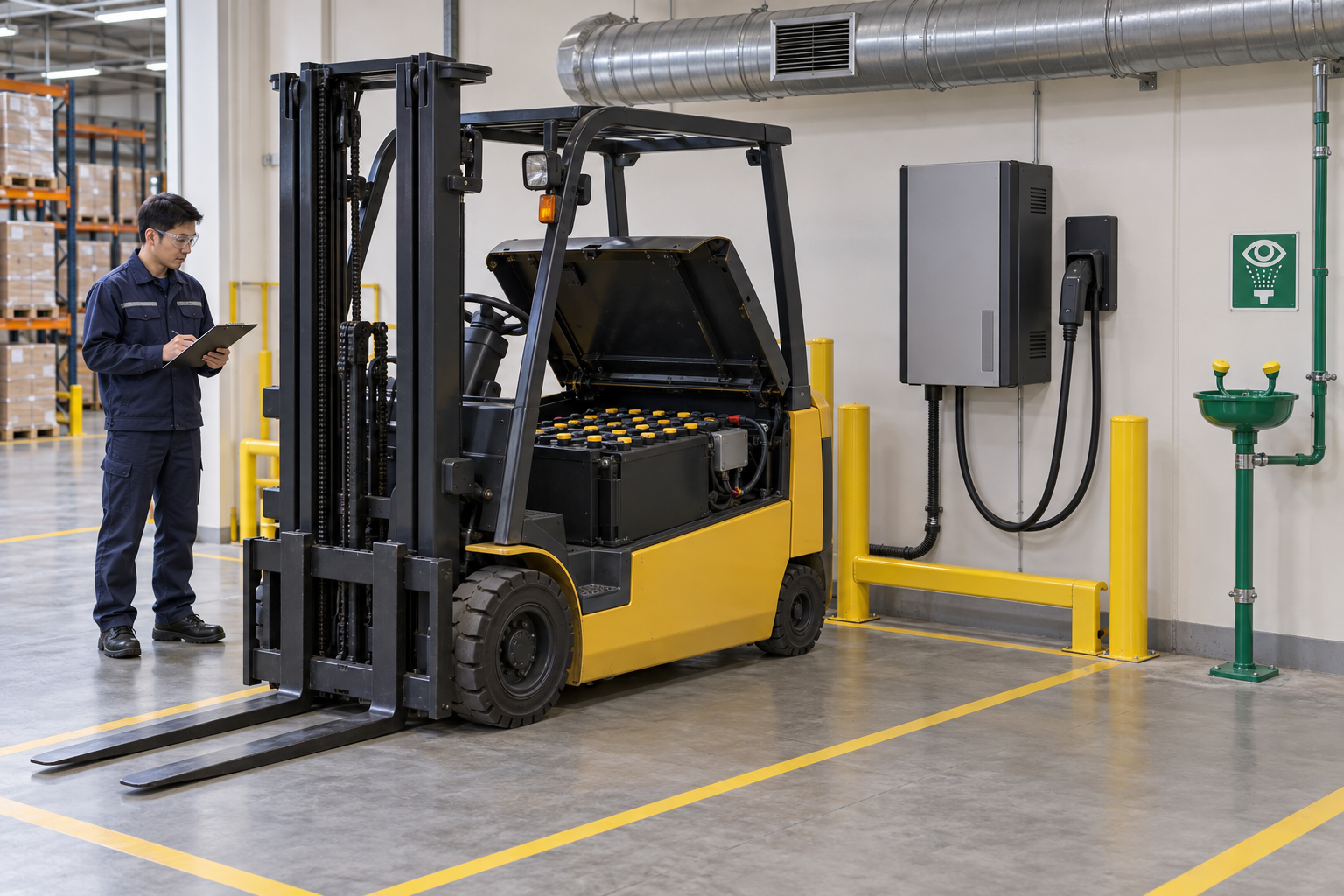
This illustration provides educational context. It is not an actual incident photograph or evidence of equipment suitability; any AI-generated depiction is illustrative only.
The scenario and record comparisons are fictional teaching examples, not records of real incidents, measurements, inspections, signatures or approvals.
| Stage | Fictional situation |
|---|---|
| Initial situation | A fictional forklift battery is charging in its designated bay. |
| Changed condition | The charger alarms and a connector appears discoloured and unusually hot. |
| Failure path | The operator proposes a reset and reconnection because the ventilation fan indicator is lit. |
| Possible outcome | The damaged connection or gas accumulation could expose people to arcing, burns and fire. |
| Prevention barrier | Hold charging and vehicle use, stop safely without approaching the suspect connector and obtain battery/charger/ventilation fault assessment. |
Failure mechanisms
Switching off the charger does not remove battery energy. Prevent tools, jewellery or other conductors from bridging terminals; routine charging does not authorise disassembly or live connector repair.
A plug fitting mechanically does not establish battery chemistry, voltage, capacity or charging-profile compatibility. If the actual instructions require removal or withdrawal, stop this on-truck procedure for the appropriate separate method.
Compartment covers and cell vent caps have different functions. Follow the model-specific ventilation/cover instructions and maintain functioning vents; do not remove caps indiscriminately. Hydrogen absence cannot be inferred from smell.
A normal stop requires the specified output-off sequence before separation. An overheated or damaged connector may require remote shutdown and specialist response instead of touching or unplugging it. Resetting the display is not fault correction.
Decision sequence
| Step | Decision |
|---|---|
| Known | Alarm and connector discolouration/heat have been reported. |
| Unknown | Contact condition, charger settings, battery damage and effective ventilation are unresolved. |
| Hold | Do not reset, reconnect or force separation of the hot connector. |
| Evidence | Record IDs, symptoms/time, safe shutdown, repair and ventilation/compatibility evidence. |
| Release | Authorise recharge separately from the later truck pre-use check and operating handover. |
Work sequence: Identify battery and charger → Park and prepare bay → Inspect before connection → Connect with output off → Charge and monitor → Stop and disconnect → Hold and resolve faults → Hand over truck. This is a teaching flow, not a device drawing or a complete operating procedure.
5. Conditional decisions and common errors
| Situation | Required action | Evidence | Proceed when |
|---|---|---|---|
| Hot connector | Hold and keep clear | Safe shutdown and damage assessment | Cause corrected |
| Ventilation lost | Stop safely | Performance and fault review | Ventilation restored |
| Unknown chemistry | Do not connect | Battery/charger instructions | Pairing accepted |
| Acid leak | Restrict; trained response | SDS and spill assessment | Area/battery released |
Similar observations, different decisions
The scenario and record comparisons are fictional teaching examples, not records of real incidents, measurements, inspections, signatures or approvals.
| Observation | Insufficient conclusion | Required distinction |
|---|---|---|
| Charger off | Battery terminals are dead. | Retain short-circuit controls; battery energy remains. |
| Fan indicator on | Gas removal is adequate. | Verify actual performance for simultaneous charging conditions. |
| Charge complete | The forklift can be driven. | Disconnect/store leads, restore compartment and complete the vehicle pre-use checks. |
6. Roles and responsibilities
| Role | Responsibility |
|---|---|
| Work supervisor | Confirm battery chemistry and id and the task scope, resources, interfaces and stop authority. |
| Qualified technical reviewer | Review truck and parking state, model limits, compatibility and unresolved technical conditions within assigned competence. |
| Work crew | Apply the listed controls, report changes and stop when evidence or safeguards are missing. |
| Inspector / assessor | Record actual charge status and warnings and other relevant checks; do not mark unverified conditions as accepted. |
| Handover authority | Reconcile battery and charge record, restrictions and outstanding actions before the next task. Role labels do not establish a legal credential. |
Supervision and handover focus
| Stage | Management action | Evidence |
|---|---|---|
| Identify battery and charger | 1. Record battery chemistry and id2. Record voltage capacity and profile3. Record approved connector pairing | 1. Battery chemistry and ID2. Voltage capacity and profile3. Approved connector pairing |
| Inspect before connection | 1. Record connector/cable condition2. Record covers and vent caps3. Record actual ventilation evidence | 1. Connector/cable condition2. Covers and vent caps3. Actual ventilation evidence |
| Connect with output off | 1. Record output state and sequence2. Record charger mode and pairing3. Record cable support and route | 1. Output state and sequence2. Charger mode and pairing3. Cable support and route |
| Charge and monitor | 1. Record charge status and warnings2. Record heat leakage and condition3. Record ventilation availability | 1. Charge status and warnings2. Heat leakage and condition3. Ventilation availability |
| Hold and resolve faults | 1. Record alarm and affected parts2. Record shutdown/residual energy3. Record ventilation and repairs | 1. Alarm and affected parts2. Shutdown/residual energy3. Ventilation and repairs |
| Hand over truck | 1. Record battery and charge record2. Record defects and corrective work3. Record operator and pre-use check | 1. Battery and charge record2. Defects and corrective work3. Operator and pre-use check |
7. Hold points and record comparison
| Hold point | Evidence before release | Actual approval |
|---|---|---|
| HP-0 Scope | Routine on-truck charging of an identified flooded lead-acid traction battery in a designated charging area, using a compatible charger only where the actual truck/battery instructions permit the on-truck ventilation arrangement. | |
| HP-1 Inspect before connection | Connector/cable condition; Covers and vent caps; Actual ventilation evidence; Leaks and metal objects | |
| HP-2 Connect with output off | Output state and sequence; Charger mode and pairing; Cable support and route; Sound complete connection | |
| HP-3 Hold and resolve faults | Alarm and affected parts; Shutdown/residual energy; Ventilation and repairs; Restart authorisation | |
| HP-4 Hand over truck | Battery and charge record; Defects and corrective work; Operator and pre-use check; Bay and lead condition |
Hold points are internal project checks. They are not universal statutory permits and do not grant work permission. Reassess after defects, changed conditions and shift changes.
Record comparison
The scenario and record comparisons are fictional teaching examples, not records of real incidents, measurements, inspections, signatures or approvals.
The boxes are static record prompts, not interactive or saved approvals. A tick does not establish suitability or permission to restart. Record the evidence, person, time and unresolved issues; retain the change history.
| Record | Insufficient record | Record checklist |
|---|---|---|
| Identify battery and charger | Only marked “OK” | □ Battery chemistry and ID□ Voltage capacity and profile□ Approved connector pairing□ Actual charging instructions |
| Connect with output off | Only marked “OK” | □ Output state and sequence□ Charger mode and pairing□ Cable support and route□ Sound complete connection |
| Hold and resolve faults | Only marked “OK” | □ Alarm and affected parts□ Shutdown/residual energy□ Ventilation and repairs□ Restart authorisation |
| Hand over truck | Only marked “OK” | □ Battery and charge record□ Defects and corrective work□ Operator and pre-use check□ Bay and lead condition |
8. Site checklist and emergency response
| Site check | Actual result | Person / action |
|---|---|---|
| Identify battery and charger: Battery chemistry and ID; Voltage capacity and profile; Approved connector pairing; Actual charging instructions | ||
| Park and prepare bay: Truck and parking state; Designated bay and protection; Flushing and spill provisions; Ignition-source control | ||
| Inspect before connection: Connector/cable condition; Covers and vent caps; Actual ventilation evidence; Leaks and metal objects | ||
| Connect with output off: Output state and sequence; Charger mode and pairing; Cable support and route; Sound complete connection | ||
| Charge and monitor: Charge status and warnings; Heat leakage and condition; Ventilation availability; Responsible attendant checks | ||
| Stop and disconnect: Normal stop complete; Required cooling or venting; Connection fully removed; Leads and compartment restored | ||
| Hold and resolve faults: Alarm and affected parts; Shutdown/residual energy; Ventilation and repairs; Restart authorisation | ||
| Hand over truck: Battery and charge record; Defects and corrective work; Operator and pre-use check; Bay and lead condition |
Stop work
Hold for uncertain chemistry, compatibility or on-truck ventilation, leakage, cracks, damaged/hot connectors, failed ventilation, smoke or abnormal charging indications. Do not reset and reconnect without verified correction.
Emergency response
Withdraw from smoke, abnormal heat or suspected gas accumulation, warn others and activate the site response. Call 995 for a medical emergency. For acid contact, begin emergency water flushing promptly and obtain medical help under the SDS/site response plan; do not apply a spill neutraliser to the person. Only trained responders should handle spills or isolate damaged equipment from a safe position.
9. Sources and review limits
Public-source access/review: 2026-10-14.
| Official source | Reviewed scope and limits |
|---|---|
| MOM: Risk management | Assess gas accumulation, short-circuit energy, acid exposure and abnormal shutdown. Official explanation of statutory duties; linked SSO text was not independently read for this item. This is not a legal opinion. |
| WSH Council: Safe Operation of Forklift Trucks | Establish the designated charging bay, competent personnel, parking, ventilation, ignition exclusion and eyewash. Guidance includes changing batteries and acid handling, which are excluded from this routine on-truck charging scope. It supplies no actual charger profile or ventilation design. |
| WSH Council: Operating Forklifts Safely | Transfer charge status and restrictions to a trained authorised operator for pre-use checks. Official safe-operation guidance; charging completion does not establish vehicle operating condition. |
| MOM/NEA/SCDF: Revised SS 586 adoption | Verify electrolyte identification and the relevant Singapore-appropriate SDS. Official adoption circular, not full paid SS 586 text or a classification of the actual product; verify current supplier label and SDS. |
| CCOHS: Forklift Trucks - Batteries | Plan prompt water flushing and medical response for acid contact, with controlled specialist fault response. Canadian technical reference; certification marks, code distances, electrical rules and emergency number are not adopted as Singapore requirements. Actual SDS and emergency plan remain necessary. |
| NEA: Toxic Waste Control | Classify acid-contaminated waste and arrange the appropriate disposal route. Apply only after classifying actual cleaner and removed contaminants; this does not classify every aqueous cleaning waste as TIW or authorise discharge. |
No actual equipment model, site measurements, design calculations or signed approval was supplied. Check the applicable Singapore requirements and approved safe work procedures against the actual equipment and site before use. Statutory duties, official guidance and manufacturer limits serve different purposes; editorial checks do not establish legal or professional approval.
10. PDF guidance and FAQ
PDF A covers basic task controls; B focuses on technical failures; C covers supervision, records and handover. The article has eight stages with four items per main cell; each PDF has six key stages with three items per main cell. P/S/R/A, measurements, confirmations and signatures remain blank for actual site assessment.
PDFs are complementary six-stage extracts. Apply all eight body stages and the actual equipment/site procedure.
Does a fitting plug prove compatibility?
No. Match chemistry, voltage, capacity, profile and manufacturer-approved pairing.
Should all cell caps be removed?
No. Follow the actual cap/vent and compartment-cover instructions.
May an alarm be reset and retried?
Hold and determine the cause; do not manipulate a hot/damaged connector.
Does a stopped charger isolate the battery?
No. Treat the battery as an energy source and refer repairs to the separate competent procedure.
Has a professional verified or approved this document?
AI-generated reference material; not professionally verified or approved. Before use, a qualified person must review and adapt it to Singapore requirements, the actual equipment/site and approved safe work procedures.
11. Revision history and authorship
AI-generated reference material; not professionally verified or approved. Before use, a qualified person must review and adapt it to Singapore requirements, the actual equipment/site and approved safe work procedures.
| Date | Version | Change | Review status |
|---|---|---|---|
| 2026-10-14 | SG 1.0 | New Singapore edition from assigned Korean source; task decisions, records and PDFs localized. | AI editorial review; no professional technical approval |
Korean edition revision history: 2026-09-23 (v1.0): initial article, sources, fictional analysis and PDF editorial checks. These are editorial records, not professional technical approval. Singapore v1.0 adapts the earlier edition to Singapore requirements and terminology.
Site reviewers must add their actual qualifications, scope, date and approval only after the review occurs.