Disconnecting power removes a source of rotation, not the sharpness of the stationary blade. Plan cloth/tool movement, exposed-edge clearance and removable-part storage. Never remove a fixed blade merely to make cleaning easier.
This is reference content written and reviced with AI. It has not been verified or approved by a professional. Review by a suitably qualified professional and site authorisation are required before use.
Stop before starting
Do not touch the blade area without verified full stop, effective isolation and the permitted cleaning method. Hold use for blade damage, poor guard fit, seal gaps, electrical water ingress or loose parts.
AI-generated reference material; not professionally verified or approved. Before use, a qualified person must review and adapt it to applicable Singapore requirements, the actual equipment/site and approved safe work procedures.
1. Legal and technical scope
Apply Singapore machinery and chemical risk controls to the stopped, isolated manual-feed slicer. Keep the fixed blade installed and remove only parts allowed for routine cleaning. Connect the separate sanitation decision to the establishment food-safety procedure and its applicable SFA licensing conditions.
| Basis | Singapore application |
|---|---|
| Risk management | The employer, self-employed person and principal assess and control work risks. Include preparation, abnormal conditions and maintenance. Coordinate affected trades and communicate controls. |
| Activity-specific guidance | Use machinery guidance for effective isolation and mechanical restoration, chemical guidance for product exposure, and the SFA non-retail overview for the separate equipment-cleaning and food-safety responsibility where applicable. |
| Permits and authority | Select permit requirements for the actual sector and activity. Site hold points and contractor role labels do not create statutory permits or qualifications. |
| Equipment and design | The SFA source reviewed concerns non-retail food establishments; retail premises must apply their own applicable licensing and hygiene requirements. No universal sanitiser dilution, contact time, blade-cleaning direction or microbiological result is supplied. A foreign cord-and-plug exception is not adopted as a Singapore legal rule. |
2. Scope and required inputs
Included work
Cleaning an identified manual-feed food slicer with the circular blade left installed; remove only trays/covers expressly designated for routine cleaning, after full stop and effective energy control.
Separate assessment
Blade removal, sharpening, replacement, automatic-feed repairs, band saws, frozen meat/bone cutting and setting food-specific sanitation standards are outside this scope.
| Required input | Evidence to obtain |
|---|---|
| Confirm model and scope | Model and manual; Removable-part list; Chemical instructions; Sanitation procedure |
| Stop and isolate | Stop and isolation; Plug or lock control; Worker communication; Tray and gauge position |
| Remove approved parts | Part identity; Removal sequence; Edge clearance; Storage location |
| Remove food residue | Tool and hand path; Blade clearance; Gap inspection; Residue locations |
No actual equipment model, SDS, site measurements, design calculations or authorisation record was supplied. Verify actual product limits and applicable Singapore requirements before use. Manufacturer guidance is not government approval.
Singapore site planning
The food-business operator must coordinate the cleaner, maintenance person and person accepting food-contact hygiene. Keep the slicer unavailable throughout cleaning and any defect hold, identify the product label/SDS and permitted method, and prevent unintended reconnection. Record dilution and contact conditions with the actual units and product basis. Verify guards, seals and part count independently of sanitation; a clean appearance alone releases neither. Identify affected food and tools if contamination or a damaged blade is discovered.
3. Eight-stage JSA
| Job stage | Hazards and effects | Failure factors | Technical and procedural controls | Site verification | P | S | R | A |
|---|---|---|---|---|---|---|---|---|
| 1. Confirm model and scope | 1. Blade cut2. Wrong disassembly3. Chemical exposure4. Sanitation error | 1. Model unknown2. Blade removal assumed3. Products mixed4. Procedure unclear | 1. Match cleaning manual2. Keep fixed blade installed3. Select approved chemicals4. Assign acceptance roles | 1. Model and manual2. Removable-part list3. Chemical instructions4. Sanitation procedure | ||||
| 2. Stop and isolate | 1. Rotating blade contact2. Coworker restart3. Coastdown contact4. Stored movement | 1. Stop button only2. Plug uncontrolled3. Early reaching4. Wrong tray position | 1. Wait for full stop2. Control supply effectively3. Prevent restart4. Set prescribed positions | 1. Stop and isolation2. Controlled disconnection3. Worker communication4. Tray and gauge position | ||||
| 3. Remove approved parts | 1. Exposed-edge cut2. Part drop3. Seal damage4. Contamination spread | 1. Hand crosses blade2. Parts piled in sink3. Seal forced4. Dirty storage | 1. Remove listed parts only2. Plan hand path3. Support each component4. Separate clean storage | 1. Part identity2. Removal sequence3. Edge clearance4. Storage location | ||||
| 4. Remove food residue | 1. Blade-edge cut2. Flying residue3. Hand entrapment4. Tool damage | 1. Wiping across edge2. Forceful scraping3. Fingers in gap4. Wrong brush | 1. Follow permitted direction2. Use designated tools3. Keep hands clear4. Check remaining residue | 1. Tool and hand path2. Blade clearance3. Gap inspection4. Residue locations | ||||
| 5. Wash and sanitise | 1. Skin exposure2. Eye splash3. Electrical ingress4. Floor slip | 1. Mixture improvised2. Spray uncontrolled3. Pressure washing4. Liquid not contained | 1. Follow label and SDS2. Limit splash3. Protect electrical parts4. Contain wet cleaning | 1. Product and dilution2. Contact conditions3. Electrical dryness4. Floor condition | ||||
| 6. Restore and check | 1. Blade exposure2. Loose tray3. Residue retained4. Seal leakage | 1. Guard missing2. Fastener loose3. Cleaning equals release4. Seal omitted | 1. Restore listed components2. Check fastening3. Verify sanitation separately4. Inspect seals | 1. Component count2. Guard and tray3. Separate hygiene acceptance4. Seal condition | ||||
| 7. Hold defect | 1. Cut during reuse2. Unsafe restart3. Contaminated product4. Repeated defect | 1. Blade damage ignored2. Hold removed early3. Ingress dismissed4. Cause unresolved | 1. Maintain isolation2. Tag equipment unavailable3. Refer qualified repair4. Verify both releases | 1. Blade and seal fault2. Ingress assessment3. Repair evidence4. Restart authority | ||||
| 8. Close and hand over | 1. Tool left inside2. Chemical residue3. Held unit used4. Cross contamination | 1. Tool count missed2. Chemical left3. Status not transferred4. Dirty tools mixed | 1. Recover tools and products2. Confirm final surfaces3. Transfer use limits4. Store tools hygienically | 1. Tools and parts2. Final cleaning record3. Use restrictions4. Recipient and status |
P = likelihood; S = severity; R = risk using the site method; A = site acceptance/authorisation. Complete after actual assessment; no score overrides an unresolved hold point or equipment limit.
4. Fictional scenario and failure mechanisms
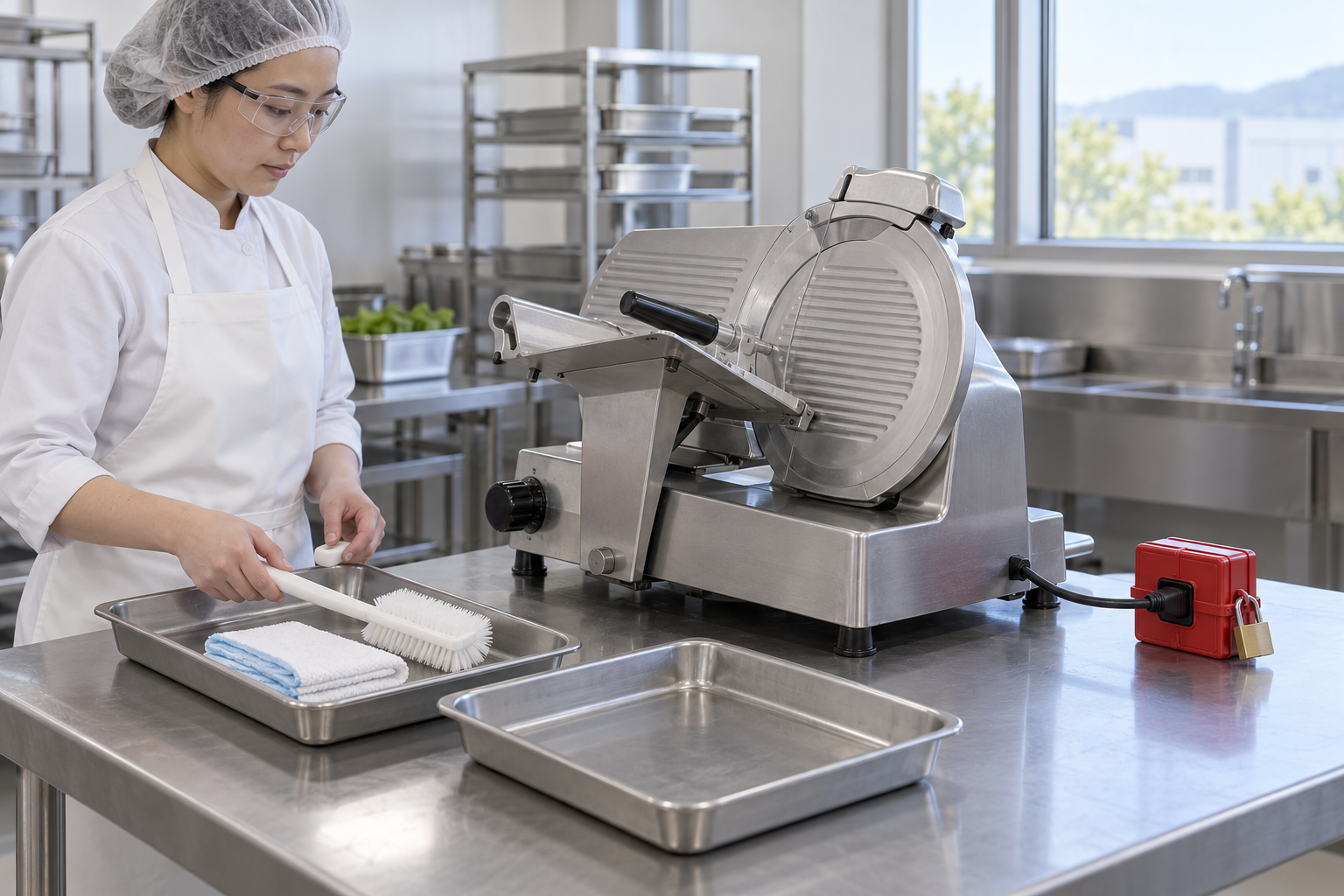
This illustration provides educational context. It is not an actual incident photograph or evidence of equipment suitability; any AI-generated depiction is illustrative only.
The scenario and record comparisons are fictional teaching examples, not records of real incidents, measurements, inspections, signatures or approvals.
| Stage | Fictional situation |
|---|---|
| Initial situation | A fictional worker finishes cleaning a slicer. |
| Changed condition | One side of the blade cover remains raised. |
| Failure path | Visible cleanliness is mistaken for safe mechanical restoration. |
| Possible outcome | An exposed blade or trapped food residue could cause injury or contamination. |
| Prevention barrier | Maintain isolation and the use hold; resolve the cover/seal fault and record mechanical and sanitation acceptance separately. |
Failure mechanisms
Disconnecting power removes a source of rotation, not the sharpness of the stationary blade. Plan cloth/tool movement, exposed-edge clearance and removable-part storage. Never remove a fixed blade merely to make cleaning easier.
A clean-looking surface does not prove that the guard, tray, fasteners and seals are restored. Record removed components and mechanical restoration separately from the food-contact sanitation decision.
Chemical mixing or pressure washing can introduce new exposure and electrical damage. Match the cleaner/sanitiser, concentration, contact conditions and permitted application to the actual product label and slicer manual.
Work sequence: Confirm model and scope → Stop and isolate → Remove approved parts → Remove food residue → Wash and sanitise → Restore and check → Hold defect → Close and hand over. This is a teaching flow, not a device drawing or a complete operating procedure.
5. Conditional decisions and common errors
| Situation | Required action | Evidence | Proceed when |
|---|---|---|---|
| Isolation unverified | Do not reach in | Safe stop and energy control | Restart prevented |
| Cover does not seat | Keep use hold | Parts, seal and fastening check | Guard restored |
| Electrical parts wet | Refer for assessment | Ingress and electrical inspection | Equipment released |
| Cleaning finished | Check two releases | Mechanical and sanitation records | Both accepted |
Similar observations, different decisions
The scenario and record comparisons are fictional teaching examples, not records of real incidents, measurements, inspections, signatures or approvals.
| Observation | Insufficient conclusion | Required distinction |
|---|---|---|
| Unplugged | Electrical source removed | Sharp blade remains |
| No visible residue | Surface looks clean | Sanitation still needs verification |
| Cover placed back | Part present | Correct engagement not proved |
6. Roles and responsibilities
| Role | Responsibility |
|---|---|
| Work supervisor | Confirm model and manual and the task scope, resources, interfaces and stop authority. |
| Qualified technical reviewer | Review stop and isolation, model limits, compatibility and unresolved technical conditions within assigned competence. |
| Work crew | Apply the listed controls, report changes and stop when evidence or safeguards are missing. |
| Inspector / assessor | Record actual product and dilution and other relevant checks; do not mark unverified conditions as accepted. |
| Handover authority | Reconcile tools and parts, restrictions and outstanding actions before the next task. Role labels do not establish a legal credential. |
The principal and employers coordinate the risk assessment and safe work procedures. These role labels allocate work; verify any qualifications and statutory appointments required for the actual Singapore activity. The receiving person must be given restrictions and unresolved defects before handover.
Record and handover perspective
| Stage | Record controls | Verification |
|---|---|---|
| Confirm model and scope | 1. Record model and manual2. Record removable-part list3. Record chemical instructions | 1. Removable-part list2. Chemical instructions3. Sanitation procedure |
| Remove approved parts | 1. Record part identity2. Record removal sequence3. Record edge clearance | 1. Removal sequence2. Edge clearance3. Storage location |
| Remove food residue | 1. Record tool and hand path2. Record blade clearance3. Record gap inspection | 1. Blade clearance2. Gap inspection3. Residue locations |
| Wash and sanitise | 1. Record product and dilution2. Record contact conditions3. Record electrical dryness | 1. Contact conditions2. Electrical dryness3. Floor condition |
| Hold defect | 1. Record blade and seal fault2. Record ingress assessment3. Record repair evidence | 1. Ingress assessment2. Repair evidence3. Restart authority |
| Close and hand over | 1. Record tools and parts2. Record final cleaning record3. Record use restrictions | 1. Final cleaning record2. Use restrictions3. Recipient and status |
7. Hold points and record comparison
| Hold point | Evidence before release | Actual record |
|---|---|---|
| HP-0 Start | Task boundary, site RA, SWP, responsibilities and emergency arrangements | |
| HP-1 Stop and isolate | Stop and isolation; Controlled disconnection; Worker communication; Tray and gauge position | |
| HP-2 Remove approved parts | Part identity; Removal sequence; Edge clearance; Storage location | |
| HP-3 Restore and check | Component count; Guard and tray; Separate hygiene acceptance; Seal condition | |
| HP-4 Close and hand over | Tools and parts; Final cleaning record; Use restrictions; Recipient and status |
Hold points are internal project checks. They are not universal statutory permits and do not grant work permission. Reassess after defects, changed conditions and shift changes.
Record comparison
The scenario and record comparisons are fictional teaching examples, not records of real incidents, measurements, inspections, signatures or approvals.
The boxes are static record prompts, not interactive or saved approvals. A tick does not establish suitability or permission to restart. Record the evidence, person, time and unresolved issues; retain the change history.
| Record | Insufficient record | Record checklist |
|---|---|---|
| Confirm model and scope | Only marked “OK” | □ Model and manual□ Removable-part list□ Chemical instructions□ Sanitation procedure |
| Remove food residue | Only marked “OK” | □ Tool and hand path□ Blade clearance□ Gap inspection□ Residue locations |
| Hold defect | Only marked “OK” | □ Blade and seal fault□ Ingress assessment□ Repair evidence□ Restart authority |
| Close and hand over | Only marked “OK” | □ Tools and parts□ Final cleaning record□ Use restrictions□ Recipient and status |
Hold points are internal checks. Determine separately whether Singapore statutory or site permit requirements apply to this work. Leave confirmation, measurements and approval records blank until the authorised site process is completed.
8. Site checklist and emergency response
| Site check | Actual result | Person / action |
|---|---|---|
| Confirm model and scope: Model and manual; Removable-part list; Chemical instructions; Sanitation procedure | ||
| Stop and isolate: Stop and isolation; Plug or lock control; Worker communication; Tray and gauge position | ||
| Remove approved parts: Part identity; Removal sequence; Edge clearance; Storage location | ||
| Remove food residue: Tool and hand path; Blade clearance; Gap inspection; Residue locations | ||
| Wash and sanitise: Product and dilution; Contact conditions; Electrical dryness; Floor condition | ||
| Restore and check: Component count; Guard and tray; Food-contact acceptance; Seal condition | ||
| Hold defect: Blade and seal fault; Ingress assessment; Repair evidence; Restart authority | ||
| Close and hand over: Tools and parts; Final cleaning record; Use restrictions; Recipient and status |
Stop work
Do not touch the blade area without verified full stop, effective isolation and the permitted cleaning method. Hold use for blade damage, poor guard fit, seal gaps, electrical water ingress or loose parts.
Emergency response
Stop exposure and call for site first aid or emergency medical care for serious cuts or electrical injury. Isolate before trained assistance. Apply the actual chemical SDS response for splash; preserve equipment hold and identify any affected food for the responsible hygiene authority.
9. Sources and review limits
Official public sources read for this Singapore edition on 2026-10-14. Guidance, statutory explanations and manufacturer limits have different roles; no source provider has approved this JSA.
| Source | Read scope and application limits |
|---|---|
| MOM — Risk management | Official explanation: employer, self-employed person and principal responsibilities; routine and non-routine risk assessment; hierarchy of controls; multidisciplinary assessment team. Official explanation of risk-management duties; no claim of reading the full linked statute. It does not specify task-specific equipment limits. Assess fixed-blade food slicer cleaning with employers, principal and affected contractors; resolve the inputs in section 2. |
| MOM — When should my company review its risk assessment? | Review every three years, after significant changes, new machinery/substances/procedures, hazard-related injury or incident, and when assessment is inadequate. General review guidance. A review interval does not permit continued operation after a known hazard or change. Reassess this operation after changes, defects, incidents or an inadequate assessment; do not wait for a scheduled review. |
| MOM — Permit-to-Work Systems | Formal work authorisation and coordination; OPEC tripartite guidance and competent permit authority with authority to reject work. OPEC-focused guidance page; not evidence of a blanket statutory permit requirement for every task. Determine permits for this actual activity and workplace; distinguish the section 7 internal hold points from statutory or site permits. |
| WSH Council — Guidelines on Safe Use of Machinery | Sections 1.1 and 1.3: scope and explanation of safeguarding/LOTO duties. Sections 4.3–4.4.3: training, maintenance, specified replacement parts and isolation of all energy sources; commissioning safety-device checks. Official practical guidance and explanation; complete current subsidiary legislation and every annex were not read. Actual manufacturer isolation and restoration instructions remain necessary. Use machinery guidance for effective isolation and mechanical restoration, chemical guidance for product exposure, and the SFA non-retail overview for the separate equipment-cleaning and food-safety responsibility where applicable. |
| WSH Council — Preventing Chemical Hazards | Chemical exposure routes, employer/employee roles, risk assessment, safe work procedures, communication, SDS, exposure monitoring and substance-dependent health surveillance. Official overview; linked exposure schedules and medical examination regulations were not read in full. Do not infer a numerical exposure limit or a universal medical examination duty. Use machinery guidance for effective isolation and mechanical restoration, chemical guidance for product exposure, and the SFA non-retail overview for the separate equipment-cleaning and food-safety responsibility where applicable. |
| SFA — Responsibilities of Food Establishment Operators | Non-retail establishment scope and food-safety control responsibilities, equipment specifications, regular cleaning/sanitising and prevention of raw/cooked cross-contamination. Applies to the stated non-retail establishment categories; do not transfer all licensing duties to every retail kitchen. Full licensing conditions and a product-specific sanitation procedure were not reviewed. Use machinery guidance for effective isolation and mechanical restoration, chemical guidance for product exposure, and the SFA non-retail overview for the separate equipment-cleaning and food-safety responsibility where applicable. |
The SFA source reviewed concerns non-retail food establishments; retail premises must apply their own applicable licensing and hygiene requirements. No universal sanitiser dilution, contact time, blade-cleaning direction or microbiological result is supplied. A foreign cord-and-plug exception is not adopted as a Singapore legal rule.
Actual site measurements, equipment instructions, engineering checks and signed approval records were not supplied. A qualified person must resolve these before use.
10. PDF guidance and FAQ
PDF A covers basic task controls; B focuses on technical failures; C covers supervision, records and handover. The article has eight stages with four items per main cell; each PDF has six key stages with three items per main cell. P/S/R/A, measurements, confirmations and signatures remain blank for actual site assessment.
PDFs are complementary six-stage extracts. Apply all eight body stages and the actual equipment/site procedure.
Can the blade be wiped while it rotates?
No. Establish full stop and effective energy control before cleaning.
Does unplugging always satisfy lockout requirements?
Do not assume a general legal exemption. Use the assessed Singapore site isolation procedure: disconnect the actual sources, prevent reconnection and verify safe conditions. The stationary blade remains sharp.
Can cleaning completion release a damaged slicer?
No. Maintain the use hold until mechanical defects and sanitation concerns are resolved.
Has a professional verified or approved this document?
No. Public sources and editorial, layout and consistency checks were reviewed using AI. No site inspection or professional technical approval has been performed. Obtain appropriate professional review before use.
Can a water-damaged slicer restart after its outside is dry?
No. Maintain isolation and the use hold until the electrical ingress concern is assessed and mechanical and hygiene release conditions are separately satisfied.
11. Revision history and authorship
AI-generated reference material; not professionally verified or approved. Before use, a qualified person must review and adapt it to applicable Singapore requirements, the actual equipment/site and approved safe work procedures.
This Singapore edition was adapted from the Korean original and its assigned US technical reference. Earlier source revisions are archival editorial history, not Singapore technical approval.
| Date | Edition | Change | Review status |
|---|---|---|---|
| 2026-09-26 | Korean source v1.0 | Source editorial publication or revision; retained as provenance of the Korean edition. | Editorial record only; no professional technical approval recorded. |
| 2026-10-14 | 1.0 en-SG | Singapore legal scope, local planning, responsibility interfaces and SI terminology; new PDF A/B/C. | AI editorial and visual review only; no professional approval. |