Open identified ordinary flour bags on a supported tipping station and feed a guarded hopper with verified dust capture and a site combustible-dust assessment.
Stop feed for abnormal capture indications, escaping dust, missing guards, blocked flow, burning odour or respiratory symptoms. Do not shake bags aggressively or insert hands or rods into a running hopper.
AI-generated reference material. It has not been professionally verified or approved. Before use, a suitably qualified person must review and adapt it to applicable Singapore requirements, the actual equipment and site, and approved safe work procedures.
1. Legal and technical scope
Apply Singapore WSH risk management, machinery guarding and combustible-dust controls to flour tipping. Since January 2025, organic combustible-dust packages of 25 kg or more require the prescribed dust warning. The occupier must check the Fourth Schedule quantity threshold and notify MOM and the factory owner where applicable; assess maximum inventory, including bagged and process stock. Food-ingredient dust warning requirements are distinct from GHS chemical labelling. An exemption from this package-labelling threshold does not establish safe dust exposure or remove explosion controls.
Assess the actual activity under the applicable Singapore WSH requirements. Statutory duties, official guidance, manufacturer instructions and approved project documents have distinct roles. A site hold point is not automatically a statutory permit. Use competent local review to resolve the applicable industry, installation, access and permit requirements.
| Basis | Application and limits |
|---|---|
| MOM risk management | Official explanation: risk assessment, control, monitoring and communication for routine and non-routine work, including maintenance; reviewed 14 October 2026. |
| WSHC preventing machine hazards | Official guidance: hierarchy of controls, guarding, competent operators and maintenance LOTO. It is not a model-specific isolation instruction. |
| WSHC Work-related Musculoskeletal Disorders | Official ergonomics guidance covers forceful pushing/pulling, repeated loads and awkward postures, and mechanical handling aids. It supplies no universal drum mass or hand-force limit. |
| MOM machinery safety and combustible dust measures | Measures effective January 2025: prescribed machinery supplier/installer duties, combustible-dust warnings and occupier notification to MOM and factory owner at applicable thresholds. Organic dust package labelling applies at 25 kg and above; hazard controls still apply below that quantity. |
| MOM machinery and combustible dust FAQs | May 2025 FAQ reviewed for quantity basis including maximum packaged/process stock, individual prescribed dusts, occupier/owner notification and organic-food-dust warning versus GHS classification. No site quantity or notification completion is asserted. |
| MOM hazards and controls of combustible dusts | Three-page 2015 technical circular: flour hazard, local extraction, housekeeping, ignition/static controls and engineered consequence mitigation. Referenced older foreign standards are not transferred as current Singapore design requirements. |
| MOM requirements for hygiene monitoring | Official toxic-substance and noise monitoring guidance: competent personnel, exposure-dependent requirements, records, worker information and reporting. No site exposure result is asserted. |
| HSE Baker | Foreign technical guidance on flour respiratory sensitisation, bag disposal dust and low-dust cleaning. UK legal surveillance or exposure requirements are not represented as Singapore duties. |
| SCDF emergency medical services | Official 995 emergency ambulance service information; use emergency services for actual emergencies. |
2. Scope and required inputs
Included: Open identified ordinary flour bags on a supported tipping station and feed a guarded hopper with verified dust capture and a site combustible-dust assessment.
Separate review: Enzyme/additive blends, bulk bags, silos, pneumatic transfer, hopper entry, blockage clearing, collector maintenance, guard removal and ignition-source work require separate assessment.
| Input | Required evidence |
|---|---|
| Match ingredient | Product/bag/hopper ID; Dust-control basis; Ingredient composition; Dust label and stock review |
| Check capture | Airflow/capture evidence; Guard/interlock state; Dust equipment review; Stop access/function |
| Feed hopper | Visible dust/capture; Hand boundary; Flow and sound; Support and workload |
| Clean and transfer | Method/equipment suitability; Residual dust; Defect and restriction; Product balance and receiver |
Verify flour composition, bag mass, hopper and capture design, normal extraction indicators, guards, safe tipping support, cleaning equipment and dust assessment. Check the actual prescribed notification threshold and stock basis with the occupier. No universal dust-depth, exposure, extraction-flow or explosion-protection design value is supplied. SS 667 and full technical standards were not obtained.
3. Eight-stage JSA
P = likelihood; S = severity; R = risk under the site method; A = acceptance or authorization as defined by the site. Leave these blank until actual assessment and control verification. A low score does not override a legal requirement, product limit or unreleased hold point.
| Job stage | Hazards and effects | Failure factors | Required controls | Site verification | P | S | R | A |
|---|---|---|---|---|---|---|---|---|
| 1. Match ingredient | 1. Wrong material exposure2. Dust explosion3. Respiratory sensitisation4. Wrong hopper feed | 1. Bag label unchecked2. Dust review absent3. Additives changed4. Hopper ID confused | 1. Match product and instruction2. Verify dust-hazard assessment3. Assess ingredient changes4. Confirm destination | 1. Product/bag/hopper ID2. Dust-control basis3. Ingredient composition4. Dust label and stock review | ||||
| 2. Support bags | 1. Back strain2. Falling bag3. Dusty-floor slip4. Blocked walkway | 1. Lift too high2. Support unstable3. Spillage ignored4. Bags in route | 1. Set suitable tipping height2. Use handling assistance3. Provide stable bag support4. Keep floor and route clear | 1. Bag weight/reach2. Support and aids3. Floor condition4. Material route | ||||
| 3. Check capture | 1. Dust inhalation2. Moving-part contact3. Ignition of dust4. Uncontrolled feed | 1. Hood misplaced2. Guard damaged3. Equipment unsuitable4. Stop inaccessible | 1. Verify capture indication2. Maintain guards/interlocks3. Confirm dust-compatible equipment4. Check nearby stop function | 1. Airflow/capture evidence2. Guard/interlock state3. Dust equipment review4. Stop access/function | ||||
| 4. Open bag | 1. Blade cut2. Packaging contamination3. Dust release4. Bag falls into hopper | 1. Cut toward hand2. Scraps not recovered3. Bag opened outside hood4. Bag unsupported | 1. Use designated safe cutter2. Recover packaging pieces3. Open within capture zone4. Keep bag supported | 1. Cutter/hand position2. Packaging count3. Hood and bag position4. Bag support | ||||
| 5. Feed hopper | 1. Dust cloud2. Hand entanglement3. Flour spill4. Operator strain | 1. High fast dump2. Hand pushes residue3. Feed exceeds capacity4. Awkward bag hold | 1. Control drop and rate2. Handle outside guard3. Monitor flow and capture4. Maintain supported posture | 1. Visible dust/capture2. Hand boundary3. Flow and sound4. Support and workload | ||||
| 6. Collect empty bags | 1. Residual dust release2. Contaminated route3. Trip from bags4. Exposure outside hood | 1. Bag shaken hard2. Thrown into open bin3. Waste piles up4. Folding elsewhere | 1. Fold by low-dust method2. Use designated collection3. Keep route clear4. Remain within capture area | 1. Residual powder2. Collection container3. Floor and waste route4. Capture at folding point | ||||
| 7. Hold abnormal feed | 1. Entrapment at blockage2. Dust ignition3. Respiratory harm4. Unexpected linked start | 1. Rod inserted running2. Capture fault ignored3. Cough dismissed4. Stop mistaken for isolation | 1. Stop further feed2. Restrict hopper access3. Transfer isolated fault clearing4. Review exposure symptoms | 1. Blockage and material2. Capture/guard condition3. Health report4. Restoration/restart evidence | ||||
| 8. Clean and transfer | 1. Dust resuspension2. Cleaner ignition source3. Unresolved fault reused4. Wrong next material | 1. Air blowdown2. Unapproved vacuum3. Fault only verbal4. Remaining product unknown | 1. Use approved low-dust cleaning2. Verify cleaning equipment3. Transfer unresolved holds4. Identify residual ingredient | 1. Method/equipment suitability2. Residual dust3. Defect and restriction4. Product balance and receiver |
4. Hypothetical scenario and failure mechanisms
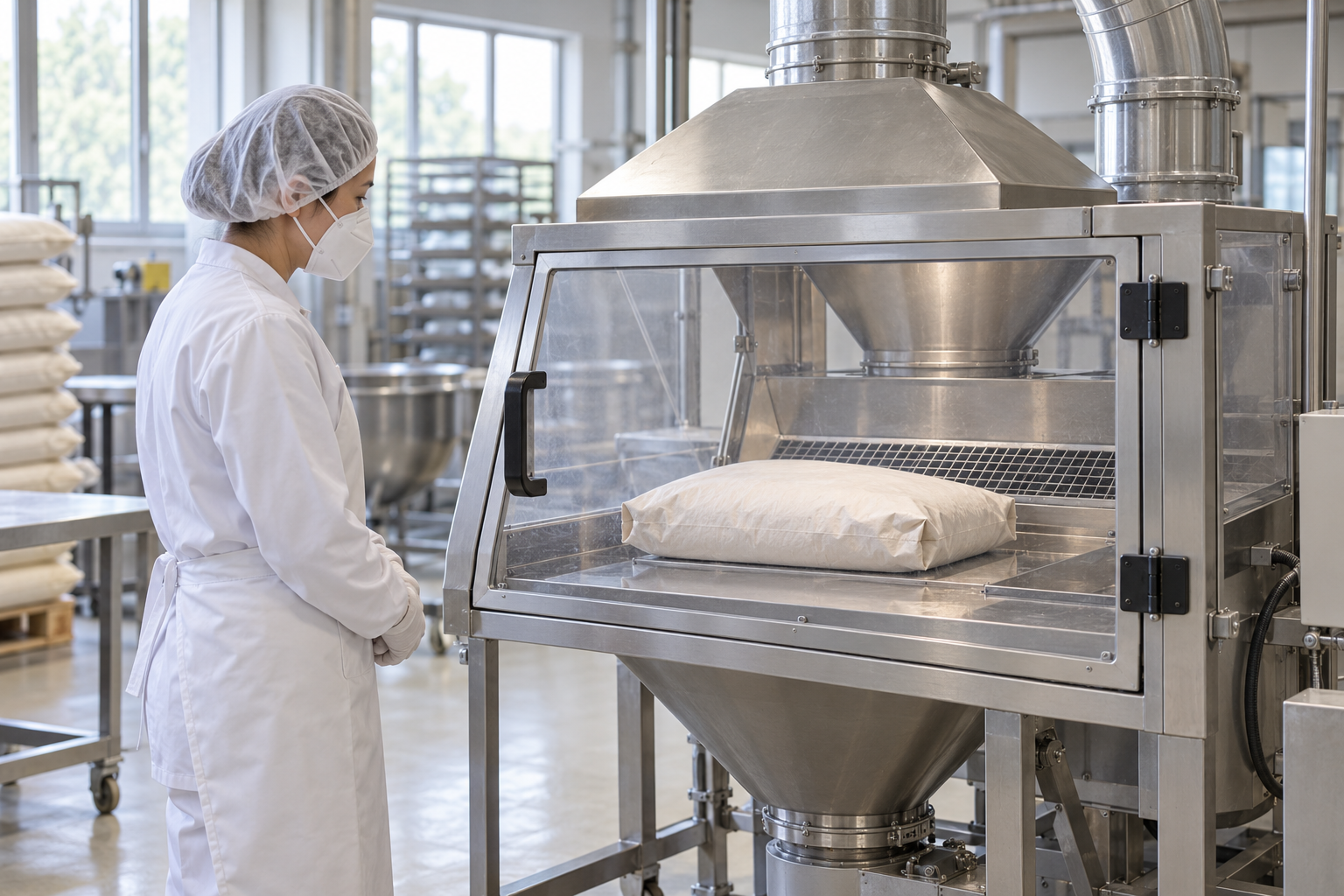 Retained source illustration: an AI-generated educational concept, not a real incident photograph or evidence of equipment suitability.
The following scenario, comparisons and example records are hypothetical teaching material. They do not reproduce actual incidents, measurements, signatures or approvals.
| Item | Hypothetical situation |
|---|---|
| Initial state | Flour is being tipped from a supported bag into a guarded hopper. |
| Change | Material stops flowing and the extraction indication leaves its normal range. |
| Failure path | The operator proposes shaking the bag and inserting a rod to maintain production. |
| Possible harm | Extra dust and moving-part contact could expose the operator while the original faults remain unresolved. |
| Barrier | Stop feed and control access; use separately isolated fault clearing and verify both capture and guarding before restart. |
Bag tipping and empty-bag handling must remain within the verified capture arrangement. Fan noise alone does not establish airflow or capture performance at the worker position.
Flour dust can cause respiratory sensitisation and can form an explosible dust cloud under suitable conditions. Dust properties, accumulation, ignition sources, electrical classification and collector protection need competent site assessment; this JSA does not design explosion protection.
Normal feeding ends when a blockage needs danger-zone access. Stop supply and refer clearing to authorised hazardous-energy control, including linked machinery and retained material. A long rod does not make running-equipment access safe.
Use a low-dust cleaning method and equipment suitable for the dust and location. Household vacuums, improvised fans and compressed-air blowdown are not default substitutes. Engineered ignition and explosion controls need actual dust and process data.
The occupier stock assessment covers more than powder visibly inside the hopper. Include packaged and process inventory when checking the applicable notification duty. The package warning informs handlers; it does not certify extraction performance or replace the process risk assessment.
| Decision | Reason and evidence |
|---|---|
| Known facts | Material stops flowing and the extraction indication leaves its normal range. |
| Unresolved | The operator proposes shaking the bag and inserting a rod to maintain production. |
| Hold reason | Stop feed for abnormal capture indications, escaping dust, missing guards, blocked flow, burning odour or respiratory symptoms. Do not shake bags aggressively or insert hands or rods into a running hopper. |
| Evidence needed | Visible dust/capture; Hand boundary; Flow and sound; Support and workload. |
| Next decision | Stop feed and control access; use separately isolated fault clearing and verify both capture and guarding before restart. |
5. Conditional decisions and common errors
| Condition | Action | Evidence | Proceed when |
|---|---|---|---|
| Capture abnormal | Stop feed and contain access | Hood, airflow indication and maintenance review | Capture restored |
| Hopper blocked | Use separate isolated clearing procedure | Energy and retained-material assessment | Cause corrected |
| New ingredient | Hold old settings | Composition and dust-hazard review | Material accepted |
| Breathing symptoms | Leave exposure and report promptly | Health assessment and exposure review | Return assessed |
| Comparison | Situation A | Situation B |
|---|---|---|
| Fan audible | Motor may be operating | Capture at bag opening remains unproved |
| Flour flows again | Material moved | Cause, guarding and dust control unresolved |
6. Roles and responsibilities
| Role | Responsibility |
|---|---|
| Work supervisor | Confirm scope, task sequence, exclusion and stop authority. Coordinate match ingredient with affected operations. |
| Technical reviewer | Resolve the actual design and equipment limits: Product/bag/hopper ID; Dust-control basis; Ingredient composition; Dust label and stock review. |
| Work crew | Perform check capture using the approved procedure; report any mismatch before proceeding. |
| Inspector / assessor | Verify Residual powder; Collection container; Floor and waste route; Capture at folding point. Record what was actually checked and what remains unresolved. |
| Release / receiving authority | Confirm Method/equipment suitability; Residual dust; Defect and restriction; Product balance and receiver. Transfer restrictions and the next permitted stage. |
These are responsibility examples, not invented statutory credentials. Meet the actual training, competent-person, qualified-person and licensing requirements for the assigned work. Anyone may raise a hazard and request a stop; only the designated authority may release the affected stage after evidence is reviewed.
7. Hold points and record comparison
| Hold point | Evidence before release | Confirmation / approval |
|---|---|---|
| HP-0 Start | Scope, jurisdiction, equipment identity, responsible people and emergency arrangements. | |
| HP-1 Support bags | Bag weight/reach; Support and aids; Floor condition; Material route | |
| HP-2 Check capture | Airflow/capture evidence; Guard/interlock state; Dust equipment review; Stop access/function | |
| HP-3 Hold abnormal feed | Blockage and material; Capture/guard condition; Health report; Restoration/restart evidence | |
| HP-4 Clean and transfer | Method/equipment suitability; Residual dust; Defect and restriction; Product balance and receiver |
Hold points are internal evidence gates. They do not replace statutory permits or actual signatures. Recheck affected gates after a change, abnormal event or shift transfer. The blank record must identify the evidence, person, time, limits and release scope.
| Record | Insufficient record | Record checklist |
|---|---|---|
| Ingredient | Food grade | □ Product/bag/hopper ID□ Dust-control basis□ Ingredient composition□ Dust label and stock review |
| Capture | Fan runs | □ Airflow/capture evidence□ Guard/interlock state□ Dust equipment review□ Stop access/function |
| Feed | Material moving | □ Visible dust/capture□ Hand boundary□ Flow and sound□ Support and workload |
| Fault | Blockage gone | □ Blockage and material□ Capture/guard condition□ Health report□ Restoration/restart evidence |
The □ boxes are static prompts, not saved or interactive approvals. Each checks one record element. A tick alone does not establish suitability or permission to restart. Link equipment IDs and supporting records; retain unresolved matters and the earlier record when conditions change.
8. Site checklist and emergency response
| Check item | Result | Person / action |
|---|---|---|
| Product/bag/hopper ID | ||
| Bag weight/reach | ||
| Airflow/capture evidence | ||
| Cutter/hand position | ||
| Visible dust/capture | ||
| Residual powder | ||
| Blockage and material | ||
| Method/equipment suitability | ||
| Emergency arrangements and unresolved restrictions communicated |
Stop work: Stop feed for abnormal capture indications, escaping dust, missing guards, blocked flow, burning odour or respiratory symptoms. Do not shake bags aggressively or insert hands or rods into a running hopper.
Emergency response: Stop feed from a safe position. For dust cloud, burning odour or fire, raise the alarm and evacuate without dispersing settled dust; do not open a collector or hopper to investigate. Call SCDF 995 for fire, severe breathing difficulty or urgent rescue. Report respiratory symptoms and arrange appropriate health/exposure review. Machinery rescue requires controlled energy and the prepared response.
9. Sources and review limits
Official-source review date: October 14, 2026. The following review is limited to the public provisions or selected manufacturer material identified below. It does not establish that any authority approved this article or the actual installation.
- MOM risk management: Official explanation: risk assessment, control, monitoring and communication for routine and non-routine work, including maintenance; reviewed 14 October 2026.
- WSHC preventing machine hazards: Official guidance: hierarchy of controls, guarding, competent operators and maintenance LOTO. It is not a model-specific isolation instruction.
- WSHC Work-related Musculoskeletal Disorders: Official ergonomics guidance covers forceful pushing/pulling, repeated loads and awkward postures, and mechanical handling aids. It supplies no universal drum mass or hand-force limit.
- MOM machinery safety and combustible dust measures: Measures effective January 2025: prescribed machinery supplier/installer duties, combustible-dust warnings and occupier notification to MOM and factory owner at applicable thresholds. Organic dust package labelling applies at 25 kg and above; hazard controls still apply below that quantity.
- MOM machinery and combustible dust FAQs: May 2025 FAQ reviewed for quantity basis including maximum packaged/process stock, individual prescribed dusts, occupier/owner notification and organic-food-dust warning versus GHS classification. No site quantity or notification completion is asserted.
- MOM hazards and controls of combustible dusts: Three-page 2015 technical circular: flour hazard, local extraction, housekeeping, ignition/static controls and engineered consequence mitigation. Referenced older foreign standards are not transferred as current Singapore design requirements.
- MOM requirements for hygiene monitoring: Official toxic-substance and noise monitoring guidance: competent personnel, exposure-dependent requirements, records, worker information and reporting. No site exposure result is asserted.
- HSE Baker: Foreign technical guidance on flour respiratory sensitisation, bag disposal dust and low-dust cleaning. UK legal surveillance or exposure requirements are not represented as Singapore duties.
- SCDF emergency medical services: Official 995 emergency ambulance service information; use emergency services for actual emergencies.
Paid consensus standards and site-specific calculations, manuals, inspection records and product certificates were not independently obtained or verified unless specifically identified. Korean and overseas legal references are source history, not Singapore statutory duties. Singapore Standards and model-specific limits were not read in full unless expressly identified.
10. PDF guidance and FAQ
PDF A covers basic task controls; B examines technical failures; C focuses on supervision, evidence and handover. Each has six rows and three items per main cell. They are complementary extracts: apply all eight body stages and the applicable site procedure. An omitted stage is not permission to omit its controls. PDF HP-0 through HP-4 are worksheet labels; match the event, evidence and authority rather than assuming they match another permit by number.
P/S/R/A, actual measurements, confirmations and signatures remain blank. The PDFs are uncompleted reference worksheets, not issued work permits.
Content group ID: jsa-flour-bag-hopper-loading
Does food-grade mean dust is harmless?
No. Assess inhalation, sensitisation and combustible-dust conditions separately from food quality.
Can a respirator replace failed capture?
Do not continue with an unresolved capture fault. Respiratory protection, where needed, requires the applicable program and exposure assessment.
Can I clear a blockage with a rod?
Not as part of normal running feed. Stop and use the authorised isolated maintenance method.
Which vacuum is suitable?
Select equipment through the site dust/fire and location assessment; ordinary appearance or suction strength does not establish suitability.
Do smaller bags make dust safe?
No. The organic-dust label threshold is separate from inhalation, fire and explosion risk controls.
Has a professional verified or approved this document?
AI-generated reference material. It has not been professionally verified or approved. Before use, a suitably qualified person must review and adapt it to applicable Singapore requirements, the actual equipment and site, and approved safe work procedures.
11. Revision history and authorship
AI-generated reference material. It has not been professionally verified or approved. Before use, a suitably qualified person must review and adapt it to applicable Singapore requirements, the actual equipment and site, and approved safe work procedures.
This system has not physically inspected the equipment, structures, ground, atmosphere or worksite. The document does not replace legal advice, manufacturer procedures, engineering design, inspection certificates, qualification evidence, the site risk assessment or an actual work permit.
Before use, a suitably qualified and authorized person must review the actual equipment, loads, methods, protection, inspection and emergency arrangements and resolve open issues. Record the real reviewer, organization, qualifications, delegated authority, reviewed documents, date, signature, exclusions and conditions of approval separately.
| Date | Version | Change | Review status |
|---|---|---|---|
| 2026-10-04 | 1.0 | Korean source revision retained in the source snapshot. | Historical editorial status; not Singapore professional approval. |
| 2026-10-14 | SG 1.0 | Singapore localisation of the Korean source with its assigned US technical reference; local applicability, task controls and sources reviewed. | AI-assisted editorial work; professional approval not performed. |