A detector LED may indicate power, communication or alarm according to its manual. It does not prove that the correct panel zone and required notification outputs respond. Record observations along the approved detection-to-panel-to-notification path.
AI-generated reference material; not professionally verified or approved. Before use, a qualified person must review and adapt it to Singapore requirements, the actual equipment/site and approved safe work procedures.
Stop before starting
Do not start with an undefined impairment area, backup arrangement, restoration owner or circuit identity. Do not declare normal service before the required signal-path tests and bypass removal are verified.
1. Legal and technical scope
| Basis | Scope and limits |
|---|---|
| MOM: Risk management | Assess the affected occupied area, impairment duration and controlled test interfaces. Official explanation of statutory duties; linked SSO text was not independently read for this item. This is not a legal opinion. |
| SCDF Fire Code 2023: Clause 6.3 | Verify the actual fire-panel/zone and applicable monitoring connection against approved requirements. Full SS 645 and actual approved design/product records were not obtained. Fire alarm provision and monitoring depend on the premises; no generic spacing, test interval or approval claim. |
| WSH Council: Preventing Falls from Height | Provide protected access and lower exclusion for mounting and retesting. Official explanatory guidance; the stated PTW scope is not a general exemption from fall controls below that height. Actual premises classification must be checked. |
| EMA: Worker licences | Review actual electrical-installation work and mains/standby supply boundaries. Official explanation; does not classify every data connector as electrical installation work. Actual work boundary and licence class require review. |
| WSH Council: Safe Use of Machinery | Control all relevant electrical and interface sources before intervention. Official guidance; cited paid Singapore Standards were not obtained. No universal wheel test duration or gap is inferred. |
Apply Singapore WSH risk management to elevated access, electrical sources and the temporary loss of fire protection. SCDF Fire Code clause 6.3 addresses the alarm panel, signal location, supervision and applicable connection to the SCDF Operations Centre through an approved monitoring company. Determine the actual premises requirements, approved design and applicable SS 645 provisions with the competent fire-system parties; the full standard has not been reviewed here. Coordinate required electrical-installation work with the appropriate LEW. A local device indication is not evidence of system restoration or fire-safety approval.
2. Scope and required inputs
Included work
Identify the detector or visual device purpose, manage system impairment, prepare elevated access and electrical boundaries, install compatible equipment, verify wiring/addressing, test the approved signal path and restore service.
Separate assessment
This does not approve detector layout, accessibility performance, suppression release changes, smoke-control interfaces or unapproved alarm impairment. Ordinary machine-status beacons and required fire notification appliances are different applications.
| Required input | Evidence to obtain |
|---|---|
| Define device purpose | Application and design; Device and zone IDs; Interface list; Test and restore plan |
| Prepare access | Platform and access; Tool retention; Mains and standby supply; Area and notifications |
| Control impairment | Area and duration; Panel and operator log; Backup alarm or watch; Release interface limits |
| Mount devices | Platform and position; Lower exclusion area; Anchor and substrate; Drilling clearance |
No actual equipment model, site measurements, design calculations or signed approval was supplied. Check the applicable Singapore requirements and approved safe work procedures against the actual equipment and site before use. Statutory duties, official guidance and manufacturer limits serve different purposes; editorial checks do not establish legal or professional approval.
Singapore site application
Agree impairment and restoration with building management, the fire-system service provider and the Fire Safety Manager where appointed. Coordinate with the approved alarm-monitoring company where the premises uses that connection; do not leave remote monitoring isolated after a local test.
Record building/floor, device/zone/address, test stimulus, observation locations and time. Use the actual approved dimensions in mm or m and required alarm criteria rather than importing detector spacing, candela values or test intervals from another jurisdiction.
3. Eight-stage JSA
| Job stage | Hazards and effects | Failure factors | Technical and procedural controls | Site verification | P | S | R | A |
|---|---|---|---|---|---|---|---|---|
| 1. Define device purpose | 1. Wrong alarm function2. Wrong zone work3. Unwanted release4. Restoration omitted | 1. Beacon confused2. Drawing outdated3. Interface missed4. No restoration owner | 1. Confirm device use2. Match area drawing3. Map all interfaces4. Assign restoration lead | 1. Application and design2. Device and zone IDs3. Interface list4. Test and restore plan | ||||
| 2. Prepare access | 1. Worker falls2. Dropped tools3. Electrical shock4. Area left unprotected | 1. Poor platform2. People below3. Battery source missed4. No backup plan | 1. Use suitable platform2. Control area below3. Map all power sources4. Prepare backup measures | 1. Platform and access2. Tool retention3. Mains and standby supply4. Area and notifications | ||||
| 3. Control impairment | 1. Detection unavailable2. Unwanted evacuation3. Suppression discharge4. Operator confusion | 1. Disable scope unclear2. No notice3. Output not controlled4. Restore lead absent | 1. Authorise impairment2. Notify affected parties3. Provide backup measures4. Control test interfaces | 1. Area and duration2. Panel and operator log3. Backup alarm or watch4. Release interface limits | ||||
| 4. Mount devices | 1. Fall from access2. Falling tool3. Ceiling support fails4. Hidden cable damage | 1. Overreach2. Uncontrolled underside3. Weak substrate4. Blind drilling | 1. Maintain safe access2. Keep people clear3. Verify independent support4. Check concealed services | 1. Platform and position2. Lower exclusion area3. Anchor and substrate4. Drilling clearance | ||||
| 5. Wire and address | 1. Shock and short2. Broken circuit3. Wrong location shown4. Alarm unavailable | 1. Supply remains2. Polarity error3. Duplicate address4. Incompatible device pairing | 1. Isolate and verify2. Follow circuit diagram3. Match address to zone4. Verify approved compatibility | 1. Source verification2. Polarity and supervision3. Address and location4. Panel-device combination | ||||
| 6. Test and restore | 1. Unwanted shutdown2. Unproven detection3. Bypass remains4. Backup ends early | 1. Interface test uncontrolled2. LED-only acceptance3. Disable list unchecked4. No restore notice | 1. Control test effects2. Verify complete signal path3. Restore normal circuits4. Notify after verification | 1. Device stimulus and result2. Panel location and output3. Bypass removal4. Impairment closure | ||||
| 7. Resolve faults | 1. Alarm not delivered2. Wrong zone alarm3. Unplanned release4. Prolonged impairment | 1. Observation incomplete2. Address mismatch3. Test scope exceeded4. Delay unreported | 1. Hold normal handover2. Compare observation points3. Keep approved test scope4. Review backup measures | 1. Signal path results2. Address-location match3. Interface restrictions4. Delay and recovery plan | ||||
| 8. Close and handover | 1. Residual bypass2. Blocked detector3. Premature watch removal4. Unknown restrictions | 1. List not reconciled2. Cover left fitted3. Installation-only release4. No receiver | 1. Reconcile impairment list2. Check final device state3. Verify service restoration4. Transfer remaining limits | 1. Normal panel indication2. Cover and fixing3. Local/remote restoration notice4. Receiver time and defects |
P = likelihood; S = severity; R = risk under the site method; A = site-defined acceptance/authorization. These actual assessment cells are blank. A low score never overrides a missing safeguard or a legal or manufacturer restriction.
4. Fictional scenario and failure mechanisms
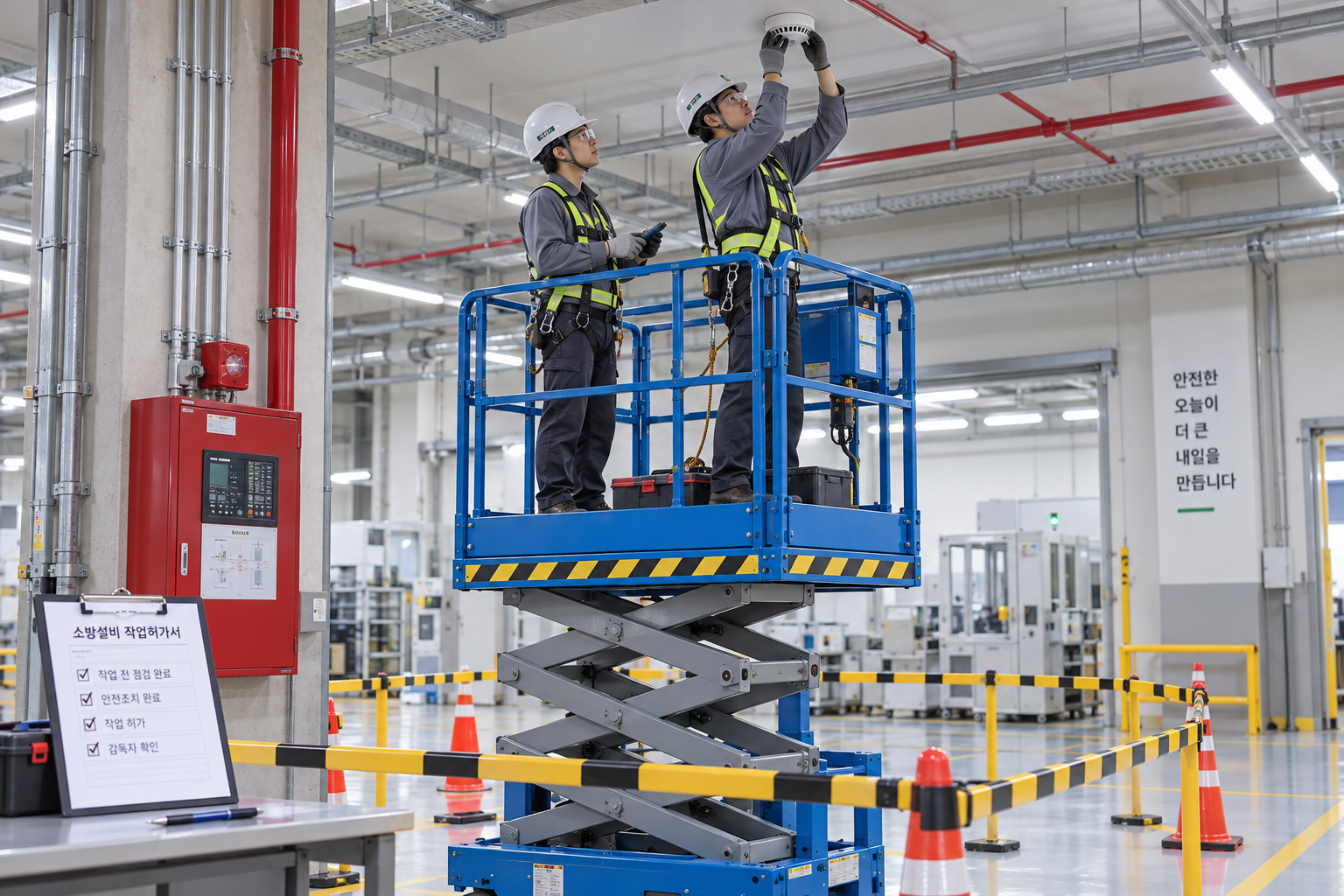
This illustration provides educational context. It is not an actual incident photograph or evidence of equipment suitability; any AI-generated depiction is illustrative only.
The scenario and record comparisons are fictional teaching examples, not records of real incidents, measurements, inspections, signatures or approvals.
| Stage | Fictional situation |
|---|---|
| Initial situation | A detector is replaced in an authorised impaired zone. |
| Changed condition | Its LED operates, but the panel still shows the zone disabled. |
| Failure path | Local indication is accepted without verifying system outputs or clearing bypasses. |
| Possible outcome | Required fire warning may remain unavailable after the installer leaves. |
| Prevention barrier | Keep the impairment controls active and compare the test results, bypass list and restoration notifications before handover. |
Failure mechanisms
A detector LED may indicate power, communication or alarm according to its manual. It does not prove that the correct panel zone and required notification outputs respond. Record observations along the approved detection-to-panel-to-notification path.
Impairment controls both inadvertent activation and loss of protection. Identify area, duration, notifications, backup alarm or watch arrangements, restoration owner and escalation if delayed. End temporary measures only after actual restoration and required notification.
Addressable and conventional circuits do not share one universal end-of-line component or wiring arrangement. Verify the approved compatible combination and approved drawing. Suppression discharge and equipment shutdown interfaces require an explicitly controlled test scope.
Decision sequence
| Step | Decision |
|---|---|
| Known | The detector LED operates while its panel zone remains disabled. |
| Unknown | Correct zone/output response, remaining bypasses and monitoring restoration are unresolved. |
| Hold | Keep impairment controls active and withhold normal-service handover. |
| Evidence | Link device/address, stimulus, panel/output observations, bypass reconciliation and required notices. |
| Release | Accept the required signal path and restored local/remote states before ending temporary measures. |
Work sequence: Define device purpose → Prepare access → Control impairment → Mount devices → Wire and address → Test and restore → Resolve faults → Close and handover. This is a teaching flow, not a device drawing or a complete operating procedure.
5. Conditional decisions and common errors
| Situation | Required action | Evidence | Proceed when |
|---|---|---|---|
| Impairment unclear | Hold circuit work | Area, duration and backup plan | Impairment authorised |
| Wrong device or zone | Reconcile drawing and listing | Device, base and panel IDs | Combination verified |
| LED only | Test approved signal path | Device, panel and output results | Required functions verified |
| Bypass remains | Continue temporary measures | Restoration and notifications | Normal service confirmed |
Similar observations, different decisions
The scenario and record comparisons are fictional teaching examples, not records of real incidents, measurements, inspections, signatures or approvals.
| Observation | Insufficient conclusion | Required distinction |
|---|---|---|
| LED operates | The alarm system is restored. | Verify the approved detection-to-panel-to-output path and remaining isolation. |
| Installer reports completion | Temporary watch may end. | Confirm restoration evidence and required notifications first. |
| Beacon looks similar | It meets fire-notification requirements. | Match the actual application, approved design and product compatibility. |
6. Roles and responsibilities
| Role | Responsibility |
|---|---|
| Work supervisor | Confirm application and design and the task scope, resources, interfaces and stop authority. |
| Qualified technical reviewer | Review platform and access, model limits, compatibility and unresolved technical conditions within assigned competence. |
| Work crew | Apply the listed controls, report changes and stop when evidence or safeguards are missing. |
| Inspector / assessor | Record actual source verification and other relevant checks; do not mark unverified conditions as accepted. |
| Handover authority | Reconcile normal panel indication, restrictions and outstanding actions before the next task. Role labels do not establish a legal credential. |
Supervision and handover focus
| Stage | Management action | Evidence |
|---|---|---|
| Define device purpose | 1. Record application and design2. Record device and zone ids3. Record interface list | 1. Application and design2. Device and zone IDs3. Interface list |
| Control impairment | 1. Record area and duration2. Record panel and operator log3. Record backup alarm or watch | 1. Area and duration2. Panel and operator log3. Backup alarm or watch |
| Wire and address | 1. Record source verification2. Record polarity and supervision3. Record address and location | 1. Source verification2. Polarity and supervision3. Address and location |
| Test and restore | 1. Record device stimulus and result2. Record panel location and output3. Record bypass removal | 1. Device stimulus and result2. Panel location and output3. Bypass removal |
| Resolve faults | 1. Record signal path results2. Record address-location match3. Record interface restrictions | 1. Signal path results2. Address-location match3. Interface restrictions |
| Close and handover | 1. Record normal panel indication2. Record cover and fixing3. Record local/remote restoration notice | 1. Normal panel indication2. Cover and fixing3. Local/remote restoration notice |
7. Hold points and record comparison
| Hold point | Evidence before release | Actual approval |
|---|---|---|
| HP-0 Scope | Identify the detector or visual device purpose, manage system impairment, prepare elevated access and electrical boundaries, install compatible equipment, verify wiring/addressing, test the approved signal path and restore service. | |
| HP-1 Control impairment | Area and duration; Panel and operator log; Backup alarm or watch; Release interface limits | |
| HP-2 Wire and address | Source verification; Polarity and supervision; Address and location; Panel-device combination | |
| HP-3 Test and restore | Device stimulus and result; Panel location and output; Bypass removal; Impairment closure | |
| HP-4 Close and handover | Normal panel indication; Cover and fixing; Local/remote restoration notice; Receiver time and defects |
Hold points are internal project checks. They are not universal statutory permits and do not grant work permission. Reassess after defects, changed conditions and shift changes.
Record comparison
The scenario and record comparisons are fictional teaching examples, not records of real incidents, measurements, inspections, signatures or approvals.
The boxes are static record prompts, not interactive or saved approvals. A tick does not establish suitability or permission to restart. Record the evidence, person, time and unresolved issues; retain the change history.
| Record | Insufficient record | Record checklist |
|---|---|---|
| Define device purpose | Only marked “OK” | □ Application and design□ Device and zone IDs□ Interface list□ Test and restore plan |
| Mount devices | Only marked “OK” | □ Platform and position□ Lower exclusion area□ Anchor and substrate□ Drilling clearance |
| Resolve faults | Only marked “OK” | □ Signal path results□ Address-location match□ Interface restrictions□ Delay and recovery plan |
| Close and handover | Only marked “OK” | □ Normal panel indication□ Cover and fixing□ Local/remote restoration notice□ Receiver time and defects |
8. Site checklist and emergency response
| Site check | Actual result | Person / action |
|---|---|---|
| Define device purpose: Application and design; Device and zone IDs; Interface list; Test and restore plan | ||
| Prepare access: Platform and access; Tool retention; Mains and standby supply; Area and notifications | ||
| Control impairment: Area and duration; Panel and operator log; Backup alarm or watch; Release interface limits | ||
| Mount devices: Platform and position; Lower exclusion area; Anchor and substrate; Drilling clearance | ||
| Wire and address: Source verification; Polarity and supervision; Address and location; Panel-device combination | ||
| Test and restore: Device stimulus and result; Panel location and output; Bypass removal; Impairment closure | ||
| Resolve faults: Signal path results; Address-location match; Interface restrictions; Delay and recovery plan | ||
| Close and handover: Normal panel indication; Cover and fixing; Local/remote restoration notice; Receiver time and defects |
Stop work
Do not start with an undefined impairment area, backup arrangement, restoration owner or circuit identity. Do not declare normal service before the required signal-path tests and bypass removal are verified.
Emergency response
Treat an actual fire or unexplained alarm as an emergency, not automatically as a test. Stop testing, tell building operations the actual impairment and monitoring state, and follow the site alarm, evacuation and emergency-call procedure. Keep temporary protection in place until its authorised closure.
9. Sources and review limits
Public-source access/review: 2026-10-14.
| Official source | Reviewed scope and limits |
|---|---|
| MOM: Risk management | Assess the affected occupied area, impairment duration and controlled test interfaces. Official explanation of statutory duties; linked SSO text was not independently read for this item. This is not a legal opinion. |
| SCDF Fire Code 2023: Clause 6.3 | Verify the actual fire-panel/zone and applicable monitoring connection against approved requirements. Full SS 645 and actual approved design/product records were not obtained. Fire alarm provision and monitoring depend on the premises; no generic spacing, test interval or approval claim. |
| WSH Council: Preventing Falls from Height | Provide protected access and lower exclusion for mounting and retesting. Official explanatory guidance; the stated PTW scope is not a general exemption from fall controls below that height. Actual premises classification must be checked. |
| EMA: Worker licences | Review actual electrical-installation work and mains/standby supply boundaries. Official explanation; does not classify every data connector as electrical installation work. Actual work boundary and licence class require review. |
| WSH Council: Safe Use of Machinery | Control all relevant electrical and interface sources before intervention. Official guidance; cited paid Singapore Standards were not obtained. No universal wheel test duration or gap is inferred. |
No actual equipment model, site measurements, design calculations or signed approval was supplied. Check the applicable Singapore requirements and approved safe work procedures against the actual equipment and site before use. Statutory duties, official guidance and manufacturer limits serve different purposes; editorial checks do not establish legal or professional approval.
10. PDF guidance and FAQ
PDF A covers basic task controls; B focuses on technical failures; C covers supervision, records and handover. The article has eight stages with four items per main cell; each PDF has six key stages with three items per main cell. P/S/R/A, measurements, confirmations and signatures remain blank for actual site assessment.
PDFs are complementary six-stage extracts. Apply all eight body stages and the actual equipment/site procedure.
Does an illuminated LED complete the test?
No. Confirm its meaning and verify the required panel indication, outputs and restoration.
Can a machine beacon replace a fire notification appliance?
Only the correct approved/listed application can satisfy the project requirements; appearance or light output alone is insufficient.
Is one end-of-line resistor suitable for every circuit?
No. Use the actual circuit type, approved drawing and compatible equipment instructions.
When can backup measures end?
After the designated authority verifies required function, clears the impairment/bypasses and completes restoration notifications.
Has a professional verified or approved this document?
AI-generated reference material; not professionally verified or approved. Before use, a qualified person must review and adapt it to Singapore requirements, the actual equipment/site and approved safe work procedures.
11. Revision history and authorship
AI-generated reference material; not professionally verified or approved. Before use, a qualified person must review and adapt it to Singapore requirements, the actual equipment/site and approved safe work procedures.
| Date | Version | Change | Review status |
|---|---|---|---|
| 2026-10-14 | SG 1.0 | New Singapore edition from assigned Korean source; task decisions, records and PDFs localized. | AI editorial review; no professional technical approval |
Korean edition revision history: 2026-09-20 (v1.0): initial article, sources, fictional analysis and PDF editorial checks; 2026-09-23 (v1.1): task decisions, record checklist, JSA and three PDF variants revised. These are editorial records, not professional technical approval. Singapore v1.0 adapts the earlier edition to Singapore requirements and terminology.
Site reviewers must add their actual qualifications, scope, date and approval only after the review occurs.