Confirm cable-specific limits and the complete route before pulling. The puller display is only one measurement: a stalled roller, changed bend or moving support requires a stop even below the recorded tension limit.
AI-generated reference material. It has not been verified or approved by a professional. Before use, a qualified person must review and adapt it to applicable Singapore requirements, the actual equipment and site, and approved safe work procedures.
1. Singapore legal and technical basis
Singapore WSH risk management covers the drum, puller, force path and adjacent circuits. Coordinate electrical installation work through the suitable Licensed Electrical Worker arrangement. Cable pulling from outside a chamber does not authorise confined-space entry, termination, testing or energisation; those activities need their own applicable controls and releases.
| Source category | Task application and limit |
|---|---|
| MOM - Risk management | Assess recoil, drum support, vertical cable weight and changed route geometry. Official explanation of WSH Risk Management duties, not a complete consolidated statutory text. |
| EMA - Engaging Licensed Electrical Workers | Assign electrical installation and subsequent testing/energisation interfaces to the appropriate licensed team. Installation, repair or modification of wiring and supply equipment is distinguished from routine operation of an intact appliance. Licence scope must match the installation. |
| WSHC - Safe Use of Machinery | Prevent restart and control stored mechanical energy before jam access. Official guidance with a summary of statutory duties; not a machine-specific safeguard design or full review of current legislation or paid standards. |
| Singapore Statutes Online - Confined Spaces, entry controls | Keep chamber entry outside this pulling release and arrange the separate current entry-control process if needed. Indexed historic consolidation only; not a full current statutory review. It establishes a separate confined-space work boundary here, not a complete entry or rescue procedure. |
Use Singapore requirements and SI units. Manufacturer limits apply to the actual model. Foreign technical examples do not establish Singapore statutory duties. A job safety analysis or completed checklist is not a permit or approval.
2. Scope and required inputs
Included work
Reviewing a new feeder route, setting the drum and puller, checking pulling attachments and rollers, making a controlled trial and continuous pull, securing and sealing ends and handing over inspection records.
Separate assessment
Manhole or confined-space entry, live connection, electrical testing, energization and forced pulling beyond approved limits require separate authorisation and methods.
| Required input | Evidence to obtain |
|---|---|
| Review route and forces | Cable and pulling method; Bends length elevation; Drum support basis; Entry and electrical boundary |
| Set drum and puller | Stand and ground; Spindle and braking; Puller anchorage; Exclusion and escape |
| Inspect cable and rollers | Cable identity; Roller rating and layout; Electrical safeguards; Connection compatibility |
| Trial pull and signals | Tension and roller behavior; Drum braking; Hands feet exclusion; Full-route communication |
Singapore application
The electrical coordinator identifies existing energised circuits, their isolation or segregation and the person controlling later connection. Agree circuit IDs at both ends before the pull; do not infer an existing cable is dead from its label or location.
3. Eight-stage JSA
| Job stage | Hazards and effects | Failure factors | Controls | Site verification | P | S | R | A |
|---|---|---|---|---|---|---|---|---|
| 1. Review route and forces | 1. Cable damage2. Rope failure3. Support collapse4. Entry exposure | 1. Cable limit unknown2. Bends omitted3. Drum weight unknown4. Entry assumed allowed | 1. Verify cable-specific limits2. Review actual route forces3. Confirm drum and floor load4. Separate entry approval | 1. Cable and pulling method2. Bends length elevation3. Drum support basis4. Entry and electrical releases | ||||
| 2. Set drum and puller | 1. Drum overturn2. Spindle release3. Puller movement4. Person struck | 1. Stand underrated2. Axle unsecured3. Reaction unreviewed4. Route shared | 1. Use rated drum stand2. Secure spindle and brake3. Support puller reaction4. Separate people and line | 1. Stand and ground2. Spindle and braking3. Puller anchorage4. Exclusion and escape | ||||
| 3. Inspect cable and rollers | 1. Jacket damage2. Roller pinch3. Electrical contact4. Pulling-eye release | 1. Wrong reel direction2. Roller spacing poor3. Adjacent source uncontrolled4. Attachment mismatched | 1. Match cable and direction2. Inspect bends and rollers3. Control existing circuits4. Verify eye rope and swivel | 1. Cable identity2. Roller rating and layout3. Electrical safeguards4. Connection compatibility | ||||
| 4. Trial pull and signals | 1. Sudden tension2. Drum overrun3. Hand pinch4. Uncontrolled pull | 1. Start abrupt2. Brake ineffective3. Hands guide cable4. Contact untested | 1. Start by approved trial2. Control drum payout3. Use rollers and guides4. Stop on signal loss | 1. Tension and roller behavior2. Drum braking3. Hands feet exclusion4. Full-route communication | ||||
| 5. Pull and monitor bends | 1. Recoil strike2. Inside-bend crush3. Cable abrasion4. Vertical cable drop | 1. People in line2. Tension unmonitored3. Radius exceeded4. Vertical support missing | 1. Keep force path clear2. Monitor force and progress3. Maintain approved geometry4. Support vertical sections | 1. Recoil and bend boundary2. Tension trend and limits3. Radius and sidewall review4. Vertical support | ||||
| 6. Secure and protect ends | 1. Cable rollback2. Residual-tension release3. Moisture ingress4. Tray overload | 1. Support absent2. Connector released early3. Ends unsealed4. Loads concentrated | 1. Accept fixing before release2. Use controlled release order3. Seal and identify ends4. Review final support loads | 1. Residual energy and sequence2. Fixing arrangement3. End seals and IDs4. Tray and support loads | ||||
| 7. Hold obstruction | 1. Attachment rupture2. Repeated shock loading3. Unexpected restart4. Stored-energy crush | 1. More force applied2. Cause ignored3. Puller not isolated4. Loaded bend entered | 1. Stop abnormal pulling2. Prevent restart3. Support and release safely4. Inspect route and cable | 1. Fault time and tension2. Cable roller condition3. Isolation record4. Residual-load control | ||||
| 8. Inspect and hand over | 1. Damaged cable used2. Wrong termination3. Route trip4. Unauthorised power | 1. History erased2. End IDs differ3. Drum debris left4. Test authority absent | 1. Retain damage assessment2. Match both end IDs3. Clear route and drum area4. Separate later test release | 1. Jacket and tension history2. Circuit end identification3. Sealed ends and route4. LEW and held-section handover |
P/S/R/A and actual measurements, checks, names and signatures remain blank for the site assessment. A score cannot waive a required control.
4. Hypothetical scenario and failure mechanisms
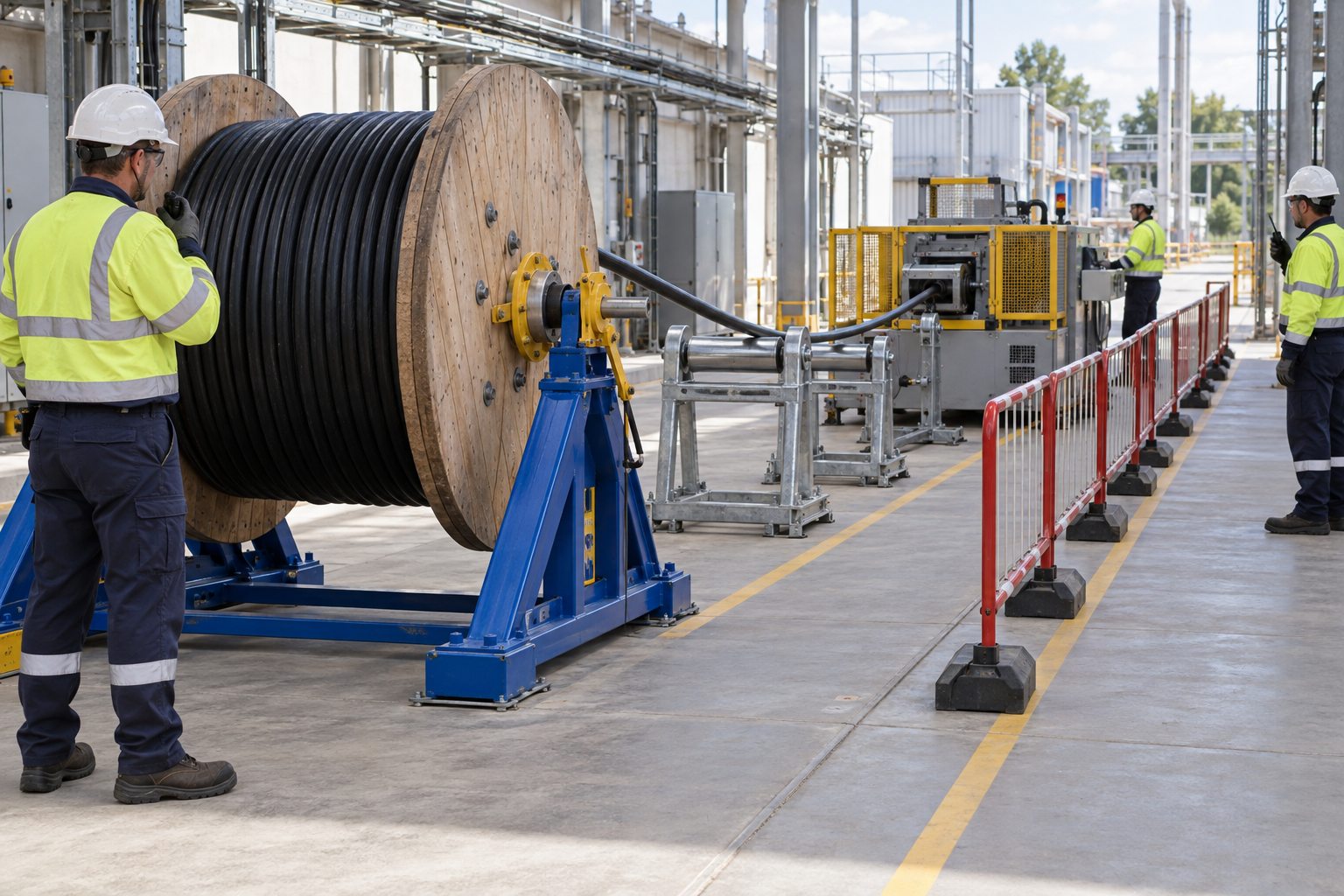
This illustration provides educational context. It is not an actual incident photograph or evidence of equipment suitability; any AI-generated depiction is illustrative only.
The scenario and record comparisons are fictional teaching examples, not records of real incidents, measurements, inspections, signatures or approvals.
| Stage | Fictional situation |
|---|---|
| Initial situation | A fictional feeder pull passes several bends. |
| Changed condition | A roller stops turning freely, cable progress slows and tension rises. |
| Failure path | The crew continues because the displayed value is below the set maximum. |
| Possible outcome | Local damage, connector failure or recoil could develop. |
| Prevention barrier | Stop the pull, prevent restart, support the cable and control residual energy before checking the route and defining the required damage assessment and restart conditions. |
Failure mechanisms
The puller reading does not establish the condition at every bend. Bend radius, cable arrangement and friction affect local forces. Moving one roller can change sidewall pressure and support even when the measured tension remains below its limit.
A stopped puller can leave elastic tension in the rope and cable and gravity load in vertical runs. Before approaching a jam or removing a connector, separately establish restart prevention, access exclusion, cable support and the approved energy-release sequence.
Clearing an obstruction does not establish cable fitness for service. Preserve the time, location and tension trend and assess the affected segment. External appearance or one electrical test cannot prove the absence of every internal or mechanical defect.
Work sequence: Review route and forces → Set drum and puller → Inspect cable and rollers → Trial pull and signals → Pull and monitor bends → Secure and protect ends → Hold obstruction → Inspect and hand over. This is a teaching flow, not a device drawing or a complete operating procedure.
Singapore application
A stopped puller can retain rope tension and vertical cable weight. Support the cable and follow the accepted energy-release order before a person reaches into a bend or disconnects a pulling eye. Changing a roller position needs the route-force assessment checked again.
5. Hold and proceed decisions
| Situation | Required action | Evidence | Proceed when |
|---|---|---|---|
| Tension rises or cable stalls | Stop pulling | Trend, roller and route evidence | Cause corrected |
| Roller moved | Review changed geometry | Bend radius and local force review | Route accepted |
| Puller stopped | Hold access to loaded path | Isolation, support and residual load | Energy controlled |
| Cable reaches destination | Inspect and identify | Damage history and end records | Handover accepted |
Similar observations, different decisions
The scenario and record comparisons are fictional teaching examples, not records of real incidents, measurements, inspections, signatures or approvals.
| Observation | Insufficient conclusion | Required distinction |
|---|---|---|
| Tension below limit | One measured value | Local bend condition separate |
| Puller off | Drive stopped | Stored tension may remain |
| Jacket looks intact | External inspection | Internal condition unproved |
6. Roles and supervision
| Role | Responsibility |
|---|---|
| Work supervisor | Confirm cable and pulling method and the task scope, resources, interfaces and stop authority. |
| Qualified technical reviewer | Review stand and ground, model limits, compatibility and unresolved technical conditions within assigned competence. |
| Work crew | Apply the listed controls, report changes and stop when evidence or safeguards are missing. |
| Inspector / assessor | Record actual recoil and bend boundary and other relevant checks; do not mark unverified conditions as accepted. |
| Handover authority | Reconcile jacket and tension history, restrictions and outstanding actions before the next task. Role labels do not establish a legal credential. |
Supervision and handover focus
| Stage | Management action | Evidence |
|---|---|---|
| Review route and forces | 1. Record cable and pulling method2. Record bends length elevation3. Record drum support basis | 1. Cable and pulling method2. Bends length elevation3. Drum support basis |
| Set drum and puller | 1. Record stand and ground2. Record spindle and braking3. Record puller anchorage | 1. Stand and ground2. Spindle and braking3. Puller anchorage |
| Trial pull and signals | 1. Record tension and roller behavior2. Record drum braking3. Record hands feet exclusion | 1. Tension and roller behavior2. Drum braking3. Hands feet exclusion |
| Pull and monitor bends | 1. Record recoil and bend boundary2. Record tension trend and limits3. Record radius and sidewall review | 1. Recoil and bend boundary2. Tension trend and limits3. Radius and sidewall review |
| Hold obstruction | 1. Record fault time and tension2. Record cable roller condition3. Record isolation record | 1. Fault time and tension2. Cable roller condition3. Isolation record |
| Inspect and hand over | 1. Record jacket and tension history2. Record circuit end identification3. Record sealed ends and route | 1. Jacket and tension history2. Circuit end identification3. Sealed ends and route |
Singapore application
The pulling supervisor retains route, tension and abnormal-event records. Transfer them with sealed-end identity and held cable sections to the electrical team. A successful pull or a single later test does not erase an unresolved mechanical-damage concern.
7. Hold points and record quality
| Hold point | Evidence before release | Actual approval |
|---|---|---|
| HP-0 Scope | Reviewing a new feeder route, setting the drum and puller, checking pulling attachments and rollers, making a controlled trial and continuous pull, securing and sealing ends and handing over inspection records. | |
| HP-1 Set drum and puller | Stand and ground; Spindle and braking; Puller anchorage; Exclusion and escape | |
| HP-2 Trial pull and signals | Tension and roller behavior; Drum braking; Hands feet exclusion; Full-route communication | |
| HP-3 Hold obstruction | Fault time and tension; Cable roller condition; Isolation record; Residual-load control | |
| HP-4 Inspect and hand over | Jacket and tension history; Circuit end identification; Sealed ends and route; Held segments and next work |
Hold points are internal project checks. They are not universal statutory permits and do not grant work permission. Reassess after defects, changed conditions and shift changes.
Record comparison
The scenario and record comparisons are fictional teaching examples, not records of real incidents, measurements, inspections, signatures or approvals.
The boxes are static record prompts, not interactive or saved approvals. A tick does not establish suitability or permission to restart. Record the evidence, person, time and unresolved issues; retain the change history.
| Record | Insufficient record | Record checklist |
|---|---|---|
| Review route and forces | Only marked “OK” | □ Cable and pulling method□ Bends length elevation□ Drum support basis□ Entry and electrical boundary |
| Trial pull and signals | Only marked “OK” | □ Tension and roller behavior□ Drum braking□ Hands feet exclusion□ Full-route communication |
| Hold obstruction | Only marked “OK” | □ Fault time and tension□ Cable roller condition□ Isolation record□ Residual-load control |
| Inspect and hand over | Only marked “OK” | □ Jacket and tension history□ Circuit end identification□ Sealed ends and route□ Held segments and next work |
8. Pre-work checks and emergency response
| Site check | Actual result | Person / action |
|---|---|---|
| Review route and forces: Cable and pulling method; Bends length elevation; Drum support basis; Entry and electrical boundary | ||
| Set drum and puller: Stand and ground; Spindle and braking; Puller anchorage; Exclusion and escape | ||
| Inspect cable and rollers: Cable identity; Roller rating and layout; Electrical safeguards; Connection compatibility | ||
| Trial pull and signals: Tension and roller behavior; Drum braking; Hands feet exclusion; Full-route communication | ||
| Pull and monitor bends: Recoil and bend boundary; Tension trend and limits; Radius and sidewall review; Vertical support | ||
| Secure and protect ends: Residual energy and sequence; Fixing arrangement; End seals and IDs; Tray and support loads | ||
| Hold obstruction: Fault time and tension; Cable roller condition; Isolation record; Residual-load control | ||
| Inspect and hand over: Jacket and tension history; Circuit end identification; Sealed ends and route; Held segments and next work |
Stop work
Stop for tension increase, cable stall, shifted rollers, moving drum/puller support, signal loss or entry into the tension line or inside bend. Hold access and connection release until residual energy and vertical support are verified.
Emergency response
Stop and secure the puller, clear recoil and cable-fall zones and activate site emergency response. Do not enter a manhole or touch adjacent electrical equipment for improvised rescue; qualified responders establish the safe route and energy condition.
Singapore application
Maintain the exclusion area and emergency route after stopping. Do not enter a chamber to free a cable or retrieve a casualty under this JSA; use the separately planned confined-space rescue and electrical safe-state arrangements.
9. Sources and review limits
Public-source review: 14 October 2026. Only the material and limits identified below were reviewed.
| Source | Reviewed material | Task application |
|---|---|---|
| MOM - Risk management | Responsibilities; routine and non-routine work; hierarchy of control and risk assessment team. Official explanation of WSH Risk Management duties, not a complete consolidated statutory text. | Assess recoil, drum support, vertical cable weight and changed route geometry. |
| EMA - Engaging Licensed Electrical Workers | Overview, examples of wiring and circuit work, licence classes and verification of valid licences. Installation, repair or modification of wiring and supply equipment is distinguished from routine operation of an intact appliance. Licence scope must match the installation. | Assign electrical installation and subsequent testing/energisation interfaces to the appropriate licensed team. |
| WSHC - Safe Use of Machinery | Printed pages 4, 27, 37-39: dangerous parts, maintenance training, hazardous-energy isolation, verification, group/shift continuity and restoration. Official guidance with a summary of statutory duties; not a machine-specific safeguard design or full review of current legislation or paid standards. | Prevent restart and control stored mechanical energy before jam access. |
| Singapore Statutes Online - Confined Spaces, entry controls | Indexed sections 9-11: appointed manager/assessor, entry permit and evaluation before entry. Indexed historic consolidation only; not a full current statutory review. It establishes a separate confined-space work boundary here, not a complete entry or rescue procedure. | Keep chamber entry outside this pulling release and arrange the separate current entry-control process if needed. |
Selected public official sources were reviewed on 14 October 2026 within the recorded scope. No full consolidated legal audit, paid Singapore Standard, actual model manual, site inspection, engineering calculation or professional approval is claimed. Verify current detailed requirements and actual equipment/site records before use.
AI-generated reference material. It has not been verified or approved by a professional. Before use, a qualified person must review and adapt it to applicable Singapore requirements, the actual equipment and site, and approved safe work procedures.
10. PDF use and frequently asked questions
PDF A covers basic task controls; B focuses on technical failures; C covers supervision, records and handover. The article has eight stages with four items per main cell; each PDF has six key stages with three items per main cell. P/S/R/A, measurements, confirmations and signatures remain blank for actual site assessment.
PDFs are complementary six-stage extracts. Apply all eight body stages and the actual equipment/site procedure.
Can pulling continue below the tension limit despite a jam?
No. Stalling, shifted rollers, unusual force or support movement are stop conditions independent of the displayed limit.
Can the pulling eye be disconnected immediately after stopping?
Only after restart prevention, cable support and the approved residual-energy release are verified.
Does completed pulling authorize energization?
No. Transfer identification and inspection evidence to separately authorised termination, testing and energization work.
Has a professional verified or approved this document?
No. Public sources and editorial, layout and consistency checks were reviewed using AI. No site inspection or professional technical approval has been performed. Obtain appropriate professional review before use.
Singapore application
Read A, B and C together with all eight JSA stages and the approved work procedure. The sheets are complementary extracts, not separate work authorisations.
11. Authorship and revision history
AI-generated reference material. It has not been verified or approved by a professional. Before use, a qualified person must review and adapt it to applicable Singapore requirements, the actual equipment and site, and approved safe work procedures.
| Date / edition | Authorship and scope | Professional approval |
|---|---|---|
| 2026-09-20 / Korean source | Original topic and educational illustration retained as references. Source content is unchanged. | Not asserted |
| 14 October 2026 / Singapore 1.0 | Added Singapore LEW and separate confined-space entry boundaries, with a local circuit handover and retained tension history rather than force-limit-only acceptance. | Not performed |
Source topic: https://smartjsabridge.com/ko/case-study/jsa-feedercable-pulling