Plans and detector marks do not prove every branch, material or depth. Safely expose the required locations under the relevant asset-owner conditions, reconcile discrepancies and update the work boundary before mechanical excavation.
AI-generated reference material; not professionally verified or approved. Before use, a qualified person must review and adapt it to Singapore requirements, the actual equipment/site and approved safe work procedures.
Stop before starting
Stop for unidentified services, unresolved owner conditions, damaged marks, unsupported entry, loss of signals, new cracks, rising water, soil loss, gas odour or defective plant protection. Do not override a hold to recover the programme.
1. Legal and technical scope
| Basis | Scope and limits |
|---|---|
| MOM: Risk management | Assess buried-service damage, staged support, plant loading, water and emergency recovery together. Official explanation of statutory duties; linked SSO text was not independently read for this item. This is not a legal opinion. |
| WSH Council: Excavation accident advisory, 11 December 2018 | Plan competent supervision, applicable PTW, protected entry and inspections after changed conditions. Dated official guidance, not a full reading of current Construction Regulations or SS 562. Actual statutory exceptions, PE/design and BCA submission requirements require project review; incident details are not reused as the fictional case. |
| EMA: Earthworks contractors | Obtain power/gas plans, NCE response and current Letter of Requirements. Review covers the explanatory requirements, not court cases or a site-specific utility clearance. Other asset owners have separate requirements. |
| EMA: Cable Detection Worker Licence | Use licensed electricity cable detection before earthworks. Licensing explanation does not prove the exact position, depth or safe mechanical approach to a particular service. |
| EMA: Registered Earthworks Supervisor scheme | Assign registered supervision where the high-voltage or medium/high-pressure gas interface applies. Scope-specific supervision; does not replace utility conditions, physical exposure or excavation protection. |
| IMDA: Earthworks Requirements | Complete the distinct telecommunications process and reconcile final approval with actual exposure. Direct page returned little text; official search-indexed page content was read. Full Version 3 PDF not read. Applies to underground telecommunications interface, separate from power/gas and other owners. |
| LTA: Works on Public Streets, April 2026 | For public-street works, obtain applicable LTA.PROMPT permission and coordinate traffic/road-opening requirements. Official public-street process. Private-premises boundaries and road-specific approvals must be checked; internal JSA hold points are not an LTA permit. |
Apply Singapore WSH risk management and the actual construction excavation/PTW requirements. WSH Council excavation guidance calls for a PTW above 1.5 m and competent assessment of protection even in shallower cuts; do not treat depth as proof of stability. Resolve applicable PE design, statutory exceptions and BCA submission conditions for the actual works. EMA requires electricity/gas plans, licensed cable detection, advance NCE and compliance with SP PowerGrid’s Letter of Requirements; the published normal NCE lead time is at least seven days. Engage a Registered Earthworks Supervisor near high-voltage cables and medium/high-pressure gas pipes. Telecommunications requires the separate IMDA process, including licensed TCDW, controlled trial holes, joint inspection and final commencement approval. A submitted notice is not clearance to dig.
2. Scope and required inputs
Included work
Investigate and safely expose buried services, excavate in controlled stages with designed support and plant separation, protect exposed services and coordinate backfill and handback.
Separate assessment
Utility diversion/isolation/repair, confined-space entry, earth-retaining design, trenchless design and excavation impact assessments require their own qualified specialists and procedures.
| Required input | Evidence to obtain |
|---|---|
| Plan the cut | PTW and owner scope; Soil and water data; Emergency contacts; Named owner and rescue arrangements. |
| Locate services | LCDW/TCDW records; NCE and owner conditions; Marks and limits; Unidentified branches and changes recorded. |
| Prepare plant | Coupler test; Platform condition; Spotter signals; Overhead route and unloading method checked. |
| Expose services | Actual line position; Tool and jet settings; Pit protection; Owner attendance or isolation conditions met. |
No actual equipment model, site measurements, design calculations or signed approval was supplied. Check the applicable Singapore requirements and approved safe work procedures against the actual equipment and site before use. Statutory duties, official guidance and manufacturer limits serve different purposes; editorial checks do not establish legal or professional approval.
Singapore site application
In a congested Singapore service corridor, maintain an owner-by-owner register for power, gas, telecommunications, water and used-water infrastructure. Record unresolved responses and do not treat one utility’s acceptance as clearance for all services.
Record exposed coordinates, depth, offset, support and plant positions in m or mm with the survey reference. Review rainfall, groundwater and pump discharge against the current support/earth-control plan. No universal 1 m utility radius, plant setback, wind or rainfall limit is assigned.
3. Eight-stage JSA
| Job stage | Hazards and effects | Failure factors | Technical and procedural controls | Site verification | P | S | R | A |
|---|---|---|---|---|---|---|---|---|
| 1. Plan the cut | 1. Utility strike2. Ground collapse3. Traffic intrusion4. Rupturing high-pressure natural gas lines causing uncontrolled vapour cloud explosions | 1. Plans out of date2. No soil review3. Unclear work limits4. Relying exclusively on outdated, unverified municipal utility record drawings | 1. Agree utility contacts2. Design support and access3. Approve traffic layout4. Plan emergency isolation and rescue before opening the cut. | 1. PTW and owner scope2. Soil and water data3. Emergency contacts4. Named owner and rescue arrangements. | ||||
| 2. Locate services | 1. Cable arc2. Gas release3. Hidden branch line4. Striking buried medium/high-voltage electrical cables causing arc flash and electrocution | 1. Paint treated as depth2. Detector used alone3. No owner response4. Traffic protection does not match the actual work zone. | 1. Combine plans and survey2. Resolve missing responses3. Mark uncertainty zone4. Repeat tracing as the excavation progresses and protect surviving marks. | 1. LCDW/TCDW records2. NCE and owner conditions3. Marks and limits4. Unidentified branches and changes recorded. | ||||
| 3. Prepare plant | 1. Bucket drop2. Rollover3. Crushing4. Run-over or struck-by crushing incidents during excavator maneuvering on soft soils | 1. Coupler not locked2. Weak working platform3. Blind reversing4. Plant inspection omitted | 1. Test hitch per manual2. Assess plant bearing area3. Separate people and plant4. Keep overhead-line clearance and unloading limits within the equipment plan. | 1. Coupler test2. Platform condition3. Spotter signals4. Overhead route and unloading method checked. | ||||
| 4. Expose services | 1. Pipe puncture2. Pit collapse3. Jet injury4. Direct bucket tooth strike puncturing gas mains or slicing high-voltage conduits | 1. Unknown line depth2. Unsafe pit entry3. Excess jet pressure4. Blind probing of unknown ground | 1. Use owner-approved method2. Protect pit before entry3. Expose route and branches4. Do not treat insulated tools or vacuum digging as permission to damage a live service. | 1. Actual line position2. Tool and jet settings3. Pit protection4. Owner attendance or isolation conditions met. | ||||
| 5. Excavate in bays | 1. Surcharge collapse2. Bucket impact3. Falling spoil4. Worker struck by rotating counterweight or crushed against trench walls (blind spots) | 1. Plant too near edge2. Person in swing area3. Cut exceeds design4. Spoil stored at unsupported edge | 1. Follow staged cut plan2. Keep swing area clear3. Set loads back by design4. Do not undermine existing foundations or utility restraints. | 1. Bay and depth2. Load setback3. Service support4. Adjacent structures and thrust blocks protected. | ||||
| 6. Support and enter | 1. Wall collapse2. Falling shield3. Blocked escape4. Struck-by trauma or rigging failure while hoisting heavy steel trench shields | 1. Wrong support model2. Entry before protection3. Unsafe lifting points4. Support arrangement or allowable gaps differ from the approved design. | 1. Install from safe position2. Check design and assembly3. Provide protected access4. Provide separate support for exposed services; do not assume the shield carries them. | 1. Support inspection2. Access route3. Entry release4. Service-support design checked independently. | ||||
| 7. Control water | 1. Soil washout2. Gas exposure3. New ground cracks4. Trench wall structural degradation and boiling caused by rising groundwater or rain | 1. Pump removes fines2. Air risks ignored3. Rain change unchecked4. Surface runoff enters cut | 1. Follow dewatering design2. Assess and test air risks3. Evacuate on deterioration4. Prevent pump discharge from returning to the excavation or undermining nearby ground. | 1. Water and soil trend2. Air assessment3. Reinspection record4. Discharge route and standby arrangements checked. | ||||
| 8. Backfill and close | 1. Unsupported service2. Road plate movement3. Public falls4. Workers struck by heavy steel road plates while handling rigging pins during demob | 1. Supports pulled early2. Unknown cover strength3. Open cut left unguarded4. Runoff enters open cut | 1. Coordinate support removal2. Verify service bedding3. Secure covers and barriers4. Record concealed service position before cover and retain barriers until handback. | 1. Backfill sequence2. Owner handback3. End-of-shift security4. As-built position and receiving party recorded. |
P = likelihood; S = severity; R = risk under the site method; A = site-defined acceptance/authorization. These actual assessment cells are blank. A low score never overrides a missing safeguard or a legal or manufacturer restriction.
4. Fictional scenario and failure mechanisms
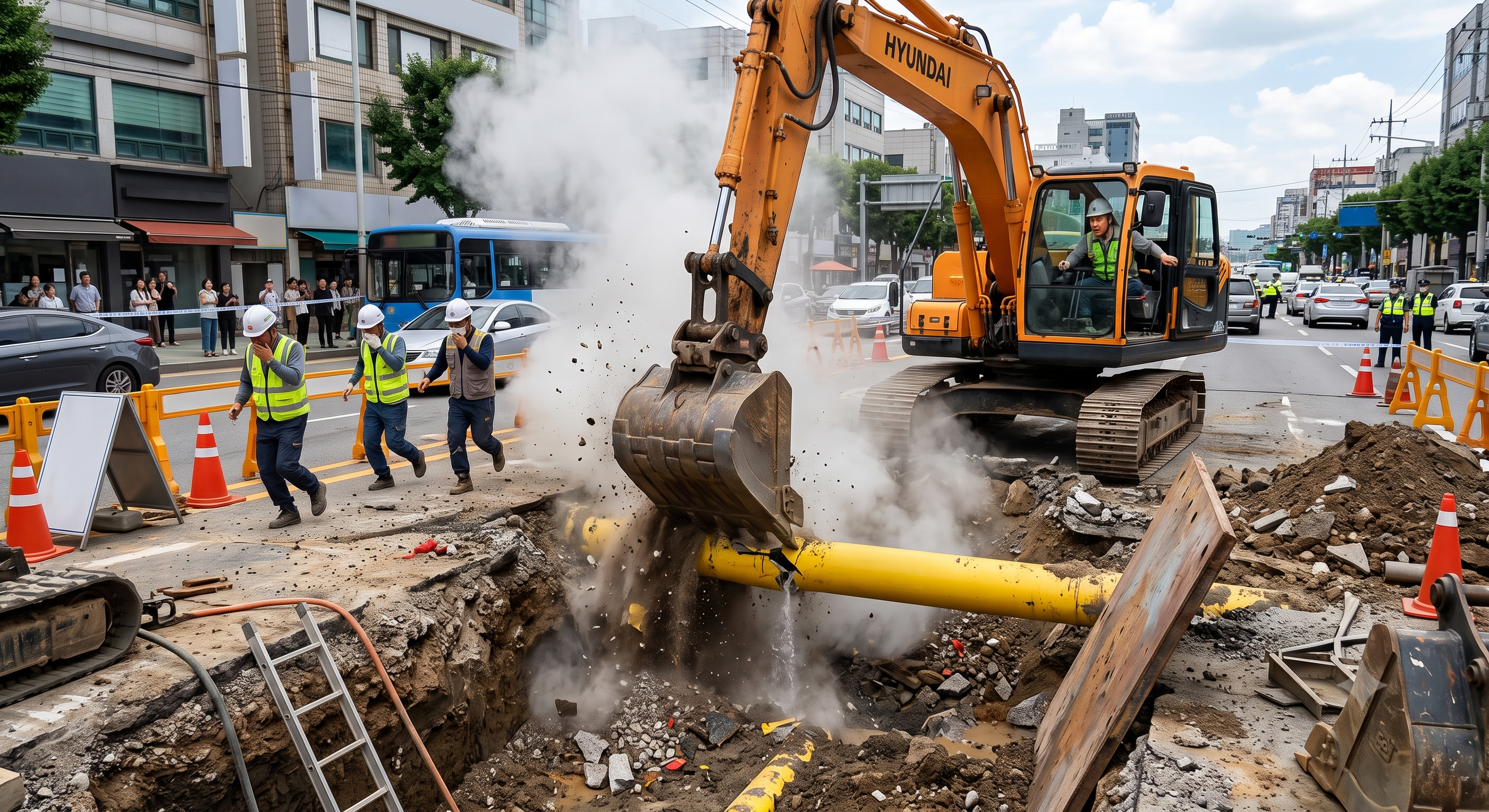
This illustration provides educational context. It is not an actual incident photograph or evidence of equipment suitability; any AI-generated depiction is illustrative only.
The scenario and record comparisons are fictional teaching examples, not records of real incidents, measurements, inspections, signatures or approvals.
| Stage | Fictional situation |
|---|---|
| Initial situation | A fictional crew compares drawings and marks during trial excavation. |
| Changed condition | An unidentified service appears away from the marked route while seepage increases. |
| Failure path | The crew proposes continuing with the excavator because the discovery is outside the original line. |
| Possible outcome | The bucket could damage the unknown service and the wet unsupported edge could fail. |
| Prevention barrier | Stop the bay, control access, contact the relevant owners and revise exposure, drainage and support before a new release. |
Failure mechanisms
Plans and detector marks do not prove every branch, material or depth. Safely expose the required locations under the relevant asset-owner conditions, reconcile discrepancies and update the work boundary before mechanical excavation.
Excavation removes confinement; soil layers, groundwater, adjacent foundations, spoil and plant loads affect stability together. Do not advance the cut beyond the accepted support sequence or let workers enter before protection and access are verified.
A trench shield protects within its design limits but does not automatically stabilise surrounding ground, carry exposed services or protect people outside its ends. Utility support requires its own accepted load path and removal sequence.
Water can erode fines or undermine nearby ground. Changed seepage, cracks, soil loss or rainfall requires withdrawal and reassessment; a running pump alone does not demonstrate stability.
A newly exposed service outside a painted route remains a stop condition. Owner confirmation, revised protection and safe trial exposure must precede release; a permit or completed notification does not identify the unknown asset.
Decision sequence
| Step | Decision |
|---|---|
| Known | Actual service position differs from the plan and water conditions have changed. |
| Unknown | Service type/status, branches, protection and ground stability remain unresolved. |
| Hold | Stop mechanical digging and entry in the affected bay. |
| Evidence | Link owner responses, safe exposure, revised survey, support and water assessment to that bay. |
| Release | Accept the specific protected area and permit/owner conditions; recheck after further discovery or change. |
Work sequence: Plan the cut → Locate services → Prepare plant → Expose services → Excavate in bays → Support and enter → Control water → Backfill and close. This is a teaching flow, not a device drawing or a complete operating procedure.
5. Conditional decisions and common errors
| Situation | Required action | Evidence | Proceed when |
|---|---|---|---|
| Unknown service | Stop digging and approach | Owner and exposure evidence | Route resolved |
| Cracks or seepage | Withdraw; restrict access | Ground/support review | Protection accepted |
| Service sags | Keep clear | Owner support detail | Support verified |
| After rain or change | Reinspect bay | Water, loads and support | Fresh release recorded |
Similar observations, different decisions
The scenario and record comparisons are fictional teaching examples, not records of real incidents, measurements, inspections, signatures or approvals.
| Observation | Insufficient conclusion | Required distinction |
|---|---|---|
| NCE submitted | Excavation is approved. | Obtain the relevant requirements/approvals and complete physical safeguards. |
| Detector mark exists | Exact depth and all branches are known. | Confirm through safe exposure and owner coordination. |
| Cut below 1.5 m | Protection is unnecessary. | Assess actual collapse, water, surcharge and access hazards. |
6. Roles and responsibilities
| Role | Responsibility |
|---|---|
| Excavation supervisor | Coordinate bays, competent supervision, permits, plant separation and stop authority. |
| Utility liaison / detection specialists | Track each owner response and relevant LCDW/TCDW evidence; reconcile trial exposure. |
| RES where required | Supervise the scoped high-voltage/gas interface under applicable requirements. |
| Ground/support designer and assessor | Resolve actual protection, sequence, loads, water and required PE/BCA conditions. |
| Receiving owner / shift | Accept supported services, backfill sequence, as-built records and public protection. |
Supervision and handover focus
| Stage | Management action | Evidence |
|---|---|---|
| Plan the cut | 1. Record ptw and owner scope2. Record soil and water data3. Record emergency contacts | 1. PTW and owner scope2. Soil and water data3. Emergency contacts |
| Locate services | 1. Record lcdw/tcdw records2. Record nce and owner conditions3. Record marks and limits | 1. LCDW/TCDW records2. NCE and owner conditions3. Marks and limits |
| Expose services | 1. Record actual line position2. Record tool and jet settings3. Record pit protection | 1. Actual line position2. Tool and jet settings3. Pit protection |
| Support and enter | 1. Record support inspection2. Record access route3. Record entry release | 1. Support inspection2. Access route3. Entry release |
| Control water | 1. Record water and soil trend2. Record air assessment3. Record reinspection record | 1. Water and soil trend2. Air assessment3. Reinspection record |
| Backfill and close | 1. Record backfill sequence2. Record owner handback3. Record end-of-shift security | 1. Backfill sequence2. Owner handback3. End-of-shift security |
7. Hold points and record comparison
| Hold point | Evidence before release | Actual approval |
|---|---|---|
| HP-0 Scope | Investigate and safely expose buried services, excavate in controlled stages with designed support and plant separation, protect exposed services and coordinate backfill and handback. | |
| HP-1 Locate services | LCDW/TCDW records; NCE and owner conditions; Marks and limits; Unidentified branches and changes recorded. | |
| HP-2 Expose services | Actual line position; Tool and jet settings; Pit protection; Owner attendance or isolation conditions met. | |
| HP-3 Support and enter | Support inspection; Access route; Entry release; Service-support design checked independently. | |
| HP-4 Backfill and close | Backfill sequence; Owner handback; End-of-shift security; As-built position and receiving party recorded. |
Hold points are internal project checks. They are not universal statutory permits and do not grant work permission. Reassess after defects, changed conditions and shift changes.
Record comparison
The scenario and record comparisons are fictional teaching examples, not records of real incidents, measurements, inspections, signatures or approvals.
The boxes are static record prompts, not interactive or saved approvals. A tick does not establish suitability or permission to restart. Record the evidence, person, time and unresolved issues; retain the change history.
| Record | Insufficient record | Record checklist |
|---|---|---|
| Plan the cut | Only marked “OK” | □ PTW and owner scope□ Soil and water data□ Emergency contacts□ Named owner and rescue arrangements. |
| Expose services | Only marked “OK” | □ Actual line position□ Tool and jet settings□ Pit protection□ Owner attendance or isolation conditions met. |
| Control water | Only marked “OK” | □ Water and soil trend□ Air assessment□ Reinspection record□ Discharge route and standby arrangements checked. |
| Backfill and close | Only marked “OK” | □ Backfill sequence□ Owner handback□ End-of-shift security□ As-built position and receiving party recorded. |
8. Site checklist and emergency response
| Site check | Actual result | Person / action |
|---|---|---|
| Plan the cut: PTW and owner scope; Soil and water data; Emergency contacts; Named owner and rescue arrangements. | ||
| Locate services: LCDW/TCDW records; NCE and owner conditions; Marks and limits; Unidentified branches and changes recorded. | ||
| Prepare plant: Coupler test; Platform condition; Spotter signals; Overhead route and unloading method checked. | ||
| Expose services: Actual line position; Tool and jet settings; Pit protection; Owner attendance or isolation conditions met. | ||
| Excavate in bays: Bay and depth; Load setback; Service support; Adjacent structures and thrust blocks protected. | ||
| Support and enter: Support inspection; Access route; Entry release; Service-support design checked independently. | ||
| Control water: Water and soil trend; Air assessment; Reinspection record; Discharge route and standby arrangements checked. | ||
| Backfill and close: Backfill sequence; Owner handback; End-of-shift security; As-built position and receiving party recorded. |
Stop work
Stop for unidentified services, unresolved owner conditions, damaged marks, unsupported entry, loss of signals, new cracks, rising water, soil loss, gas odour or defective plant protection. Do not override a hold to recover the programme.
Emergency response
Withdraw along a safe route, prevent approach and contact the site emergency team and asset owner from safety. Call 995 for a medical emergency. Do not enter an unstable or contaminated trench or approach electrically exposed plant for improvised rescue. Avoid ignition sources and unplanned switching near a suspected gas release.
9. Sources and review limits
Public-source access/review: 2026-10-14.
| Official source | Reviewed scope and limits |
|---|---|
| MOM: Risk management | Assess buried-service damage, staged support, plant loading, water and emergency recovery together. Official explanation of statutory duties; linked SSO text was not independently read for this item. This is not a legal opinion. |
| WSH Council: Excavation accident advisory, 11 December 2018 | Plan competent supervision, applicable PTW, protected entry and inspections after changed conditions. Dated official guidance, not a full reading of current Construction Regulations or SS 562. Actual statutory exceptions, PE/design and BCA submission requirements require project review; incident details are not reused as the fictional case. |
| EMA: Earthworks contractors | Obtain power/gas plans, NCE response and current Letter of Requirements. Review covers the explanatory requirements, not court cases or a site-specific utility clearance. Other asset owners have separate requirements. |
| EMA: Cable Detection Worker Licence | Use licensed electricity cable detection before earthworks. Licensing explanation does not prove the exact position, depth or safe mechanical approach to a particular service. |
| EMA: Registered Earthworks Supervisor scheme | Assign registered supervision where the high-voltage or medium/high-pressure gas interface applies. Scope-specific supervision; does not replace utility conditions, physical exposure or excavation protection. |
| IMDA: Earthworks Requirements | Complete the distinct telecommunications process and reconcile final approval with actual exposure. Direct page returned little text; official search-indexed page content was read. Full Version 3 PDF not read. Applies to underground telecommunications interface, separate from power/gas and other owners. |
| LTA: Works on Public Streets, April 2026 | For public-street works, obtain applicable LTA.PROMPT permission and coordinate traffic/road-opening requirements. Official public-street process. Private-premises boundaries and road-specific approvals must be checked; internal JSA hold points are not an LTA permit. |
No actual equipment model, site measurements, design calculations or signed approval was supplied. Check the applicable Singapore requirements and approved safe work procedures against the actual equipment and site before use. Statutory duties, official guidance and manufacturer limits serve different purposes; editorial checks do not establish legal or professional approval.
10. PDF guidance and FAQ
PDF A covers basic task controls; B focuses on technical failures; C covers supervision, records and handover. The article has eight stages with four items per main cell; each PDF has six key stages with three items per main cell. P/S/R/A, measurements, confirmations and signatures remain blank for actual site assessment.
PDFs are complementary six-stage extracts. Apply all eight body stages and the actual equipment/site procedure.
Is 1 m a universal safe digging distance?
No. Use the actual service, owner conditions, confirmed position and permitted method.
Does electricity detection cover telecommunications?
No. Follow the respective licensed detection and owner approval processes.
Can shallow excavation be entered freely?
No. Assess stability, water, loads, access and protection at the actual depth.
What changes require reassessment?
Unknown assets, rain, ground movement, soil loss, changed loads or changed excavation/support sequence.
Has a professional verified or approved this document?
AI-generated reference material; not professionally verified or approved. Before use, a qualified person must review and adapt it to Singapore requirements, the actual equipment/site and approved safe work procedures.
11. Revision history and authorship
AI-generated reference material; not professionally verified or approved. Before use, a qualified person must review and adapt it to Singapore requirements, the actual equipment/site and approved safe work procedures.
| Date | Version | Change | Review status |
|---|---|---|---|
| 2026-10-14 | SG 1.0 | New Singapore edition from assigned Korean source; task decisions, records and PDFs localized. | AI editorial review; no professional technical approval |
Korean edition revision history: 2026-07-21: earlier published draft/version retained in the source history; 2026-10-04 (v1.1): task decisions, record checklist, JSA and three PDF variants revised. These are editorial records, not professional technical approval. Singapore v1.0 adapts the earlier edition to Singapore requirements and terminology.
Site reviewers must add their actual qualifications, scope, date and approval only after the review occurs.