Low-voltage temporary board mounting, protected cable routing, isolated wiring, dead tests, controlled live tests and handover by appropriately licensed electrical personnel.
Keep affected circuits isolated for unknown sources, unverified protective continuity, failed tests, water ingress, damaged cables, overheating or unexplained trips. Do not repeatedly reset a fault.
AI-generated reference material. It has not been professionally verified or approved. Before use, a suitably qualified person must review and adapt it to applicable Singapore requirements, the actual equipment and site, and approved safe work procedures.
1. Legal and technical scope
Singapore temporary construction electrical installations require the applicable EMA installation licence regardless of approved load. The owner/user must appoint a licensed electrical worker of the appropriate class to take charge; arrange required inspection and fitness certification before use. A generator-fed non-domestic supply installation also falls within the licensing framework. Apply WSH electrical isolation and risk management, and connect site access and load changes to the LEW. A completed installation checklist does not replace that responsibility.
Assess the actual activity under the applicable Singapore WSH requirements. Statutory duties, official guidance, manufacturer instructions and approved project documents have distinct roles. A site hold point is not automatically a statutory permit. Use competent local review to resolve the applicable industry, installation, access and permit requirements.
| Basis | Application and limits |
|---|---|
| MOM risk management | Official explanation: risk assessment, control, monitoring and communication for routine and non-routine work, including maintenance; reviewed 14 October 2026. |
| WSHC electrical safety | Official guidance: maintenance energy isolation, stored-energy control, verification and reinstatement; electrical scope still requires applicable EMA authorisation. |
| EMA worker licences | Official explanation of licensed electrical work, supervision and the distinction where equipment work involves no wiring. Actual electrical duties require the appropriate licence class. |
| EMA Electrical/Supply Installation Licences | Official distinction between grid and generator supply installations; construction/hazardous-trade and non-domestic supply installations require licensing regardless of approved load. Appropriate-class LEW responsibility, inspection and fitness before use reviewed; no installation standard read in full. |
| WSHC Preventing Falls from Heights | Official explanation of access, fall-prevention plans, hazardous-WAH permits in factories and supervisor/assessor/authorised-manager roles. General fall controls are not limited to the permit threshold. |
| SCDF emergency medical services | Official 995 emergency ambulance service information; use emergency services for actual emergencies. |
2. Scope and required inputs
Included: Low-voltage temporary board mounting, protected cable routing, isolated wiring, dead tests, controlled live tests and handover by appropriately licensed electrical personnel.
Separate review: Live installation, high-voltage work, explosive-atmosphere work, protection redesign and work near utility lines require separate procedures. Elevated cable supports require planned access and fall controls.
| Input | Required evidence |
|---|---|
| Plan supply | Source drawing; Load schedule; Protection settings; LEW and installation licence |
| Mount and bond | Stand and drainage; Covers secured; PE continuity; Earthing arrangement |
| Dead tests | Test configuration; Instrument identity; Actual test readings; Defects closed |
| Handover | As-built drawing; Receiving person; Isolation for removal; Approval and date |
Use the actual supply and earthing design, source/fault data, load schedule, cable installation conditions, protection settings, manufacturer test method and acceptance criteria. No universal RCD trip setting, electrode resistance, IP rating, overhead clearance or insulation-test voltage is supplied.
3. Eight-stage JSA
P = likelihood; S = severity; R = risk under the site method; A = acceptance or authorization as defined by the site. Leave these blank until actual assessment and control verification. A low score does not override a legal requirement, product limit or unreleased hold point.
| Job stage | Hazards and effects | Failure factors | Required controls | Site verification | P | S | R | A |
|---|---|---|---|---|---|---|---|---|
| 1. Plan supply | 1. Backfeed2. Excess load3. Wrong protection4. Unknown fault level | 1. Sources not traced2. Loads not listed3. Device mismatched4. No earthing design | 1. Map every source2. Size cable and protection3. Select earthing system4. Assign appropriate-class LEW | 1. Source drawing2. Load schedule3. Protection settings4. LEW and installation licence | ||||
| 2. Isolate | 1. Electric shock2. Stored charge3. Unexpected restart4. Adjacent live parts | 1. Wrong isolator2. Remote start enabled3. Tester not proved4. Neutral overlooked | 1. Lock all sources off2. Disable auto restart3. Prove dead by contact4. Guard adjacent live parts | 1. Lock identifiers2. Tester before/after3. All conductors checked4. Discharge verified | ||||
| 3. Mount and bond | 1. Cabinet overturn2. Water ingress3. Touch voltage4. Access blocked | 1. Stand unsecured2. Glands unsuitable3. PE path broken4. Rod treated as PE | 1. Anchor stable stand2. Fit rated glands3. Bond PE to design4. Keep isolator accessible | 1. Stand and drainage2. Covers secured3. PE continuity4. Earthing arrangement | ||||
| 4. Route and wire | 1. Vehicle crush2. Sharp edge damage3. Loose hot terminal4. Coupler water ingress | 1. Route not protected2. Excess pulling force3. Torque guessed4. Tape-only repair | 1. Guard vehicle crossing2. Support without strain3. Use specified torque4. Remove damaged leads | 1. Route clearance2. Cable identification3. Torque record4. Coupler and seal | ||||
| 5. Dead tests | 1. Test voltage shock2. Electronics damaged3. False pass4. Retained test charge | 1. Loads still connected2. Wrong test voltage3. PE not tested4. Result copied | 1. Secure test boundary2. Isolate sensitive loads3. Test PE, polarity, IR4. Discharge and recheck | 1. Test configuration2. Instrument identity3. Actual test readings4. Defects closed | ||||
| 6. Live tests | 1. Arc flash2. Unexpected start3. Protection failure4. Contact with voltage | 1. Dead tests incomplete2. People in test zone3. Wrong device test4. Test button only | 1. Release test hold point2. Use authorised LEW tester3. Control energisation4. Test specified protection | 1. Dead-test review2. Device and test mode3. Trip result record4. Covers restored | ||||
| 7. Use and faults | 1. Wet damaged cable2. Repeated fault3. Overloaded lead4. Unauthorised opening | 1. Flood damage ignored2. Blind breaker reset3. New load not reviewed4. Door left open | 1. Check before use2. Isolate any defect3. Review load changes4. Retest after repair | 1. Route condition2. Fault diagnosis3. Retest evidence4. Restart authorisation | ||||
| 8. Handover | 1. Hidden change2. Unknown live cable3. Unsafe dismantling4. Open defect handed on | 1. Drawing outdated2. No circuit labels3. Disconnect under load4. Records missing | 1. Update circuit register2. Brief incoming team3. Isolate before removal4. Close or isolate defects | 1. As-built drawing2. Receiving person3. Isolation for removal4. Approval and date |
4. Hypothetical scenario and failure mechanisms
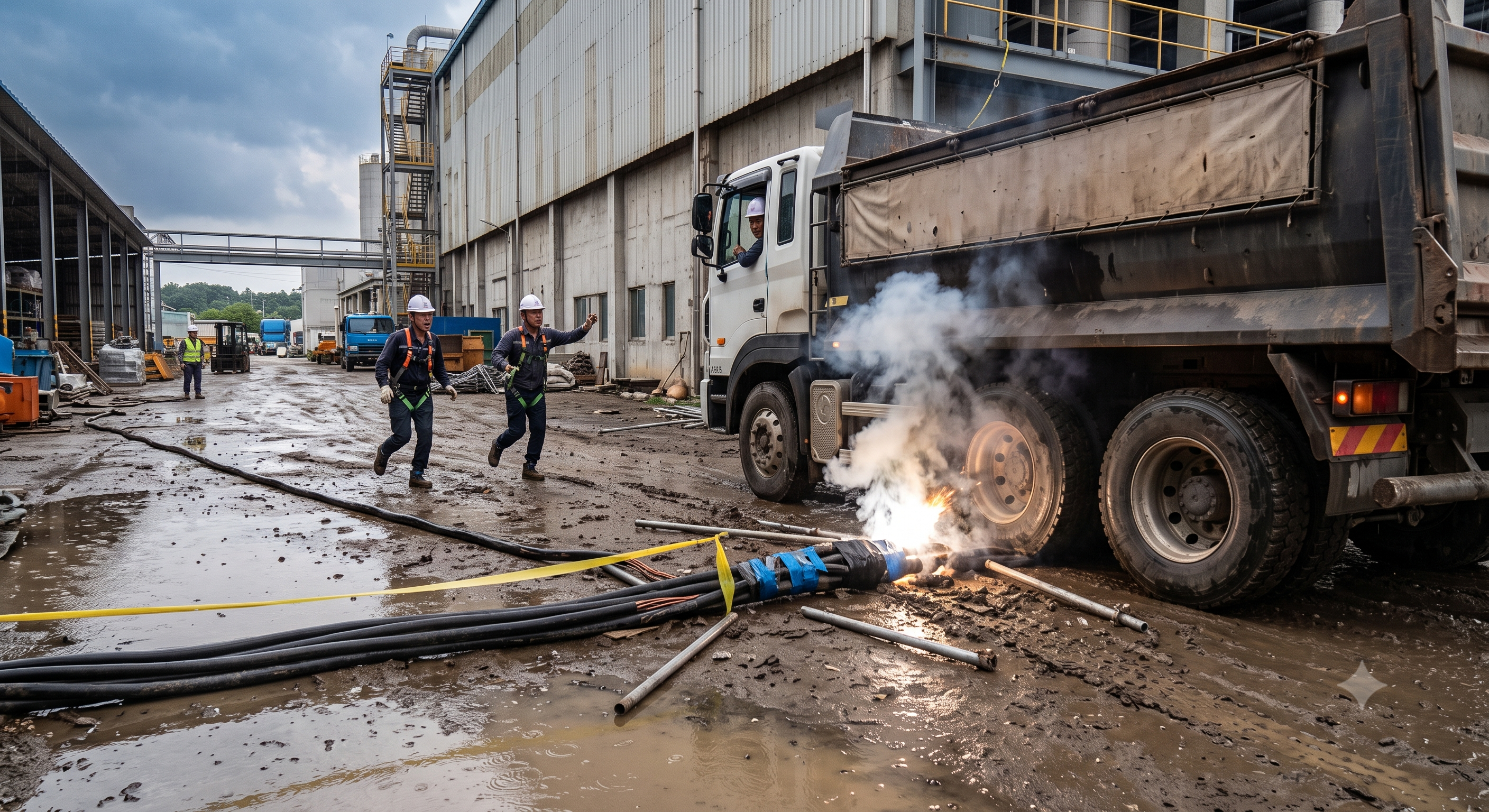 Retained source illustration: an AI-generated educational concept, not a real incident photograph or evidence of equipment suitability.
The following scenario, comparisons and example records are hypothetical teaching material. They do not reproduce actual incidents, measurements, signatures or approvals.
| Item | Hypothetical situation |
|---|---|
| Initial state | A temporary board is ready for energisation after wiring. |
| Change | The RCD test button operates but a connected appliance protective conductor remains unverified. |
| Failure path | Internal device operation is mistaken for proof of the external protective path. |
| Possible harm | A fault on the appliance enclosure could expose a user to shock. |
| Barrier | Hold energisation and have the LEW review separate continuity, circuit, insulation and protective-device evidence before release. |
The protective conductor, bonding and supply earthing arrangement form a designed protective system. Electrode resistance, protective-conductor continuity and fault-loop performance answer different questions. An earth rod is not a substitute for the circuit protective conductor.
A test button checks its device function and does not prove the whole installation. Select device type, settings, waveform compatibility and test method for the circuit; residual-current protection does not automatically provide overload protection.
Isolate every grid, generator, UPS, battery and backfeed source and control automatic restart and stored charge. Use suitable contact testing with instrument checks before and after; a stopped machine or non-contact indication alone is insufficient.
Insulation testing can damage connected electronics and introduce hazardous voltage. Establish the test boundary, protect sensitive loads, discharge and verify afterwards. Record actual readings and criteria rather than copying a pass label.
Cable performance depends on load, grouping, temperature, length and installation method. Verify actual vehicle clearance, strain relief, sharp-edge protection and wet conditions. The LEW must review changes before extra loads or repaired circuits return to use.
| Decision | Reason and evidence |
|---|---|
| Known facts | The RCD test button operates but a connected appliance protective conductor remains unverified. |
| Unresolved | Internal device operation is mistaken for proof of the external protective path. |
| Hold reason | Keep affected circuits isolated for unknown sources, unverified protective continuity, failed tests, water ingress, damaged cables, overheating or unexplained trips. Do not repeatedly reset a fault. |
| Evidence needed | Test configuration; Instrument identity; Actual test readings; Defects closed. |
| Next decision | Hold energisation and have the LEW review separate continuity, circuit, insulation and protective-device evidence before release. |
5. Conditional decisions and common errors
| Condition | Action | Evidence | Proceed when |
|---|---|---|---|
| Source unknown | Hold and trace all feeds. | Drawing isolation and backfeed evidence. | Boundary verified. |
| Dead test fails | Repair while isolated. | Actual result and retest record. | Required tests accepted. |
| Live test needed | Control separate test state. | LEW test plan and clear boundary. | Test release obtained. |
| Water or repeated trip | Restrict access and isolate. | Cause repair and retest evidence. | LEW release recorded. |
| Comparison | Situation A | Situation B |
|---|---|---|
| RCD button operates | Protective path and installation tests also verified. | External protective conductor unknown. |
| Circuit labelled passed | Actual readings and criteria linked. | Only a coloured label available. |
6. Roles and responsibilities
| Role | Responsibility |
|---|---|
| Work supervisor | Confirm scope, task sequence, exclusion and stop authority. Coordinate plan supply with affected operations. |
| Technical reviewer | Resolve the actual design and equipment limits: Source drawing; Load schedule; Protection settings; LEW and installation licence. |
| Work crew | Perform mount and bond using the approved procedure; report any mismatch before proceeding. |
| Inspector / assessor | Verify Dead-test review; Device and test mode; Trip result record; Covers restored. Record what was actually checked and what remains unresolved. |
| Release / receiving authority | Confirm As-built drawing; Receiving person; Isolation for removal; Approval and date. Transfer restrictions and the next permitted stage. |
These are responsibility examples, not invented statutory credentials. Meet the actual training, competent-person, qualified-person and licensing requirements for the assigned work. Anyone may raise a hazard and request a stop; only the designated authority may release the affected stage after evidence is reviewed.
7. Hold points and record comparison
| Hold point | Evidence before release | Confirmation / approval |
|---|---|---|
| HP-0 Start | Scope, jurisdiction, equipment identity, responsible people and emergency arrangements. | |
| HP-1 Isolate | Lock identifiers; Tester before/after; All conductors checked; Discharge verified | |
| HP-2 Dead tests | Test configuration; Instrument identity; Actual test readings; Defects closed | |
| HP-3 Live tests | Dead-test review; Device and test mode; Trip result record; Covers restored | |
| HP-4 Handover | As-built drawing; Receiving person; Isolation for removal; Approval and date |
Hold points are internal evidence gates. They do not replace statutory permits or actual signatures. Recheck affected gates after a change, abnormal event or shift transfer. The blank record must identify the evidence, person, time, limits and release scope.
| Record | Insufficient record | Record checklist |
|---|---|---|
| Isolation | Power off | □ Lock identifiers□ Tester before/after□ All conductors checked□ Discharge verified |
| Connections | Paint mark seen | □ Route clearance□ Cable identification□ Torque record□ Coupler and seal |
| Tests | Passed | □ Test configuration□ Instrument identity□ Actual test readings□ Defects closed |
| Handover | Green label | □ As-built drawing□ Receiving person□ Isolation for removal□ Approval and date |
The □ boxes are static prompts, not saved or interactive approvals. Each checks one record element. A tick alone does not establish suitability or permission to restart. Link equipment IDs and supporting records; retain unresolved matters and the earlier record when conditions change.
8. Site checklist and emergency response
| Check item | Result | Person / action |
|---|---|---|
| Source drawing | ||
| Lock identifiers | ||
| Stand and drainage | ||
| Route clearance | ||
| Test configuration | ||
| Dead-test review | ||
| Route condition | ||
| As-built drawing | ||
| Emergency arrangements and unresolved restrictions communicated |
Stop work: Keep affected circuits isolated for unknown sources, unverified protective continuity, failed tests, water ingress, damaged cables, overheating or unexplained trips. Do not repeatedly reset a fault.
Emergency response: Do not touch a casualty, flooded board or damaged cable until the electrical hazard is controlled. Have authorised personnel isolate from a safe position, restrict access and activate the site response. Call SCDF 995 for serious injury, fire or urgent rescue. Trained responders provide rescue and first aid only after the scene is safe.
9. Sources and review limits
Official-source review date: October 14, 2026. The following review is limited to the public provisions or selected manufacturer material identified below. It does not establish that any authority approved this article or the actual installation.
- MOM risk management: Official explanation: risk assessment, control, monitoring and communication for routine and non-routine work, including maintenance; reviewed 14 October 2026.
- WSHC electrical safety: Official guidance: maintenance energy isolation, stored-energy control, verification and reinstatement; electrical scope still requires applicable EMA authorisation.
- EMA worker licences: Official explanation of licensed electrical work, supervision and the distinction where equipment work involves no wiring. Actual electrical duties require the appropriate licence class.
- EMA Electrical/Supply Installation Licences: Official distinction between grid and generator supply installations; construction/hazardous-trade and non-domestic supply installations require licensing regardless of approved load. Appropriate-class LEW responsibility, inspection and fitness before use reviewed; no installation standard read in full.
- WSHC Preventing Falls from Heights: Official explanation of access, fall-prevention plans, hazardous-WAH permits in factories and supervisor/assessor/authorised-manager roles. General fall controls are not limited to the permit threshold.
- SCDF emergency medical services: Official 995 emergency ambulance service information; use emergency services for actual emergencies.
Paid consensus standards and site-specific calculations, manuals, inspection records and product certificates were not independently obtained or verified unless specifically identified. Korean and overseas legal references are source history, not Singapore statutory duties. Singapore Standards and model-specific limits were not read in full unless expressly identified.
10. PDF guidance and FAQ
PDF A covers basic task controls; B examines technical failures; C focuses on supervision, evidence and handover. Each has six rows and three items per main cell. They are complementary extracts: apply all eight body stages and the applicable site procedure. An omitted stage is not permission to omit its controls. PDF HP-0 through HP-4 are worksheet labels; match the event, evidence and authority rather than assuming they match another permit by number.
P/S/R/A, actual measurements, confirmations and signatures remain blank. The PDFs are uncompleted reference worksheets, not issued work permits.
Content group ID: jsa-electrical-safety
Does the test button prove earthing?
No. Check the external protective path and other required tests separately.
Can all circuits use one insulation-test voltage?
No. Follow the actual circuit and equipment limits and protect sensitive loads.
Does short-term construction use avoid licensing?
EMA identifies construction electrical installations as licensable regardless of approved load. Confirm the actual arrangement with the appointed LEW.
May an unexplained trip simply be reset?
Keep the affected circuit out of service until the cause is assessed and required correction and retesting are complete.
Has a professional verified or approved this document?
AI-generated reference material. It has not been professionally verified or approved. Before use, a suitably qualified person must review and adapt it to applicable Singapore requirements, the actual equipment and site, and approved safe work procedures.
11. Revision history and authorship
AI-generated reference material. It has not been professionally verified or approved. Before use, a suitably qualified person must review and adapt it to applicable Singapore requirements, the actual equipment and site, and approved safe work procedures.
This system has not physically inspected the equipment, structures, ground, atmosphere or worksite. The document does not replace legal advice, manufacturer procedures, engineering design, inspection certificates, qualification evidence, the site risk assessment or an actual work permit.
Before use, a suitably qualified and authorized person must review the actual equipment, loads, methods, protection, inspection and emergency arrangements and resolve open issues. Record the real reviewer, organization, qualifications, delegated authority, reviewed documents, date, signature, exclusions and conditions of approval separately.
| Date | Version | Change | Review status |
|---|---|---|---|
| 2026-07-01 | Unmarked | Korean source revision retained in the source snapshot. | Historical editorial status; not Singapore professional approval. |
| 2026-10-05 | 1.1 | Korean source revision retained in the source snapshot. | Historical editorial status; not Singapore professional approval. |
| 2026-10-14 | SG 1.0 | Singapore localisation of the Korean source with its assigned US technical reference; local applicability, task controls and sources reviewed. | AI-assisted editorial work; professional approval not performed. |