A narrow leak or jet can inject liquid beneath skin even when the visible wound is small. Never feel for a high-pressure leak or wash clothing/footwear while worn; suspected injection requires prompt medical assessment.
AI-generated reference material; not professionally verified or approved. Before use, a qualified person must review and adapt it to Singapore requirements, the actual equipment/site and approved safe work procedures.
Stop before starting
Hold for unknown contaminants or drainage, uncertain electrical protection, incompatible hose/nozzle ratings or failed gun stop/lock. Stop for leaks, unstable reaction, pedestrians or water reaching power. Never locate a pressure leak by hand.
1. Legal and technical scope
| Basis | Scope and limits |
|---|---|
| MOM: Risk management | Assess the full spray/runoff boundary and abnormal electrical/pressure faults. Official explanation of statutory duties; linked SSO text was not independently read for this item. This is not a legal opinion. |
| EMA: Worker licences | Assign installation wiring and electrical rectification within the applicable licensed-worker boundary. Official explanation; does not classify every data connector as electrical installation work. Actual work boundary and licence class require review. |
| PUB: Written Approval for trade effluent | Confirm premises-specific permission and conditions before any trade-effluent sewer discharge. Approval is site/business and activity dependent; clarity of the liquid is not a discharge test. No discharge limit is invented. |
| NEA: Toxic Waste Control | Assess recovered contaminated liquid before selecting the permitted disposal route. Apply only after classifying actual cleaner and removed contaminants; this does not classify every aqueous cleaning waste as TIW or authorise discharge. |
| CDC: Pressure Washer Safety | Prevent contact with high-pressure spray and obtain prompt medical attention for suspected injection. Foreign technical injury-prevention reference only; local electrical requirements and emergency contacts replace foreign arrangements. No pressure setting inferred. |
| WSH Council: Safe Use of Machinery | Control electrical supply and stored pressure before component intervention. Official guidance; cited paid Singapore Standards were not obtained. No universal wheel test duration or gap is inferred. |
Apply Singapore WSH risk management to the jet, wet electrical environment, contaminated spray and runoff. Verify suitable electrical equipment/protection and have actual installation wiring or electrical rectification handled within the applicable EMA licensed-worker requirements. Confirm the permitted waste route: PUB written approval conditions govern relevant trade-effluent discharge to public sewers, while a nearby surface drain is not an authorised disposal route. CDC material is used only for pressure-injury prevention and prompt medical assessment; its foreign electrical arrangements are not Singapore legal specifications.
2. Scope and required inputs
Included work
Clean level ground-floor surfaces outdoors or in a designated adequately ventilated wash area with an electric cold-water pressure washer, known contamination and an accepted wastewater route.
Separate assessment
Ultra-high-pressure cutting, hot water/steam, engine-powered equipment, ladders, confined spaces, pipe cleaning, hazardous-material removal and washing energised electrical installations require separate assessment.
| Required input | Evidence to obtain |
|---|---|
| Assess surface | Surface and contaminant; Approved recovery/waste route; Floor condition; Method and limits |
| Set boundary | Exclusion boundary; Runoff extent; Hose/walking route; Electrical location |
| Inspect equipment | Electrical/RCD condition; Hose and nozzle ratings; Gun function; Fitting compatibility |
| Connect and trial | Connections locked; Footing and grip; Trial direction; Water supply state |
No actual equipment model, site measurements, design calculations or signed approval was supplied. Check the applicable Singapore requirements and approved safe work procedures against the actual equipment and site before use. Statutory duties, official guidance and manufacturer limits serve different purposes; editorial checks do not establish legal or professional approval.
Singapore site application
In a Singapore building wash bay, agree the drain/recovery route with facilities management before washing. Include adjacent pedestrian access, lift lobbies and downstream pooling in the exclusion area; keep power connections outside the runoff path.
Use pressure in bar or kPa and flow in L/min with the actual hose/nozzle and machine limits. RCD protection does not permit wet connections or damaged cables. Record the protective-device check and required electrical assessment without inventing a trip rating or test result.
3. Eight-stage JSA
| Job stage | Hazards and effects | Failure factors | Technical and procedural controls | Site verification | P | S | R | A |
|---|---|---|---|---|---|---|---|---|
| 1. Assess surface | 1. Contaminated spray2. Wastewater spread3. Surface fragments4. Wrong cleaning method | 1. Coating unknown2. Drain route absent3. Loose floor layer4. Pressure guessed | 1. Identify contaminants2. Plan wastewater recovery3. Inspect substrate4. Match permitted method | 1. Surface and contaminant2. Approved recovery/waste route3. Floor condition4. Method and limits | ||||
| 2. Set boundary | 1. Person hit by jet2. Slip and fall3. Hose trip4. Water reaches power | 1. Spray zone open2. Runoff outside signs3. Hose crosses walkway4. Supply downhill | 1. Exclude spray and runoff zone2. Separate public access3. Route hose and escape4. Protect supply location | 1. Exclusion boundary2. Runoff extent3. Hose/walking route4. Electrical location | ||||
| 3. Inspect equipment | 1. Electric shock2. Hose burst3. Uncontrolled spraying4. Nozzle ejection | 1. Wet damaged lead2. Ratings mixed3. Trigger fault4. Wrong fitting | 1. Check suitable power protection2. Inspect rated hose/nozzle3. Test gun stop/lock4. Match secure connections | 1. Electrical/RCD condition2. Hose and nozzle ratings3. Gun function4. Fitting compatibility | ||||
| 4. Connect and trial | 1. Coupling separates2. Reaction throws operator3. Unexpected jet4. Dry-running damage | 1. Connection pressurized2. Footing poor3. Gun aimed at person4. Water supply absent | 1. Connect without pressure2. Establish stable two-hand stance3. Trial toward safe surface4. Follow startup and water checks | 1. Connections locked2. Footing and grip3. Trial direction4. Water supply state | ||||
| 5. Wash surface | 1. Injection injury2. Flying debris3. Loss of balance4. Chemical aerosol | 1. Jet aimed at body2. Angle/distance unsuitable3. Operator overreaches4. Contaminant changes | 1. Keep jet away from people2. Use permitted nozzle conditions3. Maintain controlled stance4. Monitor spray and surface | 1. Jet direction2. Surface and debris3. Reaction and balance4. Contaminant conditions | ||||
| 6. Move zone | 1. Residual jet discharge2. Wet-floor fall3. Pedestrian exposure4. Hose snag | 1. Trigger held during movement2. Route not checked3. Boundary removed early4. Lead drags through water | 1. Stop and secure gun2. Plan next footing3. Maintain exclusion4. Reposition hose/lead safely | 1. Gun stop/lock2. Floor and next route3. Boundary state4. Hose/lead position | ||||
| 7. Hold leak or fault | 1. Injection injury2. Electric shock3. Pressurized disassembly4. Repeated fault | 1. Leak felt by hand2. Wet plug touched3. Coupling loosened loaded4. Breaker reset repeatedly | 1. Stop and exclude access2. Arrange safe power control3. Release/verify residual pressure4. Repair before controlled retest | 1. Leak/fault location2. Electrical safe state3. Pressure-release evidence4. Repair and trial record | ||||
| 8. Shut down and transfer | 1. Hose release strike2. Slip after reopening3. Polluted drain4. Defective equipment reused | 1. Trapped pressure remains2. Floor still slick3. Waste recovery omitted4. Fault unmarked | 1. Isolate and depressurize2. Verify floor/drainage3. Recover wastewater4. Identify held equipment | 1. Pressure and disconnection2. Drain/floor condition3. Waste disposition4. Area handover and defects |
P = likelihood; S = severity; R = risk under the site method; A = site-defined acceptance/authorization. These actual assessment cells are blank. A low score never overrides a missing safeguard or a legal or manufacturer restriction.
4. Fictional scenario and failure mechanisms
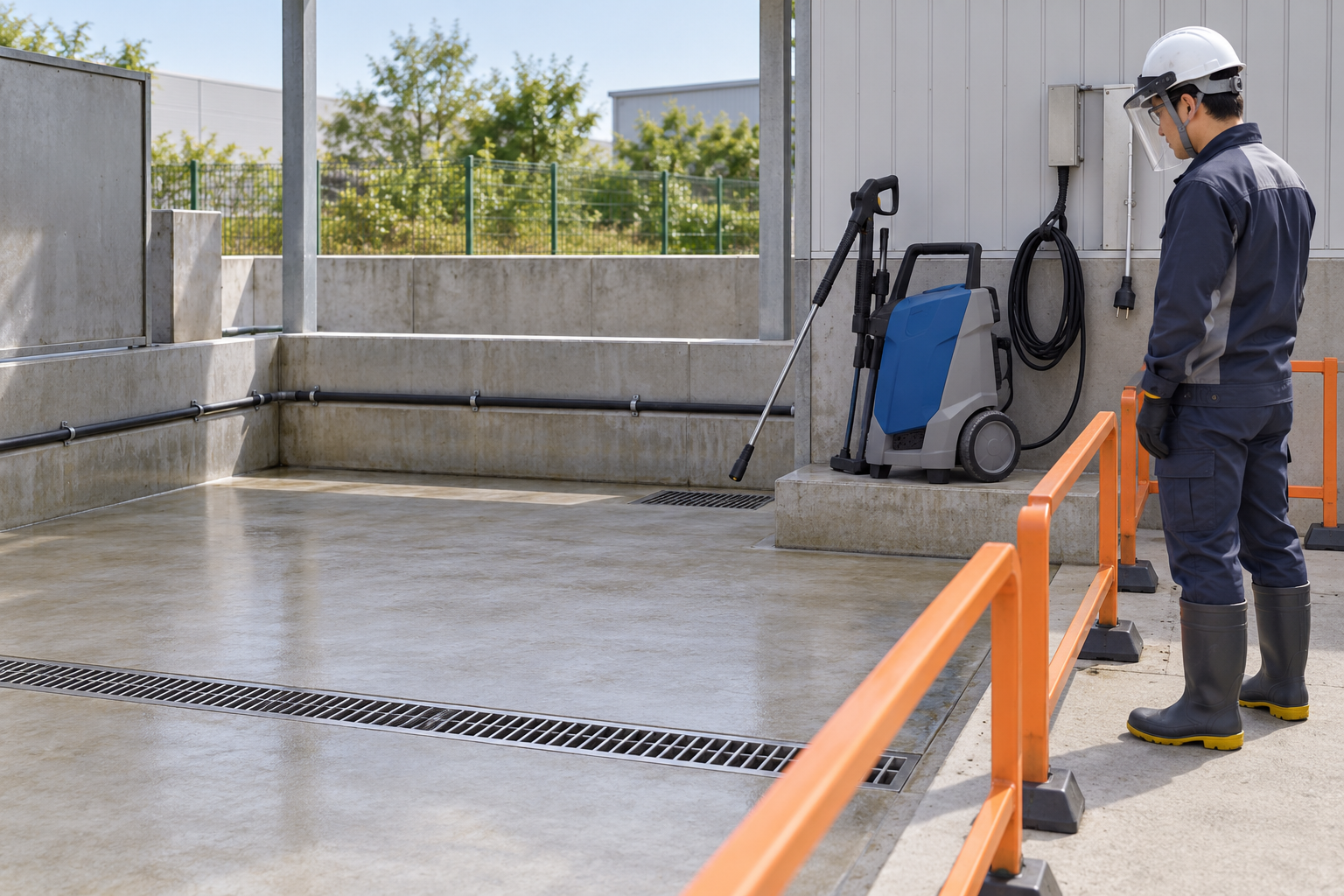
This illustration provides educational context. It is not an actual incident photograph or evidence of equipment suitability; any AI-generated depiction is illustrative only.
The scenario and record comparisons are fictional teaching examples, not records of real incidents, measurements, inspections, signatures or approvals.
| Stage | Fictional situation |
|---|---|
| Initial situation | A fictional worker washes a floor beside an extension connection. |
| Changed condition | Water pools at the electrical connection while a fine leak appears at a hose coupling. |
| Failure path | The worker proposes touching the coupling to locate the leak. |
| Possible outcome | Pressure injection and wet-electrical exposure could occur together. |
| Prevention barrier | Stop spraying, exclude access and arrange safe power isolation and verified pressure release before inspection and repair. |
Failure mechanisms
A narrow leak or jet can inject liquid beneath skin even when the visible wound is small. Never feel for a high-pressure leak or wash clothing/footwear while worn; suspected injection requires prompt medical assessment.
Releasing the trigger can stop the visible jet while leaving pressure trapped in the hose. Follow the actual shutdown, isolation, release and verification procedure before loosening a coupling.
An RCD is one protective measure. It does not make wet connectors, damaged leads or unsuitable equipment acceptable. Arrange safe electrical isolation if water reaches the supply; do not touch a wet energised plug.
Water carries contamination beyond the nozzle area. Plan containment, recovery and the permitted disposal destination before work, then inspect slip hazards and downstream electrical exposure before reopening.
Decision sequence
| Step | Decision |
|---|---|
| Known | Pooling water and a fine hose leak are visible. |
| Unknown | Electrical safe state, trapped pressure and the cause of runoff are unresolved. |
| Hold | Do not touch the leak, wet connector or coupling. |
| Evidence | Record safe isolation, pressure release, hose repair and corrected drainage/electrical protection. |
| Release | Complete a controlled retest and reset the spray/runoff boundary before resuming. |
Work sequence: Assess surface → Set boundary → Inspect equipment → Connect and trial → Wash surface → Move zone → Hold leak or fault → Shut down and transfer. This is a teaching flow, not a device drawing or a complete operating procedure.
5. Conditional decisions and common errors
| Situation | Required action | Evidence | Proceed when |
|---|---|---|---|
| Fine leak | Stop; keep hands away | Pressure release and hose inspection | Defect corrected |
| Water at supply | Exclude; isolate safely | Electrical and drainage review | Supply protected |
| Unknown coating | Hold washing | Contaminant and waste assessment | Scope accepted |
| Cleaning complete | Depressurise; inspect floor | Waste route and slip checks | Area accepted |
Similar observations, different decisions
The scenario and record comparisons are fictional teaching examples, not records of real incidents, measurements, inspections, signatures or approvals.
| Observation | Insufficient conclusion | Required distinction |
|---|---|---|
| Trigger released | The hose is depressurised. | Verify the model-specific pressure-release state before separation. |
| RCD installed | Wet connectors may remain in use. | Keep connections protected and correct any fault. |
| Drain nearby | Wash water may enter it. | Verify the approved recovery/discharge route for the actual contamination. |
6. Roles and responsibilities
| Role | Responsibility |
|---|---|
| Work supervisor | Confirm surface and contaminant and the task scope, resources, interfaces and stop authority. |
| Qualified technical reviewer | Review exclusion boundary, model limits, compatibility and unresolved technical conditions within assigned competence. |
| Work crew | Apply the listed controls, report changes and stop when evidence or safeguards are missing. |
| Inspector / assessor | Record actual jet direction and other relevant checks; do not mark unverified conditions as accepted. |
| Handover authority | Reconcile pressure and disconnection, restrictions and outstanding actions before the next task. Role labels do not establish a legal credential. |
Supervision and handover focus
| Stage | Management action | Evidence |
|---|---|---|
| Assess surface | 1. Record surface and contaminant2. Record approved recovery/waste route3. Record floor condition | 1. Surface and contaminant2. Approved recovery/waste route3. Floor condition |
| Set boundary | 1. Record exclusion boundary2. Record runoff extent3. Record hose/walking route | 1. Exclusion boundary2. Runoff extent3. Hose/walking route |
| Connect and trial | 1. Record connections locked2. Record footing and grip3. Record trial direction | 1. Connections locked2. Footing and grip3. Trial direction |
| Wash surface | 1. Record jet direction2. Record surface and debris3. Record reaction and balance | 1. Jet direction2. Surface and debris3. Reaction and balance |
| Hold leak or fault | 1. Record leak/fault location2. Record electrical safe state3. Record pressure-release evidence | 1. Leak/fault location2. Electrical safe state3. Pressure-release evidence |
| Shut down and transfer | 1. Record pressure and disconnection2. Record drain/floor condition3. Record waste disposition | 1. Pressure and disconnection2. Drain/floor condition3. Waste disposition |
7. Hold points and record comparison
| Hold point | Evidence before release | Actual approval |
|---|---|---|
| HP-0 Scope | Clean level ground-floor surfaces outdoors or in a designated adequately ventilated wash area with an electric cold-water pressure washer, known contamination and an accepted wastewater route. | |
| HP-1 Set boundary | Exclusion boundary; Runoff extent; Hose/walking route; Electrical location | |
| HP-2 Connect and trial | Connections locked; Footing and grip; Trial direction; Water supply state | |
| HP-3 Hold leak or fault | Leak/fault location; Electrical safe state; Pressure-release evidence; Repair and trial record | |
| HP-4 Shut down and transfer | Pressure and disconnection; Drain/floor condition; Waste disposition; Area handover and defects |
Hold points are internal project checks. They are not universal statutory permits and do not grant work permission. Reassess after defects, changed conditions and shift changes.
Record comparison
The scenario and record comparisons are fictional teaching examples, not records of real incidents, measurements, inspections, signatures or approvals.
The boxes are static record prompts, not interactive or saved approvals. A tick does not establish suitability or permission to restart. Record the evidence, person, time and unresolved issues; retain the change history.
| Record | Insufficient record | Record checklist |
|---|---|---|
| Assess surface | Only marked “OK” | □ Surface and contaminant□ Approved recovery/waste route□ Floor condition□ Method and limits |
| Connect and trial | Only marked “OK” | □ Connections locked□ Footing and grip□ Trial direction□ Water supply state |
| Hold leak or fault | Only marked “OK” | □ Leak/fault location□ Electrical safe state□ Pressure-release evidence□ Repair and trial record |
| Shut down and transfer | Only marked “OK” | □ Pressure and disconnection□ Drain/floor condition□ Waste disposition□ Area handover and defects |
8. Site checklist and emergency response
| Site check | Actual result | Person / action |
|---|---|---|
| Assess surface: Surface and contaminant; Approved recovery/waste route; Floor condition; Method and limits | ||
| Set boundary: Exclusion boundary; Runoff extent; Hose/walking route; Electrical location | ||
| Inspect equipment: Electrical/RCD condition; Hose and nozzle ratings; Gun function; Fitting compatibility | ||
| Connect and trial: Connections locked; Footing and grip; Trial direction; Water supply state | ||
| Wash surface: Jet direction; Surface and debris; Reaction and balance; Contaminant conditions | ||
| Move zone: Gun stop/lock; Floor and next route; Boundary state; Hose/lead position | ||
| Hold leak or fault: Leak/fault location; Electrical safe state; Pressure-release evidence; Repair and trial record | ||
| Shut down and transfer: Pressure and disconnection; Drain/floor condition; Waste disposition; Area handover and defects |
Stop work
Hold for unknown contaminants or drainage, uncertain electrical protection, incompatible hose/nozzle ratings or failed gun stop/lock. Stop for leaks, unstable reaction, pedestrians or water reaching power. Never locate a pressure leak by hand.
Emergency response
Stop the jet from a safe position and restrict the wet-electrical and pressure area. Do not touch an electrically exposed casualty or equipment before the source is safely controlled. Obtain prompt medical assessment for suspected injection; call 995 for a medical emergency. Give responders the liquid, pressure, contamination, time and location.
9. Sources and review limits
Public-source access/review: 2026-10-14.
| Official source | Reviewed scope and limits |
|---|---|
| MOM: Risk management | Assess the full spray/runoff boundary and abnormal electrical/pressure faults. Official explanation of statutory duties; linked SSO text was not independently read for this item. This is not a legal opinion. |
| EMA: Worker licences | Assign installation wiring and electrical rectification within the applicable licensed-worker boundary. Official explanation; does not classify every data connector as electrical installation work. Actual work boundary and licence class require review. |
| PUB: Written Approval for trade effluent | Confirm premises-specific permission and conditions before any trade-effluent sewer discharge. Approval is site/business and activity dependent; clarity of the liquid is not a discharge test. No discharge limit is invented. |
| NEA: Toxic Waste Control | Assess recovered contaminated liquid before selecting the permitted disposal route. Apply only after classifying actual cleaner and removed contaminants; this does not classify every aqueous cleaning waste as TIW or authorise discharge. |
| CDC: Pressure Washer Safety | Prevent contact with high-pressure spray and obtain prompt medical attention for suspected injection. Foreign technical injury-prevention reference only; local electrical requirements and emergency contacts replace foreign arrangements. No pressure setting inferred. |
| WSH Council: Safe Use of Machinery | Control electrical supply and stored pressure before component intervention. Official guidance; cited paid Singapore Standards were not obtained. No universal wheel test duration or gap is inferred. |
No actual equipment model, site measurements, design calculations or signed approval was supplied. Check the applicable Singapore requirements and approved safe work procedures against the actual equipment and site before use. Statutory duties, official guidance and manufacturer limits serve different purposes; editorial checks do not establish legal or professional approval.
10. PDF guidance and FAQ
PDF A covers basic task controls; B focuses on technical failures; C covers supervision, records and handover. The article has eight stages with four items per main cell; each PDF has six key stages with three items per main cell. P/S/R/A, measurements, confirmations and signatures remain blank for actual site assessment.
PDFs are complementary six-stage extracts. Apply all eight body stages and the actual equipment/site procedure.
May a leak be tested by hand?
No. Stop and isolate, verify pressure release and use the specified inspection method.
Is a small spray wound minor?
Do not judge by appearance; seek prompt medical assessment and identify the fluid, pressure and time.
May pressure be raised until the stain goes?
Reassess the substrate, contamination and equipment limits; hazardous removal needs another plan.
When can the area reopen?
After pressure, runoff, slip hazards, leads/hoses and waste disposition are accepted by the receiving person.
Has a professional verified or approved this document?
AI-generated reference material; not professionally verified or approved. Before use, a qualified person must review and adapt it to Singapore requirements, the actual equipment/site and approved safe work procedures.
11. Revision history and authorship
AI-generated reference material; not professionally verified or approved. Before use, a qualified person must review and adapt it to Singapore requirements, the actual equipment/site and approved safe work procedures.
| Date | Version | Change | Review status |
|---|---|---|---|
| 2026-10-14 | SG 1.0 | New Singapore edition from assigned Korean source; task decisions, records and PDFs localized. | AI editorial review; no professional technical approval |
Korean edition revision history: 2026-09-26 (v1.0): initial article, sources, fictional analysis and PDF editorial checks. These are editorial records, not professional technical approval. Singapore v1.0 adapts the earlier edition to Singapore requirements and terminology.
Site reviewers must add their actual qualifications, scope, date and approval only after the review occurs.