Do not conceal a wet duct or insulation defect with new tape. Finish the support and joint inspections before covering the work.
This is reference content written and reviced with AI. It has not been verified or approved by a professional. Review by a suitably qualified professional and required site authorisation are necessary before use.
Stop conditions first
Hold for wet material, unaccepted duct joints/supports, unsafe access, unidentified materials, ineffective dust/ventilation controls or incompatible damaged facing closures.
AI-generated reference material; not professionally verified or approved. Before use, a qualified person must review and adapt it to applicable Singapore requirements, the actual equipment/site and approved safe work procedures.
1. Singapore legal and technical basis
Apply Singapore risk assessment to new duct insulation, material exposure, sharp fixings and work at height. Use current product SDS and the accepted duct/insulation assembly. Determine the fall prevention plan and hazardous-work-at-height permit requirements for the actual workplace and possible fall, rather than using a foreign height trigger.
| Basis | Singapore application |
|---|---|
| Risk management | The employer, self-employed person and principal assess and control work risks. Include preparation, abnormal conditions and maintenance. Coordinate affected trades and communicate controls. |
| Activity-specific guidance | Use WSHC chemical/GHS guidance for identifiable materials, SDS and exposure controls; use height guidance for protected access, applicable permits and rescue. Actual product/system details determine insulation and vapour-barrier acceptance. |
| Permits and authority | Select permit requirements for the actual sector and activity. Site hold points and contractor role labels do not create statutory permits or qualifications. |
| Equipment and design | The WSHC height page explains workplace-dependent FPP duties and hazardous WAH PTW conditions, including a possible fall exceeding 3 m at a factory. Lower work can still need fall protection. Product instructions were not supplied; no universal insulation thickness, adhesive exposure limit or fixing spacing is specified. |
2. Scope and required inputs
Included
Install specified new fibrous wrap and compatible facing closures on inspected, supported, inactive sheet-metal ducts using previously installed and accepted fixings and protected access.
Separate assessment
Unknown old insulation or suspected asbestos, hot piping, smoke-control fireproofing, internal lining, field pin welding and spray adhesives require separate assessment.
| Input | Evidence needed |
|---|---|
| Match duct and materials | Duct ID/support/seams; Material/specification; Surface condition; SDS and compatibility |
| Prepare access and bench | Access/protection; Drop-zone boundary; Pin condition; Cutting setup |
| Fit insulation | Fixing/retention; Pin protection; Joint fit; Installed thickness |
| Clean and hand over | Cleanup record; Sharp-waste control; Access and labels; Restrictions/receiver |
No actual equipment model, SDS, site measurements, design calculations or authorisation record was supplied. Verify actual product limits and applicable Singapore requirements before use. Manufacturer guidance is not government approval.
Select task-appropriate eye, hand, foot, skin and hearing protection from the exposure assessment. Where respiratory protection is necessary, use the applicable respiratory-protection program; PPE does not replace isolation, guarding, support or ventilation.
Singapore site planning
The mechanical contractor must receive the duct support, joint and dry-surface inspections before insulation conceals them. Agree protected access and lower-area exclusion with adjacent trades. Record thickness and segment dimensions in mm, product identities, compatible tape or mastic, and application conditions. In Singapore humid conditions, investigate wet material and condensation before closing the vapour barrier; do not treat new foil tape as a moisture repair. Keep access doors and service labels usable.
3. Eight-stage JSA
| Job stage | Hazards and effects | Failure factors | Technical and procedural controls | Site verification | P | S | R | A |
|---|---|---|---|---|---|---|---|---|
| 1. Match duct and materials | 1. Hidden duct defect2. Wrong insulation3. Moisture trapped4. Chemical mismatch | 1. Prior check missing2. Material unidentified3. Surface wet4. SDS absent | 1. Link segment inspection2. Match specified assembly3. Verify clean dry surface4. Identify product hazards | 1. Duct ID/support/seams2. Material/specification3. Surface condition4. SDS and compatibility | ||||
| 2. Prepare access and bench | 1. Fall from platform2. Dropped tools3. Pin puncture4. Knife slip | 1. Access improvised2. Tools unsecured3. Pins unprotected4. Unstable cutting bench | 1. Inspect protected access2. Control lower area3. Guard exposed pin ends4. Provide stable workbench | 1. Access/protection2. Drop-zone boundary3. Pin condition4. Cutting setup | ||||
| 3. Cut with dust controls | 1. Fibre inhalation2. Eye irritation3. Hand cut4. Dust spread | 1. Capture ineffective2. Material shaken3. Knife toward hand4. Dry sweeping | 1. Use low-dust method2. Handle gently3. Cut away from body4. Use assessed cleanup | 1. Cutting/capture method2. Eye/skin protection3. Knife/hand position4. Waste containment | ||||
| 4. Fit insulation | 1. Material falls2. Hand puncture3. Thermal gap4. Overcompression | 1. Fixing inadequate2. Pin tip exposed3. Fit incomplete4. Wrap overtightened | 1. Use accepted fixings2. Protect hands at pins3. Fit continuous coverage4. Limit to specified compression | 1. Fixing/retention2. Pin protection3. Joint fit4. Installed thickness in mm | ||||
| 5. Seal vapour retarder | 1. Moisture entry2. Vapour exposure3. Skin contamination4. Access blocked | 1. Seam open2. Adhesive unassessed3. Glove incompatible4. Panel covered | 1. Close specified seams2. Ventilate for product3. Use SDS-based protection4. Preserve service openings | 1. Seam/closure match2. Ventilation conditions3. Glove/skin controls4. Access-edge detail | ||||
| 6. Inspect completed wrap | 1. Hidden voids2. Seal separation3. Damaged facing4. Wrong thickness | 1. Appearance trusted2. Bond conditions wrong3. Penetration missed4. Measurement omitted | 1. Inspect corners and seams2. Verify closure conditions3. Check every penetration4. Confirm thickness/fit | 1. Segment inspection2. Closure adhesion3. Pin/corner continuity4. Thickness evidence | ||||
| 7. Hold wet or torn work | 1. Moisture concealed2. Repeated damage3. Unverified substitution4. Premature operation | 1. Tape hides wetting2. Cause untreated3. Silver tape substituted4. Hold unmarked | 1. Stop concealment2. Resolve moisture cause3. Use specified repair4. Identify held segments | 1. Moisture/material findings2. Cause/correction3. Repair detail4. Segment reinspection release | ||||
| 8. Clean and hand over | 1. Loose fibre exposure2. Sharp waste injury3. Service obstruction4. Defects forgotten | 1. Waste left2. Pins/blades loose3. Labels covered4. No segment record | 1. Collect contained waste2. Secure sharps3. Keep access/labels clear4. Transfer segment status | 1. Cleanup record2. Sharp-waste control3. Access and labels4. Restrictions/receiver |
P = likelihood; S = severity; R = risk using the site method; A = site acceptance/authorisation. Complete after actual assessment; no score overrides an unresolved hold point or equipment limit.
4. Failure mechanisms and hypothetical case
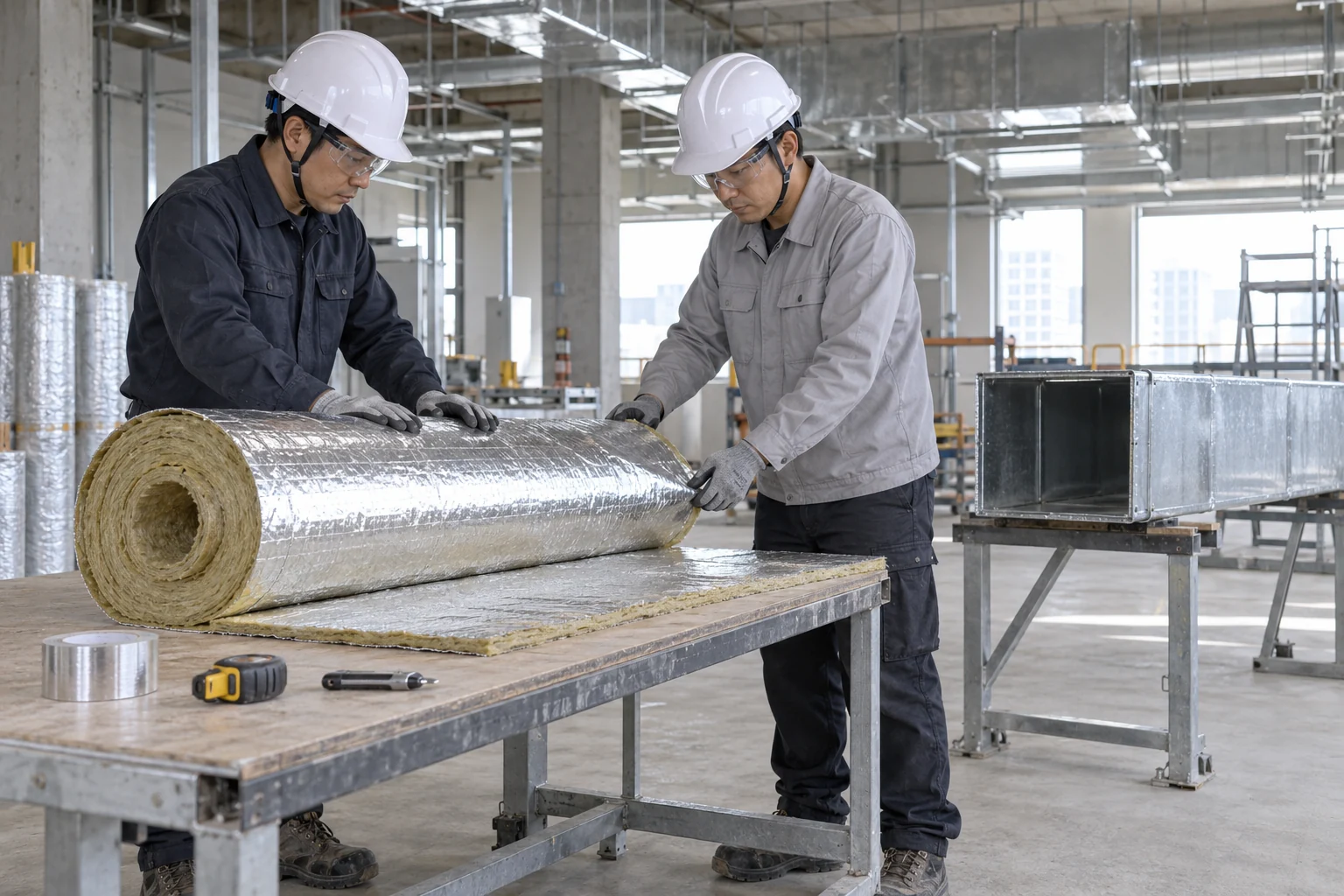
The retained illustration is an AI-generated educational image from the retained source edition. It is not an actual incident photograph, approved drawing, equipment certification or proof that the depicted arrangement is safe.
Insulation conceals duct seams and fixings. Confirm the identified segment is supported, sealed and dry before wrapping. Wet insulation requires cause assessment and an approved material disposition; covering it cannot establish dryness.
Vapour-retarder continuity depends on seams, corners, pins and access-opening edges. Silver appearance does not establish compatible tape or an intact seal. Follow the selected assembly details without obstructing required access.
Fibre dust from cutting and vapour/skin exposure from adhesive are different hazards. Use low-dust cutting and cleanup, identify any adhesive by SDS and provide the required ventilation and protection. A dust mask does not automatically protect against vapour.
Compression and gaps change insulation performance. Check installed thickness and continuity against the actual product/design; no generic example establishes the required thickness, compression or closure specification.
Hypothetical decision example
Hypothetical example: wet insulation is found under a duct and the installer proposes covering it with fresh facing tape. Hold concealment, identify the moisture source and material damage, then inspect the accepted replacement/drying and closure repair before handover.
The example is fictional; no incident, measurement, inspection or approval is asserted.
Task flow: Match duct and materials → Prepare access and bench → Cut with dust controls → Fit insulation → Seal vapour retarder → Inspect completed wrap → Hold wet or torn work → Clean and hand over
5. Hold and proceed decisions
| Condition | Action | Evidence | Proceed when |
|---|---|---|---|
| Material wet | Hold concealment | Moisture cause/material disposition | Dry assembly accepted |
| Facing tears | Repair by specified detail | Location and closure compatibility | Continuity restored |
| Dust escapes | Stop cutting; restore control | Tool/capture/cleanup check | Exposure controls ready |
| Access unsafe | Hold elevated work | Platform/protection inspection | Protected access ready |
Similar observation, different conclusion
| Observation | Supported conclusion | What remains unresolved |
|---|---|---|
| Silver facing visible | Facing covers an area | Hidden gaps/compression unresolved |
| Odor weak | Little odour noticed | Vapour/skin exposure unassessed |
6. Roles and supervision
| Role | Responsibility |
|---|---|
| Work supervisor | Coordinate match duct and materials, affected operations, stop signals and stage transitions. |
| Technical/equipment reviewer | Verify Duct ID/support/seams, Material/specification, actual instructions and unresolved technical limits. |
| Task crew | Apply the stated controls, report changes and keep actual checks and signatures factual. |
| Inspector/test lead | Connect Segment inspection, Closure adhesion to the required acceptance criteria. |
| Receiving authority | Accept the recorded restrictions, Access and labels, Restrictions/receiver, and follow-up ownership. |
These are responsibility examples, not invented statutory credentials. Verify actual competence, training and authority for the assigned work.
The principal and employers coordinate the risk assessment and safe work procedures. These role labels allocate work; verify any qualifications and statutory appointments required for the actual Singapore activity. The receiving person must be given restrictions and unresolved defects before handover.
Record and handover perspective
| Stage | Record controls | Verification |
|---|---|---|
| Match duct and materials | 1. Record duct id/support/seams2. Record material/specification3. Record surface condition | 1. Material/specification2. Surface condition3. SDS and compatibility |
| Cut with dust controls | 1. Record cutting/capture method2. Record eye/skin protection3. Record knife/hand position | 1. Eye/skin protection2. Knife/hand position3. Waste containment |
| Fit insulation | 1. Record fixing/retention2. Record pin protection3. Record joint fit | 1. Pin protection2. Joint fit3. Installed thickness in mm |
| Seal vapour retarder | 1. Record seam/closure match2. Record ventilation conditions3. Record glove/skin controls | 1. Ventilation conditions2. Glove/skin controls3. Access-edge detail |
| Hold wet or torn work | 1. Record moisture/material findings2. Record cause/correction3. Record repair detail | 1. Cause/correction2. Repair detail3. Segment reinspection release |
| Clean and hand over | 1. Record cleanup record2. Record sharp-waste control3. Record access and labels | 1. Sharp-waste control2. Access and labels3. Restrictions/receiver |
7. Hold points and record quality
| Hold point | Evidence before release | Actual record |
|---|---|---|
| HP-0 Start | Task boundary, site RA, SWP, responsibilities and emergency arrangements | |
| HP-1 Prepare access and bench | Access/protection; Drop-zone boundary; Pin condition; Cutting setup | |
| HP-2 Cut with dust controls | Cutting/capture method; Eye/skin protection; Knife/hand position; Waste containment | |
| HP-3 Inspect completed wrap | Segment inspection; Closure adhesion; Pin/corner continuity; Thickness evidence | |
| HP-4 Clean and hand over | Cleanup record; Sharp-waste control; Access and labels; Restrictions/receiver |
Hold points are internal evidence gates. They do not establish that a statutory permit exists or has been approved. Recheck affected gates after changes, faults and shift handover.
Record comparison - hypothetical templates
The 16 boxes below identify record elements, not completed checks or approvals. They are static symbols. Link equipment/location, date, actual findings and the separate record reference; preserve unresolved items.
| Record | Insufficient entry | Required record elements |
|---|---|---|
| Match duct and materials | "Checked" without supporting facts | □ Duct ID/support/seams□ Material/specification□ Surface condition□ SDS and compatibility |
| Cut with dust controls | "Checked" without supporting facts | □ Cutting/capture method□ Eye/skin protection□ Knife/hand position□ Waste containment |
| Seal vapour retarder | "Checked" without supporting facts | □ Seam/closure match□ Ventilation conditions□ Glove/skin controls□ Access-edge detail |
| Hold wet or torn work | "Checked" without supporting facts | □ Moisture/material findings□ Cause/correction□ Repair detail□ Reinspection release |
Hold points are internal checks. Determine separately whether Singapore statutory or site permit requirements apply to this work. Leave confirmation, measurements and approval records blank until the authorised site process is completed.
8. Pre-work checks and emergency response
| Check required | Result | Checker/action |
|---|---|---|
| Match duct and materials: Duct ID/support/seams | ||
| Prepare access and bench: Access/protection | ||
| Cut with dust controls: Cutting/capture method | ||
| Fit insulation: Fixing/retention | ||
| Seal vapour retarder: Seam/closure match | ||
| Inspect completed wrap: Segment inspection | ||
| Hold wet or torn work: Moisture/material findings | ||
| Clean and hand over: Cleanup record |
Stop work
Hold for wet material, unaccepted duct joints/supports, unsafe access, unidentified materials, ineffective dust/ventilation controls or incompatible damaged facing closures.
Emergency response
Stop work and clear the area after a fall hazard, sharp injury or chemical exposure. Use the product SDS and site eyewash/first-aid arrangements; call the site emergency service for serious injury or breathing difficulty. Do not re-enter an affected enclosed area or improvise a height rescue. Trained responders use the planned access and rescue method.
9. Official sources and review limits
Official public sources read for this Singapore edition on 2026-10-14. Guidance, statutory explanations and manufacturer limits have different roles; no source provider has approved this JSA.
| Source | Read scope and application limits |
|---|---|
| MOM — Risk management | Official explanation: employer, self-employed person and principal responsibilities; routine and non-routine risk assessment; hierarchy of controls; multidisciplinary assessment team. Official explanation of risk-management duties; no claim of reading the full linked statute. It does not specify task-specific equipment limits. Assess duct insulation and vapour barrier with employers, principal and affected contractors; resolve the inputs in section 2. |
| MOM — When should my company review its risk assessment? | Review every three years, after significant changes, new machinery/substances/procedures, hazard-related injury or incident, and when assessment is inadequate. General review guidance. A review interval does not permit continued operation after a known hazard or change. Reassess this operation after changes, defects, incidents or an inadequate assessment; do not wait for a scheduled review. |
| MOM — Permit-to-Work Systems | Formal work authorisation and coordination; OPEC tripartite guidance and competent permit authority with authority to reject work. OPEC-focused guidance page; not evidence of a blanket statutory permit requirement for every task. Determine permits for this actual activity and workplace; distinguish the section 7 internal hold points from statutory or site permits. |
| WSH Council — Preventing Chemical Hazards | Chemical exposure routes, employer/employee roles, risk assessment, safe work procedures, communication, SDS, exposure monitoring and substance-dependent health surveillance. Official overview; linked exposure schedules and medical examination regulations were not read in full. Do not infer a numerical exposure limit or a universal medical examination duty. Use WSHC chemical/GHS guidance for identifiable materials, SDS and exposure controls; use height guidance for protected access, applicable permits and rescue. Actual product/system details determine insulation and vapour-barrier acceptance. |
| WSH Council — GHS classification and labelling | GHS purpose and role table: suppliers provide product classification/labels/SDS; occupiers and employers obtain accessible SDS, label containers, train and inform workers. Official hazard-communication explanation, not approval of any product or proof of equipment material compatibility. Full SS 586 was not read. Use WSHC chemical/GHS guidance for identifiable materials, SDS and exposure controls; use height guidance for protected access, applicable permits and rescue. Actual product/system details determine insulation and vapour-barrier acceptance. |
| WSH Council — Preventing Falls from Height | Employer access/protection controls, workplace-dependent fall prevention plan, hazardous work at height PTW applicability and supervisor/assessor/authorised-manager process. Official overview, not a full reading of the WAH Regulations or linked codes. PTW threshold does not mean lower falls are safe; actual anchorage, access and rescue require assessment. Use WSHC chemical/GHS guidance for identifiable materials, SDS and exposure controls; use height guidance for protected access, applicable permits and rescue. Actual product/system details determine insulation and vapour-barrier acceptance. |
The WSHC height page explains workplace-dependent FPP duties and hazardous WAH PTW conditions, including a possible fall exceeding 3 m at a factory. Lower work can still need fall protection. Product instructions were not supplied; no universal insulation thickness, adhesive exposure limit or fixing spacing is specified.
Actual site measurements, equipment instructions, engineering checks and signed approval records were not supplied. A qualified person must resolve these before use.
10. PDF use and frequently asked questions
PDF A summarizes core controls; B emphasizes technical failures; C covers supervision, records and handover. Each uses six stages from or aligned with the eight-stage body. All actual risk, measurement, check and signature fields are blank. Use a separate linked record where more space is needed.
Can tape cover wet insulation?
Resolve the moisture source and material suitability before closing the assembly.
Is every foil tape compatible?
Use the tape or mastic specified for the facing and actual application conditions.
Does fibre protection also cover adhesive vapour?
Assess each exposure and select ventilation and protection for the product.
Can an access panel be wrapped shut?
Preserve the required inspection/service opening and seal its edges by the accepted detail.
Has a professional approved this JSA?
This is reference content written and reviced with AI. It has not been verified or approved by a professional. Review by a suitably qualified professional and required site authorisation are necessary before use.
11. Authorship and revision history
AI-generated reference material; not professionally verified or approved. Before use, a qualified person must review and adapt it to applicable Singapore requirements, the actual equipment/site and approved safe work procedures.
This Singapore edition was adapted from the Korean original and its assigned US technical reference. Earlier source revisions are archival editorial history, not Singapore technical approval.
| Date | Edition | Change | Review status |
|---|---|---|---|
| 2026-10-08 | Korean source v1.0 | Source editorial publication or revision; retained as provenance of the Korean edition. | Editorial record only; no professional technical approval recorded. |
| 2026-10-14 | 1.0 en-SG | Singapore legal scope, local planning, responsibility interfaces and SI terminology; new PDF A/B/C. | AI editorial and visual review only; no professional approval. |