Approved through-deck or exposed-base structural stud welding, representative trials, production inspection, repairs and transfer before concrete placement.
Hold for wet or loose deck, poor fit, failed trial, defective return circuit, changed layers/settings, new combustibles below or altered spark paths. Stop before defective studs are concealed.
AI-generated reference material. It has not been professionally verified or approved. Before use, a suitably qualified person must review and adapt it to applicable Singapore requirements, the actual equipment and site, and approved safe work procedures.
1. Legal and technical scope
Apply Singapore WSH risk management, electrical safety, chemical-exposure control and work-at-height duties to deck stud welding. MOM construction fire guidance specifically addresses hot-work sparks reaching combustible materials at lower levels. Coordinate the site hot-work authorisation and fire watch with all affected trades. Assess welding-fume exposure and applicable hygiene monitoring. Structural weld acceptance and fire-area release require separate evidence; this worksheet is neither a welding qualification nor a hot-work permit.
Assess the actual activity under the applicable Singapore WSH requirements. Statutory duties, official guidance, manufacturer instructions and approved project documents have distinct roles. A site hold point is not automatically a statutory permit. Use competent local review to resolve the applicable industry, installation, access and permit requirements.
| Basis | Application and limits |
|---|---|
| MOM risk management | Official explanation: risk assessment, control, monitoring and communication for routine and non-routine work, including maintenance; reviewed 14 October 2026. |
| MOM safe storage of combustible materials in construction | Two-page 2016 circular reviewed: elevated hot-work sparks can reach combustible material below; separate ignition sources, control storage and maintain protective covering/SWP. Historical examples are not the fictional case in this article. |
| WSHC electrical safety | Official guidance: maintenance energy isolation, stored-energy control, verification and reinstatement; electrical scope still requires applicable EMA authorisation. |
| EMA worker licences | Official explanation of licensed electrical work, supervision and the distinction where equipment work involves no wiring. Actual electrical duties require the appropriate licence class. |
| WSHC Preventing Chemical Hazards | Official guidance on chemical risk assessment, safe work procedures, exposure routes, hazard communication and exposure-dependent monitoring; not product certification. |
| MOM requirements for hygiene monitoring | Official toxic-substance and noise monitoring guidance: competent personnel, exposure-dependent requirements, records, worker information and reporting. No site exposure result is asserted. |
| WSHC Preventing Falls from Heights | Official explanation of access, fall-prevention plans, hazardous-WAH permits in factories and supervisor/assessor/authorised-manager roles. General fall controls are not limited to the permit threshold. |
| Stud Welding Products through-deck guidance | Pages 1–3 reviewed for fit, dry surfaces, return circuit and representative testing. Foreign product guidance for a particular stud size; numerical settings and older AWS references are not Singapore law or universal acceptance criteria. |
| SCDF emergency medical services | Official 995 emergency ambulance service information; use emergency services for actual emergencies. |
2. Scope and required inputs
Included: Approved through-deck or exposed-base structural stud welding, representative trials, production inspection, repairs and transfer before concrete placement.
Separate review: Unapproved multilayer combinations, bolt tightening, changed coatings/materials and structural retrofit need separate review. A trial result does not automatically cover another combination.
| Input | Required evidence |
|---|---|
| Confirm combination | Stud and ferrule; Deck and base steel; Platform condition; Procedure and inspection |
| Check power and gun | Supply and protective earthing; Return connection; Gun and ferrule; Cable condition |
| Weld production | Watch and lower area; Fume controls; Current and weld trend; Stud location record |
| Release for concrete | Inspection closure; Fire-watch completion; Deck housekeeping; Pour-release record |
Obtain the approved stud, ferrule, deck layer/coating and base-steel combination, gun and power instructions, welding procedure and inspection criteria. No universal welding current, bend angle, test interval or fire-watch duration is prescribed. Confirm local electrical and fall-protection arrangements and site hot-work controls.
3. Eight-stage JSA
P = likelihood; S = severity; R = risk under the site method; A = acceptance or authorization as defined by the site. Leave these blank until actual assessment and control verification. A low score does not override a legal requirement, product limit or unreleased hold point.
| Job stage | Hazards and effects | Failure factors | Required controls | Site verification | P | S | R | A |
|---|---|---|---|---|---|---|---|---|
| 1. Confirm combination | 1. Weak stud weld2. Deck failure3. Trip on connector4. Wrong production scope | 1. Layers unapproved2. Deck incomplete3. Connector access not planned4. Trial not representative | 1. Match approved combination2. Verify secured work platform3. Plan safe connector sequence4. Define trial coverage | 1. Stud and ferrule2. Deck and base steel3. Platform condition4. Procedure and inspection | ||||
| 2. Prepare fire area | 1. Fire below2. Arc exposure3. Edge fall4. Fume exposure | 1. Lower fuel hidden2. Screen absent3. Opening unprotected4. Ventilation changed | 1. Inspect all spark paths2. Screen neighbouring trades3. Protect edges and holes4. Assess fume controls | 1. Lower-level survey2. Fire watch and equipment3. Access protection4. Airflow and PPE | ||||
| 3. Check power and gun | 1. Electric shock2. Weak weld3. Unexpected discharge4. Cable trip | 1. Insulation damaged2. Return poor3. Gun setup wrong4. Cables crossed | 1. Inspect power protection2. Verify welding return3. Set gun per procedure4. Protect cable route | 1. Supply and protective earthing2. Return connection3. Gun and ferrule4. Cable condition | ||||
| 4. Prepare and test | 1. Defective fusion2. Metal ejection3. Burn4. False trial release | 1. Gap under deck2. Wet surface3. Wrong settings4. Test range unrecorded | 1. Check tight dry fit2. Clean joint zone3. Make specified trial4. Record actual combination | 1. Surface and fit2. Settings and supply3. Trial result4. Applicable production area | ||||
| 5. Weld production | 1. Fire2. Fume exposure3. Weld inconsistency4. Hand burn | 1. Conditions change2. Coating unassessed3. Cable heating4. Hot stud touched | 1. Maintain fire controls2. Use planned extraction3. Monitor welding condition4. Protect hot zone | 1. Watch and lower area2. Fume controls3. Current and weld trend4. Stud location record | ||||
| 6. Inspect and repair | 1. Defect concealed2. Hot fragment3. Repeat poor weld4. Wrong repair location | 1. Appearance alone2. Ferrule broken unsafely3. Cause not resolved4. Map missing | 1. Use specified inspection2. Control cooled fragments3. Apply approved repair4. Mark affected studs | 1. Inspection method2. Defect map3. Repair procedure4. Retest result | ||||
| 7. Hold changed conditions | 1. Hidden fire2. Unqualified combination3. Premature restart4. Escape blocked | 1. Packing moved2. Layers changed3. Old approval reused4. Screen moved | 1. Stop affected welding2. Review fire and quality3. Recheck trial scope4. Restore safe routes | 1. Changed area2. Material and settings3. New evidence4. Restart decision | ||||
| 8. Release for concrete | 1. Defect covered2. Smouldering fire3. Sharp debris4. Lost weld record | 1. Pour starts early2. Post-work check missed3. Ferrules scattered4. IDs disconnected | 1. Close weld defects2. Complete fire checks3. Clear sharp debris4. Transfer location records | 1. Inspection closure2. Fire-watch completion3. Deck housekeeping4. Pour-release record |
4. Hypothetical scenario and failure mechanisms
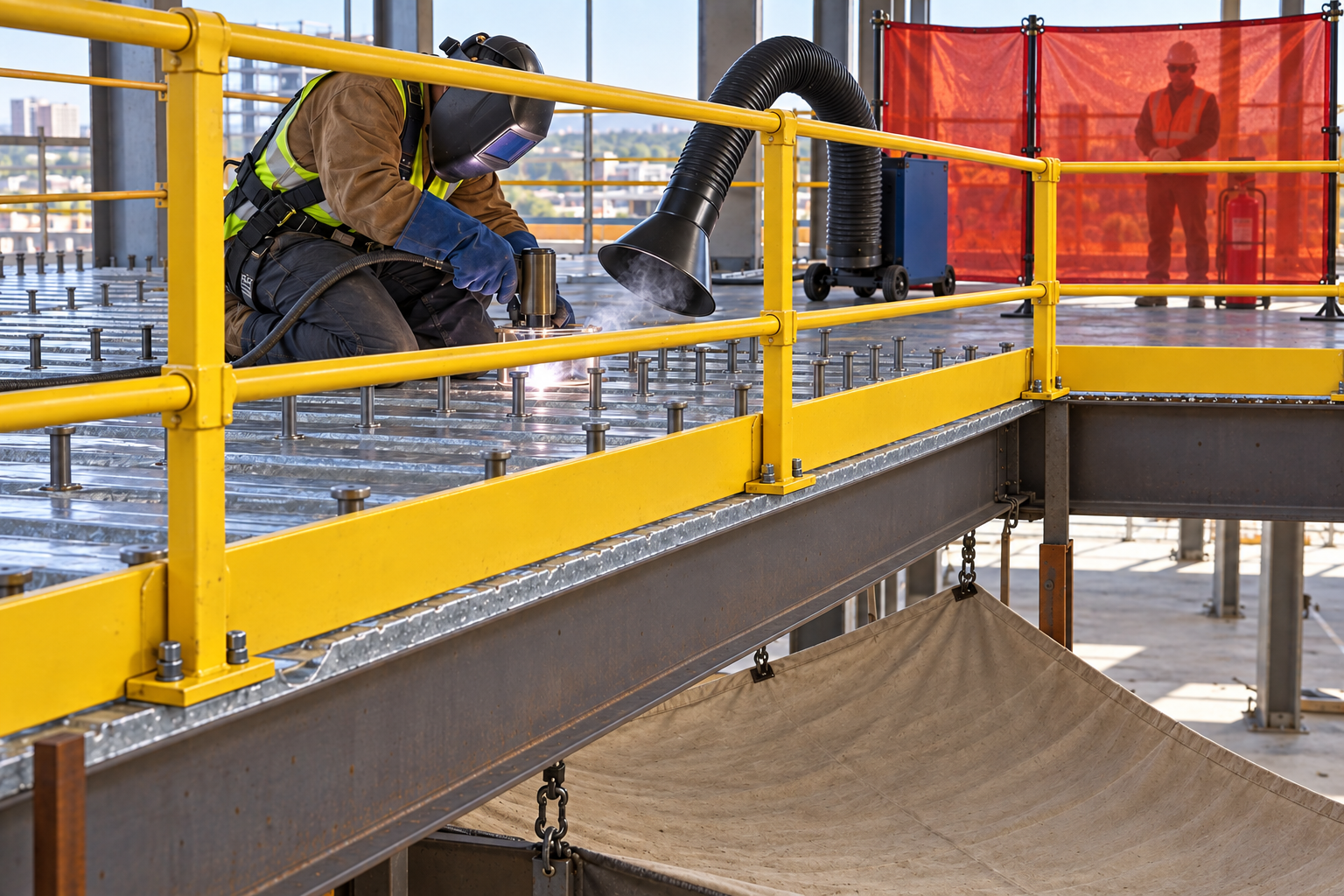 Retained source illustration: an AI-generated educational concept, not a real incident photograph or evidence of equipment suitability.
The following scenario, comparisons and example records are hypothetical teaching material. They do not reproduce actual incidents, measurements, signatures or approvals.
| Item | Hypothetical situation |
|---|---|
| Initial state | Stud welding begins above a cleared lower level. |
| Change | Another trade brings packaging below and moves a screen. |
| Failure path | The original fire-area check is treated as still valid. |
| Possible harm | Sparks passing through deck gaps may ignite hidden material even when the studs pass inspection. |
| Barrier | Hold welding, restore lower-area fire controls and inspect the changed spark path; reassess trial coverage separately if welding conditions also changed. |
Stud, ferrule, deck layers/coating, base steel and fit define the welding combination. A representative trial supports only its established production scope; changed overlap or supply can change the result.
Welding return and protective earthing serve different purposes. Verify both against the actual equipment; return continuity alone does not establish shock protection.
Weld appearance is only one inspection element. Link specified trial and production checks, marked defects, approved repair and retest to the stud location before concrete conceals it.
Sparks can reach a different storey through deck joints and penetrations. Coordinate material deliveries and screens with the lower-area fire watch. Recheck changed access and ventilation independently of weld quality.
| Decision | Reason and evidence |
|---|---|
| Known facts | Another trade brings packaging below and moves a screen. |
| Unresolved | The original fire-area check is treated as still valid. |
| Hold reason | Hold for wet or loose deck, poor fit, failed trial, defective return circuit, changed layers/settings, new combustibles below or altered spark paths. Stop before defective studs are concealed. |
| Evidence needed | Watch and lower area; Fume controls; Current and weld trend; Stud location record. |
| Next decision | Hold welding, restore lower-area fire controls and inspect the changed spark path; reassess trial coverage separately if welding conditions also changed. |
5. Conditional decisions and common errors
| Condition | Action | Evidence | Proceed when |
|---|---|---|---|
| Deck wet or loose | Hold and prepare. | Dry fit and platform checks. | Preparation accepted. |
| Combination changes | Review trial scope. | Material setup and test record. | Actual combination accepted. |
| Fuel arrives below | Stop affected welding. | Lower-area survey and controls. | Fire conditions restored. |
| Pour requested | Hold concealment. | Repair retest and location map. | Open weld defects resolved. |
| Comparison | Situation A | Situation B |
|---|---|---|
| Similar weld appearance | Trial matches actual material combination. | Only yesterday trial cited after overlap change. |
| Upper deck clear | Lower floors and spark routes also controlled. | Combustibles below unexamined. |
6. Roles and responsibilities
| Role | Responsibility |
|---|---|
| Work supervisor | Confirm scope, task sequence, exclusion and stop authority. Coordinate confirm combination with affected operations. |
| Technical reviewer | Resolve the actual design and equipment limits: Stud and ferrule; Deck and base steel; Platform condition; Procedure and inspection. |
| Work crew | Perform check power and gun using the approved procedure; report any mismatch before proceeding. |
| Inspector / assessor | Verify Inspection method; Defect map; Repair procedure; Retest result. Record what was actually checked and what remains unresolved. |
| Release / receiving authority | Confirm Inspection closure; Fire-watch completion; Deck housekeeping; Pour-release record. Transfer restrictions and the next permitted stage. |
These are responsibility examples, not invented statutory credentials. Meet the actual training, competent-person, qualified-person and licensing requirements for the assigned work. Anyone may raise a hazard and request a stop; only the designated authority may release the affected stage after evidence is reviewed.
7. Hold points and record comparison
| Hold point | Evidence before release | Confirmation / approval |
|---|---|---|
| HP-0 Start | Scope, jurisdiction, equipment identity, responsible people and emergency arrangements. | |
| HP-1 Confirm combination | Stud and ferrule; Deck and base steel; Platform condition; Procedure and inspection | |
| HP-2 Prepare fire area | Lower-level survey; Fire watch and equipment; Access protection; Airflow and PPE | |
| HP-3 Prepare and test | Surface and fit; Settings and supply; Trial result; Applicable production area | |
| HP-4 Release for concrete | Inspection closure; Fire-watch completion; Deck housekeeping; Pour-release record |
Hold points are internal evidence gates. They do not replace statutory permits or actual signatures. Recheck affected gates after a change, abnormal event or shift transfer. The blank record must identify the evidence, person, time, limits and release scope.
| Record | Insufficient record | Record checklist |
|---|---|---|
| Trial | Test good | □ Surface and fit□ Settings and supply□ Trial result□ Applicable production area |
| Fire | Area clear | □ Lower-level survey□ Fire watch and equipment□ Access protection□ Airflow and PPE |
| Production | Welding done | □ Watch and lower area□ Fume controls□ Current and weld trend□ Stud location record |
| Repair | Corrected | □ Inspection method□ Defect map□ Repair procedure□ Retest result |
The □ boxes are static prompts, not saved or interactive approvals. Each checks one record element. A tick alone does not establish suitability or permission to restart. Link equipment IDs and supporting records; retain unresolved matters and the earlier record when conditions change.
8. Site checklist and emergency response
| Check item | Result | Person / action |
|---|---|---|
| Stud and ferrule | ||
| Lower-level survey | ||
| Supply and protective earthing | ||
| Surface and fit | ||
| Watch and lower area | ||
| Inspection method | ||
| Changed area | ||
| Inspection closure | ||
| Emergency arrangements and unresolved restrictions communicated |
Stop work: Hold for wet or loose deck, poor fit, failed trial, defective return circuit, changed layers/settings, new combustibles below or altered spark paths. Stop before defective studs are concealed.
Emergency response: Stop welding, raise the alarm and evacuate affected levels for smoke or fire. Isolate electrical supply safely and use trained initial response only where escape remains safe. Call SCDF 995 for fire, serious injury or urgent rescue. Follow the planned work-at-height rescue; do not enter smoke or touch a casualty exposed to live electrical equipment.
9. Sources and review limits
Official-source review date: October 14, 2026. The following review is limited to the public provisions or selected manufacturer material identified below. It does not establish that any authority approved this article or the actual installation.
- MOM risk management: Official explanation: risk assessment, control, monitoring and communication for routine and non-routine work, including maintenance; reviewed 14 October 2026.
- MOM safe storage of combustible materials in construction: Two-page 2016 circular reviewed: elevated hot-work sparks can reach combustible material below; separate ignition sources, control storage and maintain protective covering/SWP. Historical examples are not the fictional case in this article.
- WSHC electrical safety: Official guidance: maintenance energy isolation, stored-energy control, verification and reinstatement; electrical scope still requires applicable EMA authorisation.
- EMA worker licences: Official explanation of licensed electrical work, supervision and the distinction where equipment work involves no wiring. Actual electrical duties require the appropriate licence class.
- WSHC Preventing Chemical Hazards: Official guidance on chemical risk assessment, safe work procedures, exposure routes, hazard communication and exposure-dependent monitoring; not product certification.
- MOM requirements for hygiene monitoring: Official toxic-substance and noise monitoring guidance: competent personnel, exposure-dependent requirements, records, worker information and reporting. No site exposure result is asserted.
- WSHC Preventing Falls from Heights: Official explanation of access, fall-prevention plans, hazardous-WAH permits in factories and supervisor/assessor/authorised-manager roles. General fall controls are not limited to the permit threshold.
- Stud Welding Products through-deck guidance: Pages 1–3 reviewed for fit, dry surfaces, return circuit and representative testing. Foreign product guidance for a particular stud size; numerical settings and older AWS references are not Singapore law or universal acceptance criteria.
- SCDF emergency medical services: Official 995 emergency ambulance service information; use emergency services for actual emergencies.
Paid consensus standards and site-specific calculations, manuals, inspection records and product certificates were not independently obtained or verified unless specifically identified. Korean and overseas legal references are source history, not Singapore statutory duties. Singapore Standards and model-specific limits were not read in full unless expressly identified.
10. PDF guidance and FAQ
PDF A covers basic task controls; B examines technical failures; C focuses on supervision, evidence and handover. Each has six rows and three items per main cell. They are complementary extracts: apply all eight body stages and the applicable site procedure. An omitted stage is not permission to omit its controls. PDF HP-0 through HP-4 are worksheet labels; match the event, evidence and authority rather than assuming they match another permit by number.
P/S/R/A, actual measurements, confirmations and signatures remain blank. The PDFs are uncompleted reference worksheets, not issued work permits.
Content group ID: jsa-deckstud-welding
Is this a torque-tightening task?
No. These structural connectors are arc welded using the approved procedure.
Can one trial cover any overlap?
No. Match the actual material, layer and setup combination.
Is return connection the same as earthing?
No. Verify their separate welding and electrical-protection functions.
Does a good weld release the fire watch?
No. Follow the site fire and post-work inspection arrangements separately.
Has a professional verified or approved this document?
AI-generated reference material. It has not been professionally verified or approved. Before use, a suitably qualified person must review and adapt it to applicable Singapore requirements, the actual equipment and site, and approved safe work procedures.
11. Revision history and authorship
AI-generated reference material. It has not been professionally verified or approved. Before use, a suitably qualified person must review and adapt it to applicable Singapore requirements, the actual equipment and site, and approved safe work procedures.
This system has not physically inspected the equipment, structures, ground, atmosphere or worksite. The document does not replace legal advice, manufacturer procedures, engineering design, inspection certificates, qualification evidence, the site risk assessment or an actual work permit.
Before use, a suitably qualified and authorized person must review the actual equipment, loads, methods, protection, inspection and emergency arrangements and resolve open issues. Record the real reviewer, organization, qualifications, delegated authority, reviewed documents, date, signature, exclusions and conditions of approval separately.
| Date | Version | Change | Review status |
|---|---|---|---|
| 2026-09-19 | 1.1 | Korean source revision retained in the source snapshot. | Historical editorial status; not Singapore professional approval. |
| 2026-09-26 | 1.2 | Korean source revision retained in the source snapshot. | Historical editorial status; not Singapore professional approval. |
| 2026-10-14 | SG 1.0 | Singapore localisation of the Korean source with its assigned US technical reference; local applicability, task controls and sources reviewed. | AI-assisted editorial work; professional approval not performed. |