A bundle concentrates load over a small support area. Average finished-floor capacity does not establish capacity for a bundle on partly attached deck or an erection-stage frame. Land only at the reviewed location with the required supports.
AI-generated reference material; not professionally verified or approved. Before use, a qualified person must review and adapt it to Singapore requirements, the actual equipment/site and approved safe work procedures.
Stop before starting
Hold work for unknown bundle loads, unsupported or loose access, lost edge/opening protection, unacceptable weather, damaged sheets, changed staging positions or incomplete temporary support. Do not reopen the lower zone while falling-object hazards remain.
1. Legal and technical scope
| Basis | Scope and limits |
|---|---|
| MOM: Risk management | Assess installation-stage loads, changing leading edges, weather and simultaneous work below. Official explanation of statutory duties; linked SSO text was not independently read for this item. This is not a legal opinion. |
| WSH Council: Planning a Lift | Coordinate bundle mass, lifting arrangement, landing location and agreed signals. Official practical guidance. No assertion that every activity is a crane operation or that this page itself establishes a universal statutory permit. |
| MOM: Register Lifting Equipment | Verify applicable lifting equipment/gear records. Official registration explanation; determine the actual equipment category and applicable exceptions. Registration is not approval of the individual lift. |
| WSH Council: Preventing Falls from Height | Maintain continuous edge/opening protection, safe access and applicable height permit/rescue arrangements. Official explanatory guidance; the stated PTW scope is not a general exemption from fall controls below that height. Actual premises classification must be checked. |
Apply Singapore WSH risk management to erection-stage loading, lifting, falls and work below. Use the actual lift plan and relevant equipment examination/registration requirements. Determine whether the hazardous work-at-height permit requirement for factories with a possible fall exceeding 3 m applies, and maintain suitable fall prevention and rescue at all relevant heights. Site permits and installation checks do not establish structural capacity or approval for a later concrete pour. Obtain design-specific temporary loading and support conditions before staging bundles.
2. Scope and required inputs
Included work
Receive and stage specified deck bundles, lift and land them at reviewed locations, spread and secure sheets in sequence, protect openings and transfer installation restrictions.
Separate assessment
Stud welding, concrete placement, unplanned cutting/openings, changed bundle locations, structural redesign and shoring alteration/removal require separate assessment and release.
| Required input | Evidence to obtain |
|---|---|
| Review sequence | Deck and support drawings; Bundle loading layout; Access and rescue plan; Weather and work coordination |
| Receive and stage | Bundle mass and stability; Location and support basis; Unbanding sequence; Equipment configuration |
| Inspect materials | Deck type and condition; Rigging and lifting method; Bearing and orientation; Opening and edge protection |
| Lift and land | Bundle security and balance; Weather observation; Clear route and area below; Unified signals |
No actual equipment model, site measurements, design calculations or signed approval was supplied. Check the applicable Singapore requirements and approved safe work procedures against the actual equipment and site before use. Statutory duties, official guidance and manufacturer limits serve different purposes; editorial checks do not establish legal or professional approval.
Singapore site application
On a Singapore construction floor, coordinate deck access and the exclusion below with other trades and the lifting supervisor. Mark the secured walking route and accepted staging zones so a newly covered floor cannot be mistaken for a released work platform.
Record bundle mass in kg, support spacing and bearing in mm or m, and approved distributed/concentrated loading with their actual units and design references. Set weather and wind stop criteria from the specific lift/deck plan; no universal wind speed or floor-loading value is assumed.
3. Eight-stage JSA
| Job stage | Hazards and effects | Failure factors | Technical and procedural controls | Site verification | P | S | R | A |
|---|---|---|---|---|---|---|---|---|
| 1. Review sequence | 1. Frame or deck overload2. Fall from leading edge3. Windborne sheet strike4. Falling-object injury | 1. Temporary loads omitted2. Access and rescue unplanned3. Weather limits unknown4. Work below not coordinated | 1. Review erection-stage loads2. Plan fall protection3. Set task weather limits4. Separate affected work below | 1. Deck and support drawings2. Bundle loading layout3. Access and rescue plan4. Weather and work coordination | ||||
| 2. Receive and stage | 1. Bundle overturning2. Local frame overload3. Band-release strike4. Lift-equipment instability | 1. Bearers unstable2. Bundle location improvised3. Unbanding unsupported4. Ground reactions unknown | 1. Use stable staging supports2. Land at reviewed positions3. Plan safe unbanding4. Verify lift-equipment support | 1. Bundle mass and stability2. Location and support basis3. Unbanding sequence4. Equipment configuration | ||||
| 3. Inspect materials | 1. Sharp-edge cuts2. Rigging failure3. Damaged sheet buckling4. Fall through opening | 1. Edge protection absent2. Packaging used to lift3. Wrong or bent deck4. Opening protection missing | 1. Protect against sharp edges2. Use designed lifting means3. Inspect deck identity4. Verify continuous protection | 1. Deck type and condition2. Rigging and lifting method3. Bearing and orientation4. Opening and edge protection | ||||
| 4. Lift and land | 1. Dropped bundle2. Wind-driven rotation3. Collision with frame4. Crushed landing worker | 1. Load balance unchecked2. Weather changes ignored3. Route obstructed4. Receiver in pinch zone | 1. Trial lift for balance2. Stay within weather limits3. Clear travel and fall zones4. Land with people clear | 1. Bundle security and balance2. Weather observation3. Clear route and area below4. Unified signals | ||||
| 5. Spread and secure | 1. Loose-sheet movement2. Leading-edge fall3. Pinched or cut hand4. Insufficient-bearing failure | 1. Loose deck used as walkway2. Protection lags work3. Hands align closing edges4. Wrong direction or overlap | 1. Follow protected sequence2. Secure upon placement3. Use suitable alignment tools4. Check full support and overlap | 1. Secured access boundary2. Fall protection continuity3. Hands clear of edges4. Bearing and overlap record | ||||
| 6. Complete attachments | 1. Sheet uplift2. Fastening-tool injury3. Falling cut piece4. New unprotected hole | 1. Wrong attachment pattern2. Unstable work position3. Scrap not restrained4. Opening cut too early | 1. Complete specified fasteners2. Work from protected position3. Control and recover cut pieces4. Immediately protect openings | 1. Attachment type and location2. Connection quality check3. Scrap accounted for4. Opening cover and marking | ||||
| 7. Hold on wind or defect | 1. Loose deck blows away2. Damaged deck collapse3. Fall during rework4. People below struck | 1. Remaining sheets unsecured2. Defect zone unmarked3. Support removed for repair4. Exclusion ended early | 1. Secure remaining material2. Close affected access3. Review repair sequence4. Maintain protection below | 1. Loose-sheet restraint2. Defect and zone record3. Retained support during repair4. Restart conditions | ||||
| 8. Inspect and transfer | 1. Pour-stage overload2. Incomplete attachment failure3. Cover displacement4. Early shore removal | 1. Load limits not conveyed2. Inspection incomplete3. Cover not secured4. Next-stage release assumed | 1. Inspect attachments and support2. Transfer loading limits3. Check covers and marking4. Release later work separately | 1. Installation closeout2. Load and pour restrictions3. Cover security4. Shoring and open holds |
P = likelihood; S = severity; R = risk under the site method; A = site-defined acceptance/authorization. These actual assessment cells are blank. A low score never overrides a missing safeguard or a legal or manufacturer restriction.
4. Fictional scenario and failure mechanisms
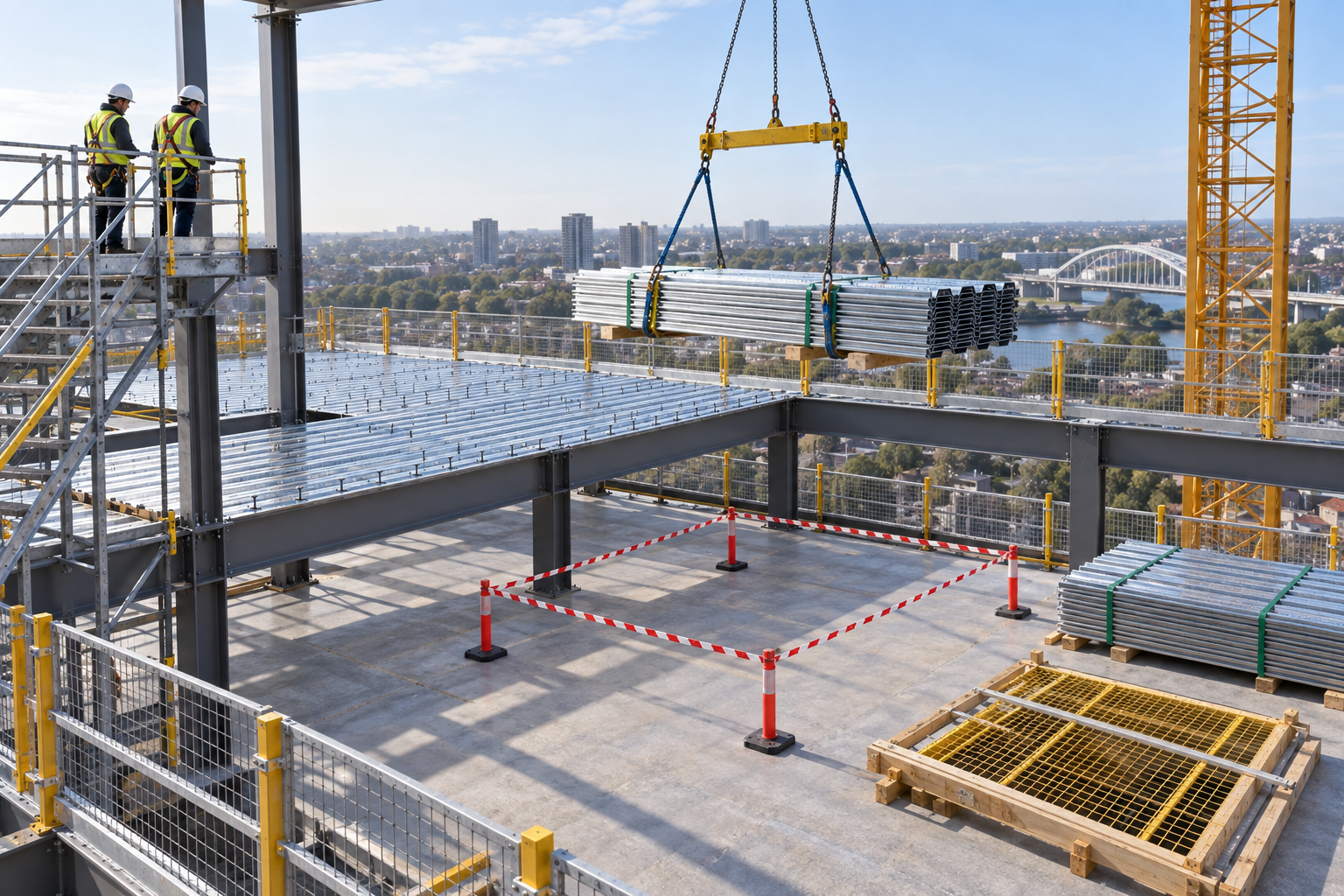
This illustration provides educational context. It is not an actual incident photograph or evidence of equipment suitability; any AI-generated depiction is illustrative only.
The scenario and record comparisons are fictional teaching examples, not records of real incidents, measurements, inspections, signatures or approvals.
| Stage | Fictional situation |
|---|---|
| Initial situation | A fictional crew spreads loose deck sheets to extend its covered area. |
| Changed condition | A delivery bundle is proposed for the newly covered zone. |
| Failure path | The sheets have not received the required attachments and the staging load has not been checked. |
| Possible outcome | Loose sheets could shift or the local support could fail under workers and the bundle. |
| Prevention barrier | Keep the route closed, complete the accepted support/fixing sequence and obtain a reviewed staging position before moving the bundle. |
Failure mechanisms
A bundle concentrates load over a small support area. Average finished-floor capacity does not establish capacity for a bundle on partly attached deck or an erection-stage frame. Land only at the reviewed location with the required supports.
A sheet covering an opening may still be loose, wrongly oriented or inadequately supported. Maintain protected access and secure each placement as specified before allowing people to use it as a walking surface.
Bearing, overlap, direction and attachment pattern act together. Do not solve poor bearing by pulling unsupported sheets or cutting new openings without an accepted detail. Keep protection continuous as the leading edge advances.
Wind can lift unsecured sheets and remaining stock even during a work stoppage. Secure unused material through a planned safe method, keep the area below closed and verify restraints and damage before restarting.
Installation completion releases only its defined condition. Transfer bundle limits, cover status, open defects and shoring restrictions; concrete placement and later loading require their own acceptance.
Decision sequence
| Step | Decision |
|---|---|
| Known | The area is covered with loose sheets. |
| Unknown | Walking restraint, bearing, attachments and concentrated bundle capacity are unconfirmed. |
| Hold | Do not treat visual coverage as permission to walk or stage loads. |
| Evidence | Verify support/attachment details, secure access boundary and the approved bundle position. |
| Release | Mark the accepted installation area and transfer loading/opening/shoring restrictions; release later stages separately. |
Work sequence: Review sequence → Receive and stage → Inspect materials → Lift and land → Spread and secure → Complete attachments → Hold on wind or defect → Inspect and transfer. This is a teaching flow, not a device drawing or a complete operating procedure.
5. Conditional decisions and common errors
| Situation | Required action | Evidence | Proceed when |
|---|---|---|---|
| Loose sheet access | Close route | Bearing and attachments | Secured route accepted |
| Bundle position changes | Hold landing | Local load/support review | Position approved |
| Wind or damage | Stop and secure safely | Restraints and defect checks | Restart conditions met |
| Installation complete | Transfer limits | Fixing, covers and open holds | Next stage separately released |
Similar observations, different decisions
The scenario and record comparisons are fictional teaching examples, not records of real incidents, measurements, inspections, signatures or approvals.
| Observation | Insufficient conclusion | Required distinction |
|---|---|---|
| Floor looks covered | It is a safe walkway. | Confirm secured deck and protected access. |
| Finished slab load is adequate | A bundle can be placed anywhere. | Review local concentrated loading in the actual installation stage. |
| Attachments finished | Concrete placement may start. | Obtain separate pour/loading and shoring acceptance. |
6. Roles and responsibilities
| Role | Responsibility |
|---|---|
| Work supervisor | Confirm deck and support drawings and the task scope, resources, interfaces and stop authority. |
| Qualified technical reviewer | Review bundle mass and stability, model limits, compatibility and unresolved technical conditions within assigned competence. |
| Work crew | Apply the listed controls, report changes and stop when evidence or safeguards are missing. |
| Inspector / assessor | Record actual secured access boundary and other relevant checks; do not mark unverified conditions as accepted. |
| Handover authority | Reconcile installation closeout, restrictions and outstanding actions before the next task. Role labels do not establish a legal credential. |
Supervision and handover focus
| Stage | Management action | Evidence |
|---|---|---|
| Review sequence | 1. Record deck and support drawings2. Record bundle loading layout3. Record access and rescue plan | 1. Deck and support drawings2. Bundle loading layout3. Access and rescue plan |
| Receive and stage | 1. Record bundle mass and stability2. Record location and support basis3. Record unbanding sequence | 1. Bundle mass and stability2. Location and support basis3. Unbanding sequence |
| Spread and secure | 1. Record secured access boundary2. Record fall protection continuity3. Record hands clear of edges | 1. Secured access boundary2. Fall protection continuity3. Hands clear of edges |
| Complete attachments | 1. Record attachment type and location2. Record connection quality check3. Record scrap accounted for | 1. Attachment type and location2. Connection quality check3. Scrap accounted for |
| Hold on wind or defect | 1. Record loose-sheet restraint2. Record defect and zone record3. Record retained support during repair | 1. Loose-sheet restraint2. Defect and zone record3. Retained support during repair |
| Inspect and transfer | 1. Record installation closeout2. Record load and pour restrictions3. Record cover security | 1. Installation closeout2. Load and pour restrictions3. Cover security |
7. Hold points and record comparison
| Hold point | Evidence before release | Actual approval |
|---|---|---|
| HP-0 Scope | Receive and stage specified deck bundles, lift and land them at reviewed locations, spread and secure sheets in sequence, protect openings and transfer installation restrictions. | |
| HP-1 Receive and stage | Bundle mass and stability; Location and support basis; Unbanding sequence; Equipment configuration | |
| HP-2 Lift and land | Bundle security and balance; Weather observation; Clear route and area below; Unified signals | |
| HP-3 Spread and secure | Secured access boundary; Fall protection continuity; Hands clear of edges; Bearing and overlap record | |
| HP-4 Inspect and transfer | Installation closeout; Load and pour restrictions; Cover security; Shoring and open holds |
Hold points are internal project checks. They are not universal statutory permits and do not grant work permission. Reassess after defects, changed conditions and shift changes.
Record comparison
The scenario and record comparisons are fictional teaching examples, not records of real incidents, measurements, inspections, signatures or approvals.
The boxes are static record prompts, not interactive or saved approvals. A tick does not establish suitability or permission to restart. Record the evidence, person, time and unresolved issues; retain the change history.
| Record | Insufficient record | Record checklist |
|---|---|---|
| Review sequence | Only marked “OK” | □ Deck and support drawings□ Bundle loading layout□ Access and rescue plan□ Weather and work coordination |
| Lift and land | Only marked “OK” | □ Bundle security and balance□ Weather observation□ Clear route and area below□ Unified signals |
| Hold on wind or defect | Only marked “OK” | □ Loose-sheet restraint□ Defect and zone record□ Retained support during repair□ Restart conditions |
| Inspect and transfer | Only marked “OK” | □ Installation closeout□ Load and pour restrictions□ Cover security□ Shoring and open holds |
8. Site checklist and emergency response
| Site check | Actual result | Person / action |
|---|---|---|
| Review sequence: Deck and support drawings; Bundle loading layout; Access and rescue plan; Weather and work coordination | ||
| Receive and stage: Bundle mass and stability; Location and support basis; Unbanding sequence; Equipment configuration | ||
| Inspect materials: Deck type and condition; Rigging and lifting method; Bearing and orientation; Opening and edge protection | ||
| Lift and land: Bundle security and balance; Weather observation; Clear route and area below; Unified signals | ||
| Spread and secure: Secured access boundary; Fall protection continuity; Hands clear of edges; Bearing and overlap record | ||
| Complete attachments: Attachment type and location; Connection quality check; Scrap accounted for; Opening cover and marking | ||
| Hold on wind or defect: Loose-sheet restraint; Defect and zone record; Retained support during repair; Restart conditions | ||
| Inspect and transfer: Installation closeout; Load and pour restrictions; Cover security; Shoring and open holds |
Stop work
Hold work for unknown bundle loads, unsupported or loose access, lost edge/opening protection, unacceptable weather, damaged sheets, changed staging positions or incomplete temporary support. Do not reopen the lower zone while falling-object hazards remain.
Emergency response
Keep people clear of unstable sheets, openings and the area below. Use the planned site and height-rescue response; call 995 for a medical emergency. Do not walk onto unverified deck or move a bundle during improvised rescue. Maintain support and isolation for trained responders.
9. Sources and review limits
Public-source access/review: 2026-10-14.
| Official source | Reviewed scope and limits |
|---|---|
| MOM: Risk management | Assess installation-stage loads, changing leading edges, weather and simultaneous work below. Official explanation of statutory duties; linked SSO text was not independently read for this item. This is not a legal opinion. |
| WSH Council: Planning a Lift | Coordinate bundle mass, lifting arrangement, landing location and agreed signals. Official practical guidance. No assertion that every activity is a crane operation or that this page itself establishes a universal statutory permit. |
| MOM: Register Lifting Equipment | Verify applicable lifting equipment/gear records. Official registration explanation; determine the actual equipment category and applicable exceptions. Registration is not approval of the individual lift. |
| WSH Council: Preventing Falls from Height | Maintain continuous edge/opening protection, safe access and applicable height permit/rescue arrangements. Official explanatory guidance; the stated PTW scope is not a general exemption from fall controls below that height. Actual premises classification must be checked. |
No actual equipment model, site measurements, design calculations or signed approval was supplied. Check the applicable Singapore requirements and approved safe work procedures against the actual equipment and site before use. Statutory duties, official guidance and manufacturer limits serve different purposes; editorial checks do not establish legal or professional approval.
10. PDF guidance and FAQ
PDF A covers basic task controls; B focuses on technical failures; C covers supervision, records and handover. The article has eight stages with four items per main cell; each PDF has six key stages with three items per main cell. P/S/R/A, measurements, confirmations and signatures remain blank for actual site assessment.
PDFs are complementary six-stage extracts. Apply all eight body stages and the actual equipment/site procedure.
Can loose sheets be used briefly as a walkway?
Keep access on the accepted secured route with continuous fall protection.
Can the bundle move to a more convenient spot?
Only after reviewing that location’s temporary support and concentrated loading.
What happens when wind interrupts work?
Use the planned safe securing procedure, maintain exclusions and inspect before restart.
Does deck handover permit pouring?
No. Convey restrictions and obtain the separate pour and support release.
Has a professional verified or approved this document?
AI-generated reference material; not professionally verified or approved. Before use, a qualified person must review and adapt it to Singapore requirements, the actual equipment/site and approved safe work procedures.
11. Revision history and authorship
AI-generated reference material; not professionally verified or approved. Before use, a qualified person must review and adapt it to Singapore requirements, the actual equipment/site and approved safe work procedures.
| Date | Version | Change | Review status |
|---|---|---|---|
| 2026-10-14 | SG 1.0 | New Singapore edition from assigned Korean source; task decisions, records and PDFs localized. | AI editorial review; no professional technical approval |
Korean edition revision history: 2026-09-19 (v1.1): earlier published draft/version retained in the source history; 2026-09-26 (v1.2): task decisions, record checklist, JSA and three PDF variants revised. These are editorial records, not professional technical approval. Singapore v1.0 adapts the earlier edition to Singapore requirements and terminology.
Site reviewers must add their actual qualifications, scope, date and approval only after the review occurs.