Treat every climbing stroke as a controlled change of structural load path. The correct model, balance arrangement, support engagement and command authority must be confirmed before normal mast connections are opened.
AI-generated reference material. It has not been verified or approved by a professional. Before use, a qualified person must review and adapt it to applicable Singapore requirements, the actual equipment and site, and approved safe work procedures.
1. Singapore legal and technical basis
Singapore tower-crane alteration belongs within the approved crane-contractor framework, using approved erectors and the actual manufacturer procedure. Coordinate the resulting configuration and test/examination route with the Authorised Examiner. The 2025 MOM revision distinguishes overload testing from load and functional tests; removal of periodic overload tests is not permission to return an altered crane to service without the required examination.
| Source category | Task application and limit |
|---|---|
| MOM - Risk management | Assess the intermediate load states, access, adjacent works and emergency holding condition. Official explanation of WSH Risk Management duties, not a complete consolidated statutory text. |
| MOM - Approved crane contractor | Use the approved contractor and verify its scope for the crane and alteration. Official explanation of the crane regime, not approval of the actual contractor, crane model or proposed climbing method. |
| MOM - Approved crane erectors | Verify approved erectors, manufacturer-specific competence and sufficient trained assistants for the actual work. The installation/dismantling assistant-count example is not automatically a complete climbing crew design; actual approved scope and staffing must be verified. |
| MOM - Test and examination circular, 29 August 2025 | Agree the altered-equipment examination scope with the Authorised Examiner using the current schedule. Table extraction has merged cells; no model-specific test scope or detailed interval is certified here. Consult the original schedule with the Authorised Examiner. |
| MOM - Lifting equipment examination FAQ | Distinguish load/functional tests from the removed periodic overload-test requirement. Removal of periodic overload tests does not remove examination, functional testing or required load tests. The actual altered crane needs AE determination. |
| MOM - Work at Heights amendment factsheet | Plan fall prevention, access and rescue and establish the applicable factory permit route. Official 2014 explanatory factsheet accessed now. Consolidated SSO fetch returned 403; full current statutory text not verified. Course names and detailed permit arrangements need current confirmation. |
Use Singapore requirements and SI units. Manufacturer limits apply to the actual model. Foreign technical examples do not establish Singapore statutory duties. A job safety analysis or completed checklist is not a permit or approval.
2. Scope and required inputs
Included: planned mast insertion using the installed tower crane climbing system and its approved procedure. Internal climbing, a different climbing frame, tie removal, structural repair and fault recovery require their own reviewed method; no common pin, jack or support sequence is prescribed here.
| Input | Evidence needed |
|---|---|
| Crane identity | Make, model, serial number, frame identity, mast combination and current manual revision. |
| Temporary structure | Foundation, ties, host structure, permitted height and every intermediate load state. |
| Balance and weather | Model balance load/radius, jib orientation, actual restraint, wind measurement basis and interruption plan. |
| People and release | Approved contractor and erectors, command and signals, access/rescue, inspection and AE coordination. |
No actual manual, structural calculation or site measurement was supplied. The manufacturer method controls support transfer: hydraulic support may carry load during a prescribed stroke, with mechanical transfer at the stages specified for that system. Do not invent a universal locking pin, wind threshold, bolt count or torque.
3. Eight-stage JSA
| Job stage | Hazards and effects | Failure factors | Controls | Site verification | P | S | R | A |
|---|---|---|---|---|---|---|---|---|
| 1. Plan the climb | 1. Wrong configuration2. Tie or support failure3. Adjacent operation strike4. Uncoordinated movement | 1. Wrong manual revision2. Host structure unchecked3. Work zones overlap4. Crew scope unverified | 1. Match model and procedure2. Verify temporary load paths3. Coordinate adjacent works4. Assign approved erectors | 1. Crane and frame identity2. Support design records3. Work-zone plan4. Contractor and crew scope | ||||
| 2. Weather and access | 1. Wind-driven rotation2. Frame distortion3. Falling components4. Fall from access | 1. Generic wind limit2. Tower reading absent3. Securing plan missing4. Unsafe climbing route | 1. Use actual stage limits2. Monitor tower conditions3. Plan safe interruption4. Protect access and rescue | 1. Wind basis and readings2. Forecast and securing plan3. Drop and collapse zones4. Access and rescue checks | ||||
| 3. Inspect the system | 1. Hydraulic drift2. Support-seat failure3. Guide binding4. Loss of fall protection | 1. Hose or valve defect2. Worn retained parts3. Mixed components4. Platform defect | 1. Inspect hydraulic system2. Verify supports and guides3. Match component identity4. Close safety defects | 1. Inspection and test scope2. Support and retainer state3. Component compatibility4. Defect closure records | ||||
| 4. Establish balance | 1. Eccentric load2. Unintended slew3. Balance-load movement4. Early mast separation | 1. Wrong load or radius2. Wrong restraint assumed3. Changed jib configuration4. Clearance not verified | 1. Set prescribed balance2. Apply actual slew restraint3. Check current configuration4. Hold before opening mast | 1. Load and trolley radius2. Restraint engagement3. Level and guide condition4. Connection-release record | ||||
| 5. Control each stroke | 1. Support slips2. Ram side loading3. Sudden frame movement4. Pinch and crush exposure | 1. Partial support seating2. Pressure mistaken for support3. Conflicting commands4. Abnormal motion ignored | 1. Follow model sequence2. Check every load transfer3. Use one command authority4. Stop at each hold point | 1. All support seats2. Stroke pressure and position3. People and guides clear4. Erector stroke release | ||||
| 6. Insert mast section | 1. Dropped section2. Transfer-device runaway3. Collision with structure4. Hands trapped at joint | 1. Wrong lifting point2. Missing end stop3. Section mismatch4. Forced hand alignment | 1. Match section and rigging2. Check transfer retainers3. Control transfer envelope4. Use approved alignment aids | 1. Section ID and weight2. Rail stops and retainers3. Load path and clearance4. Positive temporary restraint | ||||
| 7. Connect and verify | 1. Mast separation2. Fastener damage3. Incomplete pin engagement4. Dropped hardware | 1. Wrong part or reuse2. Uncontrolled tightening3. Retainer omitted4. Paint mark trusted | 1. Apply specified method2. Use suitable verified tools3. Inspect each connection4. Hold before load change | 1. Part and reuse criteria2. Tool and tightening record3. Pin and retainer checks4. Independent acceptance | ||||
| 8. Restore and release | 1. Premature operation2. Loose part falls3. Safety device fault4. Unresolved configuration | 1. Verbal completion only2. Temporary items remain3. Tests not completed4. Defects carried forward | 1. Restore operating state2. Account for people and tools3. Complete required tests4. Record operating release | 1. Final configuration2. Plumb and functional checks3. AE examination records4. Defect closure and release |
P/S/R/A and actual measurements, checks, names and signatures remain blank for the site assessment. A score cannot waive a required control.
4. Hypothetical scenario and failure mechanisms
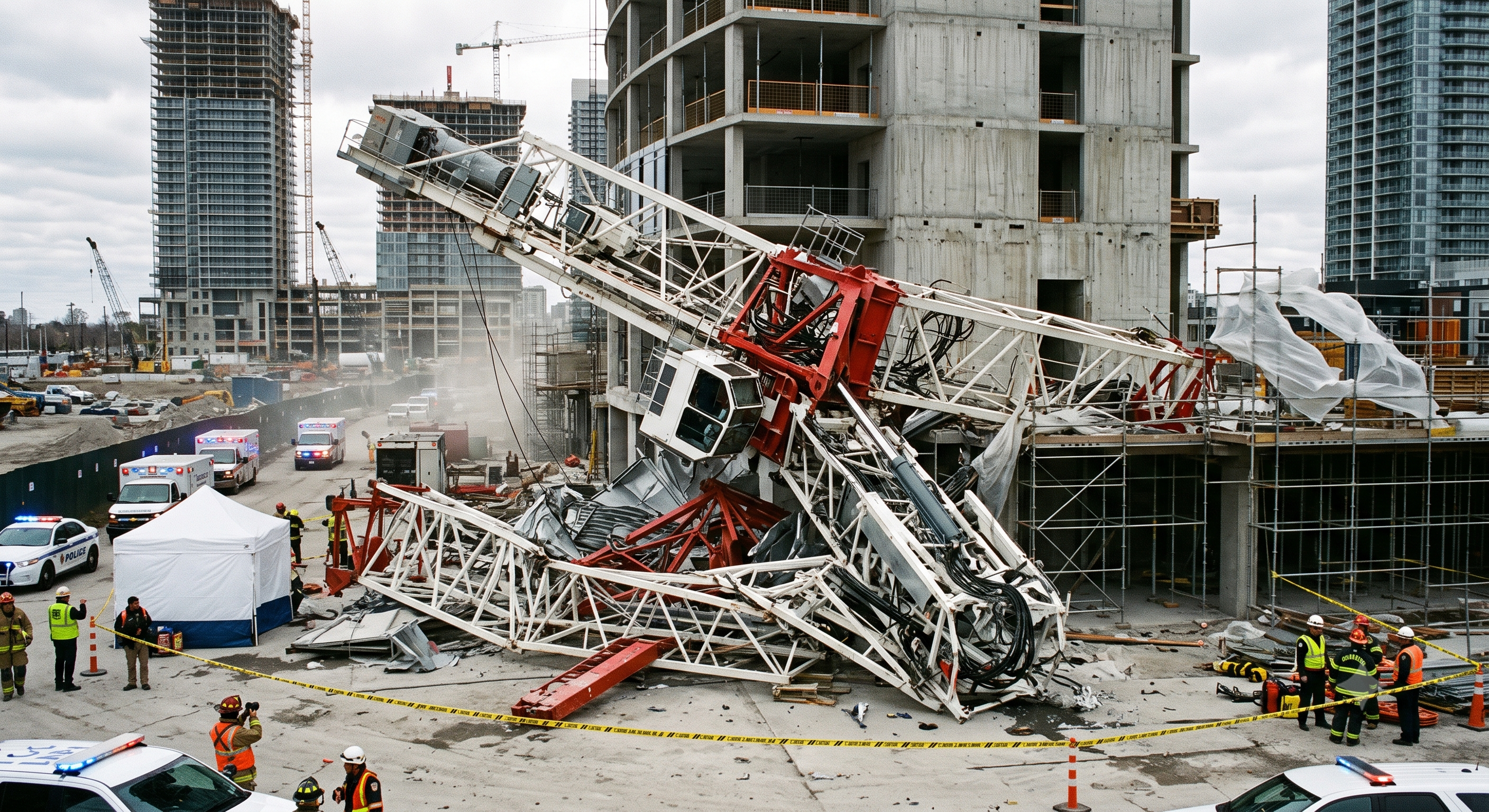
The retained image and the following scenario are educational. They are not actual incident, inspection or approval records.
| Stage | Fictional situation |
|---|---|
| Initial state | A crew prepares to add a mast section after the jib configuration has changed. |
| Changed condition | The previous balance position is reused and the support engagement is inferred from steady hydraulic pressure. |
| Failure path | Opening normal connections changes the load path before balance, restraint and all required support seats are confirmed. |
| Possible result | The frame can bind or distort and a partly seated support can lose load. |
| Barrier | Retain the prescribed holding state, compare the actual configuration with its method and verify each support before the next transfer. |
Failure mechanisms
A pressure reading does not prove support seating or acceptable guide reactions. The actual load path changes during climbing; each stroke needs its own observation and release. If wind, alignment or communication changes, stop progressing and use the model contingency for that exact state.
Paint marks can help later observation but do not prove the specified fastener installation. Verify component identity, reuse rules, lubrication, tool condition and the prescribed tightening or pin-retention method. Keep the restricted area based on actual fall, transfer, slew and collapse exposures.
Known facts, unresolved support conditions, the reason for holding, evidence required and the named restart authority must be recorded separately. Completing the lift height does not complete structural or operational acceptance.
5. Hold and proceed decisions
| Condition | Action | Evidence | Proceed when |
|---|---|---|---|
| Configuration changed | Hold connection release | Current model and balance method | Balance verified |
| Support partly seated | Stop the stroke sequence | Actual seat and retainer checks | All supports accepted |
| Unexpected movement | Apply stage contingency | Cause, repair and reinspection | Hold points released |
| Section aligned only | Retain handling support | Positive restraint and connection | Connection accepted |
| Mast joined, tests pending | Keep operational prohibition | Final configuration and required tests | Operation released |
Similar observations, different decisions
| Observation | Insufficient conclusion | Required distinction |
|---|---|---|
| Steady pressure | The support is sound | Verify the specified physical load path. |
| Wind drops | Resume immediately | Check interruption state, defects and the forecast. |
| Bolts marked | Preload accepted | Use the specified installation and verification records. |
| Height reached | Crane ready | Complete configuration, examination and operating release. |
Record the model-specific weather limits and measurement basis, balance settings, support sequence, mast/fastener acceptance and fall-protection/rescue arrangement in the work package. A missing manufacturer limit is a hold for competent resolution through the approved contractor and relevant engineer/manufacturer; this sheet supplies no alternative number.
6. Roles and supervision
| Role | Responsibility |
|---|---|
| Occupier / site coordinator | Control adjacent work, public interfaces, access and the applicable permit arrangements; retain a clear emergency route. |
| Approved crane contractor | Verify approved scope, current manufacturer procedures, competent personnel and every temporary climbing state. |
| Approved crane erectors | Direct the operation, brief the crew, confirm support transfers and control the designated stroke-release authority. |
| Responsible engineer | Resolve the actual temporary structural support, tie and host-structure design within the required professional scope. |
| Authorised Examiner | Determine and perform the applicable test and examination of the altered crane; this editorial document is not an examination certificate. |
| Operator, riggers and signalmen | Follow the agreed command system, maintain communication and stop for unclear signals or abnormal behaviour. |
| Access and rescue team | Maintain exclusion and the site-specific elevated rescue capability without improvising movement of an unstable crane. |
A team label is not proof of competence or current approval. Check the actual organisation, approved personnel, model scope and task assignments. Installer completion, engineer acceptance and AE examination are separate records; none is replaced by a JSA signature.
7. Hold points and record quality
| Hold point | Evidence before release | Confirmation / approval |
|---|---|---|
| Start | Use the exact manufacturer climbing manual, approved configuration and jurisdiction-specific engineering documents. No actual model manual or site calculations were supplied. Do not infer wind limits, torque, support capacity, free-standing height or a pin-removal sequence from this guide. A support may carry hydraulic load during a prescribed stroke; mechanical transfer is required at the stages specified for that system. | |
| HP-1 Balance | Does the counterweight and ballast match the approved configuration?; Are the balance load, trolley radius, and jib orientation correct?; Is the specified slew-restraint method fully applied?; Are level, plumb, connection-gap, and guide-clearance criteria acceptable? | |
| HP-2 Each stroke | Are the load-transfer supports fully seated and retained as specified?; Are hydraulic pressure, cylinder position, and guide alignment normal?; Are personnel clear of shear, pinch, and potential movement zones?; Has the designated approved crane erector released the hold point for this stroke? | |
| HP-3 Connect | Does every bolt, nut, pin, washer, and retainer meet the specification?; Is required tooling identified, inspected, and within its calibration period?; Are torque, tension, pin engagement, or other acceptance results recorded?; Has an independent qualified checker accepted every required connection? | |
| HP-4 Release | Does the final crane configuration match the approved plan?; Are required inspections, tests, and plumb checks complete?; Have all personnel, tools, and temporary components been accounted for?; Has the designated approved crane erector and responsible site representative authorised return to service? |
Complete after actual checks. Recheck after changes, defects or shift handover.
Record comparison examples
The boxes are static record prompts, not interactive or saved approvals. A tick does not establish suitability or permission to restart. Record the evidence, person, time and unresolved issues; retain the change history.
| Record type | Insufficient record | Record checklist |
|---|---|---|
| Weather | Verbal or undated confirmation only | □ Wind basis□ Boundary map□ Securing method□ Manual section, time and checker |
| Balance | Verbal or undated confirmation only | □ Load and radius□ Restraint state□ Temporary load path□ Manual section, time and checker |
| Each stroke | Verbal or undated confirmation only | □ All support seats□ Stroke and pressure□ People clear□ Manual section, time and checker |
| Connect | Verbal or undated confirmation only | □ Part and reuse rule□ Tool and results□ Independent check□ Manual section, time and checker |
8. Pre-work checks and emergency response
| Check item | Result | Person / action |
|---|---|---|
| □ Plan: Does the manual number and revision match the installed crane? | ||
| □ Weather: Is the controlling wind limit and measurement basis recorded? | ||
| □ Inspect: Has the required component inspection been documented? | ||
| □ Balance: Does the counterweight and ballast match the approved configuration? | ||
| □ Each stroke: Are the load-transfer supports fully seated and retained as specified? | ||
| □ Insert: Are the mast-section ID, weight, lifting points, and compatibility verified? | ||
| □ Connect: Does every bolt, nut, pin, washer, and retainer meet the specification? | ||
| □ Release: Does the final crane configuration match the approved plan? | ||
| □ Release / handover authority |
Stop work
Stop for missing support confirmation, abnormal pressure or movement, guide binding, loss of communication, weather outside the approved envelope, an incomplete connection or entry into the exposure zone. Stop progressing the sequence; keep the system in its prescribed holding condition.
Emergency response
Do not automatically depressurise, reverse the ram, lower onto the nearest support or release a slew restraint. These actions can remove the current load path. Apply the manufacturer contingency for the actual stage, secure the area and obtain the responsible technical direction. Rescue must not depend on moving an unstable crane. Restart requires cause identification, correction, reinspection and repeat release of the affected hold points.
Singapore application
The approved crane contractor retains the actual interruption state and recovery procedure. Do not automatically reverse a ram, vent pressure, release slew restraint or lower onto a nearby support; any of these can remove the current load path. The rescue plan must work with the crane held in its actual safe state.
9. Sources and review limits
Public-source review: 14 October 2026. Only the material and limits identified below were reviewed.
| Source | Reviewed material | Task application |
|---|---|---|
| MOM - Risk management | Responsibilities; routine and non-routine work; hierarchy of control and risk assessment team. Official explanation of WSH Risk Management duties, not a complete consolidated statutory text. | Assess the intermediate load states, access, adjacent works and emergency holding condition. |
| MOM - Approved crane contractor | Approved-contractor role for installation, repair, alteration and dismantling; manufacturer procedures and erector competence. Official explanation of the crane regime, not approval of the actual contractor, crane model or proposed climbing method. | Use the approved contractor and verify its scope for the crane and alteration. |
| MOM - Approved crane erectors | Erector responsibility, manufacturer-specific training and erection-team arrangements for installation, alteration and dismantling. The installation/dismantling assistant-count example is not automatically a complete climbing crew design; actual approved scope and staffing must be verified. | Verify approved erectors, manufacturer-specific competence and sufficient trained assistants for the actual work. |
| MOM - Test and examination circular, 29 August 2025 | Three-page text extraction, revised regime effective 12 September 2025, equipment categories and test definitions. Table extraction has merged cells; no model-specific test scope or detailed interval is certified here. Consult the original schedule with the Authorised Examiner. | Agree the altered-equipment examination scope with the Authorised Examiner using the current schedule. |
| MOM - Lifting equipment examination FAQ | Questions 1-6 and 15: overload versus load/functional tests, changed requirements and Authorised Examiner discretion. Removal of periodic overload tests does not remove examination, functional testing or required load tests. The actual altered crane needs AE determination. | Distinguish load/functional tests from the removed periodic overload-test requirement. |
| MOM - Work at Heights amendment factsheet | Pages 1-4, particularly Annex A questions 1-3 on factories, hazardous height and effective protection; training/role explanations. Official 2014 explanatory factsheet accessed now. Consolidated SSO fetch returned 403; full current statutory text not verified. Course names and detailed permit arrangements need current confirmation. | Plan fall prevention, access and rescue and establish the applicable factory permit route. |
Selected public official sources were reviewed on 14 October 2026 within the recorded scope. No full consolidated legal audit, paid Singapore Standard, actual model manual, site inspection, engineering calculation or professional approval is claimed. Verify current detailed requirements and actual equipment/site records before use.
AI-generated reference material. It has not been verified or approved by a professional. Before use, a qualified person must review and adapt it to applicable Singapore requirements, the actual equipment and site, and approved safe work procedures.
10. PDF use and frequently asked questions
PDF A covers basic task controls; B focuses on technical failures; C covers supervision, records and handover. The article has eight stages with four items per main cell; each PDF has six key stages with three items per main cell. P/S/R/A, measurements, confirmations and signatures remain blank for actual site assessment.
jsa-crane-telescoping
Does steady pressure prove safe support?
No. Identify the current load path and verify all supports and retainers required by the model before the next transfer. Pressure alone cannot confirm seating.
Can climbing resume as soon as wind drops?
No. Check the securing state, forecast, defects and changed configuration; repeat affected hold points before authorised restart.
Does a paint mark prove bolt preload?
No. Use the specified installation and verification method with traceable tooling and recorded results. Matchmarks are supplementary.
Are A/B/C separate operating procedures?
No. A summarises field controls, B examines mechanical failures, and C organises supervision and evidence. Read them with the full eight-stage body and actual manufacturer procedure.
Has a professional verified or approved this document?
No. Public sources and editorial, layout and consistency checks were reviewed using AI. No site inspection or professional technical approval has been performed. Obtain appropriate professional review before use.
Singapore application
Read A, B and C together with all eight JSA stages and the approved work procedure. The sheets are complementary extracts, not separate work authorisations.
11. Authorship and revision history
AI-generated reference material. It has not been verified or approved by a professional. Before use, a qualified person must review and adapt it to applicable Singapore requirements, the actual equipment and site, and approved safe work procedures.
| Date / edition | Authorship and scope | Professional approval |
|---|---|---|
| 2026-09-16 / Korean source | Original topic and educational illustration retained as references. Source content is unchanged. | Not asserted |
| 14 October 2026 / Singapore 1.0 | Rebuilt the climbing table and local responsibility structure for Singapore approved contractors, erectors and AE handover; removed foreign role definitions, wind numbers and legal citations while preserving every-stroke support verification. | Not performed |
Source topic: https://smartjsabridge.com/ko/case-study/jsa-crane-telescoping