The crane capacity label does not prove that a particular lift is safe. The actual configuration, worst working radius, support reactions and load retention must all match the lift plan before movement begins.
Mobile crane lifting
This is reference content written and reviced with AI. It has not been verified or approved by a professional. Review by a suitably qualified professional and site authorisation are required before use.
Stop work
Stop for sling movement, unexpected tilt, ground settlement, a safety-device fault, loss of signal or departure from the planned envelope. Do not bypass a limiter or approach a suspended load to correct the arrangement.
AI-generated reference material; not professionally verified or approved. Before use, a qualified person must review and adapt it to applicable Singapore requirements, the actual equipment/site and approved safe work procedures.
1. Legal and technical scope
Plan the stationary mobile-crane lift under the applicable Singapore lifting requirements, with a lift plan, risk assessment, safe work procedure and required permits. Verify the crane registration, examination status and required operator and lifting-team competence for the actual class of equipment and work.
| Basis | Singapore application |
|---|---|
| Risk management | The employer, self-employed person and principal assess and control work risks. Include preparation, abnormal conditions and maintenance. Coordinate affected trades and communicate controls. |
| Activity-specific guidance | Use WSHC planning guidance for the load, equipment, crew, environment and change controls; MOM registration and examination sources establish checks for the actual crane and lifting accessories. |
| Permits and authority | Select permit requirements for the actual sector and activity. Site hold points and contractor role labels do not create statutory permits or qualifications. |
| Equipment and design | This reference does not approve a crane configuration, support pressure, sling angle or engineering calculation. Tandem lifts, personnel lifting, travel with load and work near electrical lines require separate planning. The MOM examination circular is category-specific and removes routine periodic overload tests; it does not permit crew-deviced proof loading. |
2. Scope and required inputs
Included scope
Stationary mobile-crane lifting: planning, support setup, pre-use checks, rigging, trial lift, transfer, landing and handover. Retains the original pump-unit lifting example as a clearly hypothetical training case.
Separate review
Tandem lifting, personnel lifting, pick-and-carry, lifting over occupied areas and work near power lines need additional task-specific planning. This reference does not supply a crane setup, electrical clearance or rigging design.
| Required input | What to verify |
|---|---|
| Plan lift | Mass and centre · Worst working radius · Power line plan · Landing design |
| Set supports | Support reactions · Ground capacity · Extension and level · Void assessment |
| Check crane | Inspection record · Device functions · Chart deductions · Repair release |
| Rig load | Rigging sketch · Leg loads and WLL · Edge contact · Component identity |
Confirm Singapore lift planning, required appointments and current equipment examination before use. Follow the actual crane instructions for functional and trial-lift checks; no universal trial height, hold time or number of tag lines is supplied. Control rotation using the assessed method without exposing people to trapping or a suspended load.
Singapore site planning
The principal and lifting contractor must resolve ground support, underground services, crane configuration and the full load route before release. Assign the lifting supervisor, operator, rigger and signaller required by the applicable arrangements and verify their qualifications. Include lifting beam, hook and rigging in the load calculation, and check capacity at the worst radius along the route. Stop for an unidentified centre of gravity, sling migration, changed ground support, lost communication or a different load path.
3. Eight-stage JSA
| Job stage | Hazards and effects | Failure factors | Technical and procedural controls | Site verification | P | S | R | A |
|---|---|---|---|---|---|---|---|---|
| 1. Plan lift | 1. Load drop2. Crane overturn3. Power contact4. Public exposure | 1. Unknown gross mass2. Wrong duty chart3. Unmapped route4. Unclear roles | 1. Confirm load data2. Match configuration3. Plan full route4. Assign lifting team | 1. Mass and centre2. Worst working radius3. Power line plan4. Singapore lift plan and crew | ||||
| 2. Set supports | 1. Ground failure2. Crane tilt3. Outrigger crush4. Buried service damage | 1. Weak subgrade2. Undersized mats3. Wrong extension4. Unseen void | 1. Verify ground2. Size support system3. Use matching chart4. Guard moving supports | 1. Support reactions2. Ground capacity3. Extension and level4. Void assessment | ||||
| 3. Check crane | 1. Rope failure2. Block collision3. Unplanned movement4. Load drop | 1. Defective rope2. Failed safety device3. Wrong reeving4. Open defect | 1. Inspect before use2. Test as instructed3. Verify reeving4. Quarantine defects | 1. Asset examination status2. Device functions3. Chart deductions4. Repair release | ||||
| 4. Rig load | 1. Load slip2. Leg overload3. Sling cut4. Pin release | 1. Wrong load centre2. Shallow sling angle3. Sharp edge4. Wrong shackle loading | 1. Use planned lift points2. Rate actual hitch3. Fit edge protection4. Secure correct pins | 1. Rigging sketch2. Leg loads and WLL3. Edge contact4. Component identity | ||||
| 5. Trial lift | 1. Load tilt2. Brake slip3. Shock loading4. Rigger crush | 1. Unequal load share2. Load snagged3. Rapid hoisting4. Unsafe standing area | 1. Lift slowly as planned2. Pause near support3. Check grip and balance4. Lower if abnormal | 1. Clear separation2. No sling migration3. Brake holding4. Team clearance | ||||
| 6. Transfer load | 1. Electrical contact2. Crushing3. Load swing4. Collision | 1. Route changed2. Signal lost3. Wind effects4. Tagline snag | 1. Control full route2. Use agreed signals3. Observe weather limits4. Use planned guidance | 1. Full-route radius and load2. Signal contact3. Wind and surface area4. Guide line route | ||||
| 7. Land and release | 1. Load overturn2. Finger crush3. Support failure4. Trapped sling | 1. Weak landing bed2. Early release3. Hands in gap4. Unknown stability | 1. Prepare landing bed2. Confirm stable support3. Keep hands clear4. Release without forcing | 1. Bearing and restraint2. Load fully supported3. Release authority4. Rigging free | ||||
| 8. Stow and hand over | 1. Hook snag2. Outrigger crush3. Delayed failure4. Vehicle strike | 1. Gear left hanging2. Blind retraction3. Defect not reported4. Route obstructed | 1. Stow as instructed2. Guide moving supports3. Record outstanding defects4. Clear departure route | 1. Transport condition2. People accounted for3. Defect ownership4. Handover scope |
P = likelihood; S = severity; R = risk using the site method; A = site acceptance/authorisation. Complete after actual assessment; no score overrides an unresolved hold point or equipment limit.
4. Fictional scenario and failure mechanisms
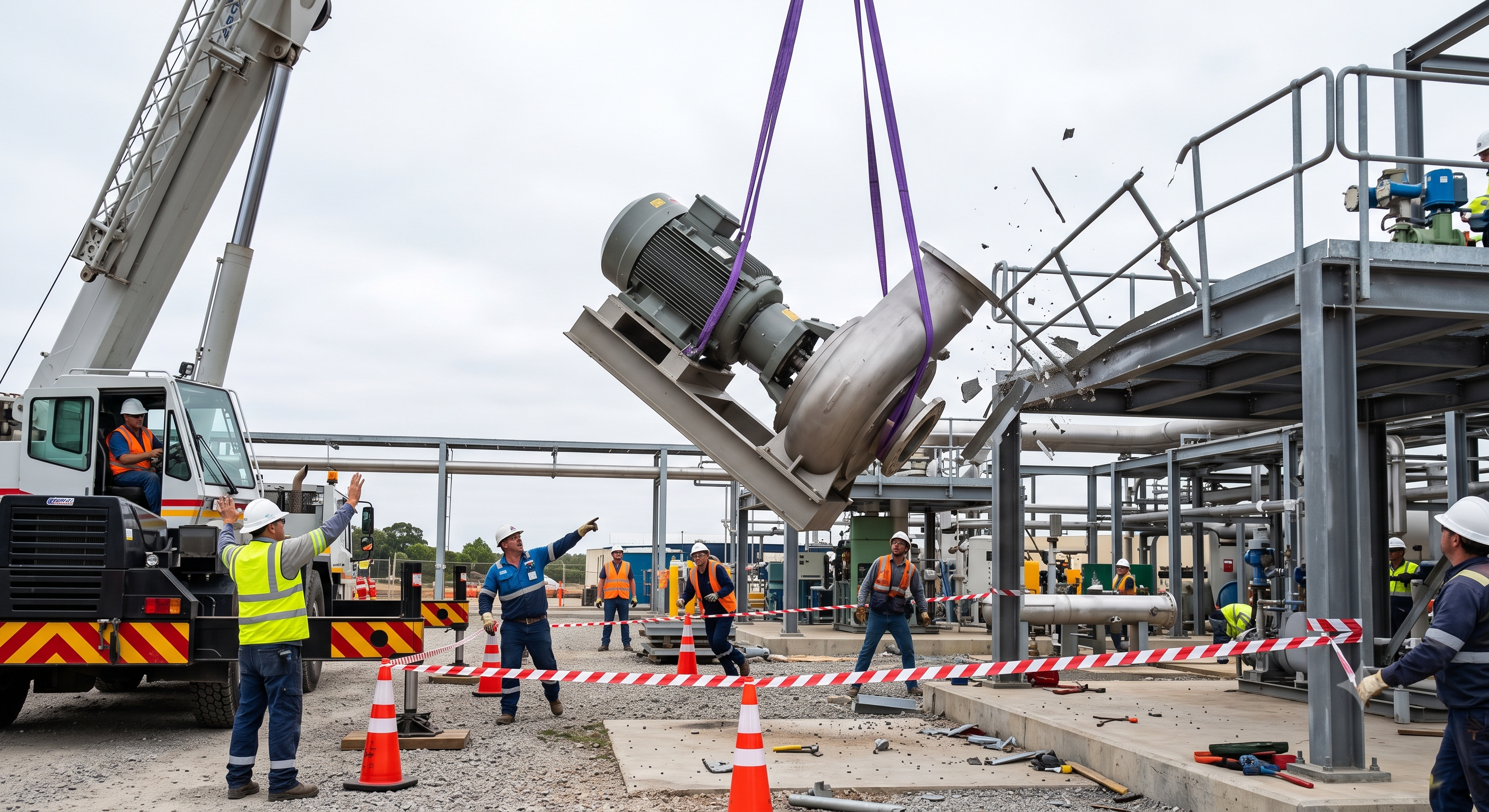
The original educational image is retained. It is not evidence of an actual incident or site suitability.
The scenario and record comparisons are fictional teaching examples, not records of real incidents, measurements, inspections, signatures or approvals.
| Item | Fictional scenario |
|---|---|
| Initial situation | A motor-pump skid is ready for lifting; its motor is offset from the frame centre. |
| Changed condition | The stated mass excludes the lifting beam and the load centre has not been confirmed. |
| Failure path | The crew proposes a direct lift because the crane has a large headline capacity. |
| Possible outcome | A sling could migrate on the painted casing while one leg takes more load than expected. |
| Prevention barrier | Hold the lift on its support, resolve gross load and lift-point geometry, then conduct the planned low trial lift. |
Failure mechanisms
For an ideal symmetric two-leg arrangement with equal sharing, T = W / (2 sin theta), with theta measured from horizontal and W the total force. This is not an exponential relationship and does not establish a universal failure angle. An offset centre, unequal leg stiffness or an unsuitable hitch invalidates equal-sharing assumptions; use rated hitch data and the planned geometry.
A load indicator does not measure ground bearing capacity or prevent sling slip. Ground reactions vary with radius, boom direction, counterweight and setup. Mat area alone cannot establish adequacy: mat bending, ground layers, voids and nearby excavations also matter.
Lift gently to the planned low trial position and check retention, balance and brake holding from a safe place. Stopping cannot correct a bad hitch. Lower to a prepared support before adjustment; do not pull a sling, push a rotating load or force a snag free.
Decision sequence
| Decision stage | What to verify |
|---|---|
| Known facts | The offset motor and unverified rigging are observable. |
| Unresolved matters | Gross lifted mass, centre of gravity, hitch capacity and landing stability remain unconfirmed. |
| Reason to hold | A nominal crane rating and a sling label cannot establish the capacity of this arrangement. |
| Required evidence | Obtain load evidence, configuration-specific chart with deductions, rigging sketch, support assessment and route/landing checks. |
| Restart decision | The designated lift supervisor releases only the checked stage after a satisfactory trial and team briefing; a changed radius or setup requires review. |
5. Conditional decisions and common errors
| Condition | Action | Evidence | Proceed when |
|---|---|---|---|
| Unknown mass | Hold on support | Load and gear evidence | Gross load known |
| Sling migration | Lower safely | Reviced rigging sketch | Retention checked |
| Ground movement | Stop affected lift | Support reassessment | Stable setup |
| Lost signal | Stop movement | Communication restored | Route reconfirmed |
Similar situations, different decisions
The scenario and record comparisons are fictional teaching examples, not records of real incidents, measurements, inspections, signatures or approvals.
| Comparison | Situation A | Situation B |
|---|---|---|
| Capacity | Crane maximum tonnage: a headline rating. | Chart for actual radius and setup: relevant capacity evidence. |
| Trial | No movement for a moment: observation only. | Retention, balance, support and brakes checked: basis for next stage. |
| Landing | The load touches the base: partial contact. | Stable support and restraint: basis for de-rigging. |
6. Roles and responsibilities
| Role | Responsibility |
|---|---|
| Work supervisor | Coordinate the lift plan, exclusion zones and signals; stop at an unverified stage. |
| Technical reviewer | Provide competent load, ground, support and rigging assessment within the assigned scope. |
| Work crew | Operator, rigger and signal person work within their competence and agree who controls movement. |
| Inspector / assessor | Record actual inspections and observations; never prefill risk or acceptance results. |
| Release / handover authority | Accept the checked landing/handover scope and retain restrictions on outstanding defects. |
The principal and employers coordinate the risk assessment and safe work procedures. These role labels allocate work; verify any qualifications and statutory appointments required for the actual Singapore activity. The receiving person must be given restrictions and unresolved defects before handover.
Record and handover perspective
| Stage | Record controls | Verification |
|---|---|---|
| Plan lift | 1. Record mass and centre2. Record worst working radius3. Record power line plan | 1. Worst working radius2. Power line plan3. Singapore lift plan and crew |
| Check crane | 1. Record asset examination status2. Record device functions3. Record chart deductions | 1. Device functions2. Chart deductions3. Repair release |
| Rig load | 1. Record rigging sketch2. Record leg loads and wll3. Record edge contact | 1. Leg loads and WLL2. Edge contact3. Component identity |
| Trial lift | 1. Record clear separation2. Record no sling migration3. Record brake holding | 1. No sling migration2. Brake holding3. Team clearance |
| Land and release | 1. Record bearing and restraint2. Record load fully supported3. Record release authority | 1. Load fully supported2. Release authority3. Rigging free |
| Stow and hand over | 1. Record transport condition2. Record people accounted for3. Record defect ownership | 1. People accounted for2. Defect ownership3. Handover scope |
7. Hold points and record comparison
| Hold point | Evidence before release | Actual record |
|---|---|---|
| HP-0 Start | Task boundary, site RA, SWP, responsibilities and emergency arrangements | |
| HP-1 Set supports | Support reactions; Ground capacity; Extension and level; Void assessment | |
| HP-2 Check crane | Asset examination status; Device functions; Chart deductions; Repair release | |
| HP-3 Transfer load | Full-route radius and load; Signal contact; Wind and surface area; Guide line route | |
| HP-4 Stow and hand over | Transport condition; People accounted for; Defect ownership; Handover scope |
Complete after actual checks. Recheck after changes, defects or shift handover.
Record comparison examples
The scenario and record comparisons are fictional teaching examples, not records of real incidents, measurements, inspections, signatures or approvals.
The boxes are static record prompts, not interactive or saved approvals. A tick does not establish suitability or permission to restart. Record the evidence, person, time and unresolved issues; retain the change history.
| Record type | Insufficient record | Record checklist |
|---|---|---|
| Load | Weight checked | □ Load identity□ Mass source□ Rigging deductions□ Worst radius |
| Ground | Mats installed | □ Support reactions□ Ground evidence□ Mat design□ Setup and level |
| Rigging | Slings certified | □ Component IDs□ Actual hitch□ Leg load assessment□ Retention and edges |
| Release | Lift complete | □ Landing support□ Remaining restraints□ Defects and limits□ Decision and person |
Hold points are internal checks. Determine separately whether Singapore statutory or site permit requirements apply to this work. Leave confirmation, measurements and approval records blank until the authorised site process is completed.
8. Site checklist and emergency response
| Check item | Result | Person / action |
|---|---|---|
| □ Plan lift: Mass and centre | ||
| □ Set supports: Support reactions | ||
| □ Check crane: Inspection record | ||
| □ Rig load: Rigging sketch | ||
| □ Trial lift: Clear separation | ||
| □ Transfer load: Clearance envelope | ||
| □ Land and release: Bearing and restraint | ||
| □ Stow and hand over: Transport condition | ||
| □ Release / handover authority |
Stop work
Stop for sling movement, unexpected tilt, ground settlement, a safety-device fault, loss of signal or departure from the planned envelope. Do not bypass a limiter or approach a suspended load to correct the arrangement.
Emergency response
Keep people outside the fall, swing and collapse zones, warn the operator and activate the site emergency plan. Electrical contact requires the utility emergency procedure; do not approach the crane or load. Recovery of an unstable crane or load requires competent planning.
9. Sources and review limits
Official public sources read for this Singapore edition on 2026-10-14. Guidance, statutory explanations and manufacturer limits have different roles; no source provider has approved this JSA.
| Source | Read scope and application limits |
|---|---|
| MOM — Risk management | Official explanation: employer, self-employed person and principal responsibilities; routine and non-routine risk assessment; hierarchy of controls; multidisciplinary assessment team. Official explanation of risk-management duties; no claim of reading the full linked statute. It does not specify task-specific equipment limits. Assess mobile crane lifting and rigging with employers, principal and affected contractors; resolve the inputs in section 2. |
| MOM — When should my company review its risk assessment? | Review every three years, after significant changes, new machinery/substances/procedures, hazard-related injury or incident, and when assessment is inadequate. General review guidance. A review interval does not permit continued operation after a known hazard or change. Reassess this operation after changes, defects, incidents or an inadequate assessment; do not wait for a scheduled review. |
| MOM — Permit-to-Work Systems | Formal work authorisation and coordination; OPEC tripartite guidance and competent permit authority with authority to reject work. OPEC-focused guidance page; not evidence of a blanket statutory permit requirement for every task. Determine permits for this actual activity and workplace; distinguish the section 7 internal hold points from statutory or site permits. |
| WSH Council — Planning a Lift | Lift planning documents, load/equipment/crew/method/site information, complex-lift engineering, and stopping when site conditions differ from the approved plan. Official practical guidance, with crane-oriented examples. Statutory appointments and permit applicability depend on the equipment and activity; not an issued permit or support design. Use WSHC planning guidance for the load, equipment, crew, environment and change controls; MOM registration and examination sources establish checks for the actual crane and lifting accessories. |
| MOM — Register Lifting Equipment | Equipment categories requiring registration, including chain blocks as lifting appliances, lifts/hoists, lifting machines and lifting gear. Registration overview; exemptions and equipment classification must be confirmed for the actual asset. Registration is not proof of suitability for a particular lift. Use WSHC planning guidance for the load, equipment, crew, environment and change controls; MOM registration and examination sources establish checks for the actual crane and lifting accessories. |
| MOM — Circular MOM/OSHD/2025-05, lifting equipment tests and examination | All three pages: requirements effective 12 September 2025, category-specific examination intervals, registration and post-change tests, and footnotes defining hoists and competent-person lifting-gear re-examination. Category-specific official circular, not a site test certificate. Periodic overload testing was removed; do not substitute routine checks for required examinations or apply lifting-gear examiner provisions to every lifting appliance. Use WSHC planning guidance for the load, equipment, crew, environment and change controls; MOM registration and examination sources establish checks for the actual crane and lifting accessories. |
This reference does not approve a crane configuration, support pressure, sling angle or engineering calculation. Tandem lifts, personnel lifting, travel with load and work near electrical lines require separate planning. The MOM examination circular is category-specific and removes routine periodic overload tests; it does not permit crew-deviced proof loading.
Actual site measurements, equipment instructions, engineering checks and signed approval records were not supplied. A qualified person must resolve these before use.
10. PDF guidance and FAQ
PDF A covers basic task controls; B focuses on technical failures; C covers supervision, records and handover. The article has eight stages with four items per main cell; each PDF has six key stages with three items per main cell. P/S/R/A, measurements, confirmations and signatures remain blank for actual site assessment.
Content group ID
jsa-crane-operation
Decision sequence?
Obtain load evidence, configuration-specific chart with deductions, rigging sketch, support assessment and route/landing checks.
Proceed when?
The designated lift supervisor releases only the checked stage after a satisfactory trial and team briefing; a changed radius or setup requires review.
Separate review?
Tandem lifting, personnel lifting, pick-and-carry, lifting over occupied areas and work near power lines need additional task-specific planning. This reference does not supply a crane setup, electrical clearance or rigging design.
Scope and limitations?
Confirm Singapore lift planning, required appointments and current equipment examination before use. Follow the actual crane instructions for functional and trial-lift checks; no universal trial height, hold time or number of tag lines is supplied. Control rotation using the assessed method without exposing people to trapping or a suspended load.
Has a professional verified or approved this document?
No. Public sources and editorial, layout and consistency checks were reviewed using AI. No site inspection or professional technical approval has been performed. Obtain appropriate professional review before use.
11. Revision history and authorship
AI-generated reference material; not professionally verified or approved. Before use, a qualified person must review and adapt it to applicable Singapore requirements, the actual equipment/site and approved safe work procedures.
This Singapore edition was adapted from the Korean original and its assigned US technical reference. Earlier source revisions are archival editorial history, not Singapore technical approval.
| Date | Edition | Change | Review status |
|---|---|---|---|
| 2026-06-27 | Korean source | Source editorial publication or revision; retained as provenance of the Korean edition. | Editorial record only; no professional technical approval recorded. |
| 2026-10-05 | Korean source v1.1 | Source editorial publication or revision; retained as provenance of the Korean edition. | Editorial record only; no professional technical approval recorded. |
| 2026-10-14 | 1.0 en-SG | Singapore legal scope, local planning, responsibility interfaces and SI terminology; new PDF A/B/C. | AI editorial and visual review only; no professional approval. |