Planning, isolation, protected access, remote sampling, ventilation, permitted internal pipe inspection, ongoing monitoring, emergency withdrawal and controlled closure.
Hold entry or withdraw on missing or unsuitable atmospheric evidence, alarm, symptoms, failed ventilation, lost communication, isolation doubt, new adjacent operations or inadequate rescue readiness. Detector silence after reset does not authorise return.
AI-generated reference material. It has not been professionally verified or approved. Before use, a suitably qualified person must review and adapt it to applicable Singapore requirements, the actual equipment and site, and approved safe work procedures.
1. Legal and technical scope
Apply Singapore confined-space entry arrangements and the WSH risk assessment to the identified pipe boundary. WSHC guidance requires assessing whether entry is necessary, safe access, gas testing, trained workers/supervisors, rescue preparation and an appointed attendant. The entry permit must connect the purpose, duration, hazards, test results and emergency plan to the supervisor, confined-space safety assessor and authorised manager. Their actual checks and signatures remain required; these blank worksheets are not entry permits.
Assess the actual activity under the applicable Singapore WSH requirements. Statutory duties, official guidance, manufacturer instructions and approved project documents have distinct roles. A site hold point is not automatically a statutory permit. Use competent local review to resolve the applicable industry, installation, access and permit requirements.
| Basis | Application and limits |
|---|---|
| MOM risk management | Official explanation: risk assessment, control, monitoring and communication for routine and non-routine work, including maintenance; reviewed 14 October 2026. |
| WSHC Working Safely in Confined Spaces | Official guidance on avoiding entry, access, gas testing, training, rescue and appointed attendant; permit identifies supervisor, confined-space safety assessor and authorised manager. |
| WSHC electrical safety | Official guidance: maintenance energy isolation, stored-energy control, verification and reinstatement; electrical scope still requires applicable EMA authorisation. |
| SCDF emergency medical services | Official 995 emergency ambulance service information; use emergency services for actual emergencies. |
2. Scope and required inputs
Included: Planning, isolation, protected access, remote sampling, ventilation, permitted internal pipe inspection, ongoing monitoring, emergency withdrawal and controlled closure.
Separate review: Hot work, inert-atmosphere entry, diving, radiation work, asbestos removal, chemical cleaning and complex entry rescue require separate specialist assessment. Heavy blinds and elevated access need their own lifting and fall controls.
| Input | Required evidence |
|---|---|
| Plan entry | Pipe identity; Task limits; SDS and drawings; Rescue geometry |
| Prepare access | Access protection; Rescue clearance; Equipment suitability; Communication test |
| Ventilate and permit | Air path; Power continuity; Retest record; Authorised manager entry permit |
| Close and hand over | Physical headcount; Closure inspection; Permit cancellation; Operations handover |
Establish acceptable entry conditions for all plausible substances using applicable Singapore requirements and actual process evidence. Obtain detector sensor coverage, calibration/response requirements, hose transport delay, ventilation design, equipment suitability and a rescue method for the pipe geometry. No imported oxygen, toxic-gas or record-retention number is supplied. An air-purifying respirator cannot supply missing oxygen; never ventilate with pure oxygen.
3. Eight-stage JSA
P = likelihood; S = severity; R = risk under the site method; A = acceptance or authorization as defined by the site. Leave these blank until actual assessment and control verification. A low score does not override a legal requirement, product limit or unreleased hold point.
| Job stage | Hazards and effects | Failure factors | Required controls | Site verification | P | S | R | A |
|---|---|---|---|---|---|---|---|---|
| 1. Plan entry | 1. Oxygen depletion2. Toxic exposure3. Restricted escape4. Adjacent operations | 1. Unknown service2. Wrong boundary3. Unmapped branches4. Unplanned hot work | 1. Avoid entry first2. Review service history3. Map connected lines4. Define permit scope | 1. Pipe identity2. Task limits3. SDS and drawings4. Rescue geometry | ||||
| 2. Isolate lines | 1. Fluid ingress2. Stored pressure3. Unexpected motion4. Heavy blind injury | 1. Passing valve2. Hidden connection3. Residual energy4. Unsupported flange | 1. Isolate all sources2. Depressurise safely3. Verify blind schedule4. Support heavy parts | 1. Isolation points2. Zero energy evidence3. Lock ownership4. Blind register | ||||
| 3. Prepare access | 1. Falls at opening2. Dropped objects3. Delayed rescue4. Ignition sources | 1. Unsafe platform2. Blocked exit3. Wrong rescue rig4. Unsuitable lighting | 1. Guard the opening2. Protect access route3. Prove rescue method4. Select rated equipment | 1. Access protection2. Rescue clearance3. Equipment suitability4. Communication test | ||||
| 4. Test atmosphere | 1. Oxygen deficiency2. Toxic gas pockets3. Flammable mixture4. False safe reading | 1. Wrong sensor2. Blocked sample hose3. Short sample time4. Missed dead leg | 1. Test from outside2. Check instrument response3. Allow hose delay4. Sample full work route | 1. Instrument identity2. Sampling locations3. Time and conditions4. Assessor results and limits | ||||
| 5. Ventilate and permit | 1. Residual gas2. Exhaust ingress3. Oxygen enrichment4. Uncontrolled entry | 1. Duct short circuit2. Dirty intake air3. Fan interruption4. Incomplete permit | 1. Use clean air2. Reach work zones3. Retest after purging4. Authorise only if ready | 1. Air path2. Power continuity3. Retest record4. Authorised manager entry permit | ||||
| 6. Work and monitor | 1. Gas release from sludge2. Heat and fatigue3. Cuts and ignition4. Loss of contact | 1. Changed task2. Damaged cable3. Sensor alarm4. Attendant distracted | 1. Monitor continuously2. Maintain appointed attendant3. Keep exit clear4. Stop at any change | 1. Entrant log2. Detector trends3. Contact continuity4. Task remains in scope | ||||
| 7. Stop and rescue | 1. Rapid incapacitation2. Secondary casualties3. Entrapment at bends4. Unsafe re-entry | 1. Alarm ignored2. Unplanned rescue entry3. Snagged retrieval4. Reset without review | 1. Evacuate on alarm2. Call planned rescue3. No impulsive entry4. Reassess before return | 1. Everyone accounted2. Cause investigated3. Rescue access ready4. New entry decision | ||||
| 8. Close and hand over | 1. Person sealed inside2. Tools left inside3. Premature energising4. Open hatch falls | 1. Incomplete headcount2. Uncontrolled de-isolation3. Wrong gasket4. Lost shift records | 1. Reconcile all exits2. Inventory tools3. Close to design4. Release isolation formally | 1. Physical headcount2. Closure inspection3. Permit cancellation4. Operations handover |
4. Hypothetical scenario and failure mechanisms
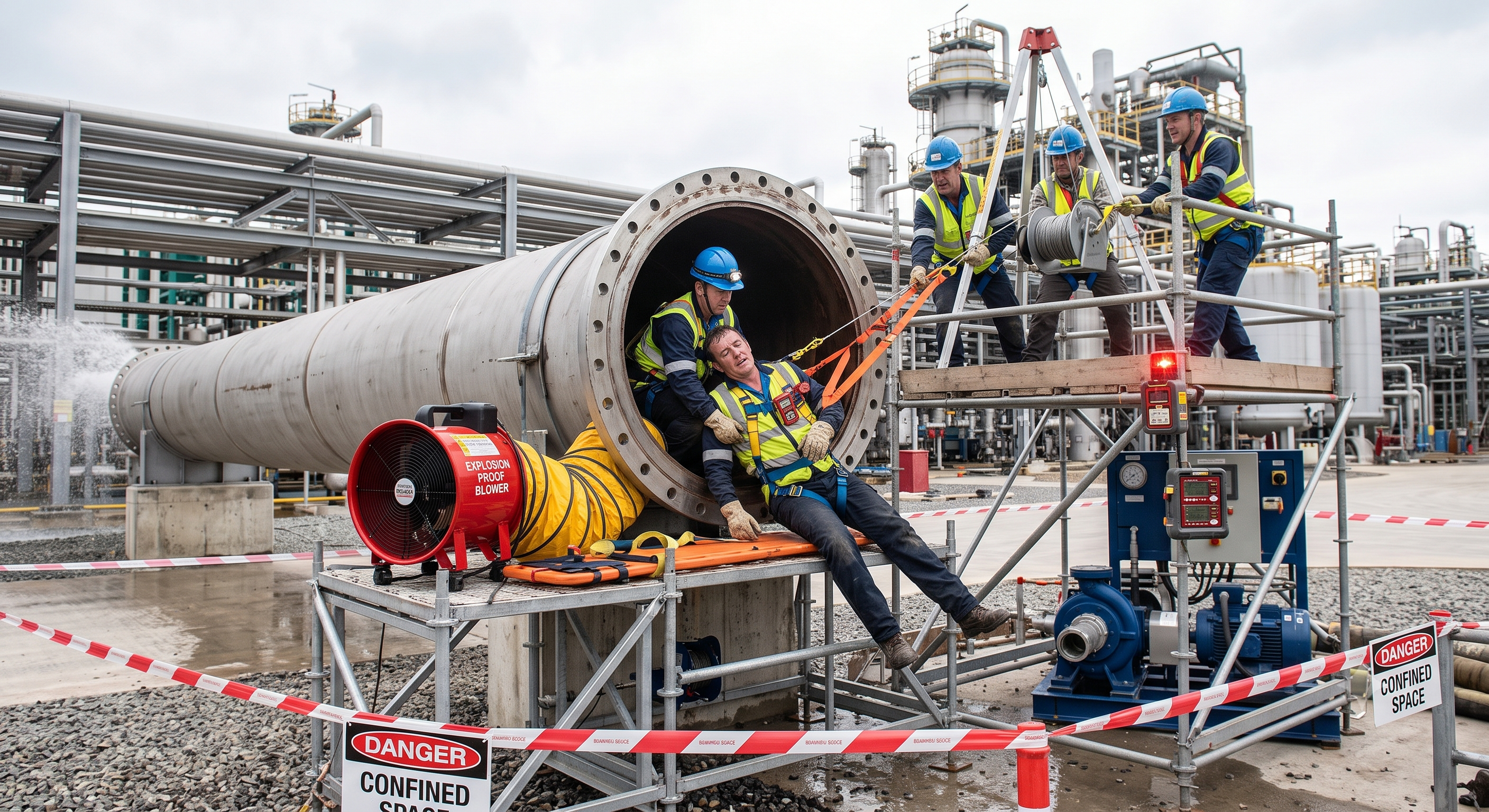 Retained source illustration: an AI-generated educational concept, not a real incident photograph or evidence of equipment suitability.
The following scenario, comparisons and example records are hypothetical teaching material. They do not reproduce actual incidents, measurements, signatures or approvals.
| Item | Hypothetical situation |
|---|---|
| Initial state | An internal inspection is proposed after pipe cleaning while a fan runs at the opening. |
| Change | A nearby nitrogen operation begins and the deep branch beyond a bend has no representative test evidence. |
| Failure path | The original hatch reading and fan operation are assumed to cover the changed work zone. |
| Possible harm | An entrant may encounter oxygen deficiency far from the exit, while a straight retrieval line could snag at the bend. |
| Barrier | Withdraw or hold entry, control the adjacent operation, verify isolation, test the actual route and confirm rescue feasibility before the required entry decision. |
Pipe atmosphere can change with residual contents, corrosion, adjacent releases and the work itself. Nitrogen does not always settle at the bottom: temperature, release point, airflow and geometry influence mixing. Sample representative levels, branches and the intended work route.
A pumped instrument shows the gas that has reached its sensor. Confirm sensor coverage, tubing compatibility, hose integrity, transport delay and response time. A common four-gas instrument does not automatically measure carbon dioxide or every process contaminant; response checks and calibration have different purposes.
A fan may circulate air between nearby inlet and outlet while remote branches remain poorly swept. Verify clean intake, duct route and representative results. Fan runtime or a generic air-change figure does not demonstrate acceptable conditions. Low-voltage lighting is not automatically suitable for an explosive atmosphere.
A tripod at the opening does not prove that a person can be recovered through a horizontal elbow. Check casualty clearance, snagging, anchors, rescue access and the trained response before entry. Keep the attendant outside; a spontaneous rescue entry can create another casualty.
Connect the Singapore permit roles to factual evidence: the supervisor coordinates work, the confined-space safety assessor evaluates the entry conditions, and the authorised manager makes the required permit decision. The appointed attendant maintains outside contact and entrant accountability. Reassess changed work and do not treat the worksheet hold-point label as a statutory signature.
| Decision | Reason and evidence |
|---|---|
| Known facts | A nearby nitrogen operation begins and the deep branch beyond a bend has no representative test evidence. |
| Unresolved | The original hatch reading and fan operation are assumed to cover the changed work zone. |
| Hold reason | Hold entry or withdraw on missing or unsuitable atmospheric evidence, alarm, symptoms, failed ventilation, lost communication, isolation doubt, new adjacent operations or inadequate rescue readiness. Detector silence after reset does not authorise return. |
| Evidence needed | Instrument identity; Sampling locations; Time and conditions; Assessor results and limits. |
| Next decision | Withdraw or hold entry, control the adjacent operation, verify isolation, test the actual route and confirm rescue feasibility before the required entry decision. |
5. Conditional decisions and common errors
| Condition | Action | Evidence | Proceed when |
|---|---|---|---|
| Test evidence missing | Keep entry closed. | Mapped results and instrument checks. | Required entry conditions verified. |
| Ventilation fails | Withdraw and control entry. | Restored air path and new tests. | Permit conditions re-established. |
| Communication lost | Withdraw safely. | Working contact and attendant coverage. | Required contact restored. |
| Adjacent work changes | Suspend affected entry. | New hazard isolation and test review. | Fresh authorised entry decision. |
| Comparison | Situation A | Situation B |
|---|---|---|
| Normal hatch result | Covers that sampled location and time. | Does not prove deep-branch conditions. |
| Fan runs | Air path and representative results also verified. | Motor operation alone accepted. |
| Winch present | Actual bend and rescue path verified. | Retrieval assumed from equipment presence. |
6. Roles and responsibilities
| Role | Responsibility |
|---|---|
| Work supervisor | Confirm scope, task sequence, exclusion and stop authority. Coordinate plan entry with affected operations. |
| Technical reviewer | Resolve the actual design and equipment limits: Pipe identity; Task limits; SDS and drawings; Rescue geometry. |
| Work crew | Perform prepare access using the approved procedure; report any mismatch before proceeding. |
| Inspector / assessor | Verify Entrant log; Detector trends; Contact continuity; Task remains in scope. Record what was actually checked and what remains unresolved. |
| Release / receiving authority | Confirm Physical headcount; Closure inspection; Permit cancellation; Operations handover. Transfer restrictions and the next permitted stage. |
These are responsibility examples, not invented statutory credentials. Meet the actual training, competent-person, qualified-person and licensing requirements for the assigned work. Anyone may raise a hazard and request a stop; only the designated authority may release the affected stage after evidence is reviewed.
7. Hold points and record comparison
| Hold point | Evidence before release | Confirmation / approval |
|---|---|---|
| HP-0 Start | Scope, jurisdiction, equipment identity, responsible people and emergency arrangements. | |
| HP-1 Isolate lines | Isolation points; Zero energy evidence; Lock ownership; Blind register | |
| HP-2 Test atmosphere | Instrument identity; Sampling locations; Time and conditions; Assessor results and limits | |
| HP-3 Ventilate and permit | Air path; Power continuity; Retest record; Authorised manager entry permit | |
| HP-4 Close and hand over | Physical headcount; Closure inspection; Permit cancellation; Operations handover |
Hold points are internal evidence gates. They do not replace statutory permits or actual signatures. Recheck affected gates after a change, abnormal event or shift transfer. The blank record must identify the evidence, person, time, limits and release scope.
| Record | Insufficient record | Record checklist |
|---|---|---|
| Space | Pipe open | □ Pipe identity□ Task limits□ SDS and drawings□ Rescue geometry |
| Isolation | Valve shut | □ Isolation points□ Zero energy evidence□ Lock ownership□ Blind register |
| Atmosphere | Oxygen normal | □ Instrument identity□ Sampling locations□ Time and conditions□ Assessor results and limits |
| Closure | Job finished | □ Physical headcount□ Closure inspection□ Permit cancellation□ Operations handover |
The □ boxes are static prompts, not saved or interactive approvals. Each checks one record element. A tick alone does not establish suitability or permission to restart. Link equipment IDs and supporting records; retain unresolved matters and the earlier record when conditions change.
8. Site checklist and emergency response
| Check item | Result | Person / action |
|---|---|---|
| Pipe identity | ||
| Isolation points | ||
| Access protection | ||
| Instrument identity | ||
| Air path | ||
| Entrant log | ||
| Everyone accounted | ||
| Physical headcount | ||
| Emergency arrangements and unresolved restrictions communicated |
Stop work: Hold entry or withdraw on missing or unsuitable atmospheric evidence, alarm, symptoms, failed ventilation, lost communication, isolation doubt, new adjacent operations or inadequate rescue readiness. Detector silence after reset does not authorise return.
Emergency response: The attendant raises the alarm from outside, accounts for entrants and activates the prepared rescue plan. Call SCDF 995 for urgent rescue or serious injury and give the pipe location, last contact, atmospheric hazards and access geometry. Use non-entry retrieval only where the assessed arrangement is suitable. Keep untrained or unprotected people out; entry rescue requires the planned trained and equipped team.
9. Sources and review limits
Official-source review date: October 14, 2026. The following review is limited to the public provisions or selected manufacturer material identified below. It does not establish that any authority approved this article or the actual installation.
- MOM risk management: Official explanation: risk assessment, control, monitoring and communication for routine and non-routine work, including maintenance; reviewed 14 October 2026.
- WSHC Working Safely in Confined Spaces: Official guidance on avoiding entry, access, gas testing, training, rescue and appointed attendant; permit identifies supervisor, confined-space safety assessor and authorised manager.
- WSHC electrical safety: Official guidance: maintenance energy isolation, stored-energy control, verification and reinstatement; electrical scope still requires applicable EMA authorisation.
- SCDF emergency medical services: Official 995 emergency ambulance service information; use emergency services for actual emergencies.
Paid consensus standards and site-specific calculations, manuals, inspection records and product certificates were not independently obtained or verified unless specifically identified. Korean and overseas legal references are source history, not Singapore statutory duties. Singapore Standards and model-specific limits were not read in full unless expressly identified.
10. PDF guidance and FAQ
PDF A covers basic task controls; B examines technical failures; C focuses on supervision, evidence and handover. Each has six rows and three items per main cell. They are complementary extracts: apply all eight body stages and the applicable site procedure. An omitted stage is not permission to omit its controls. PDF HP-0 through HP-4 are worksheet labels; match the event, evidence and authority rather than assuming they match another permit by number.
P/S/R/A, actual measurements, confirmations and signatures remain blank. The PDFs are uncompleted reference worksheets, not issued work permits.
Content group ID: jsa-confined-space
Does a short inspection need entry preparation?
Yes. Duration does not remove atmospheric or rescue hazards. Assess non-entry options first.
Is a normal hatch reading sufficient?
No. Record representative locations along the route and branches with sampling delay and changing conditions considered.
Does a low-voltage lamp establish explosion protection?
No. Electrical-shock protection and hazardous-area suitability are separate checks.
Can work restart when an alarm stops?
No. Withdraw, investigate, restore controls, retest and obtain the required entry decision.
Has a professional verified or approved this document?
AI-generated reference material. It has not been professionally verified or approved. Before use, a suitably qualified person must review and adapt it to applicable Singapore requirements, the actual equipment and site, and approved safe work procedures.
11. Revision history and authorship
AI-generated reference material. It has not been professionally verified or approved. Before use, a suitably qualified person must review and adapt it to applicable Singapore requirements, the actual equipment and site, and approved safe work procedures.
This system has not physically inspected the equipment, structures, ground, atmosphere or worksite. The document does not replace legal advice, manufacturer procedures, engineering design, inspection certificates, qualification evidence, the site risk assessment or an actual work permit.
Before use, a suitably qualified and authorized person must review the actual equipment, loads, methods, protection, inspection and emergency arrangements and resolve open issues. Record the real reviewer, organization, qualifications, delegated authority, reviewed documents, date, signature, exclusions and conditions of approval separately.
| Date | Version | Change | Review status |
|---|---|---|---|
| 2026-07-05 | Unmarked | Korean source revision retained in the source snapshot. | Historical editorial status; not Singapore professional approval. |
| 2026-10-05 | 1.1 | Korean source revision retained in the source snapshot. | Historical editorial status; not Singapore professional approval. |
| 2026-10-14 | SG 1.0 | Singapore localisation of the Korean source with its assigned US technical reference; local applicability, task controls and sources reviewed. | AI-assisted editorial work; professional approval not performed. |