A connected hose does not prove adequate capture. Check the shroud contact, hose, filter, collection capacity, alarms and required airflow; preserve exposure controls while emptying or servicing the extractor.
AI-generated reference material; not professionally verified or approved. Before use, a qualified person must review and adapt it to Singapore requirements, the actual equipment/site and approved safe work procedures.
Stop before starting
Stop for lost capture, an alarm or dust escape, wheel damage/vibration, unstable access, unknown coating, unexpected cracks, reinforcement or embedded services. Changing the method requires renewed review.
1. Legal and technical scope
| Basis | Scope and limits |
|---|---|
| MOM: Risk management | Assess material/removal limits, adjacent trades, access and the grinding and clean-up stages. Official explanation of statutory duties; linked SSO text was not independently read for this item. This is not a legal opinion. |
| MOM: Requirements for Hygiene Monitoring | Arrange appropriate silica/noise exposure assessment, effective control review and applicable reporting. Actual substances, exposure results and legal limits must be established for the site. No concentration or noise result is asserted. |
| MOM: Requirements for Medical Monitoring | Determine relevant silica/noise medical-monitoring duties with a designated workplace doctor. Employer and designated workplace doctor must establish actual coverage; this JSA is neither a medical examination nor fitness certification. |
| HSE: Scabbling or Grinding - Technical Reference | Select compatible source capture, suitable respiratory protection and controlled extractor maintenance. UK guidance is used only for technical mechanisms. Its exposure limit, protection factor and statutory examination interval are not presented as Singapore requirements. |
| WSH Council: Preventing Machine Hazards | Verify guards, wheel suitability, isolation and fault response. Official practical guidance, not the actual machine isolation procedure or proof of equipment compliance. |
| SCDF: Emergency Medical Services | Call 995 for a medical emergency and keep responders clear of live equipment and airborne dust. Official emergency-response information, not a site-specific rescue plan or authorisation for untrained rescue. |
Apply Singapore WSH risk management to concrete grinding, respirable silica, noise, rotating equipment and the access platform. MOM requires competent-person hygiene monitoring for relevant workplace exposure and specifies reporting and assessment against Singapore PELs. Review silica and excessive-noise medical-monitoring coverage with the employer and designated workplace doctor. The technical dust-control reference does not set Singapore exposure limits or imported control-table rules. Determine actual controls, respiratory protection and monitoring before starting; visible dust reduction is not exposure clearance.
2. Scope and required inputs
Included work
Shallow dry grinding of known uncoated concrete wall projections using a compatible handheld grinder, shroud and dust extractor from stable approved access.
Separate assessment
Structural demolition, exposed reinforcement, unknown coatings, asbestos/lead investigation, wet-method substitution, extended overhead grinding and rope access require separate assessment.
| Required input | Evidence to obtain |
|---|---|
| Define wall scope | Wall identity; Services and cracks; Removal depth/limits in mm; Coating assessment |
| Inspect tool isolated | Wheel and model; Isolation method; Cable condition; Shroud fit |
| Prepare capture | Flow and alarm; Hose and filter; Silica/noise exposure assessment; RPE selection and fit |
| Position and start | Access condition; Grip and stance; Hose route; Capture at start |
No actual equipment model, site measurements, design calculations or signed approval was supplied. Check the applicable Singapore requirements and approved safe work procedures against the actual equipment and site before use. Statutory duties, official guidance and manufacturer limits serve different purposes; editorial checks do not establish legal or professional approval.
Singapore site application
Coordinate enclosed wall-grinding zones with other trades in the same Singapore construction floor. Keep dusty exhaust and bag changes away from occupied corridors, air intakes and escape routes; route hoses so they do not obstruct access.
Record the wall ID and permitted removal depth in mm, actual wheel speed in r/min and the extraction performance criterion with its source. Assess the planned duration and nearby workers, including clean-up; appoint the appropriate monitoring and health-review personnel without inventing measurements or fitness approval.
3. Eight-stage JSA
| Job stage | Hazards and effects | Failure factors | Technical and procedural controls | Site verification | P | S | R | A |
|---|---|---|---|---|---|---|---|---|
| 1. Define wall scope | 1. Silica inhalation2. Hidden services3. Structural damage4. Coating exposure | 1. Material unknown2. Services unmapped3. Depth undefined4. Old coating ignored | 1. Identify wall material2. Check embedded items3. Set removal boundary4. Hold unknown surfaces | 1. Wall identity2. Services and cracks3. Removal depth/limits in mm4. Coating assessment | ||||
| 2. Inspect tool isolated | 1. Wheel burst2. Unexpected start3. Electric shock4. Guard contact | 1. Speed mismatch2. Stop only3. Cable damaged4. Wrong shroud | 1. Verify wheel and speed2. Isolate for setting3. Inspect supply4. Fit compatible guard | 1. Wheel and model2. Isolation method3. Cable condition4. Shroud fit | ||||
| 3. Prepare capture | 1. Dust escape2. Bystander exposure3. Respirator failure4. Bag release | 1. Clogged filter2. No boundary3. Wrong protection4. Damaged collection | 1. Verify capture system2. Separate adjacent work3. Apply exposure plan4. Check sealed collection | 1. Flow and alarm2. Hose and filter3. Silica/noise exposure assessment4. RPE selection and fit | ||||
| 4. Position and start | 1. Loss of balance2. Kickback3. Hose trip4. Overreach | 1. Unstable access2. One-handed grip3. Hose snag4. Poor reach | 1. Use approved platform2. Maintain two-hand grip3. Route hose safely4. Reposition access | 1. Access condition2. Grip and stance3. Hose route4. Capture at start | ||||
| 5. Grind and monitor | 1. Silica exposure2. Wheel catch3. Excess removal4. Fatigue error | 1. Alarm ignored2. Edge overloaded3. Depth unchecked4. Prolonged reach | 1. Stop lost capture2. Use specified movement3. Check surface depth4. Pause and reposition | 1. Dust and alarm2. Noise and vibration3. Depth in mm and cracks4. Worker condition | ||||
| 6. Stop and inspect | 1. Coastdown contact2. Hot wheel3. Hidden wall damage4. Restart exposure | 1. Tool laid down early2. Wheel touched3. Inspection skipped4. Hands near trigger | 1. Wait for full stop2. Set tool safely3. Inspect treated area4. Control restart | 1. Full stop2. Wheel temperature3. Surface inspection4. Held locations | ||||
| 7. Hold equipment fault | 1. Repeat dust leak2. Wheel fragment3. Unexpected start4. Uncontrolled waste | 1. Filter fault ignored2. Damage missed3. Live adjustment4. Bag opened freely | 1. Stop and disconnect2. Inspect tool and capture3. Correct approved parts4. Recheck before release | 1. Fault location2. Hose filter and bag3. Correction evidence4. Restart conditions | ||||
| 8. Collect and hand over | 1. Dust re-release2. Waste spill3. Defect reused4. Scope lost | 1. Dry sweeping2. Bag not sealed3. Damage unmarked4. Depth not recorded | 1. Use approved vacuum2. Seal and label waste3. Hold defective tools4. Record wall status | 1. Cleanup method2. Waste containment3. Tool disposition4. Area and recipient |
P = likelihood; S = severity; R = risk under the site method; A = site-defined acceptance/authorization. These actual assessment cells are blank. A low score never overrides a missing safeguard or a legal or manufacturer restriction.
4. Fictional scenario and failure mechanisms
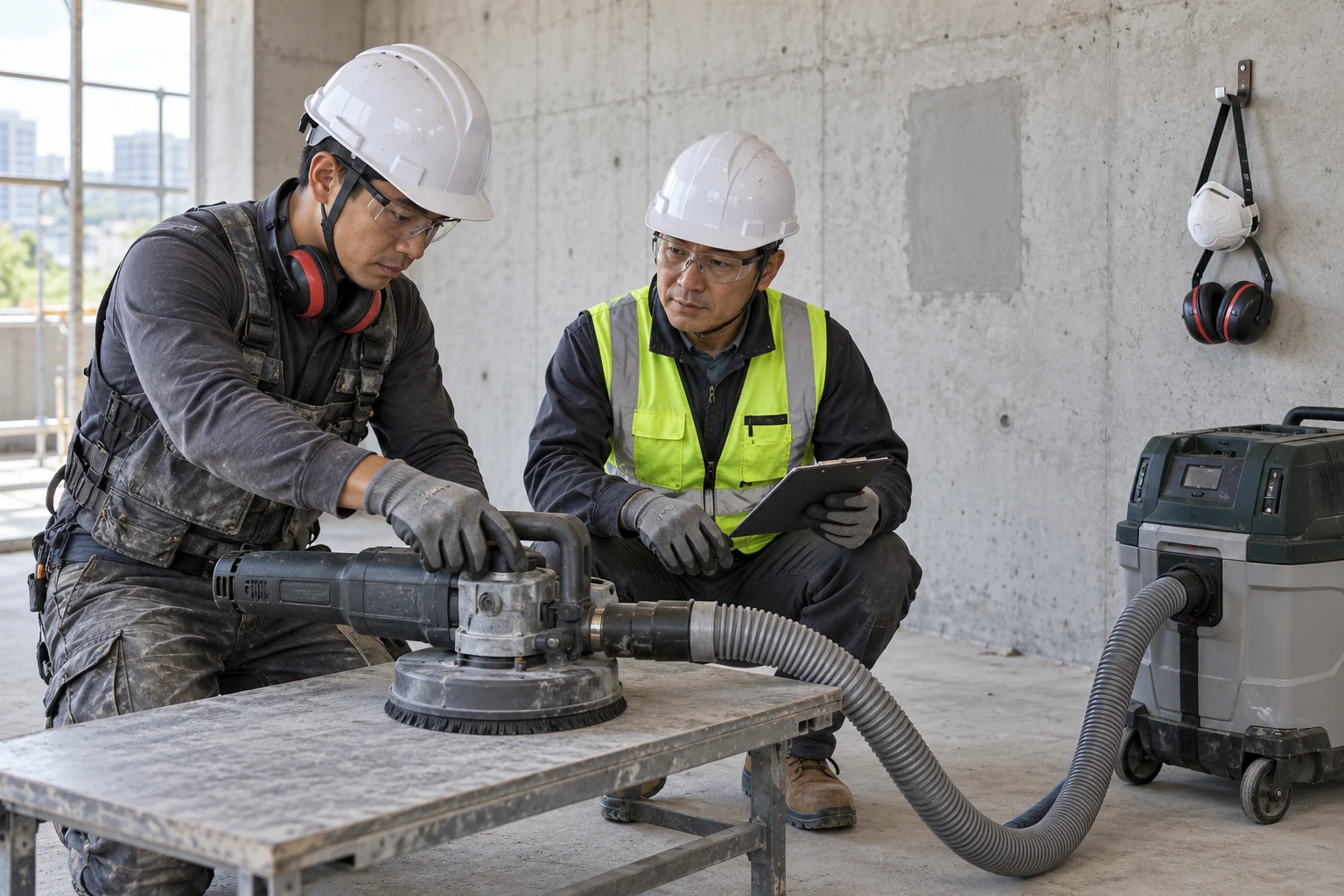
This illustration provides educational context. It is not an actual incident photograph or evidence of equipment suitability; any AI-generated depiction is illustrative only.
The scenario and record comparisons are fictional teaching examples, not records of real incidents, measurements, inspections, signatures or approvals.
| Stage | Fictional situation |
|---|---|
| Initial situation | A fictional crew grinds a concrete wall with extraction. |
| Changed condition | The extractor alarms and dust escapes, but only a small area remains. |
| Failure path | The worker continues and tightens a face covering instead of correcting capture. |
| Possible outcome | Dust exposure can increase and spread to adjacent trades. |
| Prevention barrier | Stop grinding, isolate the tool, correct the hose/filter/bag fault and verify the specified controls before a limited restart. |
Failure mechanisms
A connected hose does not prove adequate capture. Check the shroud contact, hose, filter, collection capacity, alarms and required airflow; preserve exposure controls while emptying or servicing the extractor.
Low visible dust does not establish low respirable-silica exposure. The actual material, work duration, enclosure and people nearby determine the exposure assessment and respiratory protection. Check capture performance and suitable fit/use of tight-fitting protection; a medical examination does not compensate for failed extraction.
Permission to remove a surface projection does not authorise cutting reinforcement or repairing a structural crack. Hold unexpected depth, cracks, embedded services or unknown coatings. Cleanup must avoid redistributing collected dust.
Collect and seal dust using suitable equipment and the accepted waste method. Do not blow dust from clothes or walls with compressed air, dry sweep it into the air or wash it into a drain. Changing to a wet method requires separate tool, electrical and effluent assessment.
Decision sequence
| Step | Decision |
|---|---|
| Known | An extractor alarm and visible escape occur before the small remaining area is finished. |
| Unknown | Hose leakage, filter/bag condition and effective extraction performance are unresolved. |
| Hold | A tighter face covering or short remaining duration cannot release failed source control. |
| Evidence | Stop safely, isolate for intervention and link fault correction, capture checks and exposure controls to the affected zone. |
| Restart | Confirm restored equipment and protection before limited restart; assess dust spread and clean-up before handing over the area. |
Work sequence: Define wall scope → Inspect tool isolated → Prepare capture → Position and start → Grind and monitor → Stop and inspect → Hold equipment fault → Collect and hand over. This is a teaching flow, not a device drawing or a complete operating procedure.
5. Conditional decisions and common errors
| Situation | Required action | Evidence | Proceed when |
|---|---|---|---|
| Extractor alarm | Stop and inspect capture | Hose, filter, bag and airflow | Control restored |
| Crack or steel exposed | Hold affected wall | Depth and design review | Scope reconfirmed |
| Unknown coating | Do not grind | Material characterization | Method accepted |
| Cleanup needed | Use controlled collection | Approved vacuum and waste route | Dust contained |
Similar observations, different decisions
The scenario and record comparisons are fictional teaching examples, not records of real incidents, measurements, inspections, signatures or approvals.
| Observation | Insufficient conclusion | Required distinction |
|---|---|---|
| Hose attached | Physical connection | Capture performance remains unproved |
| Little visible dust | Appearance only | Exposure requirements still apply |
| New wheel | Unused consumable | Speed, fit and shroud must match |
6. Roles and responsibilities
| Role | Responsibility |
|---|---|
| Grinding supervisor | Confirm wall material, removal limits, access and coordination with adjacent trades. |
| Tool/extraction custodian | Verify matched wheel, shroud, hose, extractor and isolated fault correction. |
| Grinding operator | Maintain two-hand control and observe capture, surface changes and stop conditions. |
| Exposure/health responsible persons | Arrange competent hygiene monitoring and applicable designated-workplace-doctor review; record actual evidence separately. |
| Quality/receiving lead | Accept surface condition and identify held cracks, exposed reinforcement, clean-up and tool restrictions. |
Supervision and handover focus
| Stage | Management action | Evidence |
|---|---|---|
| Define wall scope | 1. Record wall identity2. Record services and cracks3. Record removal depth/limits in mm | 1. Wall identity2. Services and cracks3. Removal depth/limits in mm |
| Inspect tool isolated | 1. Record wheel and model2. Record isolation method3. Record cable condition | 1. Wheel and model2. Isolation method3. Cable condition |
| Prepare capture | 1. Record flow and alarm2. Record hose and filter3. Record silica/noise exposure assessment | 1. Flow and alarm2. Hose and filter3. Silica/noise exposure assessment |
| Grind and monitor | 1. Record dust and alarm2. Record noise and vibration3. Record depth in mm and cracks | 1. Dust and alarm2. Noise and vibration3. Depth in mm and cracks |
| Hold equipment fault | 1. Record fault location2. Record hose filter and bag3. Record correction evidence | 1. Fault location2. Hose filter and bag3. Correction evidence |
| Collect and hand over | 1. Record cleanup method2. Record waste containment3. Record tool disposition | 1. Cleanup method2. Waste containment3. Tool disposition |
7. Hold points and record comparison
| Hold point | Evidence before release | Actual approval |
|---|---|---|
| HP-0 Scope | Shallow dry grinding of known uncoated concrete wall projections using a compatible handheld grinder, shroud and dust extractor from stable approved access. | |
| HP-1 Inspect tool isolated | Wheel and model; Isolation method; Cable condition; Shroud fit | |
| HP-2 Position and start | Access condition; Grip and stance; Hose route; Capture at start | |
| HP-3 Hold equipment fault | Fault location; Hose filter and bag; Correction evidence; Restart conditions | |
| HP-4 Collect and hand over | Cleanup method; Waste containment; Tool disposition; Area and recipient |
Hold points are internal project checks. They are not universal statutory permits and do not grant work permission. Reassess after defects, changed conditions and shift changes.
Record comparison
The scenario and record comparisons are fictional teaching examples, not records of real incidents, measurements, inspections, signatures or approvals.
The boxes are static record prompts, not interactive or saved approvals. A tick does not establish suitability or permission to restart. Record the evidence, person, time and unresolved issues; retain the change history.
| Record | Insufficient record | Record checklist |
|---|---|---|
| Define wall scope | Only marked “OK” | □ Wall identity□ Services and cracks□ Removal depth/limits in mm□ Coating assessment |
| Position and start | Only marked “OK” | □ Access condition□ Grip and stance□ Hose route□ Capture at start |
| Hold equipment fault | Only marked “OK” | □ Fault location□ Hose filter and bag□ Correction evidence□ Restart conditions |
| Collect and hand over | Only marked “OK” | □ Cleanup method□ Waste containment□ Tool disposition□ Area and recipient |
8. Site checklist and emergency response
| Site check | Actual result | Person / action |
|---|---|---|
| Define wall scope: Wall identity; Services and cracks; Removal depth/limits in mm; Coating assessment | ||
| Inspect tool isolated: Wheel and model; Isolation method; Cable condition; Shroud fit | ||
| Prepare capture: Flow and alarm; Hose and filter; Silica/noise exposure assessment; RPE selection and fit | ||
| Position and start: Access condition; Grip and stance; Hose route; Capture at start | ||
| Grind and monitor: Dust and alarm; Noise and vibration; Depth in mm and cracks; Worker condition | ||
| Stop and inspect: Full stop; Wheel temperature; Surface inspection; Held locations | ||
| Hold equipment fault: Fault location; Hose filter and bag; Correction evidence; Restart conditions | ||
| Collect and hand over: Cleanup method; Waste containment; Tool disposition; Area and recipient |
Stop work
Stop for lost capture, an alarm or dust escape, wheel damage/vibration, unstable access, unknown coating, unexpected cracks, reinforcement or embedded services. Changing the method requires renewed review.
Emergency response
Stop the tool safely and restrict the affected area. Move away from uncontrolled dust and obtain medical assistance for symptoms or injury; call 995 for a medical emergency. Isolate before intervention and keep responders clear of the wheel and live supply. Competent personnel control recovery and any contaminated area.
9. Sources and review limits
Public-source access/review: 2026-10-14.
| Official source | Reviewed scope and limits |
|---|---|
| MOM: Risk management | Assess material/removal limits, adjacent trades, access and the grinding and clean-up stages. Official explanation of statutory duties; linked SSO text was not independently read for this item. This is not a legal opinion. |
| MOM: Requirements for Hygiene Monitoring | Arrange appropriate silica/noise exposure assessment, effective control review and applicable reporting. Actual substances, exposure results and legal limits must be established for the site. No concentration or noise result is asserted. |
| MOM: Requirements for Medical Monitoring | Determine relevant silica/noise medical-monitoring duties with a designated workplace doctor. Employer and designated workplace doctor must establish actual coverage; this JSA is neither a medical examination nor fitness certification. |
| HSE: Scabbling or Grinding - Technical Reference | Select compatible source capture, suitable respiratory protection and controlled extractor maintenance. UK guidance is used only for technical mechanisms. Its exposure limit, protection factor and statutory examination interval are not presented as Singapore requirements. |
| WSH Council: Preventing Machine Hazards | Verify guards, wheel suitability, isolation and fault response. Official practical guidance, not the actual machine isolation procedure or proof of equipment compliance. |
| SCDF: Emergency Medical Services | Call 995 for a medical emergency and keep responders clear of live equipment and airborne dust. Official emergency-response information, not a site-specific rescue plan or authorisation for untrained rescue. |
No actual equipment model, site measurements, design calculations or signed approval was supplied. Check the applicable Singapore requirements and approved safe work procedures against the actual equipment and site before use. Statutory duties, official guidance and manufacturer limits serve different purposes; editorial checks do not establish legal or professional approval.
10. PDF guidance and FAQ
PDF A covers basic task controls; B focuses on technical failures; C covers supervision, records and handover. The article has eight stages with four items per main cell; each PDF has six key stages with three items per main cell. P/S/R/A, measurements, confirmations and signatures remain blank for actual site assessment.
PDFs are complementary six-stage extracts. Apply all eight body stages and the actual equipment/site procedure.
Does a dust mask replace extraction?
No. Use the assessed source controls and appropriate respiratory protection for the actual exposure. Check fit, compatibility and use; stop if extraction fails.
Can an air gun clean the wall?
Do not redistribute concrete dust. Use suitable controlled collection and seal waste; do not dry sweep or discharge dust/slurry into a drain.
Can grinding continue after reinforcement appears?
Hold that area and obtain design/scope review before any further removal.
Has a professional verified or approved this document?
AI-generated reference material; not professionally verified or approved. Before use, a qualified person must review and adapt it to Singapore requirements, the actual equipment/site and approved safe work procedures.
11. Revision history and authorship
AI-generated reference material; not professionally verified or approved. Before use, a qualified person must review and adapt it to Singapore requirements, the actual equipment/site and approved safe work procedures.
| Date | Version | Change | Review status |
|---|---|---|---|
| 2026-10-14 | SG 1.0 | New Singapore edition from assigned Korean source; task decisions, records and PDFs localized. | AI editorial review; no professional technical approval |
Korean edition revision history: 2026-10-08 (v1.0): initial article, sources, fictional analysis and PDF editorial checks. These are editorial records, not professional technical approval. Singapore v1.0 adapts the earlier edition to Singapore requirements and terminology.
Site reviewers must add their actual qualifications, scope, date and approval only after the review occurs.