Downstream stored air, a bypass or a common drain can re-pressurise the housing after inlet closure. Verify the complete boundary and the actual housing state by the specified method; silence can mean a blocked drain and is not proof of zero pressure.
AI-generated reference material; not professionally verified or approved. Before use, a qualified person must review and adapt it to Singapore requirements, the actual equipment/site and approved safe work procedures.
Stop before starting
Do not open until complete isolation, housing depressurisation and possible reaccumulation are verified. Hold for damaged housing, uncertain locking, wrong parts, drain malfunction, unusual noise or leakage. Never tighten a leaking pressurised bowl.
1. Legal and technical scope
| Basis | Scope and limits |
|---|---|
| MOM: Risk management | Review line-opening, stored downstream air, process outage and abnormal leak correction. Official explanation of statutory duties; linked SSO text was not independently read for this item. This is not a legal opinion. |
| WSH Council: Safe Use of Machinery | Isolate all connected energy paths, release stored pressure, verify and control restoration. Official guidance; cited paid Singapore Standards were not obtained. No universal wheel test duration or gap is inferred. |
| MOM: Register a Pressure Vessel | Establish actual classification and relevant AE/examination records before treating the equipment as available for service. Actual filter classification and registration status were not determined; registration exemption does not remove safe-maintenance duties. |
| MOM: Pressure Vessel Repairs and Modifications | Stop scope expansion into pressure-boundary repair or modification for the required approval process. No approval application or engineering classification was performed. Routine consumable exchange must not expand into unreviewed pressure-boundary repair. |
| NEA: Toxic Waste Control | Classify contaminated condensate and spent elements before selecting the permitted disposal route. Apply only after classifying actual cleaner and removed contaminants; this does not classify every aqueous cleaning waste as TIW or authorise discharge. |
| SCDF: Emergency Medical Services | Use the site response and call 995 for a medical emergency after withdrawing from pressure-release paths. Official emergency-response information, not a site-specific rescue plan or authorisation for untrained rescue. |
Apply Singapore WSH risk management and machinery energy-isolation guidance to the filter and every connected supply. Determine with competent personnel whether the actual housing is a regulated pressure vessel and whether registration, examination or exemption conditions apply; a filter name or small appearance does not decide this. MOM states that exemption from registration does not remove safe design and maintenance duties. If work becomes pressure-vessel repair or modification, hold for the required MOM approval and technical process; this element-replacement procedure does not authorise that extension.
2. Scope and required inputs
Included work
Exchange specified elements and seals in an industrial compressed-air filter using an established isolation boundary, safe drain route and verified depressurisation of the actual housing.
Separate assessment
Live-pressure replacement, pressure-boundary repair or welding, receiver entry, oxygen/fuel-gas service, breathing-air certification, dryer media replacement and air-quality system design require separate review.
| Required input | Evidence to obtain |
|---|---|
| Identify filter and parts | Filter/model ID; Flow/use requirement; Element/seal numbers; Users and vessel scope |
| Isolate all paths | Boundary drawing; Valve/lock state; Stored downstream air; Drain connection |
| Drain and verify | Drain communication; Verification method; Housing pressure/time and units; Collection/PPE |
| Open and inspect | Bowl/support condition; Residual fluid state; Threads/housing inspection; Waste containment |
No actual equipment model, site measurements, design calculations or signed approval was supplied. Check the applicable Singapore requirements and approved safe work procedures against the actual equipment and site before use. Statutory duties, official guidance and manufacturer limits serve different purposes; editorial checks do not establish legal or professional approval.
Singapore site application
In a shared factory compressed-air ring main, confirm the downstream header, standby compressor, bypass and common drains with the operations owner. A closed inlet does not protect the bowl from another tenant or process restoring a connected supply.
Use the housing nameplate pressure/temperature limits, exact element grade and seal numbers. Record pressure with its actual units (for example kPa or bar), distinguish differential pressure from housing pressure and identify the drain/verification point. Keep oily condensate contained for the assessed waste route.
3. Eight-stage JSA
| Job stage | Hazards and effects | Failure factors | Technical and procedural controls | Site verification | P | S | R | A |
|---|---|---|---|---|---|---|---|---|
| 1. Identify filter and parts | 1. Wrong housing opened2. Contaminated air3. Wrong element4. Unexpected process effect | 1. ID unclear2. Grade mismatched3. Flow direction missed4. Users not notified | 1. Match filter and diagram2. Confirm required grade3. Verify part and seals4. Coordinate supply outage | 1. Filter/model ID2. Flow/use requirement3. Element/seal numbers4. Users and vessel scope | ||||
| 2. Isolate all paths | 1. Downstream backfeed2. Bypass pressure3. Restart supply4. Drain-system return | 1. Inlet only closed2. Bypass untraced3. Lock absent4. Shared drain unknown | 1. Trace outlet and bypass2. Isolate complete boundary3. Prevent restart4. Assess connected drains | 1. Boundary drawing2. Valve/lock state3. Stored downstream air4. Drain connection | ||||
| 3. Drain and verify | 1. Bowl pressure release2. Condensate exposure3. Reaccumulation4. Noise injury | 1. Silence trusted2. Drain blocked3. Valve passing4. Discharge uncontrolled | 1. Use safe drain route2. Verify housing pressure3. Monitor possible return4. Control discharge exposure | 1. Drain communication2. Verification method3. Housing pressure/time and units4. Collection/PPE | ||||
| 4. Open and inspect | 1. Bowl drops2. Residual spray3. Thread damage4. Contamination contact | 1. Bowl unsupported2. Safe state assumed3. Wrong tool4. Waste handling absent | 1. Support bowl before release2. Reconfirm safe boundary3. Use model opening tools4. Collect contaminated parts | 1. Bowl/support condition2. Residual fluid state3. Threads/housing inspection4. Waste containment | ||||
| 5. Replace and assemble | 1. Internal bypass2. Seal failure3. Bowl separation4. Drain malfunction | 1. Element unseated2. Seal wrong/damaged3. Lock not aligned4. Drain omitted | 1. Seat specified element2. Install specified seals3. Verify full locking detail4. Restore correct drain | 1. Grade/direction/seating2. Seal condition3. Thread/lock engagement4. Drain assembly | ||||
| 6. Repressurize and test | 1. Pressure shock2. Air leak3. Sudden discharge4. Unqualified air supplied | 1. Valve opened rapidly2. Assembly defect3. Drain wrongly routed4. Quality check omitted | 1. Use model startup sequence2. Check leaks from safe position3. Verify drain function4. Confirm required quality | 1. Startup pressure trend2. Leak-test record3. Drain operation4. Use-specific release | ||||
| 7. Hold abnormal result | 1. Repeated leak2. Pressurized adjustment3. Wrong part reused4. Fault recurrence | 1. Leak tightened live2. Only alarm reset3. Part mismatch ignored4. Cause undocumented | 1. Isolate before correction2. Depressurize and verify3. Resolve assembly cause4. Repeat affected checks | 1. Fault and isolation2. Parts/lock recheck3. Corrected test result4. Restart authority | ||||
| 8. Record and transfer | 1. Missed service interval2. Unresolved quality issue3. Waste exposure4. User confusion | 1. Date omitted2. Quality inferred3. Condensate dumped4. Handover absent | 1. Record exact parts/date2. Transfer quality evidence3. Dispose by site procedure4. Brief supply receiver | 1. Part/service history2. Quality/restrictions3. Condensate disposal evidence4. Receiver and next service |
P = likelihood; S = severity; R = risk under the site method; A = site-defined acceptance/authorization. These actual assessment cells are blank. A low score never overrides a missing safeguard or a legal or manufacturer restriction.
4. Fictional scenario and failure mechanisms
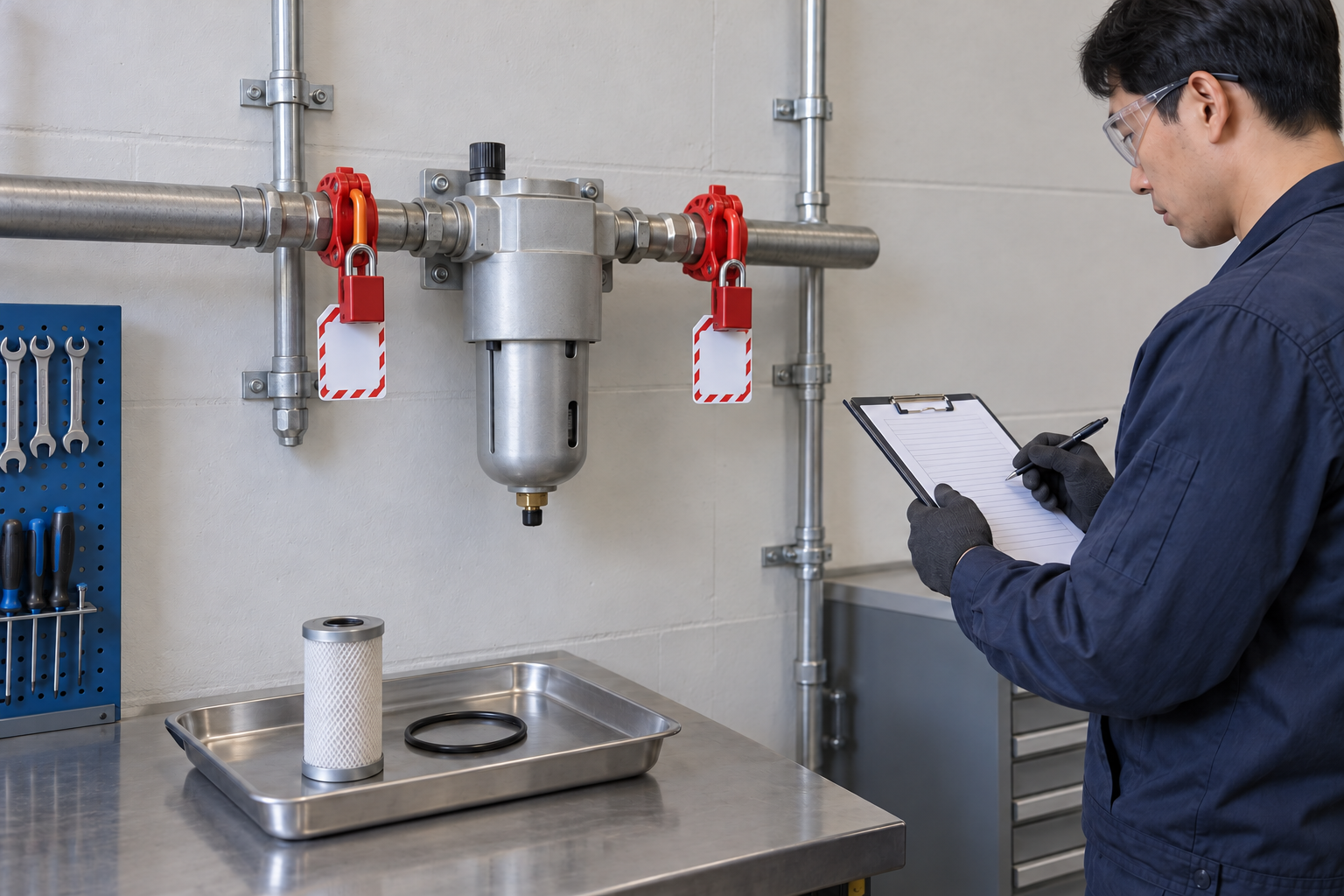
This illustration provides educational context. It is not an actual incident photograph or evidence of equipment suitability; any AI-generated depiction is illustrative only.
The scenario and record comparisons are fictional teaching examples, not records of real incidents, measurements, inspections, signatures or approvals.
| Stage | Fictional situation |
|---|---|
| Initial situation | A fictional maintenance worker closes a filter inlet and opens the drain. |
| Changed condition | The discharge sound stops, but the outlet remains connected to a factory header and the bypass position is unknown. |
| Failure path | The worker treats silence as proof of depressurisation and proposes loosening the bowl. |
| Possible outcome | Stored or returning air could eject the bowl and contaminated condensate. |
| Prevention barrier | Keep the housing closed; establish the full isolation boundary, drain communication and verified absence of pressure/reaccumulation before opening. |
Failure mechanisms
Downstream stored air, a bypass or a common drain can re-pressurise the housing after inlet closure. Verify the complete boundary and the actual housing state by the specified method; silence can mean a blocked drain and is not proof of zero pressure.
Do not loosen a bowl to discover whether it is pressurised. Support it only after verified depressurisation, then inspect threads, seals, corrosion and locking parts using the model procedure.
Similar outside dimensions do not establish the right filtration grade, direction or seal interface. Internal bypass can exist despite no external leak; assembly acceptance and downstream air-quality acceptance remain separate.
Use actual instructions for seal lubricant, locking alignment and gradual repressurisation. Low differential pressure does not establish remaining element life; link service time, contamination, element type and user-specific quality evidence.
Decision sequence
| Step | Decision |
|---|---|
| Known | Only inlet closure and the end of drain noise were observed. |
| Unknown | Outlet/bypass backfeed, drain blockage and housing pressure remain unresolved. |
| Hold | Silence cannot release the line-opening hold point. |
| Evidence | Record each isolation point and the actual housing pressure-verification method, location, person and time. |
| Restart | After accepted parts and locking, complete controlled pressure/leak/drain tests and obtain the affected supply-user handover. |
Work sequence: Identify filter and parts → Isolate all paths → Drain and verify → Open and inspect → Replace and assemble → Repressurize and test → Hold abnormal result → Record and transfer. This is a teaching flow, not a device drawing or a complete operating procedure.
5. Conditional decisions and common errors
| Situation | Required action | Evidence | Proceed when |
|---|---|---|---|
| Drain goes silent | Keep bowl closed | Housing pressure and return check | Safe state verified |
| Parts do not match | Hold assembly | Model/grade/seal evidence | Compatibility accepted |
| Lock unclear | Keep depressurised | Threads and locking marks | Engagement verified |
| Leak during test | Isolate and depressurise | Cause and corrected assembly | Retest accepted |
Similar observations, different decisions
The scenario and record comparisons are fictional teaching examples, not records of real incidents, measurements, inspections, signatures or approvals.
| Observation | Insufficient conclusion | Required distinction |
|---|---|---|
| Inlet valve closed | The housing is isolated. | Resolve outlet, bypass and drain connections. |
| Low differential pressure | Element life and air quality are acceptable. | Evaluate time, contamination and use-specific performance. |
| Bowl hand-tight | Assembly is accepted. | Confirm the specified locking/seal condition and controlled leak test. |
6. Roles and responsibilities
| Role | Responsibility |
|---|---|
| Work supervisor | Confirm filter/model id and the task scope, resources, interfaces and stop authority. |
| Qualified technical reviewer | Review boundary drawing, model limits, compatibility and unresolved technical conditions within assigned competence. |
| Work crew | Apply the listed controls, report changes and stop when evidence or safeguards are missing. |
| Inspector / assessor | Record actual grade/direction/seating and other relevant checks; do not mark unverified conditions as accepted. |
| Handover authority | Reconcile part/service history, restrictions and outstanding actions before the next task. Role labels do not establish a legal credential. |
Supervision and handover focus
| Stage | Management action | Evidence |
|---|---|---|
| Identify filter and parts | 1. Record filter/model id2. Record flow/use requirement3. Record element/seal numbers | 1. Filter/model ID2. Flow/use requirement3. Element/seal numbers |
| Isolate all paths | 1. Record boundary drawing2. Record valve/lock state3. Record stored downstream air | 1. Boundary drawing2. Valve/lock state3. Stored downstream air |
| Drain and verify | 1. Record drain communication2. Record verification method3. Record housing pressure/time and units | 1. Drain communication2. Verification method3. Housing pressure/time and units |
| Replace and assemble | 1. Record grade/direction/seating2. Record seal condition3. Record thread/lock engagement | 1. Grade/direction/seating2. Seal condition3. Thread/lock engagement |
| Repressurize and test | 1. Record startup pressure trend2. Record leak-test record3. Record drain operation | 1. Startup pressure trend2. Leak-test record3. Drain operation |
| Record and transfer | 1. Record part/service history2. Record quality/restrictions3. Record condensate disposal evidence | 1. Part/service history2. Quality/restrictions3. Condensate disposal evidence |
7. Hold points and record comparison
| Hold point | Evidence before release | Actual approval |
|---|---|---|
| HP-0 Scope | Exchange specified elements and seals in an industrial compressed-air filter using an established isolation boundary, safe drain route and verified depressurisation of the actual housing. | |
| HP-1 Drain and verify | Drain communication; Verification method; Housing pressure/time and units; Collection/PPE | |
| HP-2 Replace and assemble | Grade/direction/seating; Seal condition; Thread/lock engagement; Drain assembly | |
| HP-3 Hold abnormal result | Fault and isolation; Parts/lock recheck; Corrected test result; Restart authority | |
| HP-4 Record and transfer | Part/service history; Quality/restrictions; Condensate disposal evidence; Receiver and next service |
Hold points are internal project checks. They are not universal statutory permits and do not grant work permission. Reassess after defects, changed conditions and shift changes.
Record comparison
The scenario and record comparisons are fictional teaching examples, not records of real incidents, measurements, inspections, signatures or approvals.
The boxes are static record prompts, not interactive or saved approvals. A tick does not establish suitability or permission to restart. Record the evidence, person, time and unresolved issues; retain the change history.
| Record | Insufficient record | Record checklist |
|---|---|---|
| Identify filter and parts | Only marked “OK” | □ Filter/model ID□ Flow/use requirement□ Element/seal numbers□ Users and vessel scope |
| Open and inspect | Only marked “OK” | □ Bowl/support condition□ Residual fluid state□ Threads/housing inspection□ Waste containment |
| Hold abnormal result | Only marked “OK” | □ Fault and isolation□ Parts/lock recheck□ Corrected test result□ Restart authority |
| Record and transfer | Only marked “OK” | □ Part/service history□ Quality/restrictions□ Condensate disposal evidence□ Receiver and next service |
8. Site checklist and emergency response
| Site check | Actual result | Person / action |
|---|---|---|
| Identify filter and parts: Filter/model ID; Flow/use requirement; Element/seal numbers; Users and vessel scope | ||
| Isolate all paths: Boundary drawing; Valve/lock state; Stored downstream air; Drain connection | ||
| Drain and verify: Drain communication; Verification method; Housing pressure/time and units; Collection/PPE | ||
| Open and inspect: Bowl/support condition; Residual fluid state; Threads/housing inspection; Waste containment | ||
| Replace and assemble: Grade/direction/seating; Seal condition; Thread/lock engagement; Drain assembly | ||
| Repressurize and test: Startup pressure trend; Leak-test record; Drain operation; Use-specific release | ||
| Hold abnormal result: Fault and isolation; Parts/lock recheck; Corrected test result; Restart authority | ||
| Record and transfer: Part/service history; Quality/restrictions; Condensate disposal evidence; Receiver and next service |
Stop work
Do not open until complete isolation, housing depressurisation and possible reaccumulation are verified. Hold for damaged housing, uncertain locking, wrong parts, drain malfunction, unusual noise or leakage. Never tighten a leaking pressurised bowl.
Emergency response
Withdraw from the bowl and fitting release paths. Isolate from a safe position if possible and restrict access. Do not grasp a whipping line or tighten damaged pressurised components. Call 995 for a medical emergency; tell responders about pressure and condensate. Recovery requires verified isolation.
9. Sources and review limits
Public-source access/review: 2026-10-14.
| Official source | Reviewed scope and limits |
|---|---|
| MOM: Risk management | Review line-opening, stored downstream air, process outage and abnormal leak correction. Official explanation of statutory duties; linked SSO text was not independently read for this item. This is not a legal opinion. |
| WSH Council: Safe Use of Machinery | Isolate all connected energy paths, release stored pressure, verify and control restoration. Official guidance; cited paid Singapore Standards were not obtained. No universal wheel test duration or gap is inferred. |
| MOM: Register a Pressure Vessel | Establish actual classification and relevant AE/examination records before treating the equipment as available for service. Actual filter classification and registration status were not determined; registration exemption does not remove safe-maintenance duties. |
| MOM: Pressure Vessel Repairs and Modifications | Stop scope expansion into pressure-boundary repair or modification for the required approval process. No approval application or engineering classification was performed. Routine consumable exchange must not expand into unreviewed pressure-boundary repair. |
| NEA: Toxic Waste Control | Classify contaminated condensate and spent elements before selecting the permitted disposal route. Apply only after classifying actual cleaner and removed contaminants; this does not classify every aqueous cleaning waste as TIW or authorise discharge. |
| SCDF: Emergency Medical Services | Use the site response and call 995 for a medical emergency after withdrawing from pressure-release paths. Official emergency-response information, not a site-specific rescue plan or authorisation for untrained rescue. |
No actual equipment model, site measurements, design calculations or signed approval was supplied. Check the applicable Singapore requirements and approved safe work procedures against the actual equipment and site before use. Statutory duties, official guidance and manufacturer limits serve different purposes; editorial checks do not establish legal or professional approval.
10. PDF guidance and FAQ
PDF A covers basic task controls; B focuses on technical failures; C covers supervision, records and handover. The article has eight stages with four items per main cell; each PDF has six key stages with three items per main cell. P/S/R/A, measurements, confirmations and signatures remain blank for actual site assessment.
PDFs are complementary six-stage extracts. Apply all eight body stages and the actual equipment/site procedure.
Can a bowl be loosened to test for pressure?
No. Verify the prescribed safe state before opening.
Does a closed inlet isolate the filter?
Check all outlet, bypass and drain paths and verify the actual housing pressure and possible return.
Does leak-free assembly prove air quality?
No. Apply the downstream user’s required quality checks separately.
May a damaged housing be repaired under this JSA?
No. Stop for competent pressure-boundary review and any applicable MOM approval before repair or modification.
Has a professional verified or approved this document?
AI-generated reference material; not professionally verified or approved. Before use, a qualified person must review and adapt it to Singapore requirements, the actual equipment/site and approved safe work procedures.
11. Revision history and authorship
AI-generated reference material; not professionally verified or approved. Before use, a qualified person must review and adapt it to Singapore requirements, the actual equipment/site and approved safe work procedures.
| Date | Version | Change | Review status |
|---|---|---|---|
| 2026-10-14 | SG 1.0 | New Singapore edition from assigned Korean source; task decisions, records and PDFs localized. | AI editorial review; no professional technical approval |
Korean edition revision history: 2026-09-23 (v1.0): initial article, sources, fictional analysis and PDF editorial checks. These are editorial records, not professional technical approval. Singapore v1.0 adapts the earlier edition to Singapore requirements and terminology.
Site reviewers must add their actual qualifications, scope, date and approval only after the review occurs.