Dry only accepted washed textiles within the actual machine programme and load limit. Keep cooling completion, drum stopping and electrical isolation as separate checks; a blank display or interrupted cycle does not prove a load is safe to unload or stack.
AI-generated reference material. It has not been verified or approved by a professional. Before use, a qualified person must review and adapt it to applicable Singapore requirements, the actual equipment and site, and approved safe work procedures.
1. Singapore legal and technical basis
Singapore WSH risk management and machinery controls apply to the commercial laundry workplace. Consumer Product Safety Office dryer advice supports lint, ventilation and combustible-clearance precautions, but it is not a commercial heat-pump manual or a universal servicing interval. Wiring repairs and modifications require the appropriate licensed electrical work arrangement.
| Source category | Task application and limit |
|---|---|
| MOM - Risk management | Assess load contamination, hot textiles, slips and shift handover. Official explanation of WSH Risk Management duties, not a complete consolidated statutory text. |
| Singapore Consumer Product Safety Office - Washing machines and tumble dryers | Use the general lint, airflow and combustible-clearance principles with the commercial model instructions. Consumer appliance guidance supplies general fire-prevention principles. It does not specify commercial heat-pump servicing, refrigerant work, safety-mark applicability or the actual model cleaning method. |
| WSHC - Safe Use of Machinery | Control drum access and isolate hazardous cleaning or maintenance beyond operator tasks. Official guidance with a summary of statutory duties; not a machine-specific safeguard design or full review of current legislation or paid standards. |
| EMA - Engaging Licensed Electrical Workers | Refer wiring and circuit work to the appropriate licensed worker rather than routine operators. Installation, repair or modification of wiring and supply equipment is distinguished from routine operation of an intact appliance. Licence scope must match the installation. |
Use Singapore requirements and SI units. Manufacturer limits apply to the actual model. Foreign technical examples do not establish Singapore statutory duties. A job safety analysis or completed checklist is not a permit or approval.
2. Scope and required inputs
Included: Normal loading, drying, cooling and unloading of washed, extracted and dryer-compatible textiles in an installed commercial electric heat-pump tumble dryer. Include only the filter care expressly assigned to users by the actual manufacturer.
Separate review: Gas, steam and direct-fired dryers; dry cleaning; unknown, oil- or solvent-contaminated rags; infectious laundry; unsuitable rubber or filling materials; drum entry; and refrigerant, internal electrical or heat-exchanger repairs need separate assessment.
| Input | Required evidence |
|---|---|
| Sort textiles | Batch and fabric identity; Contamination assessment; Drying suitability; Pocket inspection |
| Load and select | Load and capacity basis; Program selection; Door and filter condition; Drum and area clear |
| Complete cooling | Cooling phase complete; Completion indication; Residual heat assessed; Drum fully stopped |
| Clean and hand over | Cleaning and filter record; Batch completion status; Unresolved equipment limits; Receiving person identified |
Confirm the actual dryer load capacity, textile programs, cooling completion indications, filter arrangement and permitted user cleaning. Plan safe cart handling and protection against hot textiles. Use the model-specific limits and cleaning intervals; no common temperature or cycle time is assigned to every dryer.
Singapore application
Keep oil-, solvent- or unknown-contaminated textiles outside this normal-load JSA until a competent review and the machine instructions establish an acceptable process. Do not rely on washing alone as proof that a combustible residue has been removed.
3. Eight-stage JSA
| Job stage | Hazards and effects | Failure factors | Controls | Site verification | P | S | R | A |
|---|---|---|---|---|---|---|---|---|
| 1. Sort textiles | 1. Contaminated-load fire2. Unsuitable textile damage3. Foreign-object damage4. Worker exposure | 1. Oil history unknown2. Care label ignored3. Pockets not checked4. Unknown rag mixed in | 1. Check batch origin2. Match drying labels3. Remove foreign objects4. Hold suspect contamination | 1. Batch and fabric identity2. Contamination assessment3. Drying suitability4. Textile contamination status | ||||
| 2. Prepare filters | 1. Lint overheating2. Unexpected drum motion3. Blocked heat exchange4. Electrical exposure | 1. Filter missing or torn2. Cleaning while active3. Air intake obstructed4. User repair exceeds scope | 1. Stop and isolate for cleaning2. Fit intact specified filters3. Clear required air paths4. Refer repairs to specialists | 1. Safe cleaning state2. Filter clean dry and fitted3. Air-path condition4. Maintenance restrictions | ||||
| 3. Load and select | 1. Uneven drying2. Overloaded drum3. Door pinch injury4. Unexpected access | 1. Capacity exceeded2. Wrong program selected3. Fabric trapped in door4. Person or object inside | 1. Match load to model2. Select textile program3. Clear door sealing area4. Check drum before closure | 1. Load and capacity basis2. Program selection3. Door and filter condition4. Drum and area clear | ||||
| 4. Start and observe | 1. Moving-drum contact2. Overheating3. Electrical fault4. Repeated unsafe restart | 1. Door safeguard faulty2. Alarm repeatedly reset3. Leak or odor ignored4. Stop function defective | 1. Verify safe normal start2. Keep safeguards effective3. Watch for abnormal signs4. Stop and report faults | 1. Door and stop function2. Program indication3. Noise odor heat and leaks4. Access controlled | ||||
| 5. Complete cooling | 1. Hot-textile burns2. Heat retained in load3. Post-cycle ignition4. Unexpected drum contact | 1. Cooling cut short2. Display off assumed complete3. Hot load left unattended4. Drum still moving | 1. Allow normal cooling2. Verify actual completion3. Assign unloading owner4. Wait for complete stop | 1. Cooling phase complete2. Completion indication3. Residual heat assessed4. Actual cooling completion | ||||
| 6. Unload safely | 1. Heat buildup in cart2. Handling strain3. Dropped heavy bundle4. Contact with hot textiles | 1. Hot dense pile formed2. Too much lifted at once3. Cart unsuitable4. Residual load overlooked | 1. Follow heat-release method2. Use manageable portions3. Use suitable stable cart4. Check entire drum | 1. Heat and storage condition2. Cart and handling space3. No laundry left inside4. Combustibles separated | ||||
| 7. Hold interrupted load | 1. Residual-heat fire2. Defective dryer restart3. Unsafe fire approach4. Untracked affected batch | 1. Power loss not logged2. Cause unresolved3. Door opened during smoke4. Hot load marked complete | 1. Identify load and stage2. Retain equipment hold3. Use emergency plan for smoke4. Follow safe interruption plan | 1. Batch and interruption time2. Heat and odor observations3. Repair and test evidence4. Interrupted-batch handover | ||||
| 8. Clean and hand over | 1. Lint accumulation2. Hot-load abandonment3. Faulty filter reuse4. Incorrect batch release | 1. Cleaning omitted2. Next shift uninformed3. Filter defect unreported4. Hold tag removed early | 1. Complete permitted cleaning2. Transfer hot-load status3. Report filter defects4. Separate complete and held loads | 1. Cleaning and filter record2. Batch completion status3. Unresolved equipment limits4. Receiving person identified |
P/S/R/A and actual measurements, checks, names and signatures remain blank for the site assessment. A score cannot waive a required control.
4. Hypothetical scenario and failure mechanisms
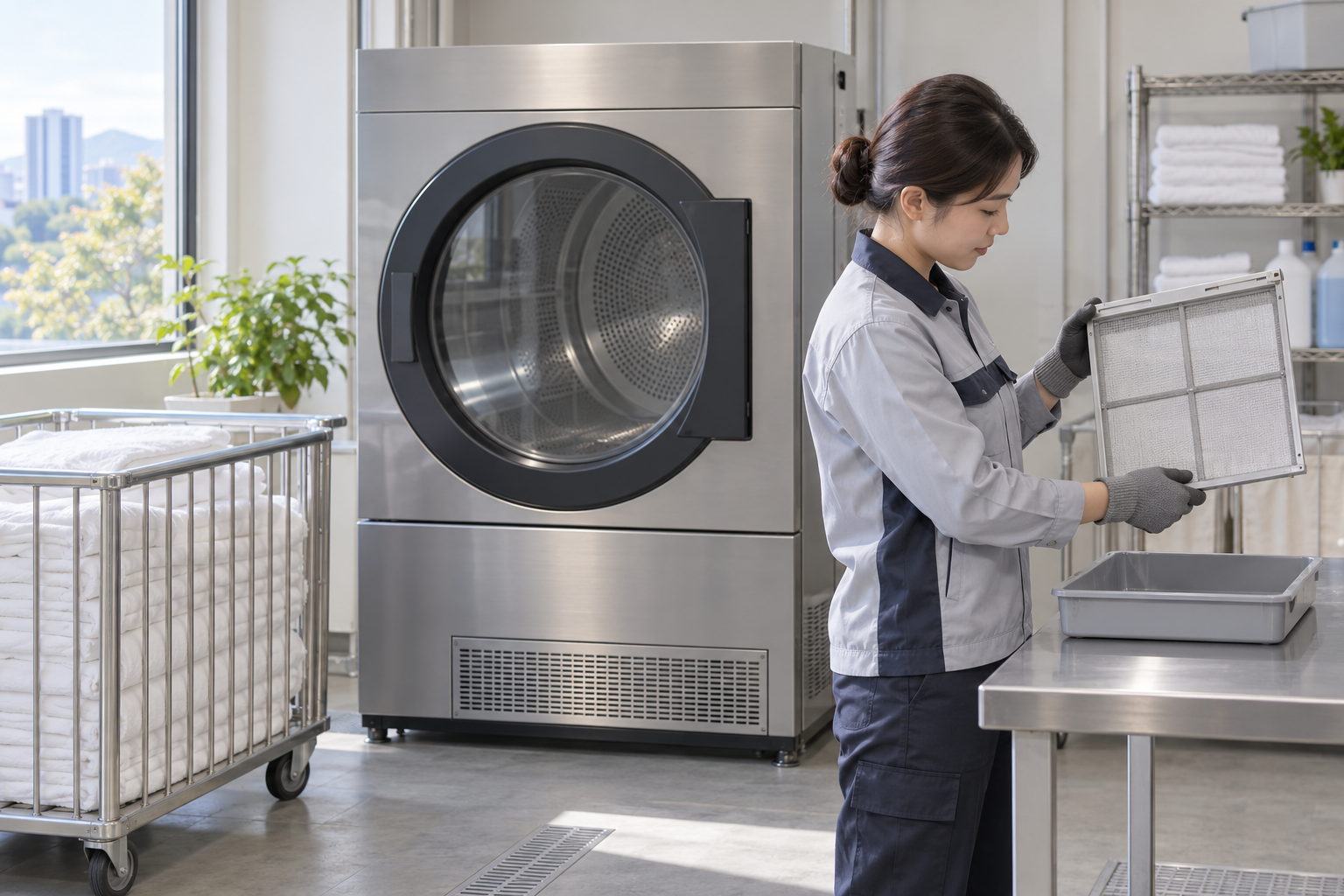
The following scenario, comparisons and example records are hypothetical teaching material. They do not reproduce actual incidents, measurements, signatures or approvals.
| Item | Hypothetical situation |
|---|---|
| Initial state | A laundry crew is approaching shift change with towels still in the cooling phase. |
| Change | The operator stops the cycle and proposes piling hot towels into a deep cart. |
| Failure path | The next worker sees a dark display and assumes the batch is complete; the dense pile restricts heat loss. |
| Possible harm | Retained heat and any overlooked contamination can create a burn or fire hazard. |
| Barrier | Keep normal cooling in the schedule. Record any interrupted batch and follow the model-specific safe heat-dissipation procedure; suspected fire requires alarm and evacuation rather than opening the dryer. |
Washing is not proof that oil or solvent residues are absent. Identify the batch origin, contamination and textile care label before accepting it into this normal-laundry workflow. Keep uncertain loads separate for review.
A dark display does not establish cool laundry or a stopped drum. Completion requires the actual program state, safe motion state and residual-heat conditions. Plan the last load early enough to complete cooling and unloading before the responsible operator leaves.
A power failure removes electrical supply but not heat already stored in the load. Where safe access is established, follow the specific interruption instructions for removing and spreading items to dissipate heat. Do not approach, open or unload a dryer that is smoking or suspected to be on fire.
Filters and clear air paths protect heat transfer. Follow the exact filter arrangement, cleaning method and drying/reinstallation instructions. Model-specific cleaning intervals and capacities must not be generalized to every commercial dryer.
| Decision | Reason and evidence |
|---|---|
| Known facts | The operator stops the cycle and proposes piling hot towels into a deep cart. |
| Unresolved | The next worker sees a dark display and assumes the batch is complete; the dense pile restricts heat loss. |
| Hold reason | Do not load when textile suitability, contamination, program or capacity is uncertain, or when filters, ventilation, doors or stop functions are defective. Smoke, burning odor or abnormal heating requires emergency response. Do not bypass normal cooling or abandon hot interrupted loads. |
| Evidence needed | Cooling phase complete; Completion indication; Residual heat assessed; Drum fully stopped. |
| Next decision | Keep normal cooling in the schedule. Record any interrupted batch and follow the model-specific safe heat-dissipation procedure; suspected fire requires alarm and evacuation rather than opening the dryer. |
Singapore application
Confirm which filters and condensate components the operator may access, how often the model requires cleaning and the required safe state. Keep ventilation openings and surrounding space clear. Refrigerant circuits, enclosed electrical equipment and guarded moving parts are for the appropriate servicing team.
5. Hold and proceed decisions
| Condition | Action | Evidence | Proceed when |
|---|---|---|---|
| Unknown laundry | Hold the load for origin and contamination review. | Batch history and textile labels. | Drying suitability established. |
| Filter defect | Stop and clean or replace by the model procedure. | Filter identity, condition and fit. | Intact filter system fitted. |
| Cooling interrupted | Assess heat and follow the safe interruption method. | Batch, stage and residual-heat record. | Heat safely dissipated. |
| Smoke or burning odor | Alarm, evacuate and restrict access. | Emergency response and specialist assessment. | Incident resolved; equipment released. |
| Comparison | Situation A | Situation B |
|---|---|---|
| Washed load | Origin, residual contamination and drying label are acceptable. | It passed through a washer but its previous use is unknown. |
| Screen off | Cooling completion and safe unloading were recorded. | An interrupted hot batch remains inside or piled in a cart. |
6. Roles and supervision
| Role | Responsibility |
|---|---|
| Work supervisor | Confirm scope, task sequence, exclusion and stop authority. Coordinate sort textiles with affected operations. |
| Technical reviewer | Resolve the actual design and equipment limits: Batch and fabric identity; Contamination assessment; Drying suitability; Pocket inspection. |
| Work crew | Perform load and select using the approved procedure; report any mismatch before proceeding. |
| Inspector / assessor | Verify Heat and storage condition; Cart and handling space; No laundry left inside; Combustibles separated. Record what was actually checked and what remains unresolved. |
| Release / receiving authority | Confirm Cleaning and filter record; Batch completion status; Unresolved equipment limits; Receiving person identified. Transfer restrictions and the next permitted stage. |
These are responsibility examples, not invented statutory credentials. Meet the actual training, competent-person, qualified-person and licensing requirements for the assigned work. Anyone may raise a hazard and request a stop; only the designated authority may release the affected stage after evidence is reviewed.
Singapore application
At shift change, identify any interrupted batch, its last completed programme stage and the person controlling the next decision. Prevent another operator from restarting or stacking the load merely because a fault message has disappeared.
7. Hold points and record quality
| Hold point | Evidence before release | Confirmation / approval |
|---|---|---|
| HP-0 Start | Scope, jurisdiction, equipment identity, responsible people and emergency arrangements. | |
| HP-1 Prepare filters | Safe cleaning state; Filter clean dry and fitted; Air-path condition; Maintenance restrictions | |
| HP-2 Start and observe | Door and stop function; Program indication; Noise odor heat and leaks; Access controlled | |
| HP-3 Unload safely | Heat and storage condition; Cart and handling space; No laundry left inside; Combustibles separated | |
| HP-4 Clean and hand over | Cleaning and filter record; Batch completion status; Unresolved equipment limits; Receiving person identified |
Hold points are internal evidence gates. They do not replace statutory permits or actual signatures. Recheck affected gates after a change, abnormal event or shift transfer. The blank record must identify the evidence, person, time, limits and release scope.
| Record | Insufficient record | Record checklist |
|---|---|---|
| Textiles | Washed already | □ Batch and fabric identity□ Contamination assessment□ Drying suitability□ Pocket inspection |
| Load | Program chosen | □ Load and capacity basis□ Program selection□ Door and filter condition□ Drum and area clear |
| Cooling | Screen is off | □ Cooling phase complete□ Completion indication□ Residual heat assessed□ Drum fully stopped |
| Interruption | Restarted normally | □ Batch and interruption time□ Heat and odor observations□ Repair and test evidence□ Release scope recorded |
The □ boxes are static prompts, not saved or interactive approvals. Each checks one record element. A tick alone does not establish suitability or permission to restart. Link equipment IDs and supporting records; retain unresolved matters and the earlier record when conditions change.
8. Pre-work checks and emergency response
| Check item | Result | Person / action |
|---|---|---|
| Batch and fabric identity | ||
| Safe cleaning state | ||
| Load and capacity basis | ||
| Door and stop function | ||
| Cooling phase complete | ||
| Heat and storage condition | ||
| Batch and interruption time | ||
| Cleaning and filter record | ||
| Emergency arrangements and unresolved restrictions communicated |
Stop work: Do not load when textile suitability, contamination, program or capacity is uncertain, or when filters, ventilation, doors or stop functions are defective. Smoke, burning odor or abnormal heating requires emergency response. Do not bypass normal cooling or abandon hot interrupted loads.
Emergency response: For smoke, burning odor or flame, raise the alarm, evacuate, restrict access and contact the site emergency responders. Use the designated stop only if safely accessible. Do not open the door to investigate or force hot laundry out during a suspected fire. Handle an ordinary interruption under the model procedure only after smoke and access hazards are excluded.
Singapore application
For smoke, abnormal burning smell or suspected fire, stop work, raise the alarm and follow the site emergency plan. Do not open the drum or unload a smoking batch to investigate. A power interruption without fire still requires the model-specific cooling and recovery procedure before handling.
9. Sources and review limits
Public-source review: 14 October 2026. Only the material and limits identified below were reviewed.
| Source | Reviewed material | Task application |
|---|---|---|
| MOM - Risk management | Responsibilities; routine and non-routine work; hierarchy of control and risk assessment team. Official explanation of WSH Risk Management duties, not a complete consolidated statutory text. | Assess load contamination, hot textiles, slips and shift handover. |
| Singapore Consumer Product Safety Office - Washing machines and tumble dryers | Complete safety guidance: capacity, suitable installation, combustible clearance, ventilation, lint, contaminated clothing and servicing. Consumer appliance guidance supplies general fire-prevention principles. It does not specify commercial heat-pump servicing, refrigerant work, safety-mark applicability or the actual model cleaning method. | Use the general lint, airflow and combustible-clearance principles with the commercial model instructions. |
| WSHC - Safe Use of Machinery | Printed pages 4, 27, 37-39: dangerous parts, maintenance training, hazardous-energy isolation, verification, group/shift continuity and restoration. Official guidance with a summary of statutory duties; not a machine-specific safeguard design or full review of current legislation or paid standards. | Control drum access and isolate hazardous cleaning or maintenance beyond operator tasks. |
| EMA - Engaging Licensed Electrical Workers | Overview, examples of wiring and circuit work, licence classes and verification of valid licences. Installation, repair or modification of wiring and supply equipment is distinguished from routine operation of an intact appliance. Licence scope must match the installation. | Refer wiring and circuit work to the appropriate licensed worker rather than routine operators. |
Selected official public sources were read on 14 October 2026 within the stated scope. No full consolidated statutory text, paid Singapore Standard, actual equipment manual, engineering calculation, site measurement or professional technical approval is claimed. Check current detailed duties and actual equipment before use.
AI-generated reference material. It has not been verified or approved by a professional. Before use, a qualified person must review and adapt it to applicable Singapore requirements, the actual equipment and site, and approved safe work procedures.
10. PDF use and frequently asked questions
PDF A covers basic task controls; B examines technical failures; C focuses on supervision, evidence and handover. Each has six rows and three items per main cell. They are complementary extracts: apply all eight body stages and the applicable site procedure. An omitted stage is not permission to omit its controls. PDF HP-0 through HP-4 are worksheet labels; match the event, evidence and authority rather than assuming they match another permit by number.
P/S/R/A, actual measurements, confirmations and signatures remain blank. The PDFs are uncompleted reference worksheets, not issued work permits.
Content group ID: jsa-commercial-heatpump-laundry-drying
Can cooling be skipped to save time?
Do not routinely interrupt the cooling phase. Include cooling and safe unloading in the work schedule.
Should laundry be removed immediately after a power failure?
First assess smoke and access hazards. If safe, follow the model-specific interruption and heat-dissipation instructions. Suspected fire calls for alarm, evacuation and emergency response.
Does washing make oily rags suitable for this procedure?
No. Unknown and oil- or solvent-contaminated rags are excluded from this normal-textile workflow.
Has a professional verified or approved this document?
No. This is AI-assisted reference material. Editorial and layout checks are not a physical inspection or professional technical approval. Obtain qualified professional review and required site approval before use.
Singapore application
Read the A, B and C sheets together with the complete JSA and approved work procedure; each sheet is a complementary extract and cannot authorise work on its own.
11. Authorship and revision history
AI-generated reference material. It has not been verified or approved by a professional. Before use, a qualified person must review and adapt it to applicable Singapore requirements, the actual equipment and site, and approved safe work procedures.
| Date / edition | Authorship and scope | Professional approval |
|---|---|---|
| 2026-10-07 / Korean source | Original topic and educational illustration retained as references. Source content is unchanged. | Not asserted |
| 14 October 2026 / Singapore 1.0 | Added Singapore official dryer-fire guidance with its consumer scope expressly limited; emphasised interrupted cooling, batch identification and the boundary between operator filter cleaning and servicing. | Not performed |
Source topic: https://smartjsabridge.com/ko/case-study/jsa-commercial-heatpump-laundry-drying