Vertical lifting, small controlled positioning adjustments, landing and removal of a manual chain hoist. Verify the entire load path from the overhead support and clamp through the hoist, hooks, sling and load to the final supports.
Stop for chain twist or binding, brake slip, hook distortion, support movement, loss of a vertical load line or abnormal hand-chain resistance.
Reference content written and revised with AI. It has not been verified or approved by a professional. Review by a suitably qualified professional and site approval are required before use.
AI-generated reference material; not professionally verified or approved. Before use, a qualified person must review and adapt it to applicable Singapore requirements, the actual equipment/site and approved safe work procedures.
1. Legal and technical scope
MOM lists chain blocks as lifting appliances. Verify the asset registration and required examination status against its actual classification; the 2025 circular gives category-specific requirements. WSH Council lifting guidance calls for a planned method, risk assessment, competent crew and controlled lift zone. The whole beam-to-load path remains a site engineering question.
| Basis | Singapore application |
|---|---|
| Risk management | The employer, self-employed person and principal assess and control work risks. Include preparation, abnormal conditions and maintenance. Coordinate affected trades and communicate controls. |
| Activity-specific guidance | Apply MOM registration/examination categories to the actual chain block and accessories, and WSHC planning guidance to support capacity, vertical movement, landing and fault recovery. |
| Permits and authority | Select permit requirements for the actual sector and activity. Site hold points and contractor role labels do not create statutory permits or qualifications. |
| Equipment and design | The 2025 MOM circular replaced the 2020 circular and removed routine periodic overload tests. It does not permit improvised proof loading by the crew. Confirm classification, exemptions, examination and post-repair requirements with the relevant competent parties. This article supplies no beam/clamp capacity or chain discard dimension. |
2. Scope and required inputs
Included: Vertical lifting, small controlled positioning adjustments, landing and removal of a manual chain hoist. Verify the entire load path from the overhead support and clamp through the hoist, hooks, sling and load to the final supports.
Separate review: Side pulling, forced bolt-hole alignment, coordinated multiple-hoist lifts, overhead support design and recovery of a suspended load after equipment failure require separate specialist review. A vertical chain-hoist example does not authorize lever-hoist pulling.
| Input | Required evidence |
|---|---|
| Plan load path | Load and lift-point record; Final support basis; Full load-path review; Vertical movement plan |
| Inspect hoist | Chain inspection record; Hook and latch condition; Rating and model identity; Brake function check |
| Adjust vertically | Alignment method; Load line and clearance; Stable load behavior; Stop signals working |
| Remove and store | Final equipment stability; Hoist load fully removed; Defect and repair status; Reuse decision and storage |
Confirm hoist and attachment ratings, overhead support capacity, permitted loading direction, chain inspection criteria and final support requirements. Select suitable handling protection and safe access. No universal beam capacity or discard dimension is supplied here; use the actual model and design evidence.
Singapore site planning
The Singapore site lifting arrangements must identify the chain block, beam/clamp, lifting gear, load mass and final supports. Match registration and examination records to the equipment ID and examine pre-use condition as a separate check. Do not apply the circular's competent-person re-examination provision for lifting gear indiscriminately to the chain block lifting appliance. Agree the applicable permit system and stop authority before the trial lift, and re-plan any side pull, multiple-hoist operation or recovery from a brake defect.
3. Eight-stage JSA
| Job stage | Hazards and effects | Failure factors | Technical and procedural controls | Site verification | P | S | R | A |
|---|---|---|---|---|---|---|---|---|
| 1. Plan load path | 1. Hoist overload2. Load overturning3. Overhead support failure4. Eccentric load rotation | 1. Mass or CG unknown2. Final support omitted3. Hoist rating checked alone4. Load sharing assumed | 1. Establish mass and CG2. Plan final stable supports3. Check every load-path part4. Exclude unreviewed multi-hoist work | 1. Load and lift-point record2. Final support basis3. Full load-path review4. Vertical movement plan | ||||
| 2. Check support | 1. Beam or clamp failure2. Dropped load strike3. Clamp detachment4. Side-force damage | 1. Local beam strength unknown2. People below load3. Wrong clamp orientation4. Pipe used as support | 1. Verify support design basis2. Control the fall zone3. Install specified connection4. Match permitted load direction | 1. Beam and clamp identity2. Capacity and orientation3. Connection installation4. Exclusion maintained | ||||
| 3. Inspect hoist | 1. Chain rupture2. Brake slip3. Hook disengagement4. Sudden chain release | 1. Twisted or worn chain2. Brake defect ignored3. Hook or latch damaged4. Chain rejoined improperly | 1. Check chain through travel2. Inspect hook and brake3. Reject defective equipment4. Use model-specific criteria | 1. Current examination record2. Hook and latch condition3. MOM category and asset ID4. Brake function check | ||||
| 4. Connect and trial lift | 1. Hook-tip disengagement2. Load swing3. Rigging separation4. Snag-induced overload | 1. Hook not seated2. Load line offset3. Chain used as sling4. Load still attached | 1. Use approved lifting gear2. Seat hooks correctly3. Establish vertical load line4. Trial lift and check balance | 1. Hook bowl loading2. Sling and lifting points3. Balance and brake response4. Load clear of obstructions | ||||
| 5. Adjust vertically | 1. Hand or foot crush2. Sudden sideways movement3. Support overload4. Loss of load control | 1. Hands under supports2. Forced hole alignment3. Hand effort increases4. Signals not understood | 1. Move in small planned steps2. Keep body out of pinch gaps3. Maintain permitted load line4. Stop on abnormal resistance | 1. Alignment method2. Load line and clearance3. Stable load behavior4. Stop signals working | ||||
| 6. Land and release | 1. Support overturning2. Residual-tension release3. Load sliding4. Crushed fingers | 1. Weak temporary support2. One support not touching3. Unhooking before restraint4. Sudden tension removal | 1. Verify designed contact2. Secure against movement3. Transfer load gradually4. Disconnect only when unloaded | 1. Support capacity and contact2. Restraint completion3. Load transfer evidence4. Residual tension removed | ||||
| 7. Hold on fault | 1. Suspended-load drop2. Upper connection failure3. Chain runaway4. Recovery injury | 1. Extra people pull harder2. Loaded chain untangled3. Repair under load4. No safe recovery plan | 1. Stop and control the area2. Do not force the hand chain3. Plan independent safe support4. Use authorised recovery method | 1. Fault and load condition2. Danger zone boundary3. Recovery plan and authority4. Post-repair inspection | ||||
| 8. Remove and store | 1. Overhead part fall2. Unexpected residual load3. Defective hoist reuse4. Trip over loose chain | 1. Unloaded state assumed2. Connection released early3. Defect tag omitted4. Chain left in walkway | 1. Confirm no remaining load2. Remove by safe access method3. Quarantine damaged equipment4. Store and transfer records | 1. Final equipment stability2. Hoist load fully removed3. Defect and repair status4. Reuse status and storage |
P = likelihood; S = severity; R = risk using the site method; A = site acceptance/authorisation. Complete after actual assessment; no score overrides an unresolved hold point or equipment limit.
4. Hypothetical scenario and failure mechanisms
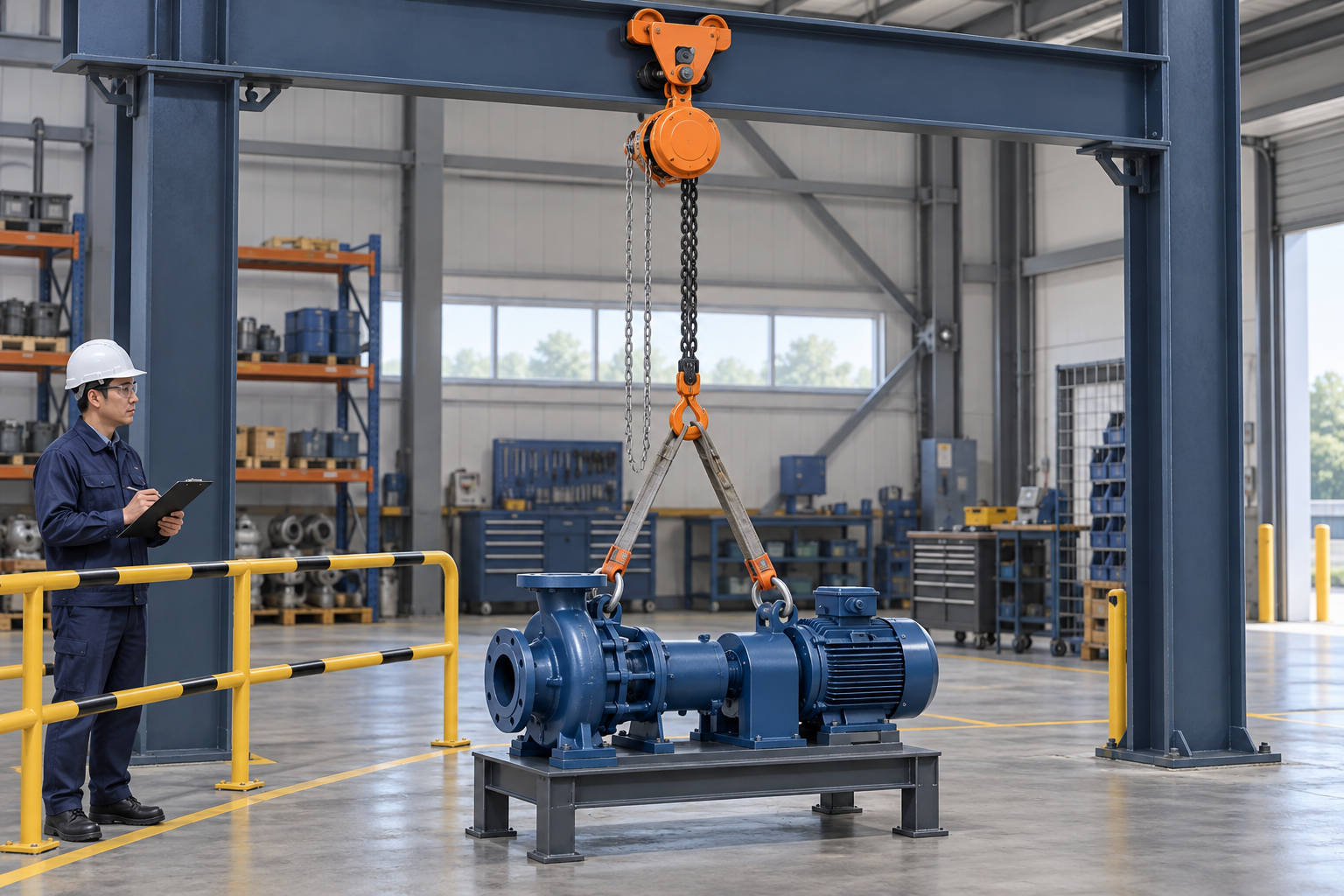 Retained source illustration: an AI-generated educational concept, not a real incident photograph or evidence of equipment suitability.
The following scenario, comparisons and example records are hypothetical teaching material. They do not reproduce actual incidents, measurements, signatures or approvals.
| Item | Hypothetical situation |
|---|---|
| Initial state | A crew lowers equipment onto its final supports using a manual chain hoist. |
| Change | Bolt holes do not align, and one support is not in contact. The crew proposes pulling the hoist sideways. |
| Failure path | Side loading changes forces in the hook, chain and overhead clamp. Increasing hand effort or releasing rigging compounds the unstable support condition. |
| Possible harm | The load could move suddenly, overturn or crush hands between the equipment and base. |
| Barrier | Hold the adjustment, clear the danger area and obtain a suitable alignment and support method. Verify full intended contact and restraint before gradually transferring load and removing the hoist. |
The hoist nameplate covers one component of a larger system. The beam, clamp, connections, lifting attachment and actual load direction each need an adequate basis. A pipe or guardrail is not a lifting point merely because a hook fits around it.
A vertical hoist must maintain the permitted load line. Pulling an offset load toward a bolt hole can load the hook and support in an unapproved direction. Use an appropriately reviewed positioning method rather than force.
Increasing hand-chain resistance can signal an overload, twist, obstruction or defect. Extra people, impact or powered assistance can bypass the warning while increasing load. Stop and determine the cause; do not work on loaded chain or brake parts.
Touching the floor does not prove stable landing. Check support capacity and contact, load distribution, restraint and remaining chain tension. Transfer the load in a controlled way before disconnecting either end of the hoist.
| Decision | Reason and evidence |
|---|---|
| Known facts | Bolt holes do not align, and one support is not in contact. The crew proposes pulling the hoist sideways. |
| Unresolved | Side loading changes forces in the hook, chain and overhead clamp. Increasing hand effort or releasing rigging compounds the unstable support condition. |
| Hold reason | Stop for chain twist or binding, brake slip, hook distortion, support movement, loss of a vertical load line or abnormal hand-chain resistance. |
| Evidence needed | Support capacity and contact; Restraint completion; Load transfer evidence; Residual tension removed. |
| Next decision | Hold the adjustment, clear the danger area and obtain a suitable alignment and support method. Verify full intended contact and restraint before gradually transferring load and removing the hoist. |
5. Conditional decisions and common errors
| Condition | Action | Evidence | Proceed when |
|---|---|---|---|
| Support uncertain | Hold lifting and verify every support connection. | Beam, clamp, direction and capacity basis. | Complete load path adequate. |
| Chain binds | Stop operating and determine the cause safely. | Chain, load, interference and defect record. | Defect and interference resolved. |
| Holes misaligned | Stop side pulling and review the positioning method. | Alignment method and support contact. | Permitted load line maintained. |
| Proposed unhooking | Verify support, restraint and remaining tension. | Landing and load-transfer records. | Stable, unloaded connection. |
| Comparison | Situation A | Situation B |
|---|---|---|
| Floor contact | The specified supports carry the load and movement is restrained. | Only one corner touches while the hoist still carries substantial load. |
| Hoist capacity | The entire support-to-load path is verified for its actual direction. | Only the hoist nameplate exceeds the estimated weight. |
6. Roles and responsibilities
| Role | Responsibility |
|---|---|
| Work supervisor | Confirm scope, task sequence, exclusion and stop authority. Coordinate plan load path with affected operations. |
| Technical reviewer | Resolve the actual design and equipment limits: Load and lift-point record; Final support basis; Full load-path review; Vertical movement plan. |
| Work crew | Perform inspect hoist using the approved procedure; report any mismatch before proceeding. |
| Inspector / assessor | Verify Support capacity and contact; Restraint completion; Load transfer evidence; Residual tension removed. Record what was actually checked and what remains unresolved. |
| Release / receiving authority | Confirm Final equipment stability; Hoist load fully removed; Defect and repair status; Reuse decision and storage. Transfer restrictions and the next permitted stage. |
These are responsibility examples, not invented statutory credentials. Meet the actual training, competent-person, qualified-person and licensing requirements for the assigned work. Anyone may raise a hazard and request a stop; only the designated authority may release the affected stage after evidence is reviewed.
The principal and employers coordinate the risk assessment and safe work procedures. These role labels allocate work; verify any qualifications and statutory appointments required for the actual Singapore activity. The receiving person must be given restrictions and unresolved defects before handover.
Record and handover perspective
| Stage | Record controls | Verification |
|---|---|---|
| Plan load path | 1. Record load and lift-point record2. Record final support basis3. Record full load-path review | 1. Final support basis2. Full load-path review3. Vertical movement plan |
| Inspect hoist | 1. Record current examination record2. Record hook and latch condition3. Record mom category and asset id | 1. Hook and latch condition2. MOM category and asset ID3. Brake function check |
| Connect and trial lift | 1. Record hook bowl loading2. Record sling and lifting points3. Record balance and brake response | 1. Sling and lifting points2. Balance and brake response3. Load clear of obstructions |
| Adjust vertically | 1. Record alignment method2. Record load line and clearance3. Record stable load behavior | 1. Load line and clearance2. Stable load behavior3. Stop signals working |
| Hold on fault | 1. Record fault and load condition2. Record danger zone boundary3. Record recovery plan and authority | 1. Danger zone boundary2. Recovery plan and authority3. Post-repair inspection |
| Remove and store | 1. Record final equipment stability2. Record hoist load fully removed3. Record defect and repair status | 1. Hoist load fully removed2. Defect and repair status3. Reuse status and storage |
7. Hold points and record comparison
| Hold point | Evidence before release | Actual record |
|---|---|---|
| HP-0 Start | Task boundary, site RA, SWP, responsibilities and emergency arrangements | |
| HP-1 Check support | Beam and clamp identity; Capacity and orientation; Connection installation; Exclusion maintained | |
| HP-2 Inspect hoist | Current examination record; Hook and latch condition; MOM category and asset ID; Brake function check | |
| HP-3 Land and release | Support capacity and contact; Restraint completion; Load transfer evidence; Residual tension removed | |
| HP-4 Remove and store | Final equipment stability; Hoist load fully removed; Defect and repair status; Reuse status and storage |
Hold points are internal evidence gates. They do not replace statutory permits or actual signatures. Recheck affected gates after a change, abnormal event or shift transfer. The blank record must identify the evidence, person, time, limits and release scope.
| Record | Insufficient record | Record checklist |
|---|---|---|
| Support | Beam usable | □ Beam and clamp identity□ Capacity and orientation□ Connection installation□ Exclusion maintained |
| Inspection | Chain looks fine | □ Chain inspection record□ Hook and latch condition□ Rating and model identity□ Brake function check |
| Landing | Load reached floor | □ Support capacity and contact□ Restraint completion□ Load transfer evidence□ Residual tension removed |
| Fault | Repair complete | □ Fault and load condition□ Danger zone boundary□ Recovery plan and authority□ Post-repair inspection |
The □ boxes are static prompts, not saved or interactive approvals. Each checks one record element. A tick alone does not establish suitability or permission to restart. Link equipment IDs and supporting records; retain unresolved matters and the earlier record when conditions change.
Hold points are internal checks. Determine separately whether Singapore statutory or site permit requirements apply to this work. Leave confirmation, measurements and approval records blank until the authorised site process is completed.
8. Site checklist and emergency response
| Check item | Result | Person / action |
|---|---|---|
| Load and lift-point record | ||
| Beam and clamp identity | ||
| Chain inspection record | ||
| Hook bowl loading | ||
| Alignment method | ||
| Support capacity and contact | ||
| Fault and load condition | ||
| Final equipment stability | ||
| Emergency arrangements and unresolved restrictions communicated |
Stop work: Stop for chain twist or binding, brake slip, hook distortion, support movement, loss of a vertical load line or abnormal hand-chain resistance.
Emergency response: Keep people out of the suspended-load and possible movement area. Do not disconnect or repair loaded chain, hooks or brakes. Use a separately reviewed recovery and independent-support method suited to the remaining load. Activate the site emergency plan and call the site emergency service for injury or an uncontrolled collapse hazard.
9. Sources and review limits
Official public sources read for this Singapore edition on 2026-10-14. Guidance, statutory explanations and manufacturer limits have different roles; no source provider has approved this JSA.
| Source | Read scope and application limits |
|---|---|
| MOM — Risk management | Official explanation: employer, self-employed person and principal responsibilities; routine and non-routine risk assessment; hierarchy of controls; multidisciplinary assessment team. Official explanation of risk-management duties; no claim of reading the full linked statute. It does not specify task-specific equipment limits. Assess manual chain block positioning with employers, principal and affected contractors; resolve the inputs in section 2. |
| MOM — When should my company review its risk assessment? | Review every three years, after significant changes, new machinery/substances/procedures, hazard-related injury or incident, and when assessment is inadequate. General review guidance. A review interval does not permit continued operation after a known hazard or change. Reassess this operation after changes, defects, incidents or an inadequate assessment; do not wait for a scheduled review. |
| MOM — Permit-to-Work Systems | Formal work authorisation and coordination; OPEC tripartite guidance and competent permit authority with authority to reject work. OPEC-focused guidance page; not evidence of a blanket statutory permit requirement for every task. Determine permits for this actual activity and workplace; distinguish the section 7 internal hold points from statutory or site permits. |
| WSH Council — Planning a Lift | Lift planning documents, load/equipment/crew/method/site information, complex-lift engineering, and stopping when site conditions differ from the approved plan. Official practical guidance, with crane-oriented examples. Statutory appointments and permit applicability depend on the equipment and activity; not an issued permit or support design. Apply MOM registration/examination categories to the actual chain block and accessories, and WSHC planning guidance to support capacity, vertical movement, landing and fault recovery. |
| MOM — Register Lifting Equipment | Equipment categories requiring registration, including chain blocks as lifting appliances, lifts/hoists, lifting machines and lifting gear. Registration overview; exemptions and equipment classification must be confirmed for the actual asset. Registration is not proof of suitability for a particular lift. Apply MOM registration/examination categories to the actual chain block and accessories, and WSHC planning guidance to support capacity, vertical movement, landing and fault recovery. |
| MOM — Circular MOM/OSHD/2025-05, lifting equipment tests and examination | All three pages: requirements effective 12 September 2025, category-specific examination intervals, registration and post-change tests, and footnotes defining hoists and competent-person lifting-gear re-examination. Category-specific official circular, not a site test certificate. Periodic overload testing was removed; do not substitute routine checks for required examinations or apply lifting-gear examiner provisions to every lifting appliance. Apply MOM registration/examination categories to the actual chain block and accessories, and WSHC planning guidance to support capacity, vertical movement, landing and fault recovery. |
The 2025 MOM circular replaced the 2020 circular and removed routine periodic overload tests. It does not permit improvised proof loading by the crew. Confirm classification, exemptions, examination and post-repair requirements with the relevant competent parties. This article supplies no beam/clamp capacity or chain discard dimension.
Actual site measurements, equipment instructions, engineering checks and signed approval records were not supplied. A qualified person must resolve these before use.
10. PDF guidance and FAQ
PDF A covers basic task controls; B examines technical failures; C focuses on supervision, evidence and handover. Each has six rows and three items per main cell. They are complementary extracts: apply all eight body stages and the applicable site procedure. An omitted stage is not permission to omit its controls. PDF HP-0 through HP-4 are worksheet labels; match the event, evidence and authority rather than assuming they match another permit by number.
P/S/R/A, actual measurements, confirmations and signatures remain blank. The PDFs are uncompleted reference worksheets, not issued work permits.
Content group ID: jsa-chainblock-positioning
Is the hoist rating enough to approve the lift?
No. Verify the beam, clamp, hooks, rigging, lifting points and actual load direction as a complete path.
Should two people pull a stiff hand chain?
Do not add force. Stop and check load, twist, interference and defects using the model procedure.
May I pull sideways to align a bolt hole?
Do not turn a vertical lift into an unapproved side pull. Obtain a suitable positioning method.
May the hook be removed once the load touches the floor?
Only after the intended supports carry the load, restraint is complete and residual hoist load has been safely removed.
Has a professional verified or approved this document?
No. This is AI-assisted reference material. Editorial and layout checks are not a physical inspection or professional technical approval. Obtain qualified professional review and required site approval before use.
11. Revision history and authorship
AI-generated reference material; not professionally verified or approved. Before use, a qualified person must review and adapt it to applicable Singapore requirements, the actual equipment/site and approved safe work procedures.
This Singapore edition was adapted from the Korean original and its assigned US technical reference. Earlier source revisions are archival editorial history, not Singapore technical approval.
| Date | Edition | Change | Review status |
|---|---|---|---|
| 2026-09-19 | Korean source v1.0 | Source editorial publication or revision; retained as provenance of the Korean edition. | Editorial record only; no professional technical approval recorded. |
| 2026-09-30 | Korean source v1.1 | Source editorial publication or revision; retained as provenance of the Korean edition. | Editorial record only; no professional technical approval recorded. |
| 2026-10-14 | 1.0 en-SG | Singapore legal scope, local planning, responsibility interfaces and SI terminology; new PDF A/B/C. | AI editorial and visual review only; no professional approval. |