Small-batch mixing of specified cement mortar with a suitable portable paddle mixer and hand application to a new indoor wall, followed by curing and inspection handover.
Do not start with uncertain mix, unstable bags or container, defective mixer or wet electrical connections. Stop for heavy dust, paddle jam or vibration, mortar inside PPE, unstable access or wall material detachment.
AI-generated reference material. It has not been professionally verified or approved. Before use, a suitably qualified person must review and adapt it to applicable Singapore requirements, the actual equipment and site, and approved safe work procedures.
1. Legal and technical scope
Apply Singapore WSH chemical-risk, machinery, electrical and access controls to the actual plastering method. WSHC guidance links the SDS and labels to training, exposure controls and safe work procedures. Where toxic substances are used or generated, MOM requires regular monitoring by a competent person, with results assessed against the applicable Singapore permissible exposure levels and reported as required. Wet mixing alone does not resolve exposure during opening, loading or cleanup. UK HSE cement advice is used only for technical exposure mechanisms, not Singapore statutory duties.
Assess the actual activity under the applicable Singapore WSH requirements. Statutory duties, official guidance, manufacturer instructions and approved project documents have distinct roles. A site hold point is not automatically a statutory permit. Use competent local review to resolve the applicable industry, installation, access and permit requirements.
| Basis | Application and limits |
|---|---|
| MOM risk management | Official explanation: risk assessment, control, monitoring and communication for routine and non-routine work, including maintenance; reviewed 14 October 2026. |
| WSHC Preventing Chemical Hazards | Official guidance on chemical risk assessment, safe work procedures, exposure routes, hazard communication and exposure-dependent monitoring; not product certification. |
| WSHC GHS chemical classification and labelling | Employer/occupier SDS access, container labelling, training and understandable hazard communication. Full SS 586 text was not obtained. |
| WSHC preventing machine hazards | Official guidance: hierarchy of controls, guarding, competent operators and maintenance LOTO. It is not a model-specific isolation instruction. |
| WSHC electrical safety | Official guidance: maintenance energy isolation, stored-energy control, verification and reinstatement; electrical scope still requires applicable EMA authorisation. |
| MOM requirements for hygiene monitoring | Official toxic-substance and noise monitoring guidance: competent personnel, exposure-dependent requirements, records, worker information and reporting. No site exposure result is asserted. |
| HSE construction hazardous substances: cement | Foreign technical reference for alkaline wet-cement contact, dust, compatible protection and prompt washing. UK COSHH duties and product thresholds are not transferred to Singapore. |
| SCDF emergency medical services | Official 995 emergency ambulance service information; use emergency services for actual emergencies. |
2. Scope and required inputs
Included: Small-batch mixing of specified cement mortar with a suitable portable paddle mixer and hand application to a new indoor wall, followed by curing and inspection handover.
Separate review: Power-trowelled floors, pumping or spraying, drum-mixer entry, grinding unknown coatings, suspended exterior work and structural repair design require separate assessment.
| Input | Required evidence |
|---|---|
| Match wall and mix | Wall and product ID; Substrate acceptance; Local product mix and SDS; Emergency wash |
| Open and load | Opening method; Pour height/order; Dust controls and monitoring plan; Eye and hand protection |
| Apply to wall | Gloves/boots and skin; Eye protection; Platform and posture; Application condition |
| Clean and handover | Power/tool state; Clean PPE and tools; Waste handling; Curing limits/recipient |
Obtain the local product SDS and mixing, working-time and curing instructions. Verify the actual mixer, paddle, container, supply protection and platform. Assess bag opening, powder loading and dry-residue cleanup for relevant dust constituents, including silica where present. No generic dust limit, bag weight, mix ratio or usable time is supplied.
3. Eight-stage JSA
P = likelihood; S = severity; R = risk under the site method; A = acceptance or authorization as defined by the site. Leave these blank until actual assessment and control verification. A low score does not override a legal requirement, product limit or unreleased hold point.
| Job stage | Hazards and effects | Failure factors | Required controls | Site verification | P | S | R | A |
|---|---|---|---|---|---|---|---|---|
| 1. Match wall and mix | 1. Plaster detachment2. Alkaline contact3. Dust exposure4. Wrong repair scope | 1. Wrong product2. Unknown substrate3. SDS unavailable4. Old coating disturbed | 1. Match wall and product2. Check substrate condition3. Obtain SDS and wash plan4. Keep excluded tasks separate | 1. Wall and product ID2. Substrate acceptance3. Local product mix and SDS4. Emergency wash | ||||
| 2. Prepare materials | 1. Handling strain2. Falling bags3. Electric shock4. Container movement | 1. Heavy solo lifting2. Unstable stack3. Wet connections4. Loose container | 1. Use handling aids2. Spread stored loads3. Protect power supply4. Secure compatible container | 1. Bag and route2. Stack stability3. Supply condition4. Container restraint | ||||
| 3. Open and load | 1. Dust inhalation2. Eye irritation3. Knife cuts4. Spilled powder | 1. High drop height2. Rapid dumping3. Hand in cut path4. Bags shaken empty | 1. Use low loading height2. Follow loading sequence3. Cut away from hands4. Control dust at source | 1. Opening method2. Pour height/order3. Dust controls and monitoring plan4. Eye and hand protection | ||||
| 4. Mix mortar | 1. Paddle entanglement2. Reaction force3. Mortar splash4. Electrical injury | 1. Tool inserted live2. Poor grip3. Container unsupported4. Water near supply | 1. Use specified grip2. Keep tools out of bowl3. Stabilize container4. Isolate before clearing | 1. Paddle and grip2. Container security3. Splash and supply4. Mix condition | ||||
| 5. Apply to wall | 1. Skin burn2. Eye contact3. Platform fall4. Muscle strain | 1. Contaminated PPE2. Splash near face3. Overreaching4. Excess load carried | 1. Prevent skin contact2. Address contamination3. Use stable access4. Adjust reach and loads | 1. Gloves/boots and skin2. Eye protection3. Platform and posture4. Application condition | ||||
| 6. Cure and inspect | 1. Loose plaster falls2. Cracking3. Slip injury4. Premature loading | 1. Curing ignored2. Mix limits exceeded3. Wet floor open4. Wall struck early | 1. Follow product curing2. Restrict affected access3. Inspect adhesion safely4. Record defects | 1. Environment/time2. Curing conditions3. Cracks and adhesion4. Inspection outcome | ||||
| 7. Hold abnormality | 1. Ongoing skin injury2. Repeated mixer fault3. Unsafe restart4. Hidden bad mix | 1. Waiting for pain2. Jam cleared live3. Defect bypassed4. Added water unapproved | 1. End exposure and follow SDS2. Isolate mixer3. Correct and recheck4. Segregate affected batch | 1. Contamination details2. Washing/medical response3. Repair and recheck4. Batch disposition | ||||
| 8. Clean and handover | 1. Residual rotation2. Alkaline exposure3. Dust release4. Wastewater escape | 1. Connected cleanup2. Dirty gloves retained3. Dry residue swept4. Drain disposal assumed | 1. Isolate before cleaning2. Use compatible protection3. Control residue dust4. Use approved waste route | 1. Power/tool state2. Clean PPE and tools3. Waste handling4. Curing limits/recipient |
4. Hypothetical scenario and failure mechanisms
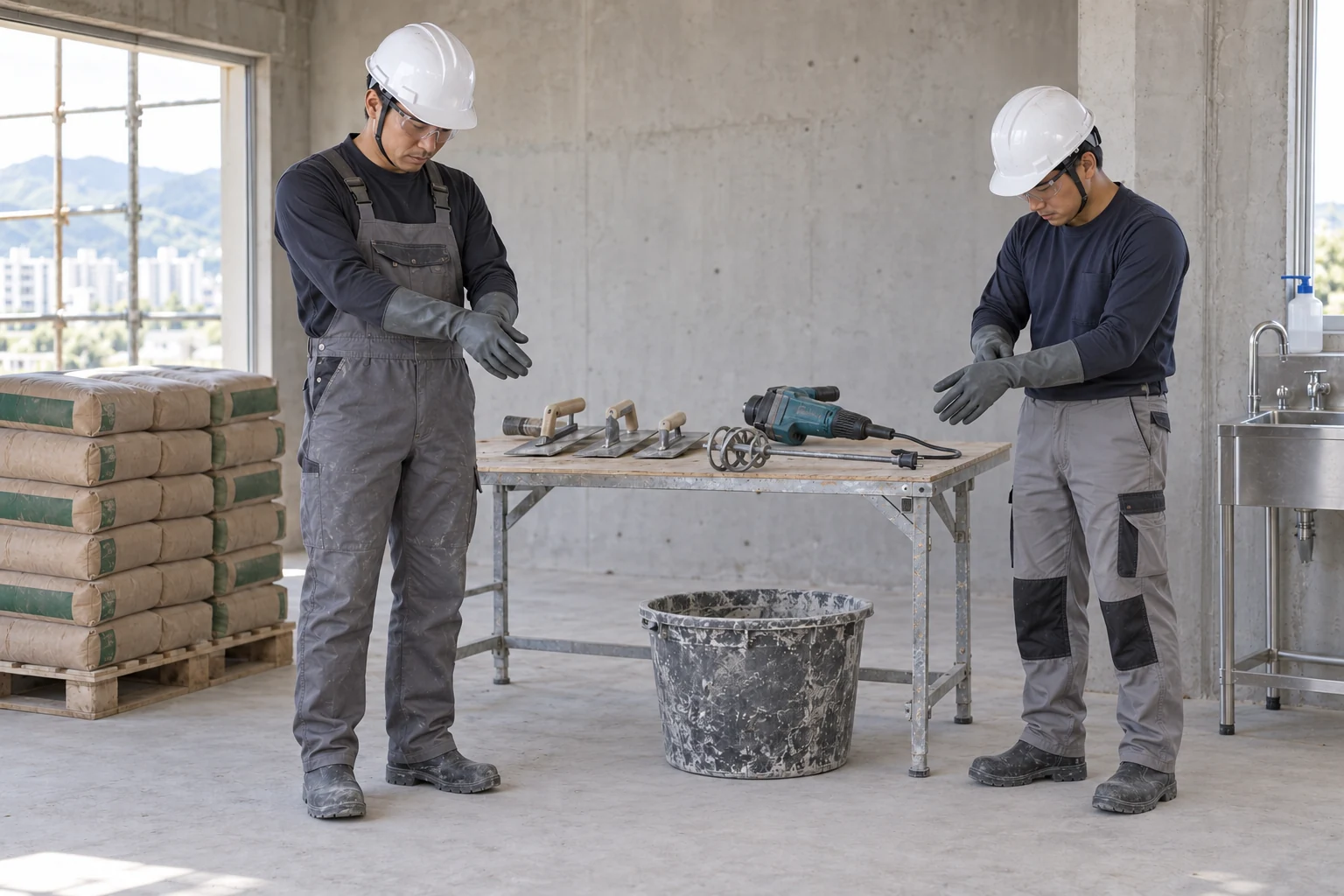 Retained source illustration: an AI-generated educational concept, not a real incident photograph or evidence of equipment suitability.
The following scenario, comparisons and example records are hypothetical teaching material. They do not reproduce actual incidents, measurements, signatures or approvals.
| Item | Hypothetical situation |
|---|---|
| Initial state | A plasterer is finishing a new indoor wall. |
| Change | Wet mortar enters a boot without causing immediate pain. |
| Failure path | Continuing to finish the wall prolongs alkaline contact beneath the protective footwear. |
| Possible harm | Chemical injury can develop while the worker assumes the intact boot and lack of pain indicate safety. |
| Barrier | Stop exposure promptly, follow the SDS washing and medical-response arrangements, and review the worker condition, clean PPE and method before return. |
Wet mortar trapped inside gloves or boots maintains skin contact. Lack of pain does not prove absence of injury. Stop and remove contamination safely, use the product/site washing procedure promptly and obtain appropriate medical assessment for exposure concerns.
A switched-off paddle may coast or restart. Keep hands and trowels out of the connected mixer; confirm full stop and isolate against restart before clearing. Stabilise the container and use the required grip to control reaction forces.
Extra water can change product performance and does not automatically extend usable batch life. Record batch, time and actual environment; segregate suspect mix and affected wall areas rather than conceal defects.
Arrange the mixing zone so the dust control, wash facilities and dry electrical connections remain effective together. The supervisor must make chemical instructions understandable to the crew and refer uncertain toxic-dust exposure to a competent monitoring person. A visually clean room or wet finished mix is not an exposure measurement.
| Decision | Reason and evidence |
|---|---|
| Known facts | Wet mortar enters a boot without causing immediate pain. |
| Unresolved | Continuing to finish the wall prolongs alkaline contact beneath the protective footwear. |
| Hold reason | Do not start with uncertain mix, unstable bags or container, defective mixer or wet electrical connections. Stop for heavy dust, paddle jam or vibration, mortar inside PPE, unstable access or wall material detachment. |
| Evidence needed | Contamination details; Washing/medical response; Repair and recheck; Batch disposition. |
| Next decision | Stop exposure promptly, follow the SDS washing and medical-response arrangements, and review the worker condition, clean PPE and method before return. |
5. Conditional decisions and common errors
| Condition | Action | Evidence | Proceed when |
|---|---|---|---|
| Mortar inside PPE | End contact and follow SDS response. | Washing and appropriate skin/medical assessment. | Exposure controlled and fitness checked. |
| Paddle jam | Stop and isolate before clearing. | Isolation and defect inspection. | Safe mixer restart confirmed. |
| Usable time exceeded | Segregate affected batch. | Product and batch-time evidence. | Material disposition accepted. |
| Unstable platform | Keep off and correct access. | Support and platform inspection. | Stable access verified. |
| Comparison | Situation A | Situation B |
|---|---|---|
| No pain | Exposure still requires prompt response. | Absence of symptoms treated as proof of no injury. |
| Mixer switch off | Full stop and power separation verified. | Coasting and restart remain possible. |
| Mix still spreads | Product batch-life criteria confirmed. | Workability alone used to extend time. |
6. Roles and responsibilities
| Role | Responsibility |
|---|---|
| Work supervisor | Confirm scope, task sequence, exclusion and stop authority. Coordinate match wall and mix with affected operations. |
| Technical reviewer | Resolve the actual design and equipment limits: Wall and product ID; Substrate acceptance; Local product mix and SDS; Emergency wash. |
| Work crew | Perform open and load using the approved procedure; report any mismatch before proceeding. |
| Inspector / assessor | Verify Environment/time; Curing conditions; Cracks and adhesion; Inspection outcome. Record what was actually checked and what remains unresolved. |
| Release / receiving authority | Confirm Power/tool state; Clean PPE and tools; Waste handling; Curing limits/recipient. Transfer restrictions and the next permitted stage. |
These are responsibility examples, not invented statutory credentials. Meet the actual training, competent-person, qualified-person and licensing requirements for the assigned work. Anyone may raise a hazard and request a stop; only the designated authority may release the affected stage after evidence is reviewed.
7. Hold points and record comparison
| Hold point | Evidence before release | Confirmation / approval |
|---|---|---|
| HP-0 Start | Scope, jurisdiction, equipment identity, responsible people and emergency arrangements. | |
| HP-1 Prepare materials | Bag and route; Stack stability; Supply condition; Container restraint | |
| HP-2 Mix mortar | Paddle and grip; Container security; Splash and supply; Mix condition | |
| HP-3 Hold abnormality | Contamination details; Washing/medical response; Repair and recheck; Batch disposition | |
| HP-4 Clean and handover | Power/tool state; Clean PPE and tools; Waste handling; Curing limits/recipient |
Hold points are internal evidence gates. They do not replace statutory permits or actual signatures. Recheck affected gates after a change, abnormal event or shift transfer. The blank record must identify the evidence, person, time, limits and release scope.
| Record | Insufficient record | Record checklist |
|---|---|---|
| Product | SDS available | □ Wall and product ID□ Substrate acceptance□ Local product mix and SDS□ Emergency wash |
| Mixing | Switch off | □ Paddle and grip□ Container security□ Splash and supply□ Mix condition |
| Exposure | No pain | □ Contamination details□ Washing/medical response□ Repair and recheck□ Batch disposition |
| Handover | Wall finished | □ Power/tool state□ Clean PPE and tools□ Waste handling□ Curing limits/recipient |
The □ boxes are static prompts, not saved or interactive approvals. Each checks one record element. A tick alone does not establish suitability or permission to restart. Link equipment IDs and supporting records; retain unresolved matters and the earlier record when conditions change.
8. Site checklist and emergency response
| Check item | Result | Person / action |
|---|---|---|
| Wall and product ID | ||
| Bag and route | ||
| Opening method | ||
| Paddle and grip | ||
| Gloves/boots and skin | ||
| Environment/time | ||
| Contamination details | ||
| Power/tool state | ||
| Emergency arrangements and unresolved restrictions communicated |
Stop work: Do not start with uncertain mix, unstable bags or container, defective mixer or wet electrical connections. Stop for heavy dust, paddle jam or vibration, mortar inside PPE, unstable access or wall material detachment.
Emergency response: End cement contact and follow the actual SDS washing instructions promptly without waiting for pain. Obtain medical assessment for eye exposure or skin injury concerns. Isolate electrical or mixer hazards from a safe place and do not touch moving paddles or enter wet energised areas. Call SCDF 995 for serious injury or an urgent medical emergency and provide product and access information.
9. Sources and review limits
Official-source review date: October 14, 2026. The following review is limited to the public provisions or selected manufacturer material identified below. It does not establish that any authority approved this article or the actual installation.
- MOM risk management: Official explanation: risk assessment, control, monitoring and communication for routine and non-routine work, including maintenance; reviewed 14 October 2026.
- WSHC Preventing Chemical Hazards: Official guidance on chemical risk assessment, safe work procedures, exposure routes, hazard communication and exposure-dependent monitoring; not product certification.
- WSHC GHS chemical classification and labelling: Employer/occupier SDS access, container labelling, training and understandable hazard communication. Full SS 586 text was not obtained.
- WSHC preventing machine hazards: Official guidance: hierarchy of controls, guarding, competent operators and maintenance LOTO. It is not a model-specific isolation instruction.
- WSHC electrical safety: Official guidance: maintenance energy isolation, stored-energy control, verification and reinstatement; electrical scope still requires applicable EMA authorisation.
- MOM requirements for hygiene monitoring: Official toxic-substance and noise monitoring guidance: competent personnel, exposure-dependent requirements, records, worker information and reporting. No site exposure result is asserted.
- HSE construction hazardous substances: cement: Foreign technical reference for alkaline wet-cement contact, dust, compatible protection and prompt washing. UK COSHH duties and product thresholds are not transferred to Singapore.
- SCDF emergency medical services: Official 995 emergency ambulance service information; use emergency services for actual emergencies.
Paid consensus standards and site-specific calculations, manuals, inspection records and product certificates were not independently obtained or verified unless specifically identified. Korean and overseas legal references are source history, not Singapore statutory duties. Singapore Standards and model-specific limits were not read in full unless expressly identified.
10. PDF guidance and FAQ
PDF A covers basic task controls; B examines technical failures; C focuses on supervision, evidence and handover. Each has six rows and three items per main cell. They are complementary extracts: apply all eight body stages and the applicable site procedure. An omitted stage is not permission to omit its controls. PDF HP-0 through HP-4 are worksheet labels; match the event, evidence and authority rather than assuming they match another permit by number.
P/S/R/A, actual measurements, confirmations and signatures remain blank. The PDFs are uncompleted reference worksheets, not issued work permits.
Content group ID: jsa-cement-mortar-wall-plastering
Can work continue if mortar in a boot does not hurt?
No. End contact promptly and follow the SDS washing and medical-response arrangements.
Can a trowel clear a running paddle?
No. Confirm complete stop and isolate against restart before the approved clearing method.
May water always be added when mortar stiffens?
Only where the actual product permits that reworking method within its limits. Record batch timing and disposition.
Does wet mixing remove the need to assess dust?
No. Opening, loading and cleanup can produce exposure. Identify constituents and apply Singapore monitoring requirements where toxic substances are used or generated.
Has a professional verified or approved this document?
AI-generated reference material. It has not been professionally verified or approved. Before use, a suitably qualified person must review and adapt it to applicable Singapore requirements, the actual equipment and site, and approved safe work procedures.
11. Revision history and authorship
AI-generated reference material. It has not been professionally verified or approved. Before use, a suitably qualified person must review and adapt it to applicable Singapore requirements, the actual equipment and site, and approved safe work procedures.
This system has not physically inspected the equipment, structures, ground, atmosphere or worksite. The document does not replace legal advice, manufacturer procedures, engineering design, inspection certificates, qualification evidence, the site risk assessment or an actual work permit.
Before use, a suitably qualified and authorized person must review the actual equipment, loads, methods, protection, inspection and emergency arrangements and resolve open issues. Record the real reviewer, organization, qualifications, delegated authority, reviewed documents, date, signature, exclusions and conditions of approval separately.
| Date | Version | Change | Review status |
|---|---|---|---|
| 2026-10-08 | 1.0 | Korean source revision retained in the source snapshot. | Historical editorial status; not Singapore professional approval. |
| 2026-10-14 | SG 1.0 | Singapore localisation of the Korean source with its assigned US technical reference; local applicability, task controls and sources reviewed. | AI-assisted editorial work; professional approval not performed. |