Planned earth pushing and surface grading with an identified crawler bulldozer on an accepted work area with defined travel, edge and pedestrian boundaries.
Stop for new cracks, track settlement, exposed services, abnormal resistance, defective braking or steering, lost rear visibility or signals, or entry of people into the machine envelope.
Reference content written and revised with AI. It has not been verified or approved by a professional. Review by a suitably qualified professional and site approval are required before use.
AI-generated reference material; not professionally verified or approved. Before use, a qualified person must review and adapt it to applicable Singapore requirements, the actual equipment/site and approved safe work procedures.
1. Legal and technical scope
Apply Singapore risk-management duties to ground support, plant movement and maintenance during grading. WSH Council machinery guidance informs guarding, operator competence and isolation. The BCA ERSS advisory is relevant only where grading affects an earth-retaining system; it does not turn all open-ground grading into an ERSS project.
| Basis | Singapore application |
|---|---|
| Risk management | The employer, self-employed person and principal assess and control work risks. Include preparation, abnormal conditions and maintenance. Coordinate affected trades and communicate controls. |
| Activity-specific guidance | Use machinery guidance for pre-use functions, warnings, guarded maintenance and energy control; apply BCA stage/ground evidence only where the dozer affects an ERSS or its surcharge zone. |
| Permits and authority | Select permit requirements for the actual sector and activity. Site hold points and contractor role labels do not create statutory permits or qualifications. |
| Equipment and design | No generic setback, slope limit or bearing pressure is prescribed. Use the actual crawler configuration, ground assessment and any project ERSS constraints. The BCA reference is a conditional interface source, not approval of a slope or working platform. |
2. Scope and required inputs
Included: Planned earth pushing and surface grading with an identified crawler bulldozer on an accepted work area with defined travel, edge and pedestrian boundaries.
Separate review: Steep-slope pioneering, demolition, disabled-machine towing or recovery and removal of embedded utilities require separate plans.
| Input | Required evidence |
|---|---|
| Review ground and plan | Ground support evidence; Fill void and service locations; Drainage and recent weather; Machine and grading plan |
| Inspect machine | Tracks and control checks; Blade hoses and fasteners; ROPS belt and access condition; Horn and reversing protection |
| Push and grade | Push location depth and load; Ground and slope response; Marked services and obstructions; Exclusion and visibility |
| Park and hand over | Machine parking state; Cracks steps and services; Remaining exclusions; Receiving crew and limits |
Review fill history, voids, drainage, ground support and utilities against the actual machine and blade work. Set site-specific edge limits, push depth and direction, load and slope restrictions, trial work and change triggers. Track ground pressure alone is not proof of edge stability. Recovery loads and towing connections are outside routine grading.
Singapore site planning
The principal, earthworks contractor and plant employer must agree the actual grading sequence and pedestrian separation. Reconcile buried services, drainage, fill history and any adjacent ERSS with the site plan. On an ERSS project, obtain the relevant QP assessment before changing surcharge, edge access or excavation stage. After rain, ponding, new cracking or deeper track marks, hold the affected route until support is reassessed. Keep towing and recovery out of routine grading and assign a separate engineered method when needed.
3. Eight-stage JSA
| Job stage | Hazards and effects | Failure factors | Technical and procedural controls | Site verification | P | S | R | A |
|---|---|---|---|---|---|---|---|---|
| 1. Review ground and plan | 1. Ground settlement2. Buried-service damage3. Backfill-edge collapse4. Void collapse | 1. Ground history missing2. Drawings differ from site3. Yesterday conditions reused4. Drainage change ignored | 1. Review fill voids and services2. Confirm actual equipment route3. Reassess after rain or change4. Set planned push sequence | 1. Ground support evidence2. Fill void and service locations3. Drainage and recent weather4. Site RA and grading plan | ||||
| 2. Control edges and people | 1. Reversing collision2. Fall beyond edge3. Soil strikes workers below4. Spotter crushed | 1. Walking route overlaps2. Edge limits undefined3. Work continues below4. Spotter position unsafe | 1. Separate pedestrian routes2. Mark reviewed approach limits3. Exclude lower affected area4. Agree safe spotter positions | 1. Reviewed edge boundary2. Rear path and sight lines3. Lower-area exclusion4. Signals and waiting positions | ||||
| 3. Inspect machine | 1. Brake or steering failure2. Hydraulic fire3. Track derailment4. Uncontrolled blade descent | 1. Controls defective2. Hose damage ignored3. Track wear unreviewed4. Protection damaged | 1. Check tracks brakes and steering2. Inspect blade and hydraulic parts3. Verify warning devices4. Use intended ROPS and restraint | 1. Tracks and control checks2. Blade hoses and fasteners3. ROPS belt and access condition4. Horn and reversing protection | ||||
| 4. Enter and trial | 1. Local support loss2. Unexpected tilt3. Drainage-ditch fall4. Unstable travel | 1. Route capacity unaccepted2. Machine width overlooked3. Ditch edge hidden4. Old route assumed safe | 1. Use accepted entry route2. Observe trial ground response3. Check drains and boundaries4. Stop for cracking or settlement | 1. Route and machine fit2. Trial track impressions3. Drainage and edge location4. Tilt and support changes | ||||
| 5. Push and grade | 1. Edge collapse2. Blade reaction overturn3. Thrown material strike4. Exposed-service damage | 1. Excessive push load2. Cut depth exceeds plan3. Exclusion breached4. Service marks displaced | 1. Follow accepted depth and direction2. Monitor soil and machine response3. Keep people outside work envelope4. Hold newly exposed services | 1. Push location depth and load2. Ground and slope response3. Marked services and obstructions4. Exclusion and visibility | ||||
| 6. Reverse turn and traverse | 1. Rollover2. Person struck behind3. Track slip4. Blind-spot collision | 1. Abrupt maneuver2. Cross-slope change ignored3. Rear route not checked4. Signal lost | 1. Follow actual travel limitations2. Check path before movement3. Use agreed reversing controls4. Stop when sight or signal is lost | 1. Grade and direction2. Rear route and people3. Warning and signal status4. Steps and track support | ||||
| 7. Stop and address faults | 1. Blade-drop crush2. Recovery-line recoil3. Further settlement4. Towing-point failure | 1. Hydraulics alone hold blade2. Recovery improvised3. Recovery load unknown4. Temporary connector used | 1. Lower or secure attachments2. Isolate and mechanically support3. Separate recovery from grading4. Exclude recoil and unstable areas | 1. Blade and movement control2. Isolation and support evidence3. Separate recovery plan4. Repair and restart authority | ||||
| 8. Park and hand over | 1. Unattended movement2. Unsafe next-trade access3. Parking-ground settlement4. Exposed-service strike | 1. Blade left raised2. Cracks not transferred3. Soft parking location4. Restrictions left verbal | 1. Park on accepted support2. Lower attachments as specified3. Identify open ground and services4. Transfer access restrictions | 1. Machine parking state2. Cracks steps and services3. Remaining exclusions4. Receiving crew restrictions |
P = likelihood; S = severity; R = risk using the site method; A = site acceptance/authorisation. Complete after actual assessment; no score overrides an unresolved hold point or equipment limit.
4. Hypothetical scenario and failure mechanisms
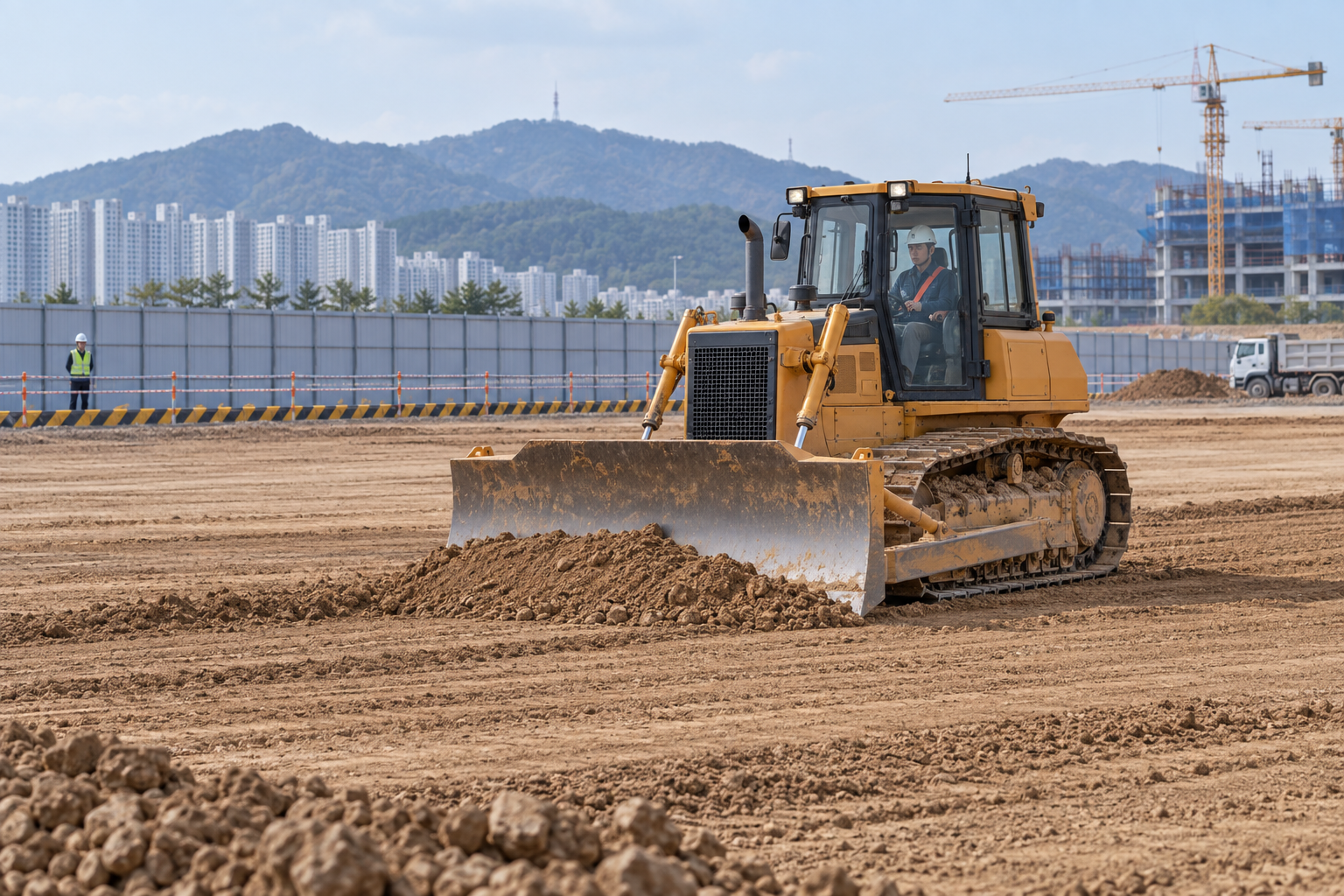 Retained source illustration: an AI-generated educational concept, not a real incident photograph or evidence of equipment suitability.
The following scenario, comparisons and example records are hypothetical teaching material. They do not reproduce actual incidents, measurements, signatures or approvals.
| Item | Hypothetical situation |
|---|---|
| Initial state | A crawler dozer pushes soil beside a backfilled edge. |
| Change | After rain, water ponds and one track leaves a progressively deeper impression. |
| Failure path | The operator relies on the level appearance and the previous day of successful work. |
| Possible harm | Local support loss combined with blade reaction can cause settlement or overturning. |
| Barrier | Stop affected travel, control access and reassess drainage, ground support, edge limits and pushing direction before a reviewed trial. |
Surface shape and bearing support are different facts. Rain, drainage changes and deeper track marks trigger review of the ground assessment, even when the planned final grade has not changed.
Blade reaction, steps and cross-slope travel change stability. The potential ground failure surface may extend beyond the visible edge. Use the actual ground and machine assessment rather than a universal setback or slope angle.
ROPS and the appropriate restraint reduce particular operator hazards but do not prevent ground failure. Preserve the intended protective configuration, inspect it and use the restraint as required by the actual machine and applicable rules.
A disabled-machine recovery is a new loading case. Towing points, rigging, recovery equipment, ground support and recoil exposure need a separate accepted plan. Adding pulling force without that review can worsen settlement or cause a connection failure.
| Decision | Reason and evidence |
|---|---|
| Known facts | After rain, water ponds and one track leaves a progressively deeper impression. |
| Unresolved | The operator relies on the level appearance and the previous day of successful work. |
| Hold reason | Stop for new cracks, track settlement, exposed services, abnormal resistance, defective braking or steering, lost rear visibility or signals, or entry of people into the machine envelope. |
| Evidence needed | Route and machine fit; Trial track impressions; Drainage and edge location; Tilt and support changes. |
| Next decision | Stop affected travel, control access and reassess drainage, ground support, edge limits and pushing direction before a reviewed trial. |
5. Conditional decisions and common errors
| Condition | Action | Evidence | Proceed when |
|---|---|---|---|
| Track settlement | Stop affected entry and pushing. | Ground and drainage assessment. | Support accepted. |
| Service exposed | Exclude affected area. | Service owner and location review. | Protection accepted. |
| Blade maintenance | Control gravity and stored energy. | Isolation and mechanical support. | Access safe. |
| Machine disabled | Hold improvised towing. | Separate recovery plan. | Recovery authorised. |
| Comparison | Situation A | Situation B |
|---|---|---|
| Level work surface | Fill, voids and drainage have been reviewed. | Appearance is the only support evidence. |
| Machine stuck | A separate recovery plan controls load and recoil. | Another machine pulls immediately. |
6. Roles and responsibilities
| Role | Responsibility |
|---|---|
| Work supervisor | Confirm scope, task sequence, exclusion and stop authority. Coordinate review ground and plan with affected operations. |
| Technical reviewer | Resolve the actual design and equipment limits: Ground support evidence; Fill void and service locations; Drainage and recent weather; Machine and grading plan. |
| Work crew | Perform inspect machine using the approved procedure; report any mismatch before proceeding. |
| Inspector / assessor | Verify Grade and direction; Rear route and people; Warning and signal status; Steps and track support. Record what was actually checked and what remains unresolved. |
| Release / receiving authority | Confirm Machine parking state; Cracks steps and services; Remaining exclusions; Receiving crew and limits. Transfer restrictions and the next permitted stage. |
These are responsibility examples, not invented statutory credentials. Meet the actual training, competent-person, qualified-person and licensing requirements for the assigned work. Anyone may raise a hazard and request a stop; only the designated authority may release the affected stage after evidence is reviewed.
The principal and employers coordinate the risk assessment and safe work procedures. These role labels allocate work; verify any qualifications and statutory appointments required for the actual Singapore activity. The receiving person must be given restrictions and unresolved defects before handover.
Record and handover perspective
| Stage | Record controls | Verification |
|---|---|---|
| Review ground and plan | 1. Record ground support evidence2. Record fill void and service locations3. Record drainage and recent weather | 1. Fill void and service locations2. Drainage and recent weather3. Site RA and grading plan |
| Inspect machine | 1. Record tracks and control checks2. Record blade hoses and fasteners3. Record rops belt and access condition | 1. Blade hoses and fasteners2. ROPS belt and access condition3. Horn and reversing protection |
| Enter and trial | 1. Record route and machine fit2. Record trial track impressions3. Record drainage and edge location | 1. Trial track impressions2. Drainage and edge location3. Tilt and support changes |
| Push and grade | 1. Record push location depth and load2. Record ground and slope response3. Record marked services and obstructions | 1. Ground and slope response2. Marked services and obstructions3. Exclusion and visibility |
| Stop and address faults | 1. Record blade and movement control2. Record isolation and support evidence3. Record separate recovery plan | 1. Isolation and support evidence2. Separate recovery plan3. Repair and restart authority |
| Park and hand over | 1. Record machine parking state2. Record cracks steps and services3. Record remaining exclusions | 1. Cracks steps and services2. Remaining exclusions3. Receiving crew restrictions |
7. Hold points and record comparison
| Hold point | Evidence before release | Actual record |
|---|---|---|
| HP-0 Start | Task boundary, site RA, SWP, responsibilities and emergency arrangements | |
| HP-1 Control edges and people | Reviewed edge boundary; Rear path and sight lines; Lower-area exclusion; Signals and waiting positions | |
| HP-2 Inspect machine | Tracks and control checks; Blade hoses and fasteners; ROPS belt and access condition; Horn and reversing protection | |
| HP-3 Reverse turn and traverse | Grade and direction; Rear route and people; Warning and signal status; Steps and track support | |
| HP-4 Park and hand over | Machine parking state; Cracks steps and services; Remaining exclusions; Receiving crew restrictions |
Hold points are internal evidence gates. They do not replace statutory permits or actual signatures. Recheck affected gates after a change, abnormal event or shift transfer. The blank record must identify the evidence, person, time, limits and release scope.
| Record | Insufficient record | Record checklist |
|---|---|---|
| Ground | Looks level | □ Ground support evidence□ Fill void and service locations□ Drainage and recent weather□ Machine and grading plan |
| Boundary | Enough clearance | □ Edge and approach boundary□ Rear path and sight lines□ Lower-area exclusion□ Signals and waiting positions |
| Trial | Worked yesterday | □ Route and machine fit□ Trial track impressions□ Drainage and edge location□ Tilt and support changes |
| Handover | Finished grading | □ Machine parking state□ Cracks steps and services□ Remaining exclusions□ Receiving crew and limits |
The □ boxes are static prompts, not saved or interactive approvals. Each checks one record element. A tick alone does not establish suitability or permission to restart. Link equipment IDs and supporting records; retain unresolved matters and the earlier record when conditions change.
Hold points are internal checks. Determine separately whether Singapore statutory or site permit requirements apply to this work. Leave confirmation, measurements and approval records blank until the authorised site process is completed.
8. Site checklist and emergency response
| Check item | Result | Person / action |
|---|---|---|
| Ground support evidence | ||
| Edge and approach boundary | ||
| Tracks and control checks | ||
| Route and machine fit | ||
| Push location depth and load | ||
| Grade and direction | ||
| Blade and movement control | ||
| Machine parking state | ||
| Emergency arrangements and unresolved restrictions communicated |
Stop work: Stop for new cracks, track settlement, exposed services, abnormal resistance, defective braking or steering, lost rear visibility or signals, or entry of people into the machine envelope.
Emergency response: Withdraw personnel and other equipment from cracking or settling ground and control access. Call the site emergency service for serious injury and use the planned response. Do not worsen the situation with improvised towing or an approach beneath an unsupported blade.
9. Sources and review limits
Official public sources read for this Singapore edition on 2026-10-14. Guidance, statutory explanations and manufacturer limits have different roles; no source provider has approved this JSA.
| Source | Read scope and application limits |
|---|---|
| MOM — Risk management | Official explanation: employer, self-employed person and principal responsibilities; routine and non-routine risk assessment; hierarchy of controls; multidisciplinary assessment team. Official explanation of risk-management duties; no claim of reading the full linked statute. It does not specify task-specific equipment limits. Assess crawler bulldozer grading with employers, principal and affected contractors; resolve the inputs in section 2. |
| MOM — When should my company review its risk assessment? | Review every three years, after significant changes, new machinery/substances/procedures, hazard-related injury or incident, and when assessment is inadequate. General review guidance. A review interval does not permit continued operation after a known hazard or change. Reassess this operation after changes, defects, incidents or an inadequate assessment; do not wait for a scheduled review. |
| MOM — Permit-to-Work Systems | Formal work authorisation and coordination; OPEC tripartite guidance and competent permit authority with authority to reject work. OPEC-focused guidance page; not evidence of a blanket statutory permit requirement for every task. Determine permits for this actual activity and workplace; distinguish the section 7 internal hold points from statutory or site permits. |
| WSH Council — Guidelines on Safe Use of Machinery | Sections 1.1 and 1.3: scope and explanation of safeguarding/LOTO duties. Sections 4.3–4.4.3: training, maintenance, specified replacement parts and isolation of all energy sources; commissioning safety-device checks. Official practical guidance and explanation; complete current subsidiary legislation and every annex were not read. Actual manufacturer isolation and restoration instructions remain necessary. Use machinery guidance for pre-use functions, warnings, guarded maintenance and energy control; apply BCA stage/ground evidence only where the dozer affects an ERSS or its surcharge zone. |
| BCA — Advisory Note 1/09 on Earth Retaining or Stabilising Structures | Note introduction and site-investigation section; staged-construction approval and monitoring record forms on PDF pages 15 and 21–22. Currently linked by the BCA structural-plan guidance page. 2009 advisory, read in the stated sections only. Check later circulars and project conditions with the appointed QP; no anchor design load, creep criterion or generic excavation depth is prescribed here. Use machinery guidance for pre-use functions, warnings, guarded maintenance and energy control; apply BCA stage/ground evidence only where the dozer affects an ERSS or its surcharge zone. |
No generic setback, slope limit or bearing pressure is prescribed. Use the actual crawler configuration, ground assessment and any project ERSS constraints. The BCA reference is a conditional interface source, not approval of a slope or working platform.
Actual site measurements, equipment instructions, engineering checks and signed approval records were not supplied. A qualified person must resolve these before use.
10. PDF guidance and FAQ
PDF A covers basic task controls; B examines technical failures; C focuses on supervision, evidence and handover. Each has six rows and three items per main cell. They are complementary extracts: apply all eight body stages and the applicable site procedure. An omitted stage is not permission to omit its controls. PDF HP-0 through HP-4 are worksheet labels; match the event, evidence and authority rather than assuming they match another permit by number.
P/S/R/A, actual measurements, confirmations and signatures remain blank. The PDFs are uncompleted reference worksheets, not issued work permits.
Content group ID: jsa-bulldozer-grading
Does a flat surface prove adequate support?
No. Check fill, voids, drainage, edges and actual equipment loading.
Is one edge setback suitable everywhere?
No. Ground, slope geometry, machine and blade work determine the reviewed limit.
Can another machine immediately pull a stuck dozer?
Recovery requires a separate plan for points, rigging, loads, support and recoil exposure.
Do ROPS and a seat belt prevent slope failure?
No. They do not replace ground stability and operating-limit controls.
Has a professional verified or approved this document?
No. This is AI-assisted reference material. Editorial and layout checks are not a physical inspection or professional technical approval. Obtain qualified professional review and required site approval before use.
11. Revision history and authorship
AI-generated reference material; not professionally verified or approved. Before use, a qualified person must review and adapt it to applicable Singapore requirements, the actual equipment/site and approved safe work procedures.
This Singapore edition was adapted from the Korean original and its assigned US technical reference. Earlier source revisions are archival editorial history, not Singapore technical approval.
| Date | Edition | Change | Review status |
|---|---|---|---|
| 2026-09-19 | Korean source v1.0 | Source editorial publication or revision; retained as provenance of the Korean edition. | Editorial record only; no professional technical approval recorded. |
| 2026-10-02 | Korean source v1.1 | Source editorial publication or revision; retained as provenance of the Korean edition. | Editorial record only; no professional technical approval recorded. |
| 2026-10-14 | 1.0 en-SG | Singapore legal scope, local planning, responsibility interfaces and SI terminology; new PDF A/B/C. | AI editorial and visual review only; no professional approval. |