A new wheel can have handling or storage damage. Inspect it and use the required sounding/inspection method appropriate to its type. An ambiguous result is a reason to reject or obtain qualified disposition, not to install and hope. A ring test does not replace identity, speed and dimensional checks.
AI-generated reference material; not professionally verified or approved. Before use, a qualified person must review and adapt it to Singapore requirements, the actual equipment/site and approved safe work procedures.
Stop before starting
Hold mounting for unknown wheel identity, speed, inspection method or mounting compatibility. Stop and isolate for cracks, damaged parts, missing guards, contact, vibration or abnormal noise during testing or dressing.
1. Legal and technical scope
| Basis | Scope and limits |
|---|---|
| MOM: Risk management | Evaluate wheel compatibility, fragment paths and non-routine defect recovery. Official explanation of statutory duties; linked SSO text was not independently read for this item. This is not a legal opinion. |
| WSH Council: Preventing Machine Hazards | Verify guards, competent operation and stop authority for abnormal vibration. Official practical guidance, not the actual machine isolation procedure or proof of equipment compliance. |
| WSH Council: Safe Use of Machinery | Apply isolation before mounting and gap adjustment, followed by controlled restoration and testing. Official guidance; cited paid Singapore Standards were not obtained. No universal wheel test duration or gap is inferred. |
| SCDF: Emergency Medical Services | Call 995 for a medical emergency while maintaining isolation and the fragment exclusion zone. Official emergency-response information, not a site-specific rescue plan or authorisation for untrained rescue. |
Apply Singapore WSH risk assessment to wheel replacement, testing, dressing and subsequent use. WSH Council machinery guidance addresses competent work, guarding, stability, all-energy isolation and verified restoration. Establish the actual grinder/wheel inspection method, permitted speed, mounting parts, guard gaps and protected test procedure before authorising the task. The source edition’s foreign statutory test times and inch-based clearances are not assigned as Singapore legal limits; unresolved local requirements or product instructions require competent review before use.
2. Scope and required inputs
Included work
Authorised replacement and dressing of an approved conventional straight abrasive wheel on a fixed double-ended bench grinder. Identify wheel type, spindle speed, mounting parts, guards and the specified dresser before work.
Separate assessment
Portable grinders, cut-off/diamond wheels, spindle or bearing repair, improvised balancing or flanges, side grinding and production-grinding systems are outside this reference.
| Required input | Evidence to obtain |
|---|---|
| Select wheel | Wheel type and lot; Machine and wheel RPM; Bore and spindle; Use and authority |
| Stop and isolate | Isolation points; Both wheels stopped; Temperature and PPE; Support and tools |
| Inspect parts | Damage and storage; Inspection result; Spindle and flange; Blotter requirements |
| Mount and guard | Flange and blotter; Fit and direction; Guard clearance; Rest/guard gaps in mm |
No actual equipment model, site measurements, design calculations or signed approval was supplied. Check the applicable Singapore requirements and approved safe work procedures against the actual equipment and site before use. Statutory duties, official guidance and manufacturer limits serve different purposes; editorial checks do not establish legal or professional approval.
Singapore site application
At a shared Singapore workshop bench, prevent the second wheel and adjacent operators from being exposed during the replacement test. Mark the machine as unavailable until the assigned recipient accepts both-wheel guarding, the test and the permitted use.
Record wheel dimensions and guard/rest gaps in mm, rotational speed in r/min, and actual test start/end times with the required duration and its source. Protect stored wheels against impact and unsuitable moisture conditions; do not infer condition from an unopened package.
3. Eight-stage JSA
| Job stage | Hazards and effects | Failure factors | Technical and procedural controls | Site verification | P | S | R | A |
|---|---|---|---|---|---|---|---|---|
| 1. Select wheel | 1. Wheel burst2. Overspeed failure3. Mounting damage4. Wrong-face use | 1. Type mismatch2. Speed unchecked3. Wrong bore4. Use label unread | 1. Match wheel and machine2. Compare speed ratings3. Check mounting parts4. Confirm permitted face | 1. Wheel type and lot2. Machine and wheel RPM3. Bore and spindle4. Use and authority | ||||
| 2. Stop and isolate | 1. Unexpected start2. Coasting contact3. Hot parts4. Dropped wheel | 1. Power not secured2. Guard removed early3. Cooling unchecked4. No support | 1. Wait for both wheels2. Isolate and verify3. Check handling temperature4. Support removed parts | 1. Isolation points2. Both wheels stopped3. Temperature and PPE4. Support and tools | ||||
| 3. Inspect parts | 1. Cracked wheel burst2. False inspection pass3. Eccentric mounting4. Uneven stress | 1. Transport damage2. Wrong test method3. Worn flange4. Dirty contact face | 1. Inspect and sound as required2. Use wheel-type method3. Check spindle and flanges4. Clean or reject parts | 1. Damage and storage2. Inspection result3. Spindle and flange4. Blotter requirements | ||||
| 4. Mount and guard | 1. Clamping crack2. Forced-fit break3. Guard contact4. Workpiece jam | 1. Overtightening2. Hole enlarged3. Guard omitted4. Large rest gap | 1. Follow mounting method2. Never force wheel3. Restore guards4. Set gaps while stopped | 1. Flange and blotter2. Fit and direction3. Guard clearance4. Rest/guard gaps in mm | ||||
| 5. Run test | 1. Flying fragments2. Continued vibration3. Bystander impact4. Adjustment contact | 1. Standing in wheel plane2. Test omitted3. Zone uncontrolled4. Live rest adjustment | 1. Use protected test position2. Run per actual instructions3. Watch sound and vibration4. Stop defects and isolate | 1. Test time and required duration2. Observer position3. Vibration and noise4. Hold/release record | ||||
| 6. Dress surface | 1. Dresser ejection2. Wheel overload3. Dust and fragments4. Entanglement | 1. Wrong dresser2. Excessive pressure3. No dust control4. Loose clothing | 1. Use specified dresser2. Follow dressing limits3. Control dust and eyes4. Keep clear of rotation | 1. Dresser support2. Surface and method3. Extraction and PPE4. Hands and clothing | ||||
| 7. Resolve defects | 1. Repeat wheel burst2. Damaged wheel reused3. Unsafe adjustment4. Unverified restart | 1. Cause concealed2. Rejected part remounted3. Running retightening4. Retest skipped | 1. Stop and isolate2. Quarantine bad parts3. Correct mount and guard4. Retest before release | 1. Symptoms and stop2. Affected components3. Correction evidence4. Retest decision | ||||
| 8. Check and handover | 1. Rest gap growth2. Wrong later use3. Dust exposure4. Held tool reused | 1. Dressing gap ignored2. Limits not shared3. Live cleanup4. Status not marked | 1. Recheck stopped gaps2. Handover wheel limits3. Clean by safe method4. Record use restrictions | 1. Final surface and gaps in mm2. Wheel and use label3. Guards and cleanup4. Test and recipient |
P = likelihood; S = severity; R = risk under the site method; A = site-defined acceptance/authorization. These actual assessment cells are blank. A low score never overrides a missing safeguard or a legal or manufacturer restriction.
4. Fictional scenario and failure mechanisms
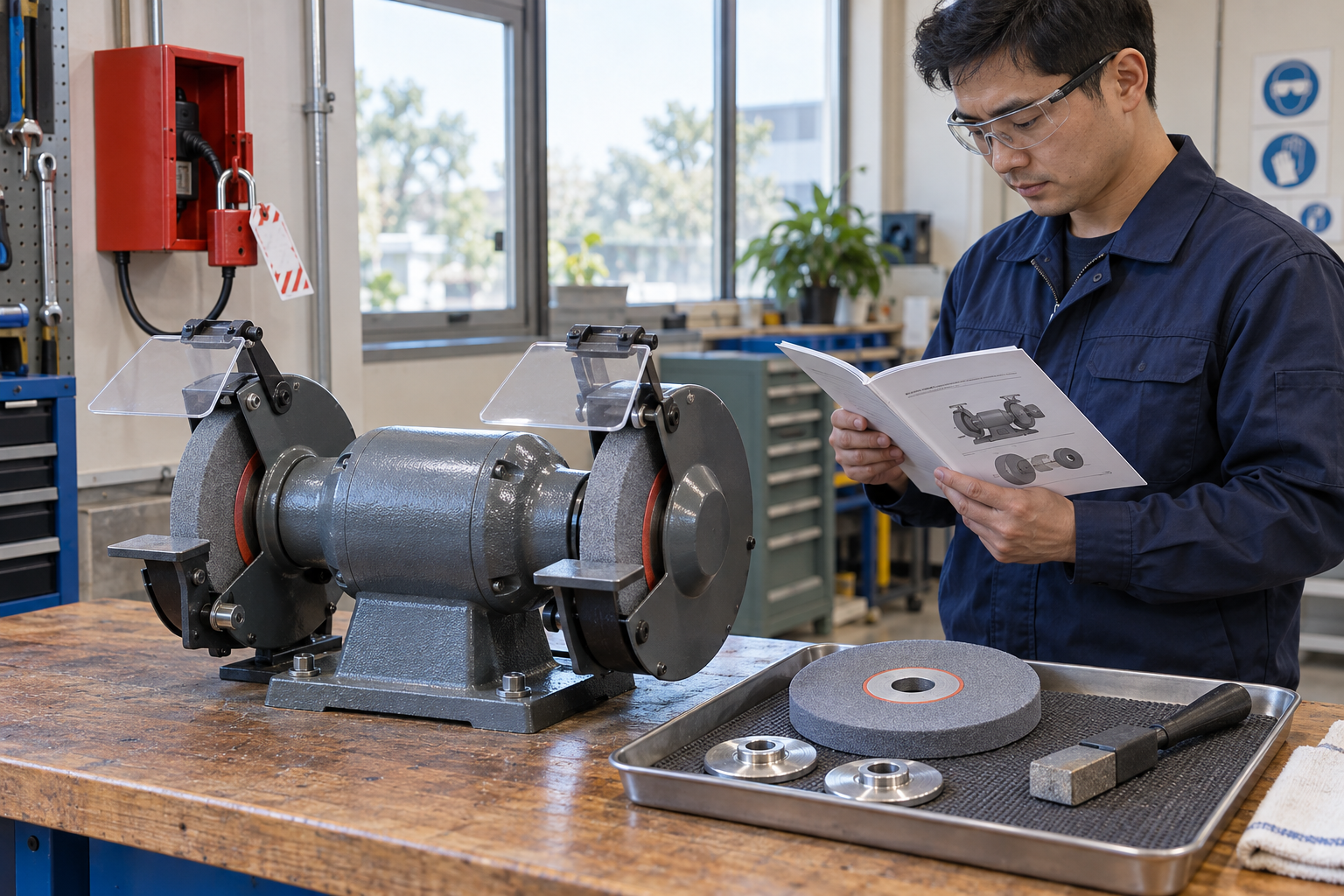
This illustration provides educational context. It is not an actual incident photograph or evidence of equipment suitability; any AI-generated depiction is illustrative only.
The scenario and record comparisons are fictional teaching examples, not records of real incidents, measurements, inspections, signatures or approvals.
| Stage | Fictional situation |
|---|---|
| Initial situation | A fictional replacement wheel shows slight wobble during startup. |
| Changed condition | The worker proposes dressing it smooth although the run-test record is missing. |
| Failure path | A contaminated flange or damaged wheel may remain overloaded even if its face looks better. |
| Possible outcome | Possible wheel fragments and contact injury; no actual failure is asserted. |
| Prevention barrier | Stop and isolate, inspect wheel and mounting parts, correct defects and complete the proper test before dressing and final gap checks. |
Failure mechanisms
A new wheel can have handling or storage damage. Inspect it and use the required sounding/inspection method appropriate to its type. An ambiguous result is a reason to reject or obtain qualified disposition, not to install and hope. A ring test does not replace identity, speed and dimensional checks.
Dirty, damaged or mismatched flanges can apply uneven stress. Do not force the wheel onto the spindle, enlarge its hole or overtighten it. Use the specified mounting components and blotters where required; mounting direction and torque come from the actual instructions.
Dressing corrects the permitted working surface; it does not repair a cracked wheel or defective spindle. Conduct the prescribed protected run test and stop for vibration or noise. Dressing reduces diameter, so recheck stopped-machine rest and guard gaps before handover.
Decision sequence
| Step | Decision |
|---|---|
| Known | The replacement wheel visibly wobbles and the trial record is missing. |
| Unknown | Wheel damage, spindle condition and contamination under the flange are unresolved. |
| Hold | Dressing cannot substitute for finding and correcting the mounting or wheel defect. |
| Evidence | Isolate, inspect the wheel and contact faces, document accepted parts, mounting and protected retest. |
| Release | After dressing, stop and isolate to confirm the final gaps and permitted use before handover. |
Work sequence: Select wheel → Stop and isolate → Inspect parts → Mount and guard → Run test → Dress surface → Resolve defects → Check and handover. This is a teaching flow, not a device drawing or a complete operating procedure.
5. Conditional decisions and common errors
| Situation | Required action | Evidence | Proceed when |
|---|---|---|---|
| Wheel rating unknown | Do not mount | Wheel label and machine speed | Speed and fit matched |
| Ambiguous inspection | Quarantine wheel | Required inspection disposition | Wheel accepted |
| Wobble or noise | Stop; isolate and investigate | Spindle, wheel and flange review | Defect resolved and retested |
| Dressing finished | Stop and recheck gaps | Rest, tongue guard and surface | Guards reset and accepted |
Similar observations, different decisions
The scenario and record comparisons are fictional teaching examples, not records of real incidents, measurements, inspections, signatures or approvals.
| Observation | Insufficient conclusion | Required distinction |
|---|---|---|
| Clear ring | One inspection response | Identity and mounting still matter |
| Smooth dressed face | Surface corrected | Does not prove internal integrity |
| Tight nut | High tightening force | Use specified mounting method |
6. Roles and responsibilities
| Role | Responsibility |
|---|---|
| Work supervisor | Confirm wheel type and lot and the task scope, resources, interfaces and stop authority. |
| Qualified technical reviewer | Review isolation points, model limits, compatibility and unresolved technical conditions within assigned competence. |
| Work crew | Apply the listed controls, report changes and stop when evidence or safeguards are missing. |
| Inspector / assessor | Record actual test time and required duration and other relevant checks; do not mark unverified conditions as accepted. |
| Handover authority | Reconcile final surface and gaps in mm, restrictions and outstanding actions before the next task. Role labels do not establish a legal credential. |
Supervision and handover focus
| Stage | Management action | Evidence |
|---|---|---|
| Select wheel | 1. Record wheel type and lot2. Record machine and wheel rpm3. Record bore and spindle | 1. Wheel type and lot2. Machine and wheel RPM3. Bore and spindle |
| Stop and isolate | 1. Record isolation points2. Record both wheels stopped3. Record temperature and ppe | 1. Isolation points2. Both wheels stopped3. Temperature and PPE |
| Mount and guard | 1. Record flange and blotter2. Record fit and direction3. Record guard clearance | 1. Flange and blotter2. Fit and direction3. Guard clearance |
| Run test | 1. Record test time and required duration2. Record observer position3. Record vibration and noise | 1. Test time and required duration2. Observer position3. Vibration and noise |
| Dress surface | 1. Record dresser support2. Record surface and method3. Record extraction and ppe | 1. Dresser support2. Surface and method3. Extraction and PPE |
| Check and handover | 1. Record final surface and gaps in mm2. Record wheel and use label3. Record guards and cleanup | 1. Final surface and gaps in mm2. Wheel and use label3. Guards and cleanup |
7. Hold points and record comparison
| Hold point | Evidence before release | Actual approval |
|---|---|---|
| HP-0 Scope | Authorised replacement and dressing of an approved conventional straight abrasive wheel on a fixed double-ended bench grinder. Identify wheel type, spindle speed, mounting parts, guards and the specified dresser before work. | |
| HP-1 Stop and isolate | Isolation points; Both wheels stopped; Temperature and PPE; Support and tools | |
| HP-2 Mount and guard | Flange and blotter; Fit and direction; Guard clearance; Rest/guard gaps in mm | |
| HP-3 Resolve defects | Symptoms and stop; Affected components; Correction evidence; Retest decision | |
| HP-4 Check and handover | Final surface and gaps in mm; Wheel and use label; Guards and cleanup; Test and recipient |
Hold points are internal project checks. They are not universal statutory permits and do not grant work permission. Reassess after defects, changed conditions and shift changes.
Record comparison
The scenario and record comparisons are fictional teaching examples, not records of real incidents, measurements, inspections, signatures or approvals.
The boxes are static record prompts, not interactive or saved approvals. A tick does not establish suitability or permission to restart. Record the evidence, person, time and unresolved issues; retain the change history.
| Record | Insufficient record | Record checklist |
|---|---|---|
| Select wheel | Only marked “OK” | □ Wheel type and lot□ Machine and wheel RPM□ Bore and spindle□ Use and authority |
| Mount and guard | Only marked “OK” | □ Flange and blotter□ Fit and direction□ Guard clearance□ Rest/guard gaps in mm |
| Resolve defects | Only marked “OK” | □ Symptoms and stop□ Affected components□ Correction evidence□ Retest decision |
| Check and handover | Only marked “OK” | □ Final surface and gaps in mm□ Wheel and use label□ Guards and cleanup□ Test and recipient |
8. Site checklist and emergency response
| Site check | Actual result | Person / action |
|---|---|---|
| Select wheel: Wheel type and lot; Machine and wheel RPM; Bore and spindle; Use and authority | ||
| Stop and isolate: Isolation points; Both wheels stopped; Temperature and PPE; Support and tools | ||
| Inspect parts: Damage and storage; Inspection result; Spindle and flange; Blotter requirements | ||
| Mount and guard: Flange and blotter; Fit and direction; Guard clearance; Rest/guard gaps in mm | ||
| Run test: Test time and required duration; Observer position; Vibration and noise; Hold/release record | ||
| Dress surface: Dresser support; Surface and method; Extraction and PPE; Hands and clothing | ||
| Resolve defects: Symptoms and stop; Affected components; Correction evidence; Retest decision | ||
| Check and handover: Final surface and gaps in mm; Wheel and use label; Guards and cleanup; Test and recipient |
Stop work
Hold mounting for unknown wheel identity, speed, inspection method or mounting compatibility. Stop and isolate for cracks, damaged parts, missing guards, contact, vibration or abnormal noise during testing or dressing.
Emergency response
Stop from a protected position and keep people away from possible wheel fragments. Isolate before intervention and wait for both wheels to stop. Call 995 for a medical emergency. Preserve the wheel, mounting parts and observed symptoms for competent investigation; do not restart to reproduce the fault.
9. Sources and review limits
Public-source access/review: 2026-10-14.
| Official source | Reviewed scope and limits |
|---|---|
| MOM: Risk management | Evaluate wheel compatibility, fragment paths and non-routine defect recovery. Official explanation of statutory duties; linked SSO text was not independently read for this item. This is not a legal opinion. |
| WSH Council: Preventing Machine Hazards | Verify guards, competent operation and stop authority for abnormal vibration. Official practical guidance, not the actual machine isolation procedure or proof of equipment compliance. |
| WSH Council: Safe Use of Machinery | Apply isolation before mounting and gap adjustment, followed by controlled restoration and testing. Official guidance; cited paid Singapore Standards were not obtained. No universal wheel test duration or gap is inferred. |
| SCDF: Emergency Medical Services | Call 995 for a medical emergency while maintaining isolation and the fragment exclusion zone. Official emergency-response information, not a site-specific rescue plan or authorisation for untrained rescue. |
No actual equipment model, site measurements, design calculations or signed approval was supplied. Check the applicable Singapore requirements and approved safe work procedures against the actual equipment and site before use. Statutory duties, official guidance and manufacturer limits serve different purposes; editorial checks do not establish legal or professional approval.
10. PDF guidance and FAQ
PDF A covers basic task controls; B focuses on technical failures; C covers supervision, records and handover. The article has eight stages with four items per main cell; each PDF has six key stages with three items per main cell. P/S/R/A, measurements, confirmations and signatures remain blank for actual site assessment.
PDFs are complementary six-stage extracts. Apply all eight body stages and the actual equipment/site procedure.
May a wheel with uncertain speed markings be installed?
No. Establish its maximum operating speed, dimensions and suitability against the grinder before mounting.
Can dressing remove a dangerous vibration?
Do not use dressing to mask an unknown defect. Stop and isolate, then determine the wheel, spindle and flange condition.
Can the rest be moved while the wheel rotates?
No. Stop the wheel before adjustment and use the applicable energy-control procedure for the task.
How is the replacement run-test duration set?
Verify applicable Singapore requirements and the actual wheel/grinder instructions before work. Record the required duration and source, then the actual start/end times and observations. Do not import a foreign test time as a local legal rule.
Has a professional verified or approved this document?
AI-generated reference material; not professionally verified or approved. Before use, a qualified person must review and adapt it to Singapore requirements, the actual equipment/site and approved safe work procedures.
11. Revision history and authorship
AI-generated reference material; not professionally verified or approved. Before use, a qualified person must review and adapt it to Singapore requirements, the actual equipment/site and approved safe work procedures.
| Date | Version | Change | Review status |
|---|---|---|---|
| 2026-10-14 | SG 1.0 | New Singapore edition from assigned Korean source; task decisions, records and PDFs localized. | AI editorial review; no professional technical approval |
Korean edition revision history: 2026-09-23 (v1.0): initial article, sources, fictional analysis and PDF editorial checks. These are editorial records, not professional technical approval. Singapore v1.0 adapts the earlier edition to Singapore requirements and terminology.
Site reviewers must add their actual qualifications, scope, date and approval only after the review occurs.