Replace a bridge bearing only under an engineered sequence that maintains a verified load path. Confirm Singapore road or facility owner restrictions, traffic separation and the actual jacking-point drawings before transferring any structural load.
AI-generated reference material. It has not been verified or approved by a professional. Before use, a qualified person must review and adapt it to applicable Singapore requirements, the actual equipment and site, and approved safe work procedures.
1. Singapore legal and technical basis
Apply Singapore WSH risk management to each temporary load state, access arrangement and lifting interface. The bridge owner and responsible engineer must accept the replacement sequence, support system and release criteria. LTA design guidance identifies jacking provisions and maintenance information, but does not approve this replacement or establish that an existing structure can carry the proposed temporary reactions.
| Source category | Task application and limit |
|---|---|
| MOM - Risk management | Assess each intermediate support state and foreseeable hydraulic or movement fault. Official explanation of WSH Risk Management duties, not a complete consolidated statutory text. |
| LTA - Civil Design Criteria, December 2025 | Obtain the actual jacking locations, force information and maintenance drawings; reconcile permanent marks with present condition. LTA project design criteria, not a universal rule or approval of an existing bridge. Actual drawings, present condition and engineer-approved temporary works govern the proposed replacement. |
| WSHC - Planning a Lift | Plan lifting equipment, personnel, exclusion areas and changes to the approved method. Official guidance. The plan and permit requirements must be determined for the actual lifting operation; this page is not a universal permit rule. |
| MOM - Work at Heights amendment factsheet | Determine safe access, edge protection and any applicable factory work-at-height permit. Official 2014 explanatory factsheet accessed now. Consolidated SSO fetch returned 403; full current statutory text not verified. Course names and detailed permit arrangements need current confirmation. |
Use Singapore requirements and SI units. Manufacturer limits apply to the actual model. Foreign technical examples do not establish Singapore statutory duties. A job safety analysis or completed checklist is not a permit or approval.
2. Scope and required inputs
Included
Engineered lifting, temporary mechanical support, existing bridge-bearing replacement, anchoring/grouting, staged load return and inspection. New bridge erection has a different load state and requires its own plan.
Separate assessment
Unplanned emergency lifts, bearing-type changes, general strengthening, damaged substructure repairs or changed live-traffic conditions require separate structural review.
| Input | Evidence needed |
|---|---|
| Engineer lift | Engineered lift plan; Local strength review; Traffic-control plan; Reaction and movement limits |
| Prepare support | Access and fall protection; Foundation/support design; Exclusion boundary; Equipment and calibration |
| Lift and secure | Differential movement; Contact and reaction; Support inspection; Traffic exclusion |
| Inspect and release | Support-removal criteria; Shipping-restraint status; Defect and monitoring log; Owner traffic decision |
Select task-appropriate eye, hand, foot, skin and hearing protection from the exposure assessment. Where respiratory protection is necessary, use the applicable respiratory-protection program; PPE does not replace isolation, guarding, support or ventilation.
Singapore application
Check whether the actual bridge is subject to LTA or another owner specification. Permanent jacking marks and old drawings are inputs to the engineer review, not evidence that deterioration, repairs or current traffic loads have been assessed. Keep traffic permission and structural load-transfer permission as separately recorded decisions.
3. Eight-stage JSA
| Job stage | Hazards and effects | Failure factors | Controls | Site verification | P | S | R | A |
|---|---|---|---|---|---|---|---|---|
| 1. Engineer lift | 1. Structural instability2. Local jack-point failure3. Live-load change4. Adjacent bearing overload | 1. Load path omitted2. Local strength unchecked3. Traffic uncontrolled4. Limits not defined | 1. Review staged load path2. Design jack-point support3. Control traffic loads4. Define monitoring limits | 1. Owner and engineer release2. Local strength review3. Traffic-control plan4. Reaction and movement limits | ||||
| 2. Prepare support | 1. Fall from access2. Support buckling3. Falling tools4. Hydraulic hose failure | 1. Platform unsuitable2. Foundation weak3. Area below occupied4. Ratings mismatch | 1. Provide safe access2. Verify mechanical support3. Exclude people below4. Inspect matched equipment | 1. Access and fall protection2. Foundation/support design3. Exclusion boundary4. Equipment and calibration | ||||
| 3. Survey bearing | 1. Damaged pier failure2. Restraint release3. Wrong bearing4. Datum movement | 1. Cracks missed2. Direction confused3. Height mismatch4. Zero unchecked | 1. Survey damage and restraint2. Match fixed/guided direction3. Check height and anchors4. Verify stable datum | 1. Damage survey2. Bearing and orientation3. Anchor dimensions4. Actual jacking-point records | ||||
| 4. Lift and secure | 1. Unequal-lift cracking2. Jack slip3. Sudden descent4. Traffic impact | 1. Movements not compared2. Eccentric contact3. Mechanical support absent4. Traffic enters zone | 1. Lift by engineered stages2. Monitor force and movement3. Secure mechanical support4. Stop under one command | 1. Differential movement2. Contact and reaction3. Support inspection4. Movement and support evidence | ||||
| 5. Replace bearing | 1. Stored-force release2. Crushing descent3. Dropped bearing4. Anchor damage | 1. Restraint order wrong2. Hydraulics alone trusted3. Hands in gap4. Unapproved drilling | 1. Control residual restraints2. Maintain mechanical support3. Use handling/alignment aids4. Refer changes to engineer | 1. Restraint-release plan2. Support maintained3. Hands clear of gap4. Orientation and anchor check | ||||
| 6. Return load | 1. Grout crushing2. Eccentric bearing stress3. Movement restrained4. Uneven lowering | 1. Strength assumed2. Contact gap3. Temperature ignored4. Lowering sequence changed | 1. Verify required strength2. Inspect contact and anchors3. Check installation position4. Lower with monitoring | 1. Grout-strength evidence2. Contact and fixation3. Temperature/movement basis4. Load-return record | ||||
| 7. Respond to fault | 1. Support settlement2. Hose-loss descent3. Secondary collapse4. Crushing during recovery | 1. Alarm ignored2. Load/pressure confused3. Recovery improvised4. Commands conflict | 1. Evacuate unstable zone2. Use engineered safe hold3. Obtain recovery review4. Recheck before restart | 1. Fault location2. Load and pressure state3. Recovery authorisation4. Repeated monitoring | ||||
| 8. Inspect and release | 1. Support removed early2. Bearing cannot move3. Unresolved cracking4. Traffic overload | 1. Transfer not accepted2. Shipping restraint retained3. Record omitted4. Owner release absent | 1. Accept completed transfer2. Check movement and fittings3. Transfer crack/movement log4. Obtain traffic release | 1. Support-removal criteria2. Shipping-restraint status3. Defect and monitoring log4. Traffic release recorded |
P/S/R/A and actual measurements, checks, names and signatures remain blank for the site assessment. A score cannot waive a required control.
4. Hypothetical scenario and failure mechanisms
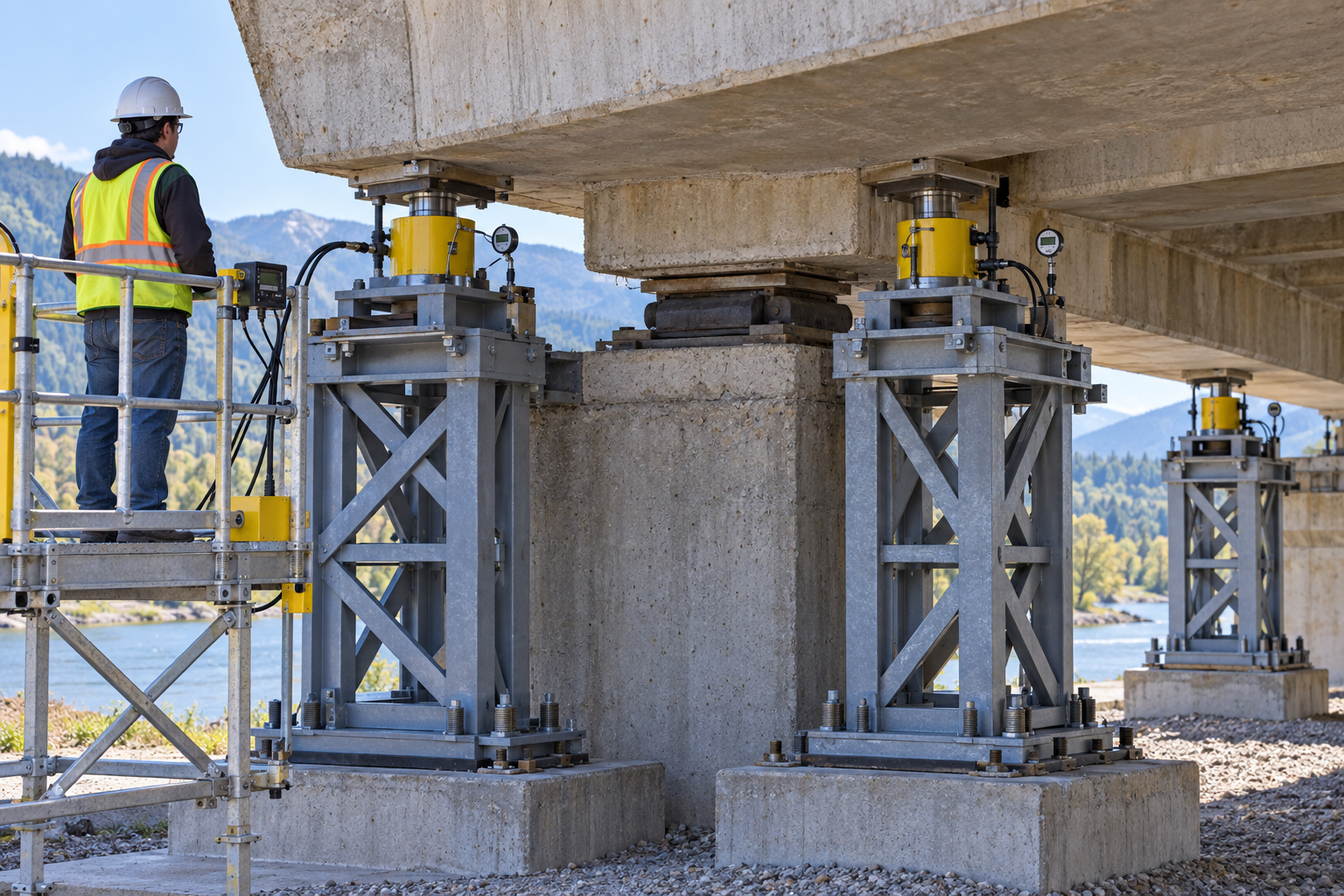
The retained illustration is an AI-generated educational image from the Korean source. It is not an actual incident photograph, approved drawing, equipment certification or proof that the depicted arrangement is safe.
Equal pressure does not necessarily mean equal force: effective piston areas and calibration can differ. Equal force also does not imply equal movement when support stiffness differs. Interpret pressure with the engineered reaction and displacement records.
A closed hydraulic valve is not a substitute for the planned mechanical load-support system. A leak or component failure can change the load rapidly; access below the lifted structure needs verified support and stability.
Bearing orientation, installation position and temperature affect designed movement and rotation. Incorrect restraint can move force into other members. Do not alter anchor holes or bearing direction without engineering review.
Surface-hard grout is not proof of load-bearing strength. Confirm specified material, cure/strength evidence, contact and staged lowering criteria before returning load and removing temporary support.
Hypothetical decision example
Hypothetical example: one jack point rises more than the others, although the pressure gauges look alike. A worker proposes entering before the mechanical support inspection is complete; lifting and access must be held.
The example is fictional; no incident, measurement, inspection or approval is asserted.
Task flow: Engineer lift → Prepare support → Survey bearing → Lift and secure → Replace bearing → Return load → Respond to fault → Inspect and release
Singapore application
Equal hydraulic pressure does not establish equal jack force or equal bridge movement. Use the accepted monitoring arrangement and stop limits for the actual system; keep personnel outside a load path that depends only on hydraulic pressure. Mechanical restraint and support must be accepted before access beneath the lifted structure.
5. Hold and proceed decisions
| Condition | Action | Evidence | Proceed when |
|---|---|---|---|
| Unequal movement | Stop and compare reference points/support | Displacement, pressure and reaction record | Cause resolved |
| Entry below bridge | Verify mechanical support load path | Installed support and stability inspection | Support accepted |
| Unknown orientation | Check design position and movement | Bearing drawing, marks and temperature | Position matches design |
| Load return | Verify strength/contact; lower in stages | Grout, anchors and monitoring evidence | Transfer criteria met |
Similar observation, different conclusion
| Observation | Supported conclusion | What remains unresolved |
|---|---|---|
| Similar pressures | Reaction, datum and movement reconciled | Gauge agreement alone leaves loads unknown |
| Load held | Mechanical support inspected | Hydraulics alone cannot release access |
6. Roles and supervision
| Role | Responsibility |
|---|---|
| Work supervisor | Coordinate engineer lift, affected operations, stop signals and stage transitions. |
| Technical/equipment reviewer | Verify Engineered lift plan, Local strength review, actual instructions and unresolved technical limits. |
| Task crew | Apply the stated controls, report changes and keep actual checks and signatures factual. |
| Inspector/test lead | Connect Grout-strength evidence, Contact and fixation to the required acceptance criteria. |
| Receiving authority | Accept the recorded restrictions, Defect and monitoring log, Owner traffic decision, and follow-up ownership. |
These are responsibility examples, not invented statutory credentials. Verify actual competence, training and authority for the assigned work.
Supervision and handover controls
| Stage | Management controls | Evidence |
|---|---|---|
| Plan review | 1. Assign technical owner2. Close task-specific questions3. Review staged load path | 1. Engineered lift plan2. Local strength review3. Reaction and movement limits |
| Competence | 1. Verify required competence2. Assign stop authority3. Provide safe access | 1. Access and fall protection2. Training and task briefing3. Equipment and calibration |
| Prestart evidence | 1. Inspect actual equipment2. Link evidence to this stage3. Lift by engineered stages | 1. Differential movement2. Contact and reaction3. Traffic exclusion |
| Change control | 1. Stop and secure the area2. Review affected controls3. Evacuate unstable zone | 1. Fault location2. Load and pressure state3. Repeated monitoring |
| Shift handover | 1. Identify remaining restrictions2. Confirm receiving responsibility3. Accept completed transfer | 1. Support-removal criteria2. Shipping-restraint status3. Owner traffic decision |
| Closeout | 1. Record defect disposition2. Archive factual evidence3. Accept completed transfer | 1. Support-removal criteria2. Shipping-restraint status3. Owner traffic decision |
Singapore application
Identify the engineer controlling the lift sequence, the bridge-owner representative controlling traffic and the lifting team supervisor. Changes in jack location, shim configuration, support settlement or traffic state require a hold and reassessment before movement resumes.
7. Hold points and record quality
| Hold point | Evidence before release | Actual record |
|---|---|---|
| HP-0 Start | Engineered lifting, temporary mechanical support, existing bridge-bearing replacement, anchoring/grouting, staged load return and inspection. New bridge erection has a different load state and requires its own plan. | |
| HP-1 Prepare support | Access and fall protection; Foundation/support design; Exclusion boundary; Equipment and calibration | |
| HP-2 Lift and secure | Differential movement; Contact and reaction; Support inspection; Traffic exclusion | |
| HP-3 Respond to fault | Fault location; Load and pressure state; Recovery authorisation; Repeated monitoring | |
| HP-4 Inspect and release | Support-removal criteria; Shipping-restraint status; Defect and monitoring log; Owner traffic decision |
Hold points are internal evidence gates. They do not establish that a statutory permit exists or has been approved. Recheck affected gates after changes, faults and shift handover.
Record comparison - hypothetical templates
The 16 boxes below identify record elements, not completed checks or approvals. They are static symbols. Link equipment/location, date, actual findings and the separate record reference; preserve unresolved items.
| Record | Insufficient entry | Required record elements |
|---|---|---|
| Engineer lift | "Checked" without supporting facts | □ Engineered lift plan□ Local strength review□ Traffic-control plan□ Reaction and movement limits |
| Survey bearing | "Checked" without supporting facts | □ Damage survey□ Bearing and orientation□ Anchor dimensions□ Datum and zero record |
| Replace bearing | "Checked" without supporting facts | □ Restraint-release plan□ Support maintained□ Hands clear of gap□ Orientation and anchor check |
| Respond to fault | "Checked" without supporting facts | □ Fault location□ Load and pressure state□ Recovery authorisation□ Repeated monitoring |
8. Pre-work checks and emergency response
| Check required | Result | Checker/action |
|---|---|---|
| Engineer lift: Engineered lift plan | ||
| Prepare support: Access and fall protection | ||
| Survey bearing: Damage survey | ||
| Lift and secure: Differential movement | ||
| Replace bearing: Restraint-release plan | ||
| Return load: Grout-strength evidence | ||
| Respond to fault: Fault location | ||
| Inspect and release: Support-removal criteria |
Stop work
Stop lifting or lowering for unequal movement, reaction outside the engineered limits, settlement, cracking, leakage or unstable support. Exclude personnel and do not improvise an extra stroke at one jack.
Emergency response
Stop lifting or lowering under the agreed command and evacuate the unstable support zone. Keep workers out from beneath the bridge; do not adjust a jack or enter to inspect a moving support. Activate the structural emergency and traffic-control plan. Contact the site emergency responders for injury or collapse and provide the staged load, jack/support locations and traffic status. Recovery requires the responsible engineer and prepared rescue arrangements.
Singapore application
On unexpected movement, leakage or support distress, stop the operation and clear the engineered exclusion area. Do not enter beneath the bridge to tighten a leaking connection or improvise packing; the engineer determines a controlled recovery from the recorded load state.
9. Sources and review limits
Public-source review: 14 October 2026. Only the material and limits identified below were reviewed.
| Source | Reviewed material | Task application |
|---|---|---|
| MOM - Risk management | Responsibilities; routine and non-routine work; hierarchy of control and risk assessment team. Official explanation of WSH Risk Management duties, not a complete consolidated statutory text. | Assess each intermediate support state and foreseeable hydraulic or movement fault. |
| LTA - Civil Design Criteria, December 2025 | Chapter 9.5, PDF pages 186-188: maintenance access, bearing replacement and designated jacking points, drawing forces and permanent markings. LTA project design criteria, not a universal rule or approval of an existing bridge. Actual drawings, present condition and engineer-approved temporary works govern the proposed replacement. | Obtain the actual jacking locations, force information and maintenance drawings; reconcile permanent marks with present condition. |
| WSHC - Planning a Lift | Main guidance on lifting plans, load, equipment, crew, method, communication, environment and changed conditions. Official guidance. The plan and permit requirements must be determined for the actual lifting operation; this page is not a universal permit rule. | Plan lifting equipment, personnel, exclusion areas and changes to the approved method. |
| MOM - Work at Heights amendment factsheet | Pages 1-4, particularly Annex A questions 1-3 on factories, hazardous height and effective protection; training/role explanations. Official 2014 explanatory factsheet accessed now. Consolidated SSO fetch returned 403; full current statutory text not verified. Course names and detailed permit arrangements need current confirmation. | Determine safe access, edge protection and any applicable factory work-at-height permit. |
Selected official public sources were read on 14 October 2026 within the stated scope. No full consolidated statutory text, paid Singapore Standard, actual equipment manual, engineering calculation, site measurement or professional technical approval is claimed. Check current detailed duties and actual equipment before use.
AI-generated reference material. It has not been verified or approved by a professional. Before use, a qualified person must review and adapt it to applicable Singapore requirements, the actual equipment and site, and approved safe work procedures.
10. PDF use and frequently asked questions
PDF A summarizes core controls; B emphasizes technical failures; C covers supervision, records and handover. Each uses six stages from or aligned with the eight-stage body. All actual risk, measurement, check and signature fields are blank. Use a separate linked record where more space is needed.
Do matching pressures prove equal lift?
No. Relate effective area, calibration, load path and displacement to the engineered plan.
Can workers enter after closing the valve?
Only after the planned mechanical support, stability and access conditions are verified.
Can fixed and guided directions be swapped?
No. Any change needs structural/design review of movement and force paths.
When may traffic return?
After the owner-defined structural, bearing, load-transfer and traffic-release requirements are satisfied.
Has a professional approved this JSA?
This is reference content written and revised with AI. It has not been verified or approved by a professional. Review by a suitably qualified professional and required site authorisation are necessary before use.
Singapore application
Read the A, B and C sheets together with the complete JSA and approved work procedure; each sheet is a complementary extract and cannot authorise work on its own.
11. Authorship and revision history
AI-generated reference material. It has not been verified or approved by a professional. Before use, a qualified person must review and adapt it to applicable Singapore requirements, the actual equipment and site, and approved safe work procedures.
| Date / edition | Authorship and scope | Professional approval |
|---|---|---|
| 2026-09-19 / Korean source | Original topic and educational illustration retained as references. Source content is unchanged. | Not asserted |
| 14 October 2026 / Singapore 1.0 | Added Singapore bridge-owner and LTA design-information interface; retained engineered temporary support, differential movement and grout-strength release rather than treating hydraulic pressure or elapsed curing time as approval. | Not performed |
Source topic: https://smartjsabridge.com/ko/case-study/jsa-bearing-replacement