Delivery, lifting and erection of identified columns and beams, temporary bracing, final joints, connected metal decking and controlled handover.
Hold for uncertain anchors, incomplete bracing or connections, unexplained movement, lost lift signals, unsafe access, unsecured decking or weather outside assessed equipment and erection limits. Do not walk onto an unstable bay to test it.
AI-generated reference material. It has not been professionally verified or approved. Before use, a suitably qualified person must review and adapt it to applicable Singapore requirements, the actual equipment and site, and approved safe work procedures.
1. Legal and technical scope
Apply Singapore WSH risk management to each erection stage and its changing temporary load path. Coordinate the lifting plan and safe work procedure with the erection designer and lifting team. WSHC guidance calls for a fall prevention plan at worksites where work at height is carried out. Apply the hazardous-work-at-height permit system where its factory and work conditions apply, with supervisor application, safety-assessor evaluation and authorised-manager approval. A permit or lifting checklist does not certify structural stability.
Assess the actual activity under the applicable Singapore WSH requirements. Statutory duties, official guidance, manufacturer instructions and approved project documents have distinct roles. A site hold point is not automatically a statutory permit. Use competent local review to resolve the applicable industry, installation, access and permit requirements.
| Basis | Application and limits |
|---|---|
| MOM risk management | Official explanation: risk assessment, control, monitoring and communication for routine and non-routine work, including maintenance; reviewed 14 October 2026. |
| WSHC Planning a Lift | Official lifting guidance: risk-supported lift plan, safe work procedure, permit arrangements, load/equipment/crew/environment details and stop when conditions differ. Confirm the applicable statutory permit scope separately. |
| WSHC Preventing Falls from Heights | Official explanation of access, fall-prevention plans, hazardous-WAH permits in factories and supervisor/assessor/authorised-manager roles. General fall controls are not limited to the permit threshold. |
| SCDF emergency medical services | Official 995 emergency ambulance service information; use emergency services for actual emergencies. |
2. Scope and required inputs
Included: Delivery, lifting and erection of identified columns and beams, temporary bracing, final joints, connected metal decking and controlled handover.
Separate review: Structural redesign, damaged-member repair, demolition, tandem lifts, proprietary systems and anchor or connection-hole alterations require separate engineered procedures.
| Input | Required evidence |
|---|---|
| Plan erection | Drawing revision; Stability stages; Fall plan access and rescue; Change authority |
| Erect column | Base support; Engineer-approved rod changes; Brace connections; Release criteria |
| Complete joints | Bolt inspection; Weld inspection; Fire-watch plan; Ventilation and PPE |
| Close and hand over | Cleared work area; Remaining braces; Joint records; Receiving crew |
Use actual member mass, centre of gravity, crane and rigging data, base support, erection sequence, temporary connection criteria, deck support and loading limits. Neither bolt count nor final torque alone proves temporary stability. Obtain job-specific wind, lightning, visibility and ground conditions; do not import another jurisdiction wind or fastener thresholds.
3. Eight-stage JSA
P = likelihood; S = severity; R = risk under the site method; A = acceptance or authorization as defined by the site. Leave these blank until actual assessment and control verification. A low score does not override a legal requirement, product limit or unreleased hold point.
| Job stage | Hazards and effects | Failure factors | Required controls | Site verification | P | S | R | A |
|---|---|---|---|---|---|---|---|---|
| 1. Plan erection | 1. Frame collapse2. Unsafe access3. Service contact4. Wrong member | 1. Old drawings2. Missing load path3. Unknown ground4. Unplanned changes | 1. Confirm erection sequence2. Design temporary bracing3. Plan protected access4. Resolve deviations first | 1. Drawing revision2. Stability stages3. Fall plan access and rescue4. Change authority | ||||
| 2. Deliver and rig | 1. Dropped steel2. Crushing3. Cuts4. Crane overturn | 1. Wrong sling angle2. Unstable stack3. Weak outrigger ground4. Poor communications | 1. Use rated rigging2. Secure stored steel3. Verify crane support4. Agree lift signals | 1. Mass and lift points2. Rigging condition3. Ground capacity4. Lift route | ||||
| 3. Erect column | 1. Column overturn2. Base crushing3. Anchor failure4. Frame movement | 1. Unsupported base2. Damaged rods3. Missing braces4. Early crane release | 1. Verify specified anchors and base2. Install specified braces3. Exclude pinch points4. Release after stability check | 1. Base support2. Engineer-approved rod changes3. Brace connections4. Release criteria | ||||
| 4. Connect beam | 1. Worker fall2. Beam rotation3. Hand trapping4. Dropped hardware | 1. Unsafe access2. Incomplete far joint3. Forced alignment4. Shared bolt removed | 1. Use planned platform2. Meet designed release criteria3. Keep hands clear4. Control shared connections | 1. Safe access2. Specified release fasteners3. Temporary load path4. Release decision | ||||
| 5. Complete joints | 1. Joint failure2. Falling tools3. Fire4. Welding fume | 1. Wrong tightening2. Loose equipment3. Exposed combustibles4. Poor fume control | 1. Follow joint procedure2. Secure tools and area3. Apply hot-work controls4. Control fume exposure | 1. Bolt inspection2. Weld inspection3. Fire-watch plan4. Ventilation and PPE | ||||
| 6. Install decking | 1. Fall through2. Bundle overload3. Windblown sheet4. Falling scraps | 1. Insufficient bearing2. Unverified landing bay3. Delayed fastening4. Unprotected opening | 1. Verify supports and load2. Use specified fasteners3. Secure sheets promptly4. Protect every opening | 1. Bearing and span2. Bundle landing load3. Fixings and edges4. Opening protection | ||||
| 7. Review changes | 1. Progressive collapse2. Fall during rescue3. Hidden defect4. Uncontrolled restart | 1. Brace removed early2. Wind/access change3. Damage not reported4. No rescue arrangement | 1. Hold affected bay2. Reassess changed loads3. Inspect after incident4. Confirm rescue readiness | 1. Brace status2. Weather and access3. Defect disposition4. Restart authority | ||||
| 8. Close and hand over | 1. Falling remnants2. Unsafe next shift3. Plant collision4. Premature loading | 1. Loose items aloft2. Restrictions lost3. Unplanned crane exit4. Incomplete joints | 1. Lower loose materials2. Record bay limitations3. Control demobilisation4. Authorise loading stage | 1. Cleared work area2. Remaining braces3. Joint records4. Receiving crew |
4. Hypothetical scenario and failure mechanisms
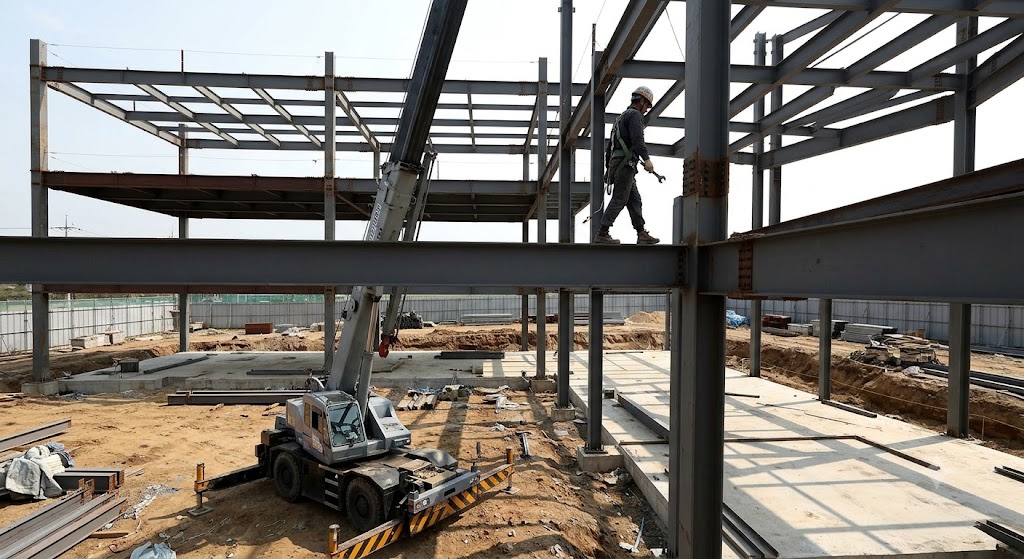 Retained source illustration: an AI-generated educational concept, not a real incident photograph or evidence of equipment suitability.
The following scenario, comparisons and example records are hypothetical teaching material. They do not reproduce actual incidents, measurements, signatures or approvals.
| Item | Hypothetical situation |
|---|---|
| Initial state | A beam is positioned while the crane retains the planned support. |
| Change | The access platform cannot reach after its ground route deteriorates. |
| Failure path | The crew proposes walking the beam and releasing after seeing bolts at one end. |
| Possible harm | Fit-up force or wind can move the incompletely braced member and expose a worker to a fall. |
| Barrier | Hold, restore assessed access and verify both connections, base support and bracing before the designated support-transfer release. |
Every erection stage needs a continuous load path through the member, connections, braces, base and supporting ground. Permanent-frame design strength does not automatically exist during assembly. An upright column may still lack restraint in one direction.
Partial connections can permit rotation or movement under fit-up loads. Keep hands clear and use the planned platform and alignment tools. Do not force an unauthorised anchor or hole change using the crane.
Temporary support release and final bolt or weld acceptance are separate decisions. Specify fastener assemblies, installation stage and inspection criteria. Neither a universal bolt count nor a completed torque check proves that the braced bay is stable.
Deck sheets and bundles impose different loads. Verify bundle landing positions, bearing, fastening and openings before access. Debris containment is not automatically a personnel fall-arrest system.
Coordinate the lift supervisor, erection designer and work-at-height permit roles before changing access or connection sequence. Reassess rain-softened platform ground and the actual wind/lightning exposure; a valid permit does not make changed conditions acceptable.
| Decision | Reason and evidence |
|---|---|
| Known facts | The access platform cannot reach after its ground route deteriorates. |
| Unresolved | The crew proposes walking the beam and releasing after seeing bolts at one end. |
| Hold reason | Hold for uncertain anchors, incomplete bracing or connections, unexplained movement, lost lift signals, unsafe access, unsecured decking or weather outside assessed equipment and erection limits. Do not walk onto an unstable bay to test it. |
| Evidence needed | Bearing and span; Bundle landing load; Fixings and edges; Opening protection. |
| Next decision | Hold, restore assessed access and verify both connections, base support and bracing before the designated support-transfer release. |
5. Conditional decisions and common errors
| Condition | Action | Evidence | Proceed when |
|---|---|---|---|
| Access ground changes | Hold and reassess platform access. | Ground, platform and rescue review. | Safe access restored. |
| Anchor differs | Hold column release. | Designer disposition and inspection. | Base and restraint accepted. |
| Connection incomplete | Retain planned crane support. | Both ends and braced bay evidence. | Stable stage confirmed. |
| Loose deck or changed weather | Stop spreading and secure safely. | Fixing and weather review. | Assessed deck stage restored. |
| Comparison | Situation A | Situation B |
|---|---|---|
| Bolts visible | Both ends and temporary load path verified. | Opposite end or bracing unverified; retain support. |
| Joints finally tightened | Designer release sequence and bay inspection met. | Brace removal assumed from torque alone. |
6. Roles and responsibilities
| Role | Responsibility |
|---|---|
| Work supervisor | Confirm scope, task sequence, exclusion and stop authority. Coordinate plan erection with affected operations. |
| Technical reviewer | Resolve the actual design and equipment limits: Drawing revision; Stability stages; Fall plan access and rescue; Change authority. |
| Work crew | Perform erect column using the approved procedure; report any mismatch before proceeding. |
| Inspector / assessor | Verify Bearing and span; Bundle landing load; Fixings and edges; Opening protection. Record what was actually checked and what remains unresolved. |
| Release / receiving authority | Confirm Cleared work area; Remaining braces; Joint records; Receiving crew. Transfer restrictions and the next permitted stage. |
These are responsibility examples, not invented statutory credentials. Meet the actual training, competent-person, qualified-person and licensing requirements for the assigned work. Anyone may raise a hazard and request a stop; only the designated authority may release the affected stage after evidence is reviewed.
7. Hold points and record comparison
| Hold point | Evidence before release | Confirmation / approval |
|---|---|---|
| HP-0 Start | Scope, jurisdiction, equipment identity, responsible people and emergency arrangements. | |
| HP-1 Erect column | Base support; Engineer-approved rod changes; Brace connections; Release criteria | |
| HP-2 Connect beam | Safe access; Specified release fasteners; Temporary load path; Release decision | |
| HP-3 Install decking | Bearing and span; Bundle landing load; Fixings and edges; Opening protection | |
| HP-4 Close and hand over | Cleared work area; Remaining braces; Joint records; Receiving crew |
Hold points are internal evidence gates. They do not replace statutory permits or actual signatures. Recheck affected gates after a change, abnormal event or shift transfer. The blank record must identify the evidence, person, time, limits and release scope.
| Record | Insufficient record | Record checklist |
|---|---|---|
| Column | Anchors seen | □ Base support□ Engineer-approved rod changes□ Brace connections□ Release criteria |
| Connection | Bolts tight | □ Safe access□ Specified release fasteners□ Temporary load path□ Release decision |
| Deck | Sheets laid | □ Bearing and span□ Bundle landing load□ Fixings and edges□ Opening protection |
| Handover | Bay complete | □ Cleared work area□ Remaining braces□ Joint records□ Receiving crew |
The □ boxes are static prompts, not saved or interactive approvals. Each checks one record element. A tick alone does not establish suitability or permission to restart. Link equipment IDs and supporting records; retain unresolved matters and the earlier record when conditions change.
8. Site checklist and emergency response
| Check item | Result | Person / action |
|---|---|---|
| Drawing revision | ||
| Mass and lift points | ||
| Base support | ||
| Safe access | ||
| Bolt inspection | ||
| Bearing and span | ||
| Brace status | ||
| Cleared work area | ||
| Emergency arrangements and unresolved restrictions communicated |
Stop work: Hold for uncertain anchors, incomplete bracing or connections, unexplained movement, lost lift signals, unsafe access, unsecured decking or weather outside assessed equipment and erection limits. Do not walk onto an unstable bay to test it.
Emergency response: Warn the lifting team, stop further lifting and loading, and clear the collapse and falling-object zone. Activate the planned trained rescue for a suspended worker and call SCDF 995 for urgent rescue or serious injury. Do not enter unstable steelwork or improvise a crane rescue. Stabilisation and re-entry require competent engineering review.
9. Sources and review limits
Official-source review date: October 14, 2026. The following review is limited to the public provisions or selected manufacturer material identified below. It does not establish that any authority approved this article or the actual installation.
- MOM risk management: Official explanation: risk assessment, control, monitoring and communication for routine and non-routine work, including maintenance; reviewed 14 October 2026.
- WSHC Planning a Lift: Official lifting guidance: risk-supported lift plan, safe work procedure, permit arrangements, load/equipment/crew/environment details and stop when conditions differ. Confirm the applicable statutory permit scope separately.
- WSHC Preventing Falls from Heights: Official explanation of access, fall-prevention plans, hazardous-WAH permits in factories and supervisor/assessor/authorised-manager roles. General fall controls are not limited to the permit threshold.
- SCDF emergency medical services: Official 995 emergency ambulance service information; use emergency services for actual emergencies.
Paid consensus standards and site-specific calculations, manuals, inspection records and product certificates were not independently obtained or verified unless specifically identified. Korean and overseas legal references are source history, not Singapore statutory duties. Singapore Standards and model-specific limits were not read in full unless expressly identified.
10. PDF guidance and FAQ
PDF A covers basic task controls; B examines technical failures; C focuses on supervision, evidence and handover. Each has six rows and three items per main cell. They are complementary extracts: apply all eight body stages and the applicable site procedure. An omitted stage is not permission to omit its controls. PDF HP-0 through HP-4 are worksheet labels; match the event, evidence and authority rather than assuming they match another permit by number.
P/S/R/A, actual measurements, confirmations and signatures remain blank. The PDFs are uncompleted reference worksheets, not issued work permits.
Content group ID: jsa-beam-work
Do two bolts always permit crane release?
No. Use the actual engineered erection-stage connection and full stability requirements; the article supplies no universal bolt count.
Can workers walk a beam when the platform cannot reach?
Failed access is a hold point. Re-plan access and suitable fall prevention or protection, anchorage and rescue; a harness does not make an unstable frame safe.
Can final tightening release temporary braces?
Only when the responsible design sequence, completed load path and required inspections support removal. Record the stage and release authority.
Does the WAH permit prove structural stability?
No. It controls its stated fall hazards and work conditions. The erection-stage load path and crane support transfer require their own evidence.
Has a professional verified or approved this document?
AI-generated reference material. It has not been professionally verified or approved. Before use, a suitably qualified person must review and adapt it to applicable Singapore requirements, the actual equipment and site, and approved safe work procedures.
11. Revision history and authorship
AI-generated reference material. It has not been professionally verified or approved. Before use, a suitably qualified person must review and adapt it to applicable Singapore requirements, the actual equipment and site, and approved safe work procedures.
This system has not physically inspected the equipment, structures, ground, atmosphere or worksite. The document does not replace legal advice, manufacturer procedures, engineering design, inspection certificates, qualification evidence, the site risk assessment or an actual work permit.
Before use, a suitably qualified and authorized person must review the actual equipment, loads, methods, protection, inspection and emergency arrangements and resolve open issues. Record the real reviewer, organization, qualifications, delegated authority, reviewed documents, date, signature, exclusions and conditions of approval separately.
| Date | Version | Change | Review status |
|---|---|---|---|
| 2026-08-30 | Unmarked | Korean source revision retained in the source snapshot. | Historical editorial status; not Singapore professional approval. |
| 2026-10-03 | 1.1 | Korean source revision retained in the source snapshot. | Historical editorial status; not Singapore professional approval. |
| 2026-10-14 | SG 1.0 | Singapore localisation of the Korean source with its assigned US technical reference; local applicability, task controls and sources reviewed. | AI-assisted editorial work; professional approval not performed. |