Advance warning, traffic guidance, buffer space and the working area have different functions. A truck parked in the buffer or a blocked pedestrian route defeats the planned separation even when the fence itself is complete.
AI-generated reference material; not professionally verified or approved. Before use, a qualified person must review and adapt it to Singapore requirements, the actual equipment/site and approved safe work procedures.
Stop before starting
Stop exposed work for traffic intrusion, lost signals, missing pedestrian diversion, unverified barrier function, occupied deflection space, unstable panels or inadequate visibility. Hold a damaged, leaking or moved section pending inspection and accepted restoration.
1. Legal and technical scope
| Basis | Scope and limits |
|---|---|
| MOM: Risk management | Assess installation and withdrawal exposure, handling, wind, wet surfaces and public access for each traffic stage. Official explanation of statutory duties; linked SSO text was not independently read for this item. This is not a legal opinion. |
| LTA: Traffic Control at Work Zone, July 2019 | Match the required protection function, accepted complete system, connections, ends and movement space to the actual work-zone layout. Official road work-zone requirements; use the road-specific accepted layout and current project conditions. Numeric examples are not universal values; overseas crash-test references appear within LTA guidance, not standalone US law. |
| LTA: Works on Public Streets, April 2026 | Verify public-street approval, LTA.PROMPT permit and traffic-stage conditions before occupying or changing the road space. Official public-street process. Private-premises boundaries and road-specific approvals must be checked; internal JSA hold points are not an LTA permit. |
| SCDF: Emergency Medical Services | Call 995 for a medical emergency after withdrawing to a protected position; give the road, direction and nearest clear access landmark. Official emergency-response information, not a site-specific rescue plan or authorisation for untrained rescue. |
Use Singapore WSH risk management for the installation crew and public interfaces. For work affecting public streets, establish the applicable LTA approval and permit under the current Works on Public Streets process, including the accepted traffic-control layout. Apply the LTA work-zone code to the required protection function and complete barrier configuration. A pedestrian fence or an unverified plastic unit is not accepted vehicle restraint merely because it is filled. An internal JSA or site booking does not replace the road authority permit or authorise a changed lane arrangement.
2. Scope and required inputs
Included work
Protected delivery, installation, maintenance, stage changes and withdrawal of temporary barricades and pedestrian fencing at an identified road work zone.
Separate assessment
Vehicle-restraint design, road closure and traffic diversion approval, bridge-parapet replacement and untested product combinations require separate competent design and authority review.
| Required input | Evidence to obtain |
|---|---|
| Select function | Device function; Product instructions; LTA plan and permit revision; Public access |
| Protect work zone | Advance warning; Protected delivery zone; Traffic-control roles; Escape route |
| Unload and handle | Unit mass; Lifting points and gear; Handling assessment; Stack restraint |
| Prepare support | Base and slope; Footing arrangement; Service clearance; Rainwater drainage path |
No actual equipment model, site measurements, design calculations or signed approval was supplied. Check the applicable Singapore requirements and approved safe work procedures against the actual equipment and site before use. Statutory duties, official guidance and manufacturer limits serve different purposes; editorial checks do not establish legal or professional approval.
Singapore site application
Read the local traffic approach and approved arrows from the actual Singapore lane arrangement; do not mirror a foreign diagram or assume one taper length suits every road. Keep pedestrian access continuous around the works, including the approach to crossings and bus stops.
Allow for rainwater drainage and wind loading on panels, especially when banners or solid covers are proposed. Keep anchors clear of identified services and use the product-specific fill, foot and brace arrangement. Recheck impact damage, leaks and changed weather before relying on the barrier again.
3. Eight-stage JSA
| Job stage | Hazards and effects | Failure factors | Technical and procedural controls | Site verification | P | S | R | A |
|---|---|---|---|---|---|---|---|---|
| 1. Select function | 1. Vehicle intrusion2. Wrong protection3. Unsafe diversion4. Public injury | 1. Guidance called restraint2. Unknown product3. Old traffic plan4. Missing pedestrian route | 1. Define required function2. Identify exact system3. Confirm LTA layout and permit4. Plan accessible route | 1. Device function2. Product instructions3. LTA plan and permit revision4. Public access | ||||
| 2. Protect work zone | 1. Vehicle strike2. Reversing impact3. Traffic conflict4. Trapped worker | 1. Signs too late2. Unprotected unloading3. Unclear signals4. No escape route | 1. Establish staged controls2. Use protected work side3. Agree communications4. Keep escape route clear | 1. Advance warning2. Protected delivery zone3. Traffic-control roles4. Escape route | ||||
| 3. Unload and handle | 1. Dropped unit2. Crushing3. Muscle injury4. Panel blown away | 1. Unsuitable lifting point2. Hands in gap3. Awkward manual lift4. Loose transport stack | 1. Use rated handling gear2. Exclude pinch zones3. Use handling aids4. Secure remaining stack | 1. Unit mass2. Lifting points and gear3. Handling assessment4. Stack restraint | ||||
| 4. Prepare support | 1. Sliding unit2. Fence overturn3. Service strike4. Blocked drainage | 1. Sloping weak base2. Wrong footing3. Unlocated services4. Drain covered | 1. Verify stable bearing2. Fit specified feet3. Locate before staking4. Maintain drainage | 1. Base and slope2. Footing arrangement3. Service clearance4. Rainwater drainage path | ||||
| 5. Connect and fill | 1. Vehicle penetration2. Separated units3. Impact into workers4. Loss of stability | 1. Missing pins2. Wrong fill level3. Blocked movement space4. Unapproved cover | 1. Fit compatible connections2. Use specified fill3. Keep deflection space clear4. Use approved fence bracing | 1. Pins and ends2. Fill and leak check3. Movement clearance4. Braces and covers | ||||
| 6. Check visibility | 1. Night collision2. Pedestrian trip3. Electric shock4. Confusing guidance | 1. Dirty reflectors2. Projecting feet3. Damaged cables4. Conflicting signs | 1. Check approach visibility2. Protect walking route3. Use suitable electrics4. Remove conflicting cues | 1. Signs and lamps2. Accessible route3. Cable and supply condition4. Sight lines | ||||
| 7. Inspect and hand over | 1. Undetected damage2. Wind collapse3. Loss of restraint4. Uncontrolled change | 1. No post-impact check2. Weather changes3. Slow leakage4. Moved unit | 1. Inspect defined intervals2. Recheck after triggers3. Repair under protection4. Record layout changes | 1. Connection condition2. Wind and damage review3. Fill and support4. Handover responsibility | ||||
| 8. Remove in stages | 1. Vehicle strike2. Falling panel3. Water discharge4. Road debris | 1. Protection removed early2. Brace released first3. Unplanned draining4. Loose pins left | 1. Keep staged protection2. Support before releasing3. Control fill disposal4. Sweep and inspect route | 1. Protected withdrawal2. Handling and support3. Drainage/disposal plan4. Final road check |
P = likelihood; S = severity; R = risk under the site method; A = site-defined acceptance/authorization. These actual assessment cells are blank. A low score never overrides a missing safeguard or a legal or manufacturer restriction.
4. Fictional scenario and failure mechanisms
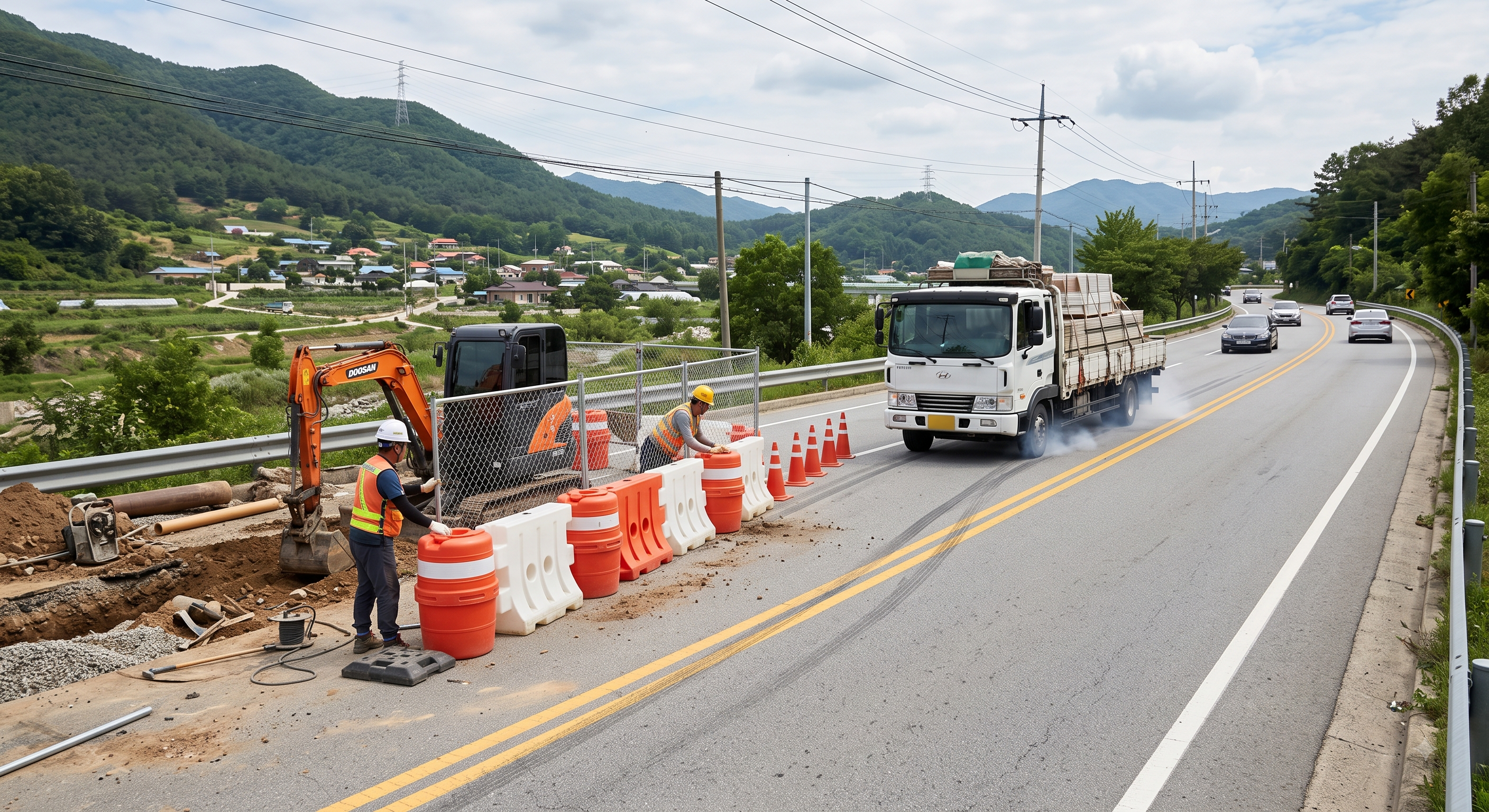
This illustration provides educational context. It is not an actual incident photograph or evidence of equipment suitability; any AI-generated depiction is illustrative only.
The scenario and record comparisons are fictional teaching examples, not records of real incidents, measurements, inspections, signatures or approvals.
| Stage | Fictional situation |
|---|---|
| Initial situation | A fictional crew is extending a roadside fence. |
| Changed condition | The delivery truck occupies the buffer space and blocks the pedestrian route. |
| Failure path | Workers step onto the traffic side to fasten panels and pedestrians detour into the carriageway. |
| Possible outcome | An approaching driver may encounter people inside the intended separation zone. |
| Prevention barrier | Hold exposed work, move delivery into a protected area and restore the accepted traffic stage and pedestrian diversion before continuing. |
Failure mechanisms
Advance warning, traffic guidance, buffer space and the working area have different functions. A truck parked in the buffer or a blocked pedestrian route defeats the planned separation even when the fence itself is complete.
Vehicle restraint depends on an accepted complete system, including connections, ends and available movement space. The LTA code distinguishes safety barrier functions and arrangements; ordinary access fencing is not evidence of crash protection.
Panels transfer wind load into their feet, braces and anchorage. Added sheeting changes the load, and guessed ballast or fill is not proof of stability. Check visibility from approaching drivers as well as pedestrians, including glare and projecting feet.
The installers need protection before the first panel is unloaded and until the last exposed activity is complete. Review each withdrawal stage; a universal reverse-installation instruction does not address changing lanes, junctions or delivery access.
Decision sequence
| Step | Decision |
|---|---|
| Known | Record the truck, workers and pedestrian positions in the current stage. |
| Unknown | The remaining buffer and protected work side have not been verified. |
| Hold | The fence cannot be assumed to stop a vehicle or protect work outside it. |
| Evidence | Check the accepted layout, pedestrian diversion, delivery position and withdrawal stages. |
| Restart | Restore protection before workers enter, then inspect visibility and transfer the stage to the next shift. |
Work sequence: Select function → Protect work zone → Unload and handle → Prepare support → Connect and fill → Check visibility → Inspect and hand over → Remove in stages. This is a teaching flow, not a device drawing or a complete operating procedure.
5. Conditional decisions and common errors
| Situation | Required action | Evidence | Proceed when |
|---|---|---|---|
| Vehicle intrusion | Withdraw; stop exposed work | Traffic stage and communications | Protection restored |
| Footpath blocked | Provide accepted diversion | Continuous accessible route | Route available |
| Panel moves | Review support and wind loading | Product and brace arrangement | Stability verified |
| Stage change | Protect the next work position first | Accepted transition sequence | Safe stage ready |
Similar observations, different decisions
The scenario and record comparisons are fictional teaching examples, not records of real incidents, measurements, inspections, signatures or approvals.
| Observation | Insufficient conclusion | Required distinction |
|---|---|---|
| Similar filled units | Both must be crash barriers. | Verify the actual system function and LTA-accepted complete configuration. |
| Bright lamps | Night visibility is accepted. | Check driver recognition, glare and the pedestrian route from actual approaches. |
| Fence line restored after impact | The barrier is ready to use. | Inspect hidden connections, ends and supports before releasing the section. |
6. Roles and responsibilities
| Role | Responsibility |
|---|---|
| Work supervisor | Confirm device function and the task scope, resources, interfaces and stop authority. |
| Qualified technical reviewer | Review advance warning, model limits, compatibility and unresolved technical conditions within assigned competence. |
| Work crew | Apply the listed controls, report changes and stop when evidence or safeguards are missing. |
| Inspector / assessor | Record actual pins and ends and other relevant checks; do not mark unverified conditions as accepted. |
| Handover authority | Reconcile protected withdrawal, restrictions and outstanding actions before the next task. Role labels do not establish a legal credential. |
Supervision and handover focus
| Stage | Management action | Evidence |
|---|---|---|
| Select function | 1. Record device function2. Record product instructions3. Record lta plan and permit revision | 1. Device function2. Product instructions3. LTA plan and permit revision |
| Protect work zone | 1. Record advance warning2. Record protected delivery zone3. Record traffic-control roles | 1. Advance warning2. Protected delivery zone3. Traffic-control roles |
| Prepare support | 1. Record base and slope2. Record footing arrangement3. Record service clearance | 1. Base and slope2. Footing arrangement3. Service clearance |
| Connect and fill | 1. Record pins and ends2. Record fill and leak check3. Record movement clearance | 1. Pins and ends2. Fill and leak check3. Movement clearance |
| Inspect and hand over | 1. Record connection condition2. Record wind and damage review3. Record fill and support | 1. Connection condition2. Wind and damage review3. Fill and support |
| Remove in stages | 1. Record protected withdrawal2. Record handling and support3. Record drainage/disposal plan | 1. Protected withdrawal2. Handling and support3. Drainage/disposal plan |
7. Hold points and record comparison
| Hold point | Evidence before release | Actual approval |
|---|---|---|
| HP-0 Scope | Protected delivery, installation, maintenance, stage changes and withdrawal of temporary barricades and pedestrian fencing at an identified road work zone. | |
| HP-1 Protect work zone | Advance warning; Protected delivery zone; Traffic-control roles; Escape route | |
| HP-2 Prepare support | Base and slope; Footing arrangement; Service clearance; Rainwater drainage path | |
| HP-3 Check visibility | Signs and lamps; Accessible route; Cable and supply condition; Sight lines | |
| HP-4 Remove in stages | Protected withdrawal; Handling and support; Drainage/disposal plan; Final road check |
Hold points are internal project checks. They are not universal statutory permits and do not grant work permission. Reassess after defects, changed conditions and shift changes.
Record comparison
The scenario and record comparisons are fictional teaching examples, not records of real incidents, measurements, inspections, signatures or approvals.
The boxes are static record prompts, not interactive or saved approvals. A tick does not establish suitability or permission to restart. Record the evidence, person, time and unresolved issues; retain the change history.
| Record | Insufficient record | Record checklist |
|---|---|---|
| Select function | Only marked “OK” | □ Device function□ Product instructions□ LTA plan and permit revision□ Public access |
| Prepare support | Only marked “OK” | □ Base and slope□ Footing arrangement□ Service clearance□ Rainwater drainage path |
| Inspect and hand over | Only marked “OK” | □ Connection condition□ Wind and damage review□ Fill and support□ Handover responsibility |
| Remove in stages | Only marked “OK” | □ Protected withdrawal□ Handling and support□ Drainage/disposal plan□ Final road check |
8. Site checklist and emergency response
| Site check | Actual result | Person / action |
|---|---|---|
| Select function: Device function; Product instructions; LTA plan and permit revision; Public access | ||
| Protect work zone: Advance warning; Protected delivery zone; Traffic-control roles; Escape route | ||
| Unload and handle: Unit mass; Lifting points and gear; Handling assessment; Stack restraint | ||
| Prepare support: Base and slope; Footing arrangement; Service clearance; Rainwater drainage path | ||
| Connect and fill: Pins and ends; Fill and leak check; Movement clearance; Braces and covers | ||
| Check visibility: Signs and lamps; Accessible route; Cable and supply condition; Sight lines | ||
| Inspect and hand over: Connection condition; Wind and damage review; Fill and support; Handover responsibility | ||
| Remove in stages: Protected withdrawal; Handling and support; Drainage/disposal plan; Final road check |
Stop work
Stop exposed work for traffic intrusion, lost signals, missing pedestrian diversion, unverified barrier function, occupied deflection space, unstable panels or inadequate visibility. Hold a damaged, leaking or moved section pending inspection and accepted restoration.
Emergency response
Warn the traffic-control lead and withdraw along the planned escape route. Do not enter a live lane to retrieve a fallen fence. Establish protection before rescue or recovery; call 995 for a medical emergency and give the road, travel direction and access landmark. Preserve the affected layout for assessment.
9. Sources and review limits
Public-source access/review: 2026-10-14.
| Official source | Reviewed scope and limits |
|---|---|
| MOM: Risk management | Assess installation and withdrawal exposure, handling, wind, wet surfaces and public access for each traffic stage. Official explanation of statutory duties; linked SSO text was not independently read for this item. This is not a legal opinion. |
| LTA: Traffic Control at Work Zone, July 2019 | Match the required protection function, accepted complete system, connections, ends and movement space to the actual work-zone layout. Official road work-zone requirements; use the road-specific accepted layout and current project conditions. Numeric examples are not universal values; overseas crash-test references appear within LTA guidance, not standalone US law. |
| LTA: Works on Public Streets, April 2026 | Verify public-street approval, LTA.PROMPT permit and traffic-stage conditions before occupying or changing the road space. Official public-street process. Private-premises boundaries and road-specific approvals must be checked; internal JSA hold points are not an LTA permit. |
| SCDF: Emergency Medical Services | Call 995 for a medical emergency after withdrawing to a protected position; give the road, direction and nearest clear access landmark. Official emergency-response information, not a site-specific rescue plan or authorisation for untrained rescue. |
No actual equipment model, site measurements, design calculations or signed approval was supplied. Check the applicable Singapore requirements and approved safe work procedures against the actual equipment and site before use. Statutory duties, official guidance and manufacturer limits serve different purposes; editorial checks do not establish legal or professional approval.
10. PDF guidance and FAQ
PDF A covers basic task controls; B focuses on technical failures; C covers supervision, records and handover. The article has eight stages with four items per main cell; each PDF has six key stages with three items per main cell. P/S/R/A, measurements, confirmations and signatures remain blank for actual site assessment.
PDFs are complementary six-stage extracts. Apply all eight body stages and the actual equipment/site procedure.
Does filling a plastic unit make it vehicle restraint?
No. Verify its declared function and the accepted complete system, including connections, ends and available movement space.
May mesh fencing be covered for privacy?
Only after checking the permitted wind-loading arrangement, supports and actual site conditions. Improvised ballast does not prove stability.
Is withdrawal always the reverse of installation?
Use the accepted stage-by-stage withdrawal plan for the actual traffic, pedestrian route and protected work positions.
Does this JSA authorise road occupation?
No. Verify applicable LTA and other authority approvals and permit conditions for the public-street work.
Has a professional verified or approved this document?
AI-generated reference material; not professionally verified or approved. Before use, a qualified person must review and adapt it to Singapore requirements, the actual equipment/site and approved safe work procedures.
11. Revision history and authorship
AI-generated reference material; not professionally verified or approved. Before use, a qualified person must review and adapt it to Singapore requirements, the actual equipment/site and approved safe work procedures.
| Date | Version | Change | Review status |
|---|---|---|---|
| 2026-10-14 | SG 1.0 | New Singapore edition from assigned Korean source; task decisions, records and PDFs localized. | AI editorial review; no professional technical approval |
Korean edition revision history: 2026-08-17: earlier published draft/version retained in the source history; 2026-10-04 (v1.1): task decisions, record checklist, JSA and three PDF variants revised. These are editorial records, not professional technical approval. Singapore v1.0 adapts the earlier edition to Singapore requirements and terminology.
Site reviewers must add their actual qualifications, scope, date and approval only after the review occurs.