Water-based describes the product system, not the safety of skin contact or mixing. Match the label to the SDS and distinguish concentrate from working solution. Check metal, coating and residues before choosing dilution and contact time.
AI-generated reference material; not professionally verified or approved. Before use, a qualified person must review and adapt it to Singapore requirements, the actual equipment/site and approved safe work procedures.
Stop before starting
Stop for uncertain product, dilution, material or residue, an unintended mixture, abnormal heat, gas, foam or irritation, glove damage or leakage. Do not compensate by adding concentrate or another chemical.
1. Legal and technical scope
| Basis | Scope and limits |
|---|---|
| MOM: Risk management | Assess manual contact, mixing, sharp parts, splash, abnormal reaction and recovery before the bench task. Official explanation of statutory duties; linked SSO text was not independently read for this item. This is not a legal opinion. |
| MOM/NEA/SCDF: Revised SS 586 adoption | Check product identity, dilution, incompatibility and exposure controls from the current Singapore-appropriate label/SDS. Official adoption circular, not full paid SS 586 text or a classification of the actual product; verify current supplier label and SDS. |
| NEA: Toxic Waste Control | Classify spent cleaner and removed residues; use approved treatment or an appropriately licensed TIW collector when that classification applies. Apply only after classifying actual cleaner and removed contaminants; this does not classify every aqueous cleaning waste as TIW or authorise discharge. |
| PUB: Written Approval for trade effluent | Verify the actual premises approval and conditions before any proposed trade-effluent sewer discharge. Approval is site/business and activity dependent; clarity of the liquid is not a discharge test. No discharge limit is invented. |
| SCDF: Emergency Medical Services | Use the SDS first-aid response and call 995 for a medical emergency; give the product and exposure information to responders. Official emergency-response information, not a site-specific rescue plan or authorisation for untrained rescue. |
Assess this manual cleaning task under Singapore WSH risk management, using actual product classification, exposure and the supplier label/SDS. The joint MOM/NEA/SCDF circular identifies the revised SS 586 hazard-communication framework for covered chemicals; the product being water-based does not establish harmlessness. Determine spent-cleaner and contamination classification for the NEA waste route. Where trade effluent is proposed for discharge to a public sewer, PUB Written Approval and its conditions must be satisfied. Neither clear appearance nor a generic SDS disposal line authorises discharge.
2. Scope and required inputs
Included work
Ambient-temperature manual cleaning of small, safely removed metal parts with an identified water-based product suitable for the material and contaminant. Use compatible containers, brushes and baskets, then rinse, drain and dry as instructed.
Separate assessment
Solvent cleaning, acid pickling, strong-caustic stripping, reactive metals or unknown residues, heated/ultrasonic/high-pressure/automatic washing, compressed-air drying, electrical components and equipment disassembly require separate review.
| Required input | Evidence to obtain |
|---|---|
| Match parts | Part and material ID; Product identity; Residue assessment; Removal confirmation |
| Prepare bench | Bench and support; Container condition; Basket and tools; Part weight and edges |
| Check protection | Glove material; Eye protection; Ventilation condition; Wash and alarm access |
| Prepare solution | Product and amount; Measured dilution and units; Order and temperature; Container label |
No actual equipment model, site measurements, design calculations or signed approval was supplied. Check the applicable Singapore requirements and approved safe work procedures against the actual equipment and site before use. Statutory duties, official guidance and manufacturer limits serve different purposes; editorial checks do not establish legal or professional approval.
Singapore site application
Keep labelled concentrate, working solution and collected waste separate in the shared wash area. Use measured dilution in the units specified by the product instructions; wet gloves or a familiar cleaner name do not establish compatibility.
Identify whether a nearby inlet leads to a public sewer or a surface-water drain. Keep the liquid contained while the environmental responsible person confirms classification and the permitted route. A PUB approval for another process or premises does not release this batch.
3. Eight-stage JSA
| Job stage | Hazards and effects | Failure factors | Technical and procedural controls | Site verification | P | S | R | A |
|---|---|---|---|---|---|---|---|---|
| 1. Match parts | 1. Chemical reaction2. Coating damage3. Residue exposure4. Sharp-edge cuts | 1. Unknown alloy2. Wrong cleaner3. Hidden residue4. Unsorted sharp parts | 1. Identify metal and coating2. Match product and SDS3. Confirm safe removal4. Plan handling tools | 1. Part and material ID2. Product identity3. Residue assessment4. Removal confirmation | ||||
| 2. Prepare bench | 1. Container tip2. Liquid leak3. Dropped part4. Handling strain | 1. Weak support2. Wrong container3. Overloaded basket4. Blocked route | 1. Stabilise container2. Check compatibility3. Limit basket load4. Clear handling route | 1. Bench and support2. Container condition3. Basket and tools4. Part weight and edges | ||||
| 3. Check protection | 1. Skin contact2. Eye splash3. Inhaled irritant4. Delayed washing | 1. Wrong gloves2. No eye protection3. Poor ventilation4. Blocked eyewash | 1. Select compatible gloves2. Protect eyes from splash3. Provide assessed ventilation4. Keep washing accessible | 1. Glove material2. Eye protection3. Ventilation condition4. Wash and alarm access | ||||
| 4. Prepare solution | 1. Concentrate splash2. Mixing reaction3. Wrong concentration4. Container confusion | 1. Eyeballed dilution2. Products mixed3. Wrong mixing order4. No label | 1. Measure per instructions2. Use one approved product3. Follow mixing order4. Label working solution | 1. Product and amount2. Measured dilution and units3. Order and temperature4. Container label | ||||
| 5. Brush and soak | 1. Liquid splash2. Prolonged contact3. Cuts under liquid4. Dropped sharp part | 1. Rapid brushing2. Hands in bath3. Hidden blade edge4. Unstable part | 1. Use basket and tools2. Reduce splash3. Support part securely4. Watch liquid changes | 1. Brush direction2. Part support3. Glove condition4. Solution changes | ||||
| 6. Rinse and dry | 1. Residual chemical2. Slippery floor3. Coating damage4. Mist exposure | 1. Rinse omitted2. Uncontained drainage3. Drying rushed4. Air gun substituted | 1. Follow rinse instructions2. Contain drainage3. Use stable drying rack4. Keep assessed drying method | 1. Rinse requirement2. Residual liquid3. Rack and floor4. Dryness and coating | ||||
| 7. Hold reaction | 1. Continued exposure2. Gas release3. Hot mixture4. Unsafe reuse | 1. Foam ignored2. Neutralizer improvised3. Symptoms dismissed4. Cause unresolved | 1. Stop handling2. Control affected area3. Follow SDS response4. Get competent review | 1. Products mixed2. Change and symptoms3. Recovery method4. Restart evidence | ||||
| 8. Waste and handover | 1. Waste mixing2. Drain contamination3. Part corrosion4. Defect passed on | 1. Unlabelled waste2. Sewer discharge assumed3. Crevices stay wet4. Visual clean accepted | 1. Classify and label waste2. Verify permitted waste route3. Inspect part condition4. Handover restrictions | 1. Waste identity2. NEA route / PUB conditions3. Residue and damage4. Recipient and limits |
P = likelihood; S = severity; R = risk under the site method; A = site-defined acceptance/authorization. These actual assessment cells are blank. A low score never overrides a missing safeguard or a legal or manufacturer restriction.
4. Fictional scenario and failure mechanisms
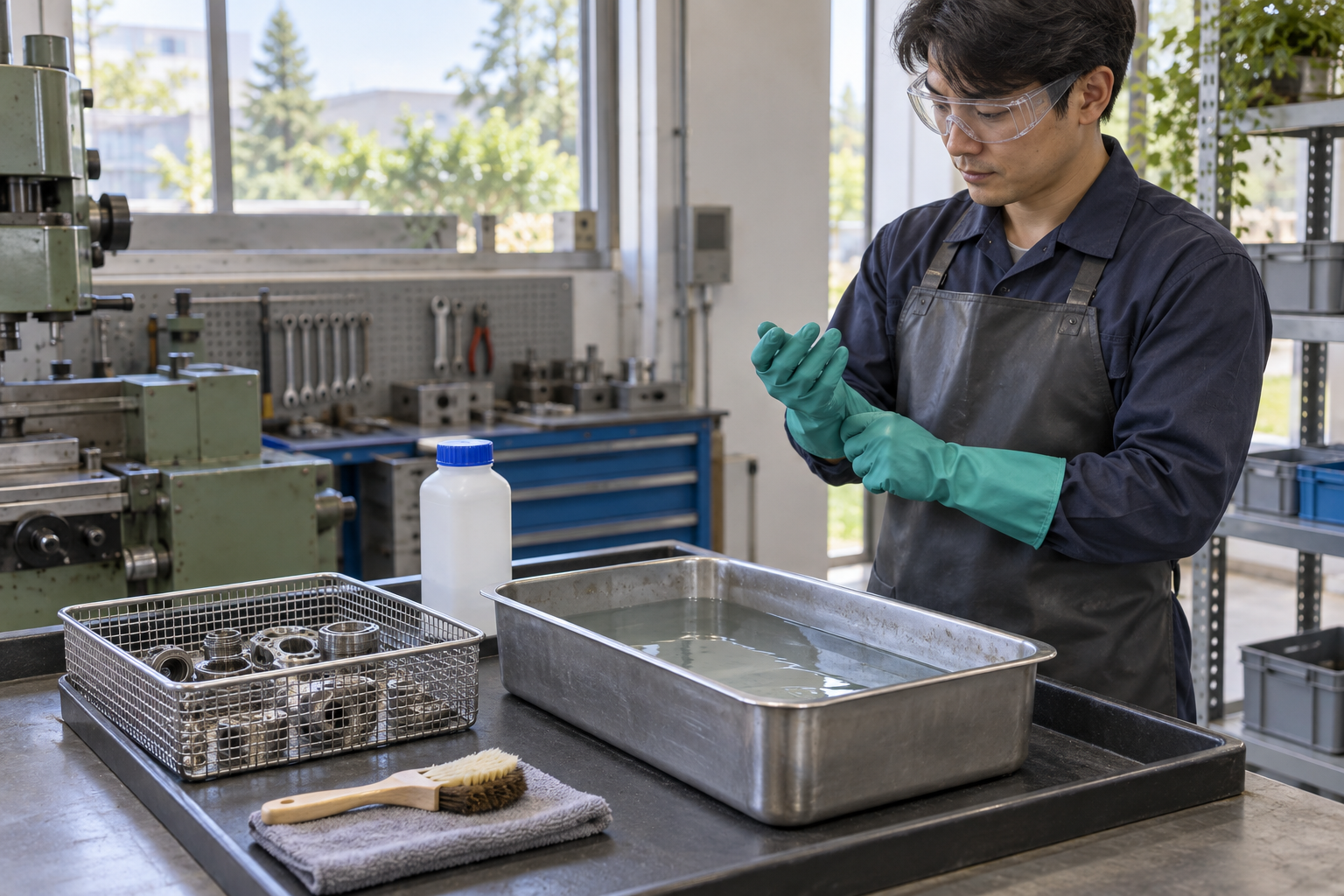
This illustration provides educational context. It is not an actual incident photograph or evidence of equipment suitability; any AI-generated depiction is illustrative only.
The scenario and record comparisons are fictional teaching examples, not records of real incidents, measurements, inspections, signatures or approvals.
| Stage | Fictional situation |
|---|---|
| Initial situation | A fictional worker finds that oily parts remain dirty. |
| Changed condition | A second unlabelled cleaner is added and unusual foam and irritation appear. |
| Failure path | Continuing to reach into the container prolongs exposure to an unassessed mixture. |
| Possible outcome | Possible chemical injury and damaged parts; no actual exposure results are asserted. |
| Prevention barrier | Stop contact, control access and have the responsible chemical specialist assess the products, affected parts and recovery method. |
Failure mechanisms
Water-based describes the product system, not the safety of skin contact or mixing. Match the label to the SDS and distinguish concentrate from working solution. Check metal, coating and residues before choosing dilution and contact time.
Poor cleaning does not authorise adding concentrate, another detergent, heat or pressure. Those changes can alter reaction and exposure conditions. Review the permitted brush, loading, contact time and solution condition; segregate unfinished parts pending a revised method.
A clean-looking surface may retain fluid in crevices or have damaged coating or corrosion. Acceptance must address subsequent assembly/use, drying and inspection. Clear waste liquid is not proof that sewer discharge is permitted.
Decision sequence
| Step | Decision |
|---|---|
| Known | A second unlabelled product was added and abnormal foam and irritation appeared. |
| Unknown | Product identities, quantities, exposure and affected parts are not established. |
| Hold | Continuing contact or improvised neutralisation can worsen an unassessed reaction. |
| Evidence | Identify both products and SDSs; obtain a competent response, recovery and waste-classification decision. |
| Restart | Use a verified method with suitable container and PPE, inspected parts and documented release; retain waste restrictions. |
Work sequence: Match parts → Prepare bench → Check protection → Prepare solution → Brush and soak → Rinse and dry → Hold reaction → Waste and handover. This is a teaching flow, not a device drawing or a complete operating procedure.
5. Conditional decisions and common errors
| Situation | Required action | Evidence | Proceed when |
|---|---|---|---|
| Unknown product | Hold cleaning; identify material | Label, SDS and parts record | Product and part matched |
| Poor cleaning | Review permitted method | Dilution, contact time and condition | Method remains within limits |
| Foam or irritation | Stop contact; isolate area | Product identities and response review | Cause resolved and fresh release |
| Part looks clean | Inspect residue and damage | Dryness, coating and use criteria | Part accepted for next task |
Similar observations, different decisions
The scenario and record comparisons are fictional teaching examples, not records of real incidents, measurements, inspections, signatures or approvals.
| Observation | Insufficient conclusion | Required distinction |
|---|---|---|
| Water-based | Mixes with water | Does not prove skin or mixture safety |
| Clean surface | Oil appears removed | Dryness and damage remain separate |
| Clear waste | Low visible colour | Discharge permission still required |
6. Roles and responsibilities
| Role | Responsibility |
|---|---|
| Work supervisor | Confirm part and material id and the task scope, resources, interfaces and stop authority. |
| Qualified technical reviewer | Review bench and support, model limits, compatibility and unresolved technical conditions within assigned competence. |
| Work crew | Apply the listed controls, report changes and stop when evidence or safeguards are missing. |
| Inspector / assessor | Record actual brush direction and other relevant checks; do not mark unverified conditions as accepted. |
| Handover authority | Reconcile waste identity, restrictions and outstanding actions before the next task. Role labels do not establish a legal credential. |
Supervision and handover focus
| Stage | Management action | Evidence |
|---|---|---|
| Match parts | 1. Record part and material id2. Record product identity3. Record residue assessment | 1. Part and material ID2. Product identity3. Residue assessment |
| Prepare bench | 1. Record bench and support2. Record container condition3. Record basket and tools | 1. Bench and support2. Container condition3. Basket and tools |
| Prepare solution | 1. Record product and amount2. Record measured dilution and units3. Record order and temperature | 1. Product and amount2. Measured dilution and units3. Order and temperature |
| Brush and soak | 1. Record brush direction2. Record part support3. Record glove condition | 1. Brush direction2. Part support3. Glove condition |
| Hold reaction | 1. Record products mixed2. Record change and symptoms3. Record recovery method | 1. Products mixed2. Change and symptoms3. Recovery method |
| Waste and handover | 1. Record waste identity2. Record nea route / pub conditions3. Record residue and damage | 1. Waste identity2. NEA route / PUB conditions3. Residue and damage |
7. Hold points and record comparison
| Hold point | Evidence before release | Actual approval |
|---|---|---|
| HP-0 Scope | Ambient-temperature manual cleaning of small, safely removed metal parts with an identified water-based product suitable for the material and contaminant. Use compatible containers, brushes and baskets, then rinse, drain and dry as instructed. | |
| HP-1 Prepare bench | Bench and support; Container condition; Basket and tools; Part weight and edges | |
| HP-2 Prepare solution | Product and amount; Measured dilution and units; Order and temperature; Container label | |
| HP-3 Hold reaction | Products mixed; Change and symptoms; Recovery method; Restart evidence | |
| HP-4 Waste and handover | Waste identity; NEA route / PUB conditions; Residue and damage; Recipient and limits |
Hold points are internal project checks. They are not universal statutory permits and do not grant work permission. Reassess after defects, changed conditions and shift changes.
Record comparison
The scenario and record comparisons are fictional teaching examples, not records of real incidents, measurements, inspections, signatures or approvals.
The boxes are static record prompts, not interactive or saved approvals. A tick does not establish suitability or permission to restart. Record the evidence, person, time and unresolved issues; retain the change history.
| Record | Insufficient record | Record checklist |
|---|---|---|
| Match parts | Only marked “OK” | □ Part and material ID□ Product identity□ Residue assessment□ Removal confirmation |
| Prepare solution | Only marked “OK” | □ Product and amount□ Measured dilution and units□ Order and temperature□ Container label |
| Hold reaction | Only marked “OK” | □ Products mixed□ Change and symptoms□ Recovery method□ Restart evidence |
| Waste and handover | Only marked “OK” | □ Waste identity□ NEA route / PUB conditions□ Residue and damage□ Recipient and limits |
8. Site checklist and emergency response
| Site check | Actual result | Person / action |
|---|---|---|
| Match parts: Part and material ID; Product identity; Residue assessment; Removal confirmation | ||
| Prepare bench: Bench and support; Container condition; Basket and tools; Part weight and edges | ||
| Check protection: Glove material; Eye protection; Ventilation condition; Wash and alarm access | ||
| Prepare solution: Product and amount; Measured dilution and units; Order and temperature; Container label | ||
| Brush and soak: Brush direction; Part support; Glove condition; Solution changes | ||
| Rinse and dry: Rinse requirement; Residual liquid; Rack and floor; Dryness and coating | ||
| Hold reaction: Products mixed; Change and symptoms; Recovery method; Restart evidence | ||
| Waste and handover: Waste identity; NEA route / PUB conditions; Residue and damage; Recipient and limits |
Stop work
Stop for uncertain product, dilution, material or residue, an unintended mixture, abnormal heat, gas, foam or irritation, glove damage or leakage. Do not compensate by adding concentrate or another chemical.
Emergency response
Stop contact and keep people away from the reacting bath. Follow the actual product SDS and site response for eye/skin exposure or inhalation, obtain medical assistance and call 995 for a medical emergency. Do not add another chemical to neutralise the bath or move an unsafe container; competent responders determine recovery and waste handling.
9. Sources and review limits
Public-source access/review: 2026-10-14.
| Official source | Reviewed scope and limits |
|---|---|
| MOM: Risk management | Assess manual contact, mixing, sharp parts, splash, abnormal reaction and recovery before the bench task. Official explanation of statutory duties; linked SSO text was not independently read for this item. This is not a legal opinion. |
| MOM/NEA/SCDF: Revised SS 586 adoption | Check product identity, dilution, incompatibility and exposure controls from the current Singapore-appropriate label/SDS. Official adoption circular, not full paid SS 586 text or a classification of the actual product; verify current supplier label and SDS. |
| NEA: Toxic Waste Control | Classify spent cleaner and removed residues; use approved treatment or an appropriately licensed TIW collector when that classification applies. Apply only after classifying actual cleaner and removed contaminants; this does not classify every aqueous cleaning waste as TIW or authorise discharge. |
| PUB: Written Approval for trade effluent | Verify the actual premises approval and conditions before any proposed trade-effluent sewer discharge. Approval is site/business and activity dependent; clarity of the liquid is not a discharge test. No discharge limit is invented. |
| SCDF: Emergency Medical Services | Use the SDS first-aid response and call 995 for a medical emergency; give the product and exposure information to responders. Official emergency-response information, not a site-specific rescue plan or authorisation for untrained rescue. |
No actual equipment model, site measurements, design calculations or signed approval was supplied. Check the applicable Singapore requirements and approved safe work procedures against the actual equipment and site before use. Statutory duties, official guidance and manufacturer limits serve different purposes; editorial checks do not establish legal or professional approval.
10. PDF guidance and FAQ
PDF A covers basic task controls; B focuses on technical failures; C covers supervision, records and handover. The article has eight stages with four items per main cell; each PDF has six key stages with three items per main cell. P/S/R/A, measurements, confirmations and signatures remain blank for actual site assessment.
PDFs are complementary six-stage extracts. Apply all eight body stages and the actual equipment/site procedure.
Can a water-based cleaner be used barehanded?
Select contact controls and compatible gloves from the actual product and task; the product name does not establish safety.
May concentration be increased when cleaning is slow?
Only within a verified product method for the actual material and residue. Do not improvise mixtures or heating.
Can small parts be found by feeling inside the bath?
Use a suitable basket or tool. Gloves do not make unseen sharp edges or chemical exposure harmless.
Can compressed air speed drying?
Compressed-air drying is outside this scope because it can disperse residual liquid. Follow the accepted drain/dry method.
Has a professional verified or approved this document?
AI-generated reference material; not professionally verified or approved. Before use, a qualified person must review and adapt it to Singapore requirements, the actual equipment/site and approved safe work procedures.
11. Revision history and authorship
AI-generated reference material; not professionally verified or approved. Before use, a qualified person must review and adapt it to Singapore requirements, the actual equipment/site and approved safe work procedures.
| Date | Version | Change | Review status |
|---|---|---|---|
| 2026-10-14 | SG 1.0 | New Singapore edition from assigned Korean source; task decisions, records and PDFs localized. | AI editorial review; no professional technical approval |
Korean edition revision history: 2026-10-04 (v1.0): initial article, sources, fictional analysis and PDF editorial checks. These are editorial records, not professional technical approval. Singapore v1.0 adapts the earlier edition to Singapore requirements and terminology.
Site reviewers must add their actual qualifications, scope, date and approval only after the review occurs.