Degreasing and oxide removal address different contamination. Confirm a suitable solvent and dryness before dedicated clean tooling; protect prepared joints and filler from recontamination.
AI-generated reference material; not professionally verified or approved. Before use, a qualified person must review and adapt it to Singapore requirements, the actual equipment/site and approved safe work procedures.
Stop before starting
Hold unknown pipe isolation, material/filler traceability, WPS, cleanliness, dryness or hot-work safeguards. Stop for shielding failure, electrode contact, gas leakage, poor air conditions or changed work interfaces; identify the affected joints before recovery.
1. Legal and technical scope
| Basis | Scope and limits |
|---|---|
| MOM: Risk management | Include preparation, gas change, rework and later service handover in the pipe-welding RA and SWP. Official explanation of statutory duties; linked SSO text was not independently read for this item. This is not a legal opinion. |
| MOM/NEA/SCDF: Revised SS 586 adoption | Match the actual degreaser and gas label/SDS to the Singapore hazard-communication requirements within scope. Official adoption circular, not full paid SS 586 text or a classification of the actual product; verify current supplier label and SDS. |
| WSH Council: Managing WSH for SMEs in Metalworking | Prepare the hot-work area, protect the opposite side, maintain ventilation and fire watch, inspect cables and gas supply, and close the post-work checks. Official sector guidance and sample controls, not a universal statutory permit rule, a qualified WPS or a current-edition certificate. Linked paid standards were not read; direct SSO General Provisions access returned 403. |
| SCDF: Emergency Medical Services | For serious burns, breathing difficulty or other medical emergencies call 995; control access and guide responders. Official emergency-response information, not a site-specific rescue plan or authorisation for untrained rescue. |
Apply Singapore WSH risk management to the identified pipe, preparation chemicals, AC TIG equipment, shielding gas and surrounding work. Follow the site hot-work permit system and approved safe work procedure, using WSH Council metalworking guidance for pre-work inspection, fire watch, ventilation and post-work checks. Confirm the actual sector-specific statutory permit duties rather than treating a sample permit as a nationwide rule. The revised SS 586 labelling/SDS framework must be considered for covered preparation chemicals. Actual piping service and project specifications determine the WPS, welder competence, inspection and acceptance; this article supplies no qualified welding procedure.
2. Scope and required inputs
Included work
Identify, isolate, prepare, AC TIG weld, cool and inspect aluminium pipe joints with traceable material, filler and approved welding procedure.
Separate assessment
Live or contaminated process lines, confined-space entry, other welding processes and pressure-test execution require separate plans.
| Required input | Evidence to obtain |
|---|---|
| Identify joint | Pipe and isolation; Alloy and filler lot; WPS revision; Hot-work permit and contacts |
| Prepare station | Tool and SDS checks; Pipe support; Cylinder and regulator; Clear escape route |
| Clean joint | Residual contents; Clean dry surfaces; Solvent suitability; Material and WPS |
| Check power and gas | Insulation and return; Gas and air assessment; Cylinder restraint; Hood and shielding |
No actual equipment model, site measurements, design calculations or signed approval was supplied. Check the applicable Singapore requirements and approved safe work procedures against the actual equipment and site before use. Statutory duties, official guidance and manufacturer limits serve different purposes; editorial checks do not establish legal or professional approval.
Singapore site application
In a shared Singapore fabrication bay, screen nearby trades without enclosing the welder in an unventilated pocket. Include adjacent storage and the opposite side of heated surfaces in the hot-work review; fire watch and cooling checks are separate from weld acceptance.
Humid storage and rain-exposed staging can reintroduce moisture after cleaning. Keep prepared aluminium and filler dry and segregate dedicated brushes; do not raise gas flow to hide a preparation or draught problem. Record actual electrical and gas settings with units from the approved WPS, not a borrowed machine setting.
3. Eight-stage JSA
| Job stage | Hazards and effects | Failure factors | Technical and procedural controls | Site verification | P | S | R | A |
|---|---|---|---|---|---|---|---|---|
| 1. Identify joint | 1. Residue fire2. Wrong alloy joint3. Bystander arc exposure4. Delayed gas response | 1. Isolation incomplete2. Filler mismatch3. Screen absent4. Roles unclear | 1. Verify pipe boundary2. Match alloy and WPS3. Plan hot-work screens4. Assign stop and response | 1. Pipe and isolation2. Alloy and filler lot3. WPS revision4. Hot-work permit and contacts | ||||
| 2. Prepare station | 1. Joint contamination2. Pipe rolls3. Cylinder falls4. Hose trip | 1. Tools mixed2. Support loose3. Cylinder unsecured4. Route cluttered | 1. Separate clean tools2. Secure pipe jig3. Secure correct cylinder4. Protect cables and hoses | 1. Tool and SDS checks2. Pipe support3. Cylinder and regulator4. Clear escape route | ||||
| 3. Clean joint | 1. Residue ignition2. Porosity3. Toxic solvent gas4. Wrong preparation | 1. Oil retained2. Moisture remains3. Chlorinated cleaner4. Oxide not removed | 1. Confirm isolation and cleaning2. Degrease and dry3. Check solvent SDS4. Use dedicated clean brush | 1. Residual contents2. Clean dry surfaces3. Solvent suitability4. Material and WPS | ||||
| 4. Check power and gas | 1. Electric shock2. Oxygen depletion3. Gas leak4. Ozone exposure | 1. Insulation damaged2. Gas accumulates3. Connection defective4. Extraction ineffective | 1. Inspect torch and circuit2. Assess atmosphere3. Check gas connections4. Provide effective extraction | 1. Insulation and return2. Gas and air assessment3. Cylinder restraint4. Hood and shielding | ||||
| 5. Weld joint | 1. Arc injury2. Burn-through3. Distortion4. Tungsten inclusion | 1. Protection unsuitable2. Heat input wrong3. Support shifts4. Electrode contact ignored | 1. Use suitable arc protection2. Apply approved AC settings3. Maintain stable support4. Stop for electrode contact | 1. Screens and PPE2. Current balance and gas3. Fit and sequence4. Electrode and weld | ||||
| 6. Cool and inspect | 1. Residual heat burn2. Gas remains3. Defect released4. Repair contamination | 1. Colour trusted2. Supply left open3. Inspection incomplete4. Recleaning skipped | 1. Mark hot material2. Shut down per manual3. Complete required examination4. Reclean before repair | 1. Temperature method2. Power and gas state3. Examination result4. Repair and retest | ||||
| 7. Resolve abnormality | 1. Fire2. Repeated defect3. Unexpected restart4. Exposure recurs | 1. Cause unknown2. Joint unmarked3. Conditions changed4. Ventilation unverified | 1. Stop affected welding2. Identify impacted joints3. Review changed conditions4. Verify before restart | 1. Stop condition2. Joint range3. Cause and correction4. Restart authority | ||||
| 8. Handover | 1. Hot pipe contact2. Gas leakage3. Untested joint used4. Traceability lost | 1. Temperature unchecked2. Shutoff missed3. Appearance accepted4. Records separated | 1. Verify safe temperature2. Check shutdown state3. Close weld and fire checks4. Transfer joint records | 1. Temperature and marking2. Supply and ventilation3. Weld and fire-watch closure4. Joint repair history |
P = likelihood; S = severity; R = risk under the site method; A = site-defined acceptance/authorization. These actual assessment cells are blank. A low score never overrides a missing safeguard or a legal or manufacturer restriction.
4. Fictional scenario and failure mechanisms
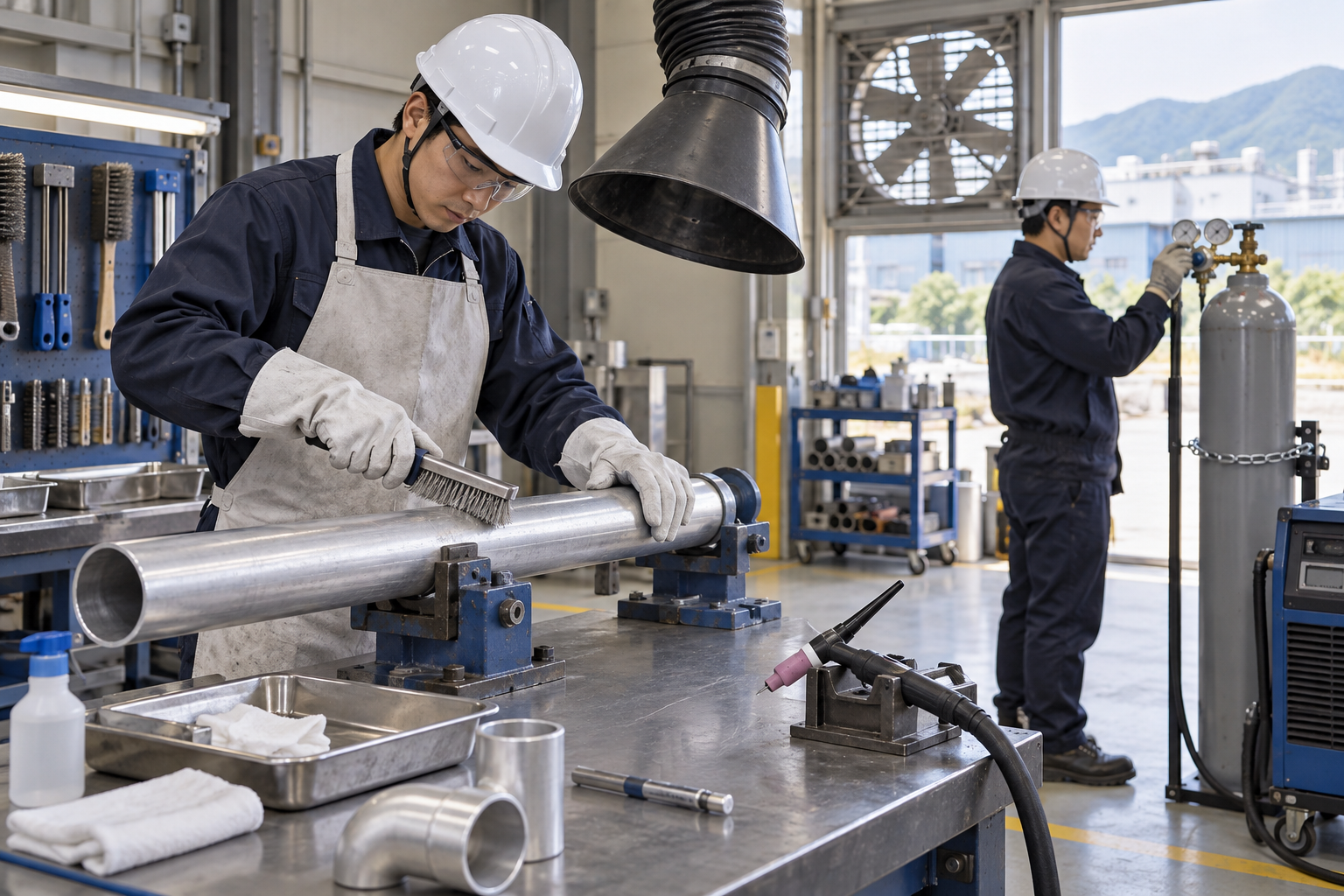
This illustration provides educational context. It is not an actual incident photograph or evidence of equipment suitability; any AI-generated depiction is illustrative only.
The scenario and record comparisons are fictional teaching examples, not records of real incidents, measurements, inspections, signatures or approvals.
| Stage | Fictional situation |
|---|---|
| Initial situation | An isolated aluminium pipe joint is ready for preparation. |
| Changed condition | A brush previously used on other material is substituted and drying is skipped. |
| Failure path | Contamination remains despite a bright surface. |
| Possible outcome | Porosity or other defects may require examination and repair; appearance does not identify a single cause. |
| Prevention barrier | Hold welding, restore clean dry preparation and connect affected joints to the approved inspection disposition. |
Failure mechanisms
Degreasing and oxide removal address different contamination. Confirm a suitable solvent and dryness before dedicated clean tooling; protect prepared joints and filler from recontamination.
Little visible smoke does not establish clean air. Assess ozone and argon accumulation, while locating extraction so it does not defeat shielding. Neither a hood nor PPE alone proves control.
Aluminium colour is not a cooling test. Use an appropriate temperature check and hot-material marking. Accept welds through the specified examination and repair process, linked to joint identity.
Decision sequence
| Step | Decision |
|---|---|
| Known | A previously used brush is substituted and drying is skipped. |
| Unknown | Remaining oil/moisture and the affected joint range are not established. |
| Hold | A bright surface does not prove clean, dry weld preparation. |
| Evidence | Record cleaning product/SDS, dedicated-tool condition, drying, filler and WPS against each affected joint. |
| Restart | Restore preparation and hot-work controls, then apply the specified inspection and repair disposition. |
Work sequence: Identify joint → Prepare station → Clean joint → Check power and gas → Weld joint → Cool and inspect → Resolve abnormality → Handover. This is a teaching flow, not a device drawing or a complete operating procedure.
5. Conditional decisions and common errors
| Situation | Required action | Evidence | Proceed when |
|---|---|---|---|
| Tool mixed | Hold and reclean | Tool identity and dry surface | Preparation accepted |
| Hood moved | Recheck air and shielding | Extraction and gas condition | Both controls effective |
| Electrode contacts | Stop and mark joint | WPS and affected weld | Disposition accepted |
| Inspection incomplete | Hold service handover | Joint and examination record | Open items closed |
Similar observations, different decisions
The scenario and record comparisons are fictional teaching examples, not records of real incidents, measurements, inspections, signatures or approvals.
| Observation | Insufficient conclusion | Required distinction |
|---|---|---|
| Dedicated brush available | Cleaning is complete. | Verify suitable degreasing, drying and protection from recontamination. |
| Little visible fume | Extraction is unnecessary. | Assess ozone, gas accumulation and air movement as well as shielding. |
| Hot-work permit closed | The pipe is fit for service. | Weld examination, repairs, cooling and service acceptance remain separate. |
6. Roles and responsibilities
| Role | Responsibility |
|---|---|
| Work supervisor | Confirm pipe and isolation and the task scope, resources, interfaces and stop authority. |
| Qualified technical reviewer | Review tool and sds checks, model limits, compatibility and unresolved technical conditions within assigned competence. |
| Work crew | Apply the listed controls, report changes and stop when evidence or safeguards are missing. |
| Inspector / assessor | Record actual screens and ppe and other relevant checks; do not mark unverified conditions as accepted. |
| Handover authority | Reconcile temperature and marking, restrictions and outstanding actions before the next task. Role labels do not establish a legal credential. |
Supervision and handover focus
| Stage | Management action | Evidence |
|---|---|---|
| Identify joint | 1. Record pipe and isolation2. Record alloy and filler lot3. Record wps revision | 1. Pipe and isolation2. Alloy and filler lot3. WPS revision |
| Prepare station | 1. Record tool and sds checks2. Record pipe support3. Record cylinder and regulator | 1. Tool and SDS checks2. Pipe support3. Cylinder and regulator |
| Check power and gas | 1. Record insulation and return2. Record gas and air assessment3. Record cylinder restraint | 1. Insulation and return2. Gas and air assessment3. Cylinder restraint |
| Weld joint | 1. Record screens and ppe2. Record current balance and gas3. Record fit and sequence | 1. Screens and PPE2. Current balance and gas3. Fit and sequence |
| Resolve abnormality | 1. Record stop condition2. Record joint range3. Record cause and correction | 1. Stop condition2. Joint range3. Cause and correction |
| Handover | 1. Record temperature and marking2. Record supply and ventilation3. Record weld and fire-watch closure | 1. Temperature and marking2. Supply and ventilation3. Weld and fire-watch closure |
7. Hold points and record comparison
| Hold point | Evidence before release | Actual approval |
|---|---|---|
| HP-0 Scope | Identify, isolate, prepare, AC TIG weld, cool and inspect aluminium pipe joints with traceable material, filler and approved welding procedure. | |
| HP-1 Identify joint | Pipe and isolation; Alloy and filler lot; WPS revision; Hot-work permit and contacts | |
| HP-2 Clean joint | Residual contents; Clean dry surfaces; Solvent suitability; Material and WPS | |
| HP-3 Check power and gas | Insulation and return; Gas and air assessment; Cylinder restraint; Hood and shielding | |
| HP-4 Handover | Temperature and marking; Supply and ventilation; Weld and fire-watch closure; Joint repair history |
Hold points are internal project checks. They are not universal statutory permits and do not grant work permission. Reassess after defects, changed conditions and shift changes.
Record comparison
The scenario and record comparisons are fictional teaching examples, not records of real incidents, measurements, inspections, signatures or approvals.
The boxes are static record prompts, not interactive or saved approvals. A tick does not establish suitability or permission to restart. Record the evidence, person, time and unresolved issues; retain the change history.
| Record | Insufficient record | Record checklist |
|---|---|---|
| Identify joint | Only marked “OK” | □ Pipe and isolation□ Alloy and filler lot□ WPS revision□ Hot-work permit and contacts |
| Check power and gas | Only marked “OK” | □ Insulation and return□ Gas and air assessment□ Cylinder restraint□ Hood and shielding |
| Resolve abnormality | Only marked “OK” | □ Stop condition□ Joint range□ Cause and correction□ Restart authority |
| Handover | Only marked “OK” | □ Temperature and marking□ Supply and ventilation□ Weld and fire-watch closure□ Joint repair history |
8. Site checklist and emergency response
| Site check | Actual result | Person / action |
|---|---|---|
| Identify joint: Pipe and isolation; Alloy and filler lot; WPS revision; Hot-work permit and contacts | ||
| Prepare station: Tool and SDS checks; Pipe support; Cylinder and regulator; Clear escape route | ||
| Clean joint: Residual contents; Clean dry surfaces; Solvent suitability; Material and WPS | ||
| Check power and gas: Insulation and return; Gas and air assessment; Cylinder restraint; Hood and shielding | ||
| Weld joint: Screens and PPE; Current balance and gas; Fit and sequence; Electrode and weld | ||
| Cool and inspect: Temperature method; Power and gas state; Examination result; Repair and retest | ||
| Resolve abnormality: Stop condition; Joint range; Cause and correction; Restart authority | ||
| Handover: Temperature and marking; Supply and ventilation; Weld and fire-watch closure; Joint repair history |
Stop work
Hold unknown pipe isolation, material/filler traceability, WPS, cleanliness, dryness or hot-work safeguards. Stop for shielding failure, electrode contact, gas leakage, poor air conditions or changed work interfaces; identify the affected joints before recovery.
Emergency response
Stop welding and withdraw from gas accumulation, fire or unsafe electrical conditions. Raise the site alarm and call 995 for a medical emergency. Do not enter an oxygen-deficient or otherwise unsafe area to rescue a colleague; trained responders must control access and hazards. Retain joint IDs and safe shutdown records before a reviewed restart.
9. Sources and review limits
Public-source access/review: 2026-10-14.
| Official source | Reviewed scope and limits |
|---|---|
| MOM: Risk management | Include preparation, gas change, rework and later service handover in the pipe-welding RA and SWP. Official explanation of statutory duties; linked SSO text was not independently read for this item. This is not a legal opinion. |
| MOM/NEA/SCDF: Revised SS 586 adoption | Match the actual degreaser and gas label/SDS to the Singapore hazard-communication requirements within scope. Official adoption circular, not full paid SS 586 text or a classification of the actual product; verify current supplier label and SDS. |
| WSH Council: Managing WSH for SMEs in Metalworking | Prepare the hot-work area, protect the opposite side, maintain ventilation and fire watch, inspect cables and gas supply, and close the post-work checks. Official sector guidance and sample controls, not a universal statutory permit rule, a qualified WPS or a current-edition certificate. Linked paid standards were not read; direct SSO General Provisions access returned 403. |
| SCDF: Emergency Medical Services | For serious burns, breathing difficulty or other medical emergencies call 995; control access and guide responders. Official emergency-response information, not a site-specific rescue plan or authorisation for untrained rescue. |
No actual equipment model, site measurements, design calculations or signed approval was supplied. Check the applicable Singapore requirements and approved safe work procedures against the actual equipment and site before use. Statutory duties, official guidance and manufacturer limits serve different purposes; editorial checks do not establish legal or professional approval.
10. PDF guidance and FAQ
PDF A covers basic task controls; B focuses on technical failures; C covers supervision, records and handover. The article has eight stages with four items per main cell; each PDF has six key stages with three items per main cell. P/S/R/A, measurements, confirmations and signatures remain blank for actual site assessment.
PDFs are complementary six-stage extracts. Apply all eight body stages and the actual equipment/site procedure.
Is a dedicated brush enough?
No. Degrease, dry and prevent recontamination as well.
Does little smoke mean ventilation is unnecessary?
No. Assess ozone, shielding gas and actual exposure.
May colour establish a cool pipe?
No. Use an appropriate temperature-check method.
Does a smooth bead prove acceptance?
No. Complete the specified examination and any repair and retest.
Has a professional verified or approved this document?
AI-generated reference material; not professionally verified or approved. Before use, a qualified person must review and adapt it to Singapore requirements, the actual equipment/site and approved safe work procedures.
11. Revision history and authorship
AI-generated reference material; not professionally verified or approved. Before use, a qualified person must review and adapt it to Singapore requirements, the actual equipment/site and approved safe work procedures.
| Date | Version | Change | Review status |
|---|---|---|---|
| 2026-10-14 | SG 1.0 | New Singapore edition from assigned Korean source; task decisions, records and PDFs localized. | AI editorial review; no professional technical approval |
Korean edition revision history: 2026-09-20 (v1.0): initial article, sources, fictional analysis and PDF editorial checks; 2026-09-22 (v1.1): earlier published draft/version retained in the source history; 2026-10-12 (v1.2): earlier published draft/version retained in the source history. These are editorial records, not professional technical approval. Singapore v1.0 adapts the earlier edition to Singapore requirements and terminology.
Site reviewers must add their actual qualifications, scope, date and approval only after the review occurs.