Plan the receiver foundation and drain connection together with the Singapore registration/examination route. Keep the first pressurisation separate from mechanical installation acceptance; connected receivers and automatic systems can reintroduce energy.
AI-generated reference material. It has not been verified or approved by a professional. Before use, a qualified person must review and adapt it to applicable Singapore requirements, the actual equipment and site, and approved safe work procedures.
1. Singapore legal and technical basis
Singapore air receivers fall within the MOM pressure-vessel registration framework, subject to defined exemptions. The owner must establish the actual registration and examination position with an Authorised Examiner before use. Installation completion, a pressure gauge reading and an exemption from registration are different decisions. Risk assessment covers lifting, stored pressure, automatic drain operation and subsequent maintenance.
| Source category | Task application and limit |
|---|---|
| MOM - Risk management | Assess unloading, anchoring, all connected pressure sources and future drain maintenance. Official explanation of WSH Risk Management duties, not a complete consolidated statutory text. |
| MOM - Register a Pressure Vessel | Check safe working pressure, volume, receiver identity, registration/exemption evidence and the Authorised Examiner interface before operation. Official explanation. Registration exemptions do not remove design, maintenance or other WSH duties. Boiler-specific documents are not automatically receiver requirements. |
| WSHC - Safe Use of Machinery | Apply verified isolation to automatic drain power and connected pressure sources before opening or repair. Official guidance with a summary of statutory duties; not a machine-specific safeguard design or full review of current legislation or paid standards. |
Use Singapore requirements and SI units. Manufacturer limits apply to the actual model. Foreign technical examples do not establish Singapore statutory duties. A job safety analysis or completed checklist is not a permit or approval.
2. Scope and required inputs
Included: Unloading, positioning and securing an air receiver, connecting its drain piping while isolated and depressurized, and handing the installation over for a separately controlled initial pressurization. Identify every connection to compressors, other receivers, headers and automatic drain power before opening the system.
Separate review: Pressure-vessel repair, welding or drilling the vessel, live tightening, pressure testing, and commissioning beyond the documented handover require separate procedures. Installation completion does not authorize operation.
| Input | Required evidence |
|---|---|
| Plan receiver | Vessel ID and rating; Mass and support basis; Anchor drawing revision; Drain and gauge access |
| Isolate and vent | Isolation boundary record; Zero-energy verification; Automatic functions isolated; Residual pockets addressed |
| Connect drain | Fitting and seal identity; Nozzle load and alignment; Collection arrangement; Drain access and protection |
| Hand over | Installation acceptance; Pressurization authority; Open items and restrictions; Operator handover record |
Confirm vessel pressure rating, drain component compatibility, lifting configuration, support reactions and anchor requirements from the actual documents. Select eye, hand, foot and other protection for lifting, sharp parts and condensate exposure. Record the applicable value, units, document revision and acceptance method.
Singapore application
MOM lists exemption from registration for an air receiver whose safe working pressure does not exceed 0.5 bar OR whose safe-working-pressure times volume does not exceed 100 bar litres. Use actual vessel records and confirm the category with the owner/Authorised Examiner; exemption does not remove safe design or maintenance duties. Do not substitute a compressor nameplate pressure for the receiver rating.
3. Eight-stage JSA
| Job stage | Hazards and effects | Failure factors | Controls | Site verification | P | S | R | A |
|---|---|---|---|---|---|---|---|---|
| 1. Plan receiver | 1. Vessel rupture2. Foundation overload3. Receiver overturning4. Maintenance obstruction | 1. Wrong vessel rating2. Unknown operating mass3. Anchor layout conflict4. Drain access blocked | 1. Verify vessel documents2. Check foundation reactions3. Match anchors to design4. Reserve service access | 1. Vessel ID and MOM status2. Mass and support basis3. Anchor drawing revision4. Drain and gauge access | ||||
| 2. Unload and move | 1. Dropped receiver2. Swinging load strike3. Nozzle damage4. Pinch injury | 1. Wrong lifting points2. Unstable travel route3. Rigging bears on fittings4. Hands under the base | 1. Use approved lift points2. Prepare route and exclusion3. Protect vessel fittings4. Use hands-clear positioning | 1. Shipping mass and CG2. Rigging inspection3. Route bearing capacity4. Signals and clearance | ||||
| 3. Isolate and vent | 1. Pressure jet2. Backfeed injury3. Automatic restart4. Condensate splash | 1. Common header overlooked2. Blocked gauge connection3. Drain power still live4. Trapped pipe pocket | 1. Isolate every pressure feed2. Verify designated venting3. Control drain power4. Collect discharge safely | 1. Isolation boundary record2. Zero-energy verification3. Automatic functions isolated4. Residual pockets addressed | ||||
| 4. Seat and secure | 1. Receiver movement2. Anchor failure3. Base distortion4. Crushed fingers | 1. Uneven base contact2. Wrong anchor installation3. Forced bolt alignment4. Premature sling release | 1. Check level and contact2. Install specified anchors3. Resolve fit without force4. Release after stable support | 1. Support contact record2. Anchor installation check3. Alignment acceptance4. Stability before unhooking | ||||
| 5. Connect drain | 1. Fitting ejection2. Nozzle overload3. Slippery condensate4. Blocked condensate drain | 1. Wrong fitting rating2. Unsupported pipe weight3. Unsafe discharge route4. Drain slope unsuitable | 1. Match gas pressure ratings2. Support piping separately3. Route to safe collection4. Check slope and blockage | 1. Fitting and seal identity2. Nozzle load and alignment3. Collection arrangement4. Drain access and protection | ||||
| 6. Inspect devices | 1. Vessel overpressure2. Undetected pressure3. Blocked drainage4. Unsafe maintenance | 1. Relief path isolated2. Gauge not readable3. Drain point obstructed4. Device details unverified | 1. Keep relief path open2. Check gauge access3. Verify low-point drainage4. Inspect specified devices | 1. Relief path inspection2. Gauge identity and range3. Drain arrangement check4. Device documents available | ||||
| 7. Hold on leakage | 1. Air or liquid jet2. Fitting separation3. Repeat pressure release4. Uncontrolled restart | 1. Tightening while live2. Fault cause unknown3. Temporary repair accepted4. Boundary changed unnoticed | 1. Stop and isolate again2. Depressurize before repair3. Use approved repair scope4. Repeat affected inspections | 1. Defect and isolation record2. Cause and repair evidence3. Retest procedure reference4. Revised boundary check | ||||
| 8. Hand over | 1. Early pressurization2. Unreleased defect3. Unsafe vent discharge4. Future isolation error | 1. Mechanical finish assumed2. Test scope not defined3. People remain exposed4. Drawings not updated | 1. Issue installation record2. Use separate test procedure3. Clear the affected area4. Transfer isolation drawings | 1. AE and installation records2. Pressurization authority3. Open items and restrictions4. Operator handover record |
P/S/R/A and actual measurements, checks, names and signatures remain blank for the site assessment. A score cannot waive a required control.
4. Hypothetical scenario and failure mechanisms
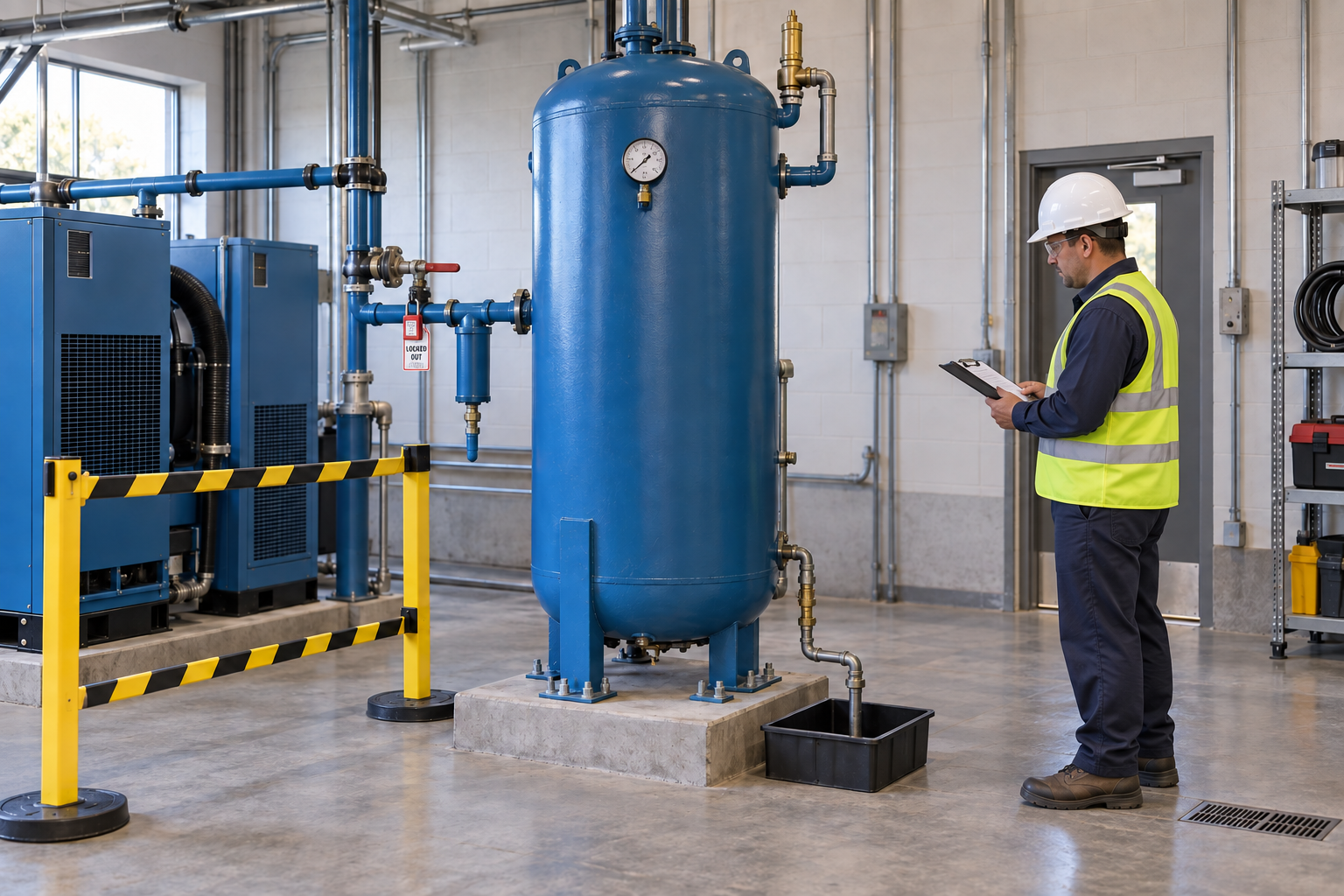
The following scenario, comparisons and example records are hypothetical teaching material. They do not reproduce actual incidents, measurements, signatures or approvals.
| Item | Hypothetical situation |
|---|---|
| Initial state | A crew prepares to connect a receiver drain after stopping its compressor. |
| Change | The gauge reads zero, but another receiver remains connected through the common header. |
| Failure path | A blocked gauge connection or an overlooked backfeed can leave pressure at the union. Loosening it to check pressure opens an uncontrolled release path. |
| Possible harm | An air jet, expelled fitting or hot oily condensate could strike the worker. |
| Barrier | Identify and isolate all feeds; use the designed vent and verification method. Hold the opening until the actual boundary and zero-energy evidence agree. |
A stopped compressor is a control state, not an isolation boundary. A shared header, a second receiver or automatic restart can supply energy after the local machine stops. Verify the complete system boundary before opening the drain.
A zero indication is useful evidence only when the instrument and its connection are reliable and the relevant trapped volumes are addressed. Never create a test opening by cracking a union or removing a plug. Keep the vent discharge directed to a safe place.
Piping weight, forced alignment and thermal movement can load a receiver nozzle. Provide designed independent supports and compatible fittings; anchors secure the receiver but do not make an incorrectly loaded nozzle acceptable.
Relief protection and condensate drainage have different functions. Verify the unrestricted relief path, accessible gauge and low-point drain arrangement. Site-specific blockage control, oily-condensate collection and later maintenance access remain part of installation handover.
| Decision | Reason and evidence |
|---|---|
| Known facts | The gauge reads zero, but another receiver remains connected through the common header. |
| Unresolved | A blocked gauge connection or an overlooked backfeed can leave pressure at the union. Loosening it to check pressure opens an uncontrolled release path. |
| Hold reason | Stop for uncertain isolation, residual pressure, damaged lifting points, unsupported pipe forces, a blocked relief path, leaks or unverified vessel ratings. |
| Evidence needed | Fitting and seal identity; Nozzle load and alignment; Collection arrangement; Drain access and protection. |
| Next decision | Identify and isolate all feeds; use the designed vent and verification method. Hold the opening until the actual boundary and zero-energy evidence agree. |
Singapore application
In humid service, accumulated condensate can obstruct drainage or conceal deterioration. Route it to the approved collection system; do not assume an oily discharge may enter a stormwater drain. Freezing needs assessment only where the actual refrigerated process or environment creates it.
5. Hold and proceed decisions
| Condition | Action | Evidence | Proceed when |
|---|---|---|---|
| Isolation uncertain | Hold opening; identify all feeds and trapped volumes. | Boundary, vent and zero-energy records. | All pressure sources controlled. |
| Drain misaligned | Support and realign without loading the nozzle. | Support drawing and fitting identification. | Supported, compatible connection. |
| Relief path uncertain | Hold pressurization and inspect the complete path. | Device and connection records. | Unrestricted relief path. |
| Leak found | Stop, isolate, depressurize and correct by procedure. | Defect, repair and retest records. | Repair passes controlled retest. |
| Comparison | Situation A | Situation B |
|---|---|---|
| Zero gauge | All supply paths isolated and the designated vent verified. | Only the compressor stop button was pressed. |
| Connection complete | Supports, ratings, devices and inspection records match the installation. | The joint looks tight, but pressurization and device checks remain open. |
6. Roles and supervision
| Role | Responsibility |
|---|---|
| Work supervisor | Confirm scope, task sequence, exclusion and stop authority. Coordinate plan receiver with affected operations. |
| Technical reviewer | Resolve the actual design and equipment limits: Vessel ID and rating; Mass and support basis; Anchor drawing revision; Drain and gauge access. |
| Work crew | Perform isolate and vent using the approved procedure; report any mismatch before proceeding. |
| Inspector / assessor | Verify Relief path inspection; Gauge identity and range; Drain arrangement check; Device documents available. Record what was actually checked and what remains unresolved. |
| Release / receiving authority | Confirm Installation acceptance; Pressurization authority; Open items and restrictions; Operator handover record. Transfer restrictions and the next permitted stage. |
These are responsibility examples, not invented statutory credentials. Meet the actual training, competent-person, qualified-person and licensing requirements for the assigned work. Anyone may raise a hazard and request a stop; only the designated authority may release the affected stage after evidence is reviewed.
Singapore application
The owner provides the vessel fabrication and design records and arranges required registration/examination through an Authorised Examiner. The installer records supports, connected pipework and device paths. Neither the installation supervisor nor this reference replaces the AE role.
7. Hold points and record quality
| Hold point | Evidence before release | Confirmation / approval |
|---|---|---|
| HP-0 Start | Scope, jurisdiction, equipment identity, responsible people and emergency arrangements. | |
| HP-1 Isolate and vent | Isolation boundary record; Zero-energy verification; Automatic functions isolated; Residual pockets addressed | |
| HP-2 Connect drain | Fitting and seal identity; Nozzle load and alignment; Collection arrangement; Drain access and protection | |
| HP-3 Inspect devices | Relief path inspection; Gauge identity and range; Drain arrangement check; Device documents available | |
| HP-4 Hand over | Installation acceptance; Pressurization authority; Open items and restrictions; Operator handover record |
Hold points are internal evidence gates. They do not replace statutory permits or actual signatures. Recheck affected gates after a change, abnormal event or shift transfer. The blank record must identify the evidence, person, time, limits and release scope.
| Record | Insufficient record | Record checklist |
|---|---|---|
| Vessel | Tank is OK | □ Vessel ID and rating□ Mass and support basis□ Anchor drawing revision□ Drain and gauge access |
| Isolation | Gauge is zero | □ Isolation boundary record□ Zero-energy verification□ Automatic functions isolated□ Residual pockets addressed |
| Connection | Pipe installed | □ Fitting and seal identity□ Nozzle load and alignment□ Collection arrangement□ Drain access and protection |
| Handover | Ready to run | □ Installation acceptance□ Pressurization authority□ Open items and restrictions□ Operator handover record |
The □ boxes are static prompts, not saved or interactive approvals. Each checks one record element. A tick alone does not establish suitability or permission to restart. Link equipment IDs and supporting records; retain unresolved matters and the earlier record when conditions change.
8. Pre-work checks and emergency response
| Check item | Result | Person / action |
|---|---|---|
| Vessel ID and rating | ||
| Shipping mass and CG | ||
| Isolation boundary record | ||
| Support contact record | ||
| Fitting and seal identity | ||
| Relief path inspection | ||
| Defect and isolation record | ||
| Installation acceptance | ||
| Emergency arrangements and unresolved restrictions communicated |
Stop work: Stop for uncertain isolation, residual pressure, damaged lifting points, unsupported pipe forces, a blocked relief path, leaks or unverified vessel ratings.
Emergency response: Keep people out of the jet, fitting-ejection and potential vessel-failure area. Stop and isolate from a safe location if trained and able to do so; do not approach a leaking pressurized fitting. Activate the site emergency plan and contact the site emergency responders for an injury or uncontrolled hazardous release. Recovery and depressurization require a reviewed method.
9. Sources and review limits
Public-source review: 14 October 2026. Only the material and limits identified below were reviewed.
| Source | Reviewed material | Task application |
|---|---|---|
| MOM - Risk management | Responsibilities; routine and non-routine work; hierarchy of control and risk assessment team. Official explanation of WSH Risk Management duties, not a complete consolidated statutory text. | Assess unloading, anchoring, all connected pressure sources and future drain maintenance. |
| MOM - Register a Pressure Vessel | Registration categories, exemptions, owner and Authorised Examiner responsibilities and supporting documents. Official explanation. Registration exemptions do not remove design, maintenance or other WSH duties. Boiler-specific documents are not automatically receiver requirements. | Check safe working pressure, volume, receiver identity, registration/exemption evidence and the Authorised Examiner interface before operation. |
| WSHC - Safe Use of Machinery | Printed pages 4, 27, 37-39: dangerous parts, maintenance training, hazardous-energy isolation, verification, group/shift continuity and restoration. Official guidance with a summary of statutory duties; not a machine-specific safeguard design or full review of current legislation or paid standards. | Apply verified isolation to automatic drain power and connected pressure sources before opening or repair. |
Selected official public sources were read on 14 October 2026 within the stated scope. No full consolidated statutory text, paid Singapore Standard, actual equipment manual, engineering calculation, site measurement or professional technical approval is claimed. Check current detailed duties and actual equipment before use.
AI-generated reference material. It has not been verified or approved by a professional. Before use, a qualified person must review and adapt it to applicable Singapore requirements, the actual equipment and site, and approved safe work procedures.
10. PDF use and frequently asked questions
PDF A covers basic task controls; B examines technical failures; C focuses on supervision, evidence and handover. Each has six rows and three items per main cell. They are complementary extracts: apply all eight body stages and the applicable site procedure. An omitted stage is not permission to omit its controls. PDF HP-0 through HP-4 are worksheet labels; match the event, evidence and authority rather than assuming they match another permit by number.
P/S/R/A, actual measurements, confirmations and signatures remain blank. The PDFs are uncompleted reference worksheets, not issued work permits.
Content group ID: jsa-airreceiver-installation
Does zero on the gauge prove it is safe to open?
No. Verify isolation, the instrument path and all trapped volumes using the approved procedure; do not loosen a fitting as a pressure test.
Can a valve be fitted between the receiver and its safety valve?
Keep the designed relief path effective and verify the accepted arrangement with the competent vessel reviewer before release.
Does this sheet authorize a pressure test?
No. Use a separately reviewed test and commissioning procedure with its own boundaries, instruments, limits and release authority.
Has a professional verified or approved this document?
No. This is AI-assisted reference material. Editorial and layout checks are not a physical inspection or professional technical approval. Obtain qualified professional review and required site approval before use.
Singapore application
Relief-path integrity must be checked against the accepted receiver design and applicable Singapore requirements. Do not add or close an isolating device that defeats overpressure protection; unresolved protection is a hold on pressurisation.
11. Authorship and revision history
AI-generated reference material. It has not been verified or approved by a professional. Before use, a qualified person must review and adapt it to applicable Singapore requirements, the actual equipment and site, and approved safe work procedures.
| Date / edition | Authorship and scope | Professional approval |
|---|---|---|
| 2026-09-20 / Korean source | Original topic and educational illustration retained as references. Source content is unchanged. | Not asserted |
| 14 October 2026 / Singapore 1.0 | Added Singapore MOM registration/exemption and Authorised Examiner handover; replaced foreign receiver-law assertion; prioritised condensate blockage, corrosion and safe oily-water collection for the actual local installation. | Not performed |
Source topic: https://smartjsabridge.com/ko/case-study/jsa-airreceiver-installation