Replace ordinary disposable HVAC filters through an external access opening from a stable floor. No person enters the air handler.
Do not open the unit with unidentified isolation points or any fan movement. Hold work for unknown contamination, mould or leakage, excessive dust release, wrong filters, damaged tracks or seals, or unsafe access.
AI-generated reference material. It has not been professionally verified or approved. Before use, a suitably qualified person must review and adapt it to applicable Singapore requirements, the actual equipment and site, and approved safe work procedures.
1. Legal and technical scope
Singapore facility maintenance must be included in the workplace risk assessment and communicated to affected people, as explained by MOM under the WSH risk-management framework. Apply the assessed safe work procedure for isolating fan, automatic controls, accessories and stored movement. WSHC guidance connects ACMV maintenance with indoor-air-quality management. This external-access filter task does not authorise electrical wiring or repair; arrange the appropriate EMA-licensed electrical worker where that scope is involved. Do not infer a blanket statutory permit from this worksheet.
Assess the actual activity under the applicable Singapore WSH requirements. Statutory duties, official guidance, manufacturer instructions and approved project documents have distinct roles. A site hold point is not automatically a statutory permit. Use competent local review to resolve the applicable industry, installation, access and permit requirements.
| Basis | Application and limits |
|---|---|
| MOM risk management | Official explanation: risk assessment, control, monitoring and communication for routine and non-routine work, including maintenance; reviewed 14 October 2026. |
| WSHC preventing machine hazards | Official guidance: hierarchy of controls, guarding, competent operators and maintenance LOTO. It is not a model-specific isolation instruction. |
| WSHC electrical safety | Official guidance: maintenance energy isolation, stored-energy control, verification and reinstatement; electrical scope still requires applicable EMA authorisation. |
| EMA worker licences | Official explanation of licensed electrical work, supervision and the distinction where equipment work involves no wiring. Actual electrical duties require the appropriate licence class. |
| WSHC Indoor Air Quality | Official guidance on indoor contaminants and systematic IAQ management; references SS 553 and SS 554, whose full text was not obtained. |
| WSHC Management of Indoor Air Quality guidelines | Selected introduction, risk-management and programme sections 3 and 5.1–5.2: Singapore ACMV context, responsible facilities coordination and occupant communication. Historical guide references do not prove current standard editions. |
| SCDF emergency medical services | Official 995 emergency ambulance service information; use emergency services for actual emergencies. |
2. Scope and required inputs
Included: Replace ordinary disposable HVAC filters through an external access opening from a stable floor. No person enters the air handler.
Separate review: Internal entry, elevated access, suspected infectious/process/asbestos contamination, HEPA integrity testing, UV treatment and electrostatic-cleaner servicing require separate analysis.
| Input | Required evidence |
|---|---|
| Identify unit | Unit ID and operator; Filter part and grade; Served area and occupant notice; Contamination history |
| Prepare access | Door pressure state; Contamination and handling plan; Door restraint; Withdrawal space |
| Fit replacement | Part and airflow marks; Seal continuity; Installed count; Retainer condition |
| Dispose and hand over | Waste destination; Parts and positions; Date and reading record; Facilities follow-up owner |
Use the actual filter grade, frame, seal, direction and operating-pressure criteria. Coordinate the shutdown and return to service with the building facilities team and affected occupants. In Singapore air-conditioned premises, moisture, leakage and mould findings require investigation and suitable exposure controls before ordinary filter handling resumes. Do not assume that changing filters certifies indoor air quality. No universal pressure drop, exposure limit or replacement interval is supplied.
3. Eight-stage JSA
P = likelihood; S = severity; R = risk under the site method; A = acceptance or authorization as defined by the site. Leave these blank until actual assessment and control verification. A low score does not override a legal requirement, product limit or unreleased hold point.
| Job stage | Hazards and effects | Failure factors | Required controls | Site verification | P | S | R | A |
|---|---|---|---|---|---|---|---|---|
| 1. Identify unit | 1. Wrong unit stopped2. Unsuitable filter3. Service interruption4. Hidden contamination | 1. Tag mismatch2. Size-only selection3. Operator not informed4. History omitted | 1. Match unit and service2. Check grade and frame3. Coordinate facilities shutdown4. Review contamination | 1. Unit ID and operator2. Filter part and grade3. Served area and occupant notice4. Contamination history | ||||
| 2. Isolate fan | 1. Fan contact2. Unexpected restart3. Accessory exposure4. Residual rotation | 1. Remote OFF only2. Auto-start retained3. Accessory feed missed4. Airflow drives fan | 1. Isolate all sources2. Control automatic starts3. Verify isolation and zero motion4. Verify accessory state | 1. Isolation-point list2. Lockout verification3. Fan-motion check4. Accessory identification | ||||
| 3. Prepare access | 1. Door movement2. Dust inhalation3. Pinched fingers4. Blocked withdrawal | 1. Pressure remains2. Residue unknown3. Door unsecured4. Access obstructed | 1. Confirm safe pressure2. Assess dust moisture and mould3. Secure access door4. Clear removal path | 1. Door pressure state2. Contamination and handling plan3. Door restraint4. Withdrawal space | ||||
| 4. Remove used filter | 1. Dust release2. Contaminated contact3. Frame cuts4. Dropped filter | 1. Filter shaken2. Packaging absent3. Broken frame gripped4. Load not supported | 1. Withdraw without shaking2. Bag at removal point3. Protect sharp edges4. Support filter weight | 1. Visible damage2. Package suitability3. Contact protection4. Removal arrangement | ||||
| 5. Fit replacement | 1. Air bypass2. Filter collapse3. Wrong filtration4. Loose frame | 1. Seal damaged2. Airflow reversed3. Wrong filter grade4. Fastener omitted | 1. Match part and direction2. Inspect tracks and seals3. Check grade and count4. Secure each position | 1. Part and airflow marks2. Seal continuity3. Installed count4. Retainer condition | ||||
| 6. Restore and start | 1. Tool drawn into fan2. Open rotating parts3. Dust recirculation4. Unexpected occupant impact | 1. Tools left inside2. Door not secured3. Waste remains4. No restart notice | 1. Account for tools and waste2. Close doors and guards3. Clear and notify staff4. Use controlled restart | 1. Tool and waste count2. Door closure3. People clear4. Restart authorisation | ||||
| 7. Check operation | 1. Bypass leakage2. Abnormal pressure drop3. Filter deformation4. Missed service fault | 1. Low reading accepted2. Fan condition changed3. Seal gap overlooked4. Noise ignored | 1. Compare operating state2. Check specified readings3. Inspect safe indicators4. Stop on abnormality | 1. ACMV operating state2. Pressure-drop basis3. Seal and defect report4. Corrective action | ||||
| 8. Dispose and hand over | 1. Contaminant spread2. Wrong future replacement3. History loss4. Premature acceptance | 1. Bag reopened2. Location omitted3. Readings unlinked4. Defect concealed | 1. Keep waste contained2. Record filter locations3. Link baseline readings4. Transfer open issues | 1. Waste destination2. Parts and positions3. Date and reading record4. Facilities follow-up owner |
4. Hypothetical scenario and failure mechanisms
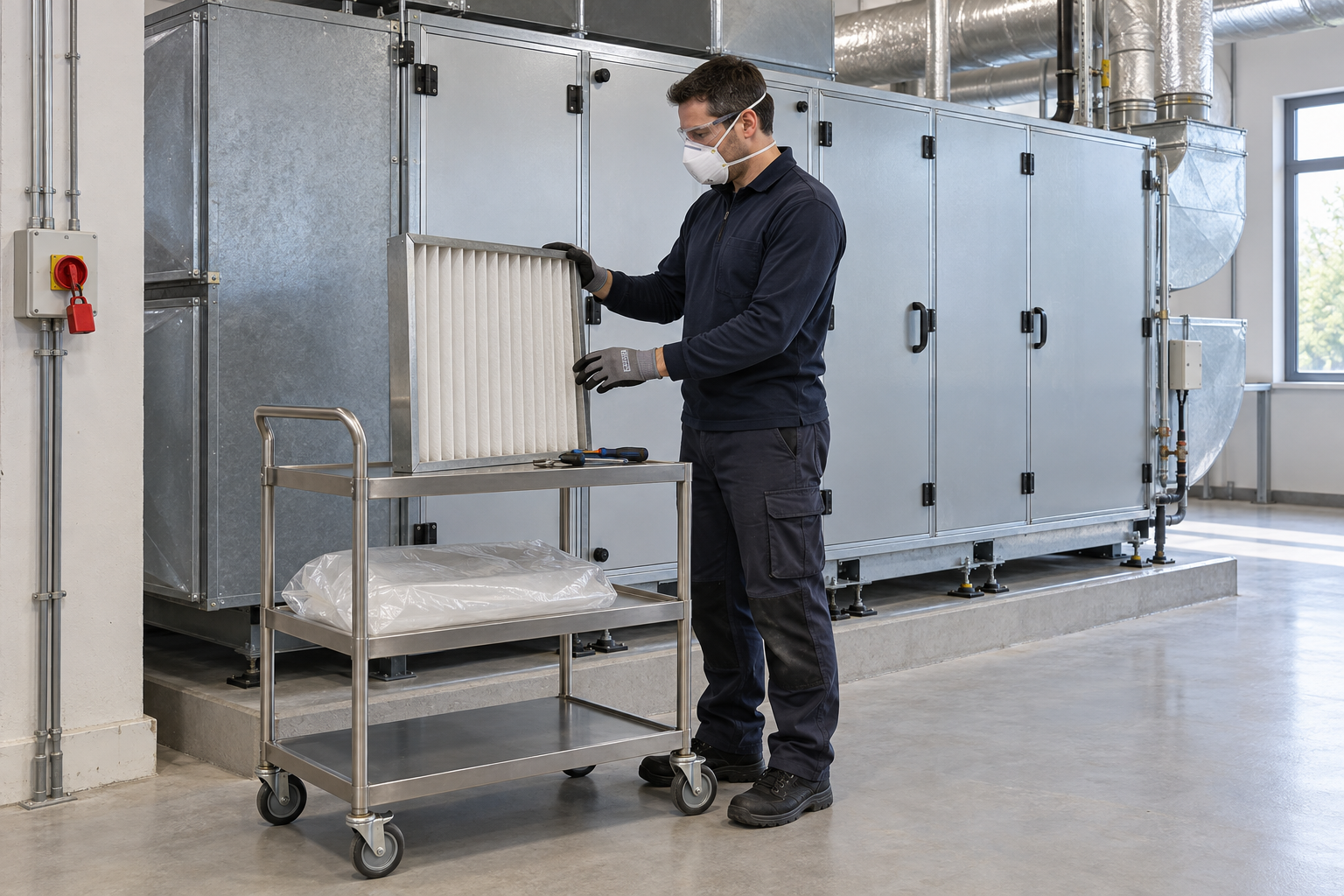 Retained source illustration: an AI-generated educational concept, not a real incident photograph or evidence of equipment suitability.
The following scenario, comparisons and example records are hypothetical teaching material. They do not reproduce actual incidents, measurements, signatures or approvals.
| Item | Hypothetical situation |
|---|---|
| Initial state | A facilities crew replaces a filter through an external AHU opening. |
| Change | The new frame is thinner and an edge gap remains although the pressure drop falls. |
| Failure path | The crew treats the lower reading as successful replacement without checking bypass or the fan operating state. |
| Possible harm | Unfiltered air and disturbed contamination may enter occupied areas; opening the running unit adds fan-contact exposure. |
| Barrier | Stop and isolate, verify compatible frame and continuous sealing, restore doors and perform the authorised operating checks before the facilities team releases service. |
A lower pressure drop is not proof of a successful replacement. A missing filter, edge gap or changed fan operating point can also reduce the reading. Compare readings under documented operating conditions and verify the complete air path.
A remote OFF command does not physically isolate energy. Identify local, building-control and automatic restart sources, accessories and residual rotation. Verify the isolation under the site energy-control program before opening access.
Do not shake or blow out a disposable filter for reuse. Unexpected mould, leakage or process residues change the exposure and disposal assessment; stop and obtain an appropriate containment plan.
Coordinate this maintenance window through the building facilities or IAQ team. Record the served area, occupant notifications, discovered moisture or mould, and the conditions under which service may resume. An IAQ programme role is a management arrangement in the cited guidance, not an invented licence for every filter installer.
| Decision | Reason and evidence |
|---|---|
| Known facts | The new frame is thinner and an edge gap remains although the pressure drop falls. |
| Unresolved | The crew treats the lower reading as successful replacement without checking bypass or the fan operating state. |
| Hold reason | Do not open the unit with unidentified isolation points or any fan movement. Hold work for unknown contamination, mould or leakage, excessive dust release, wrong filters, damaged tracks or seals, or unsafe access. |
| Evidence needed | Part and airflow marks; Seal continuity; Installed count; Retainer condition. |
| Next decision | Stop and isolate, verify compatible frame and continuous sealing, restore doors and perform the authorised operating checks before the facilities team releases service. |
5. Conditional decisions and common errors
| Condition | Action | Evidence | Proceed when |
|---|---|---|---|
| Edge gap | Stop and isolate before correction | Part number, track and seal inspection | Correct fit and seal |
| Fan movement | Keep access closed; verify all energy paths | Isolation points and zero-motion check | Fan safely stationary |
| Unknown residue | Contain area and reassess handling | Contamination history and disposal plan | Exposure controls ready |
| Restart | Clear tools, restore doors, notify operators | Closure and operating-condition record | Unit closed and cleared |
| Comparison | Situation A | Situation B |
|---|---|---|
| Same dimensions | Correct grade, frame and seal documented | Size alone leaves compatibility unresolved |
| Lower pressure drop | Seal and fan conditions checked | Low reading alone could indicate bypass |
6. Roles and responsibilities
| Role | Responsibility |
|---|---|
| Work supervisor | Confirm scope, task sequence, exclusion and stop authority. Coordinate identify unit with affected operations. |
| Technical reviewer | Resolve the actual design and equipment limits: Unit ID and operator; Filter part and grade; Served area and occupant notice; Contamination history. |
| Work crew | Perform prepare access using the approved procedure; report any mismatch before proceeding. |
| Inspector / assessor | Verify Tool and waste count; Door closure; People clear; Restart authorisation. Record what was actually checked and what remains unresolved. |
| Release / receiving authority | Confirm Waste destination; Parts and positions; Date and reading record; Facilities follow-up owner. Transfer restrictions and the next permitted stage. |
These are responsibility examples, not invented statutory credentials. Meet the actual training, competent-person, qualified-person and licensing requirements for the assigned work. Anyone may raise a hazard and request a stop; only the designated authority may release the affected stage after evidence is reviewed.
7. Hold points and record comparison
| Hold point | Evidence before release | Confirmation / approval |
|---|---|---|
| HP-0 Start | Scope, jurisdiction, equipment identity, responsible people and emergency arrangements. | |
| HP-1 Isolate fan | Isolation-point list; Lockout verification; Fan-motion check; Accessory identification | |
| HP-2 Fit replacement | Part and airflow marks; Seal continuity; Installed count; Retainer condition | |
| HP-3 Check operation | ACMV operating state; Pressure-drop basis; Seal and defect report; Corrective action | |
| HP-4 Dispose and hand over | Waste destination; Parts and positions; Date and reading record; Facilities follow-up owner |
Hold points are internal evidence gates. They do not replace statutory permits or actual signatures. Recheck affected gates after a change, abnormal event or shift transfer. The blank record must identify the evidence, person, time, limits and release scope.
| Record | Insufficient record | Record checklist |
|---|---|---|
| Unit and service | Correct size | □ Unit ID and operator□ Filter part and grade□ Served area and occupant notice□ Contamination history |
| Access and exposure | Door open | □ Door pressure state□ Contamination and handling plan□ Door restraint□ Withdrawal space |
| Filter fit | New filter fitted | □ Part and airflow marks□ Seal continuity□ Installed count□ Retainer condition |
| Operating release | Pressure lower | □ ACMV operating state□ Pressure-drop basis□ Seal and defect report□ Corrective action |
The □ boxes are static prompts, not saved or interactive approvals. Each checks one record element. A tick alone does not establish suitability or permission to restart. Link equipment IDs and supporting records; retain unresolved matters and the earlier record when conditions change.
8. Site checklist and emergency response
| Check item | Result | Person / action |
|---|---|---|
| Unit ID and operator | ||
| Isolation-point list | ||
| Door pressure state | ||
| Visible damage | ||
| Part and airflow marks | ||
| Tool and waste count | ||
| ACMV operating state | ||
| Waste destination | ||
| Emergency arrangements and unresolved restrictions communicated |
Stop work: Do not open the unit with unidentified isolation points or any fan movement. Hold work for unknown contamination, mould or leakage, excessive dust release, wrong filters, damaged tracks or seals, or unsafe access.
Emergency response: If the fan moves unexpectedly, keep people outside the opening and have designated personnel control and verify all energy sources. For expanding dust or suspected contamination exposure, withdraw, prevent dispersal and activate the site response plan. Call SCDF 995 for serious injury, severe breathing difficulty or fire; give the AHU location, access route, energy state and contaminant information. Do not reach into moving parts to attempt rescue.
9. Sources and review limits
Official-source review date: October 14, 2026. The following review is limited to the public provisions or selected manufacturer material identified below. It does not establish that any authority approved this article or the actual installation.
- MOM risk management: Official explanation: risk assessment, control, monitoring and communication for routine and non-routine work, including maintenance; reviewed 14 October 2026.
- WSHC preventing machine hazards: Official guidance: hierarchy of controls, guarding, competent operators and maintenance LOTO. It is not a model-specific isolation instruction.
- WSHC electrical safety: Official guidance: maintenance energy isolation, stored-energy control, verification and reinstatement; electrical scope still requires applicable EMA authorisation.
- EMA worker licences: Official explanation of licensed electrical work, supervision and the distinction where equipment work involves no wiring. Actual electrical duties require the appropriate licence class.
- WSHC Indoor Air Quality: Official guidance on indoor contaminants and systematic IAQ management; references SS 553 and SS 554, whose full text was not obtained.
- WSHC Management of Indoor Air Quality guidelines: Selected introduction, risk-management and programme sections 3 and 5.1–5.2: Singapore ACMV context, responsible facilities coordination and occupant communication. Historical guide references do not prove current standard editions.
- SCDF emergency medical services: Official 995 emergency ambulance service information; use emergency services for actual emergencies.
Paid consensus standards and site-specific calculations, manuals, inspection records and product certificates were not independently obtained or verified unless specifically identified. Korean and overseas legal references are source history, not Singapore statutory duties. Singapore Standards and model-specific limits were not read in full unless expressly identified.
10. PDF guidance and FAQ
PDF A covers basic task controls; B examines technical failures; C focuses on supervision, evidence and handover. Each has six rows and three items per main cell. They are complementary extracts: apply all eight body stages and the applicable site procedure. An omitted stage is not permission to omit its controls. PDF HP-0 through HP-4 are worksheet labels; match the event, evidence and authority rather than assuming they match another permit by number.
P/S/R/A, actual measurements, confirmations and signatures remain blank. The PDFs are uncompleted reference worksheets, not issued work permits.
Content group ID: jsa-ahu-filter-replacement
Does remote OFF make the unit safe?
No. Use the applicable energy-control procedure, including automatic starts, accessories and residual motion.
What pressure drop requires replacement?
Use the actual unit/filter criteria and operating conditions. This edition supplies no universal setting.
Can a disposable filter be cleaned with air?
This scope is replacement, not cleaning for reuse. Avoid dust dispersal and follow the contamination-specific handling plan.
Does this cover entering the unit?
No. Entry, access, energy and possible confined-space hazards require separate assessment.
Has a professional verified or approved this document?
AI-generated reference material. It has not been professionally verified or approved. Before use, a suitably qualified person must review and adapt it to applicable Singapore requirements, the actual equipment and site, and approved safe work procedures.
11. Revision history and authorship
AI-generated reference material. It has not been professionally verified or approved. Before use, a suitably qualified person must review and adapt it to applicable Singapore requirements, the actual equipment and site, and approved safe work procedures.
This system has not physically inspected the equipment, structures, ground, atmosphere or worksite. The document does not replace legal advice, manufacturer procedures, engineering design, inspection certificates, qualification evidence, the site risk assessment or an actual work permit.
Before use, a suitably qualified and authorized person must review the actual equipment, loads, methods, protection, inspection and emergency arrangements and resolve open issues. Record the real reviewer, organization, qualifications, delegated authority, reviewed documents, date, signature, exclusions and conditions of approval separately.
| Date | Version | Change | Review status |
|---|---|---|---|
| 2026-09-25 | 1.0 | Korean source revision retained in the source snapshot. | Historical editorial status; not Singapore professional approval. |
| 2026-10-14 | SG 1.0 | Singapore localisation of the Korean source with its assigned US technical reference; local applicability, task controls and sources reviewed. | AI-assisted editorial work; professional approval not performed. |