A sectional unit and a completed assembly have different weights and centres of gravity. Verify the authorised lifting configuration before rigging, including doors and loose internal components.
AI-generated reference material; not professionally verified or approved. Before use, a qualified person must review and adapt it to Singapore requirements, the actual equipment/site and approved safe work procedures.
Stop before starting
Hold lifting for unknown lifting points, centre of gravity or support capacity. Stop duct connection for forced alignment, casing distortion, unstable supports or unisolated fan starting sources.
1. Legal and technical scope
| Basis | Scope and limits |
|---|---|
| MOM: Risk management | Assess receiving, lifting, duct connection and separate fan commissioning with the occupier, contractors and facility operator; brief the crew on changing interfaces. Official explanation of statutory duties; linked SSO text was not independently read for this item. This is not a legal opinion. |
| WSH Council: Planning a Lift | Prepare the module-specific lifting plan and PTW arrangement; include lifting unit, gross load, radius, support, signalman and exclusion zone. Stop and revise the plan when the actual route or configuration changes. Official practical guidance. No assertion that every activity is a crane operation or that this page itself establishes a universal statutory permit. |
| MOM: Register Lifting Equipment | Match the actual crane/hoist and rigging IDs to the applicable MOM registration and examination evidence before the AHU lift; retain the distinction between equipment examination and lift release. Official registration explanation; determine the actual equipment category and applicable exceptions. Registration is not approval of the individual lift. |
| WSH Council: Preventing Falls from Height | Select protected platforms for elevated duct joints; confirm whether the premises and fall distance trigger hazardous-WAH PTW, and integrate relevant FPP controls. Official explanatory guidance; the stated PTW scope is not a general exemption from fall controls below that height. Actual premises classification must be checked. |
| WSH Council: Preventing Machine Hazards | Prevent fan start from main supply, controls and building-management interfaces; verify isolation before entering the casing or correcting a joint and restore guards before commissioning. Official practical guidance, not the actual machine isolation procedure or proof of equipment compliance. |
| SCDF: Emergency Medical Services | Call 995 for a medical emergency, give the building, floor and plantroom access point and arrange a guide while keeping personnel outside the unstable load or fan danger zone. Official emergency-response information, not a site-specific rescue plan or authorisation for untrained rescue. |
In Singapore, the employer, principal and other relevant duty holders must manage risks for the actual installation and subsequent commissioning. Follow the WSH Council lifting-plan guidance and verify applicable MOM equipment registration and examination records. The lifting plan, safe work procedure and permit arrangement must describe this module and lifting configuration. For elevated connections, check WSH (Work at Heights) requirements against the premises and fall exposure: the official hazardous-WAH PTW explanation applies to factories where a person could fall more than 3 metres. Fall protection is still needed for other fall hazards. Use verified lock-out/tag-out for all fan starting sources. These sources explain different duties and safeguards; no universal permit or professional approval is inferred.
2. Scope and required inputs
Included work
Receive, lift, set and connect sectional air-handling units; verify foundations, vibration isolators, independently supported ductwork and the transition to commissioning.
Separate assessment
Refrigerant charging, energised electrical work, fan operation and balancing are separate tasks. Lifting a field-assembled unit using the lifting points of a single section requires explicit manufacturer authorisation.
| Required input | Evidence to obtain |
|---|---|
| Plan route | Module mass and centre; Foundation review; Route dimensions; Door swing |
| Prepare area | Platform and rails; Lifting team and signals; Capacity and radius; Gloves and eye PPE |
| Rig and isolate | Lifting configuration; Rigging ID and examination; Energy verification; Shipping restraints |
| Lift and move | Load balance; Radius in m and rated load; Escape clearance; Lift-zone control |
No actual equipment model, site measurements, design calculations or signed approval was supplied. Check the applicable Singapore requirements and approved safe work procedures against the actual equipment and site before use. Statutory duties, official guidance and manufacturer limits serve different purposes; editorial checks do not establish legal or professional approval.
Singapore site application
In an occupied Singapore building, coordinate the receiving bay, goods-lift route and plantroom access with the facility operator. Keep the public out of the lifting and overhead duct zones, maintain emergency access and include simultaneous trades in the RA and SWP briefing. A booking for the loading bay does not release the lift.
For external or rooftop transfer, assess rain-wet access, lightning exposure, wind effects on the module and the actual equipment weather limits. Suspend the affected operation when the site plan or conditions require it; do not invent a universal wind-speed limit.
Use kilograms for module and rigging mass, metres for the actual lifting radius and millimetres for the relevant clearances, with the equipment chart units verified. Record module ID, crane/hoist ID, examination evidence, lifting-plan revision and the assigned lifting team separately from the duct-installation and fan-commissioning releases.
3. Eight-stage JSA
| Job stage | Hazards and effects | Failure factors | Technical and procedural controls | Site verification | P | S | R | A |
|---|---|---|---|---|---|---|---|---|
| 1. Plan route | 1. Floor failure2. Unit overturn3. Transport collision4. Maintenance entrapment | 1. Unknown unit weight2. Weak foundation3. Route obstruction4. Door clearance lost | 1. Confirm module mass in kg2. Check floor support3. Measure access route4. Reserve service space | 1. Module mass and centre2. Foundation review3. Route dimensions4. Door swing | ||||
| 2. Prepare area | 1. Worker fall2. Falling material3. Crane overturn4. Sheet-metal cuts | 1. Unsafe work platform2. Uncontrolled lift zone3. Wrong crane radius4. Unprotected edges | 1. Provide safe access2. Apply lift plan and PTW3. Verify crane support4. Use edge protection | 1. Platform and rails2. Lifting team and signals3. Capacity and radius4. Gloves and eye PPE | ||||
| 3. Rig and isolate | 1. Casing rupture2. Sling damage3. Unexpected fan start4. Loose parts fall | 1. Wrong lifting point2. Sharp sling contact3. Control power remains4. Unsecured doors | 1. Use designated frame2. Protect sling contact3. Isolate all starts4. Secure internal parts | 1. Lifting configuration2. Rigging ID and examination3. Energy verification4. Shipping restraints | ||||
| 4. Lift and move | 1. Load rotation2. Crane overload3. Crushing at wall4. Struck-by load | 1. Unbalanced rigging2. Radius increases3. Unsafe guide position4. People below load | 1. Check balance low2. Monitor lift radius3. Follow signalman directions4. Exclude people below | 1. Load balance2. Radius in m and rated load3. Escape clearance4. Lift-zone control | ||||
| 5. Set modules | 1. Crushed fingers2. Isolator displacement3. Base distortion4. Unit overturn | 1. Hand alignment2. Wrong mount position3. Uneven support4. Early rigging release | 1. Use alignment tools2. Match mount layout3. Check base contact4. Secure before release | 1. Hands clear2. Mount load sharing3. Base level4. Release stability | ||||
| 6. Connect duct | 1. Falling duct2. Casing distortion3. Sharp-edge cuts4. Worker fall | 1. Missing hangers2. Forced flange fit3. Exposed cut ends4. Poor work access | 1. Support duct separately2. Align flexible joint3. Protect cut ends4. Maintain safe platform | 1. Hanger condition2. Joint force and slack3. Edge protection4. Access location | ||||
| 7. Correct defects | 1. Stored load shifts2. Sharp debris3. Fan contact4. Structural weakening | 1. Joint released early2. Debris left behind3. Isolation lost4. Unapproved drilling | 1. Support before release2. Remove sharp scrap3. Recheck isolation4. Revise and re-approve plan | 1. Support sequence2. Workface cleanup3. Start prevention4. Change drawing | ||||
| 8. Inspect and handover | 1. Vibration and leakage2. Exposed moving parts3. Restraints remain4. Unplanned startup | 1. Joint unchecked2. Guard left open3. Restraint list missing4. Release confused | 1. Inspect joints and mounts2. Restore guards and doors3. Record restraints4. Separate startup release | 1. Joint inspection2. Guard fasteners3. Restraint checklist4. Commissioning scope |
P = likelihood; S = severity; R = risk under the site method; A = site-defined acceptance/authorization. These actual assessment cells are blank. A low score never overrides a missing safeguard or a legal or manufacturer restriction.
4. Fictional scenario and failure mechanisms
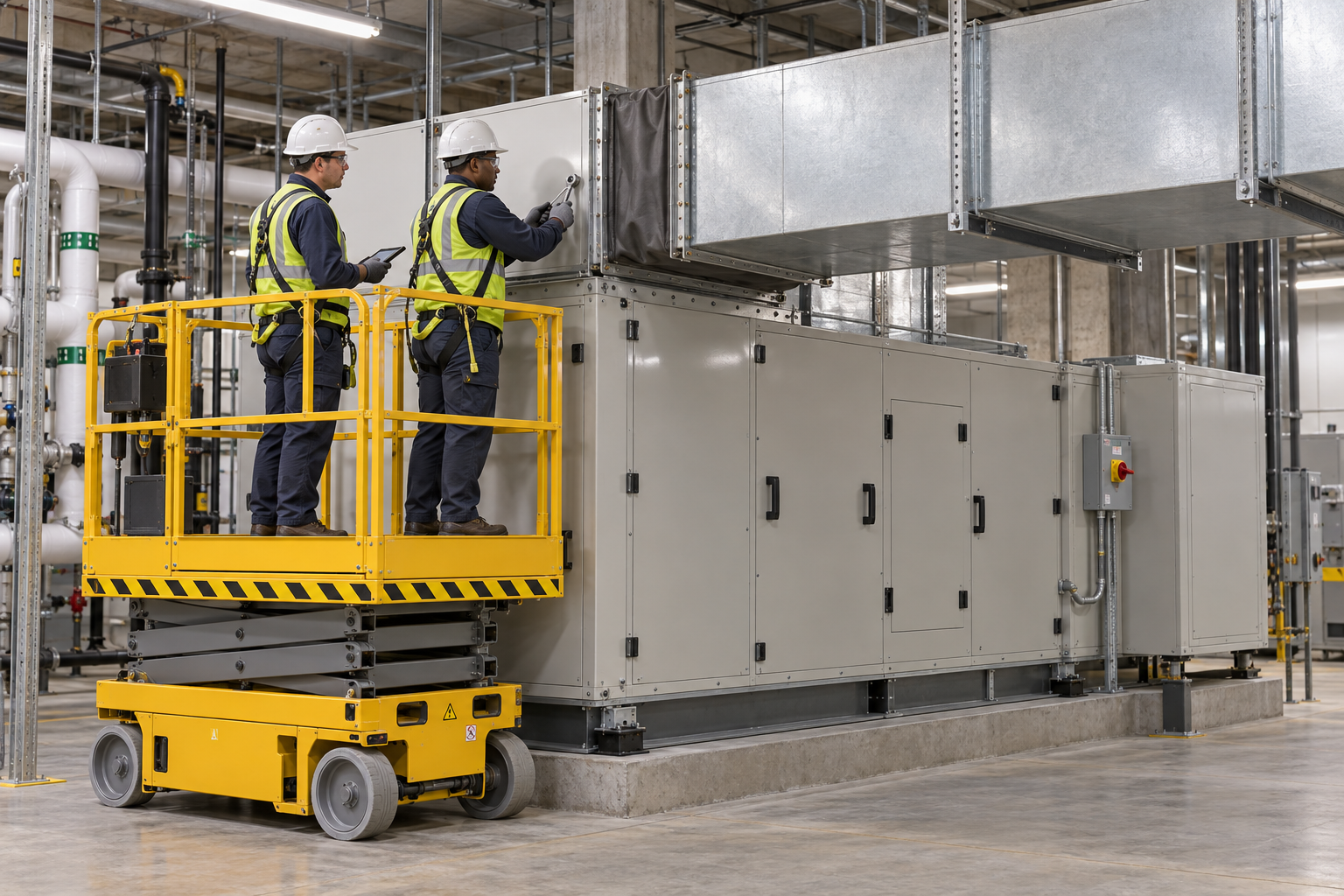
This illustration provides educational context. It is not an actual incident photograph or evidence of equipment suitability; any AI-generated depiction is illustrative only.
The scenario and record comparisons are fictional teaching examples, not records of real incidents, measurements, inspections, signatures or approvals.
| Stage | Fictional situation |
|---|---|
| Initial situation | A crew has set an air handler and is connecting the duct. |
| Changed condition | The hanger does not align, so flange bolts are used to pull the duct toward the casing. |
| Failure path | The casing and flexible connector receive duct weight and alignment force. |
| Possible outcome | The casing can distort, isolator loading can change and the joint can leak. |
| Prevention barrier | Hold the connection; correct independent support and alignment, inspect the affected mounts and joint, then review commissioning separately. |
Failure mechanisms
A sectional unit and a completed assembly have different weights and centres of gravity. Verify the authorised lifting configuration before rigging, including doors and loose internal components.
A level casing does not prove that all vibration isolators share the load. Check mounting orientation, contact, shipping restraints and the manufacturer sequence for releasing them.
A flexible duct connector accommodates intended movement; it does not replace duct hangers. Correct hanger location and alignment before connecting, and distinguish installation acceptance from permission to start the fan.
Decision sequence
| Step | Decision |
|---|---|
| Known | The duct hanger is misaligned and the crew proposes drawing the flange to the casing with bolts. |
| Unknown | The actual duct load path, forces on the casing and contact at each vibration mount are not verified. |
| Hold | Bolting cannot compensate for missing independent support or an unsuitable alignment. |
| Evidence | Link hanger arrangement, alignment, connector allowance and isolator inspection to the specific module and joint. |
| Restart | Remove the forced load, verify independent support and mount contact, inspect the joint, and retain the separate commissioning release. |
Work sequence: Plan route → Prepare area → Rig and isolate → Lift and move → Set modules → Connect duct → Correct defects → Inspect and handover. This is a teaching flow, not a device drawing or a complete operating procedure.
5. Conditional decisions and common errors
| Situation | Required action | Evidence | Proceed when |
|---|---|---|---|
| Combined lift | Verify authorised lifting configuration | Assembly weight, centre and lifting drawing | Lifting points confirmed |
| Uneven mounts | Correct support and shipping restraints | Mount layout and contact checks | Load support confirmed |
| Forced flange | Realign independent duct supports | Hanger and connector inspection | External force removed |
| Fan startup | Complete a separate commissioning release | Guards, tools and restraint checklist | Startup conditions verified |
Similar observations, different decisions
The scenario and record comparisons are fictional teaching examples, not records of real incidents, measurements, inspections, signatures or approvals.
| Observation | Insufficient conclusion | Required distinction |
|---|---|---|
| Bolted duct joint | The bolt holes line up, so support is accepted. | Independent hangers carry the duct; alignment, flexible-joint allowance and isolator contact are verified. |
| MOM equipment record | The equipment is registered, so this combined-module lift is accepted. | Equipment evidence and the actual load/configuration lifting plan are separate checks. |
| Connection complete | Fan start may proceed immediately. | Isolation release, guards, personnel clearance and commissioning authorisation are separately verified. |
6. Roles and responsibilities
| Role | Responsibility |
|---|---|
| Employer / principal and work supervisor | Resource and brief the task RA/SWP, coordinate the occupied-building interfaces and enforce hold conditions. |
| Lifting supervisor and lifting team | Use the approved module lifting plan; verify actual load, rigging, radius, support and signals. Establish the appropriate trained and appointed roles for the selected crane/hoist operation. |
| Facility and isolation lead | Control main, control and building-management starting sources; record verified isolation and the separate commissioning release. |
| Duct / mechanical installation lead | Confirm independent hangers, alignment, flexible-joint allowance, vibration-mount contact and transport-restraint treatment. |
| WAH and handover personnel | Where the hazardous-WAH PTW provisions apply, use the required assessment and authorisation process. Transfer inspection evidence and unresolved defects; these role labels do not confer statutory qualifications. |
Supervision and handover focus
| Stage | Management action | Evidence |
|---|---|---|
| Plan route | 1. Record module mass and centre2. Record foundation review3. Record route dimensions | 1. Module mass and centre2. Foundation review3. Route dimensions |
| Rig and isolate | 1. Record lifting configuration2. Record rigging id and examination3. Record energy verification | 1. Lifting configuration2. Rigging ID and examination3. Energy verification |
| Lift and move | 1. Record load balance2. Record radius in m and rated load3. Record escape clearance | 1. Load balance2. Radius in m and rated load3. Escape clearance |
| Set modules | 1. Record hands clear2. Record mount load sharing3. Record base level | 1. Hands clear2. Mount load sharing3. Base level |
| Connect duct | 1. Record hanger condition2. Record joint force and slack3. Record edge protection | 1. Hanger condition2. Joint force and slack3. Edge protection |
| Inspect and handover | 1. Record joint inspection2. Record guard fasteners3. Record restraint checklist | 1. Joint inspection2. Guard fasteners3. Restraint checklist |
7. Hold points and record comparison
| Hold point | Evidence before release | Actual approval |
|---|---|---|
| HP-0 Scope | Receive, lift, set and connect sectional air-handling units; verify foundations, vibration isolators, independently supported ductwork and the transition to commissioning. | |
| HP-1 Rig and isolate | Lifting configuration; Rigging ID and examination; Energy verification; Shipping restraints | |
| HP-2 Lift and move | Load balance; Radius in m and rated load; Escape clearance; Lift-zone control | |
| HP-3 Connect duct | Hanger condition; Joint force and slack; Edge protection; Access location | |
| HP-4 Inspect and handover | Joint inspection; Guard fasteners; Restraint checklist; Commissioning scope |
Hold points are internal project checks. They are not universal statutory permits and do not grant work permission. Reassess after defects, changed conditions and shift changes.
Record comparison
The scenario and record comparisons are fictional teaching examples, not records of real incidents, measurements, inspections, signatures or approvals.
The boxes are static record prompts, not interactive or saved approvals. A tick does not establish suitability or permission to restart. Record the evidence, person, time and unresolved issues; retain the change history.
| Record | Insufficient record | Record checklist |
|---|---|---|
| Plan route | Only marked “OK” | □ Module mass and centre□ Foundation review□ Route dimensions□ Door swing |
| Lift and move | Only marked “OK” | □ Load balance□ Radius in m and rated load□ Escape clearance□ Lift-zone control |
| Correct defects | Only marked “OK” | □ Support sequence□ Workface cleanup□ Start prevention□ Change drawing |
| Inspect and handover | Only marked “OK” | □ Joint inspection□ Guard fasteners□ Restraint checklist□ Commissioning scope |
8. Site checklist and emergency response
| Site check | Actual result | Person / action |
|---|---|---|
| Plan route: Module mass and centre; Foundation review; Route dimensions; Door swing | ||
| Prepare area: Platform and rails; Lifting team and signals; Capacity and radius; Gloves and eye PPE | ||
| Rig and isolate: Lifting configuration; Rigging ID and examination; Energy verification; Shipping restraints | ||
| Lift and move: Load balance; Radius in m and rated load; Escape clearance; Lift-zone control | ||
| Set modules: Hands clear; Mount load sharing; Base level; Release stability | ||
| Connect duct: Hanger condition; Joint force and slack; Edge protection; Access location | ||
| Correct defects: Support sequence; Workface cleanup; Start prevention; Change drawing | ||
| Inspect and handover: Joint inspection; Guard fasteners; Restraint checklist; Commissioning scope |
Stop work
Hold lifting for unknown lifting points, centre of gravity or support capacity. Stop duct connection for forced alignment, casing distortion, unstable supports or unisolated fan starting sources.
Emergency response
Stop lifting or connection from a safe position and prevent access to the unstable module, duct or fan danger zone. Do not place hands in the gap or attempt an improvised rescue. Activate the site emergency plan; call 995 for a medical emergency, give the building, floor and plantroom access point, and guide responders. Secure the area and control all energy sources before authorised recovery.
9. Sources and review limits
Public-source access/review: 2026-10-14.
| Official source | Reviewed scope and limits |
|---|---|
| MOM: Risk management | Assess receiving, lifting, duct connection and separate fan commissioning with the occupier, contractors and facility operator; brief the crew on changing interfaces. Official explanation of statutory duties; linked SSO text was not independently read for this item. This is not a legal opinion. |
| WSH Council: Planning a Lift | Prepare the module-specific lifting plan and PTW arrangement; include lifting unit, gross load, radius, support, signalman and exclusion zone. Stop and revise the plan when the actual route or configuration changes. Official practical guidance. No assertion that every activity is a crane operation or that this page itself establishes a universal statutory permit. |
| MOM: Register Lifting Equipment | Match the actual crane/hoist and rigging IDs to the applicable MOM registration and examination evidence before the AHU lift; retain the distinction between equipment examination and lift release. Official registration explanation; determine the actual equipment category and applicable exceptions. Registration is not approval of the individual lift. |
| WSH Council: Preventing Falls from Height | Select protected platforms for elevated duct joints; confirm whether the premises and fall distance trigger hazardous-WAH PTW, and integrate relevant FPP controls. Official explanatory guidance; the stated PTW scope is not a general exemption from fall controls below that height. Actual premises classification must be checked. |
| WSH Council: Preventing Machine Hazards | Prevent fan start from main supply, controls and building-management interfaces; verify isolation before entering the casing or correcting a joint and restore guards before commissioning. Official practical guidance, not the actual machine isolation procedure or proof of equipment compliance. |
| SCDF: Emergency Medical Services | Call 995 for a medical emergency, give the building, floor and plantroom access point and arrange a guide while keeping personnel outside the unstable load or fan danger zone. Official emergency-response information, not a site-specific rescue plan or authorisation for untrained rescue. |
No actual equipment model, site measurements, design calculations or signed approval was supplied. Check the applicable Singapore requirements and approved safe work procedures against the actual equipment and site before use. Statutory duties, official guidance and manufacturer limits serve different purposes; editorial checks do not establish legal or professional approval.
10. PDF guidance and FAQ
PDF A covers basic task controls; B focuses on technical failures; C covers supervision, records and handover. The article has eight stages with four items per main cell; each PDF has six key stages with three items per main cell. P/S/R/A, measurements, confirmations and signatures remain blank for actual site assessment.
PDFs are complementary six-stage extracts. Apply all eight body stages and the actual equipment/site procedure.
Can section lifting eyes lift the whole assembled unit?
Only when the actual manufacturer lifting arrangement permits that assembly and load. Section ratings are not assembly ratings.
Does a flexible connector support the duct?
No. Provide the designed independent duct support and alignment.
When are shipping restraints removed?
Follow the actual manufacturer sequence for assembly, lifting and startup; record each retained or released restraint.
Does a completed duct joint authorise fan operation?
No. Verify isolation release, guards, personnel clearance and the separate commissioning plan.
Has a professional verified or approved this document?
AI-generated reference material; not professionally verified or approved. Before use, a qualified person must review and adapt it to Singapore requirements, the actual equipment/site and approved safe work procedures.
11. Revision history and authorship
AI-generated reference material; not professionally verified or approved. Before use, a qualified person must review and adapt it to Singapore requirements, the actual equipment/site and approved safe work procedures.
| Date | Version | Change | Review status |
|---|---|---|---|
| 2026-10-14 | SG 1.0 | New Singapore edition from assigned Korean source; task decisions, records and PDFs localized. | AI editorial review; no professional technical approval |
Korean edition revision history: 2026-09-19 (v1.1): earlier published draft/version retained in the source history; 2026-09-26 (v1.2): task decisions, record checklist, JSA and three PDF variants revised. These are editorial records, not professional technical approval. Singapore v1.0 adapts the earlier edition to Singapore requirements and terminology.
Site reviewers must add their actual qualifications, scope, date and approval only after the review occurs.