Separate access for installers from the lifting and support of a facade panel. A platform may be within its mass rating while an unapproved panel rack, wind area or side force makes the operation unsuitable. Verify the complete arrangement before lifting anyone.
Handling method → ground and traffic → functional checks → protected access → panel restraint → fixing → lowering → departure
This is reference content written and revised with AI. It has not been verified or approved by a professional. Review by a suitably qualified professional and site authorisation are required before use.
Stop work
Stop for ground movement, changing wind beyond the approved limits, unapproved panel handling, overload, loss of communication, a failed safety function or entry into the exclusion zone. Do not force a panel into place using the boom or release a loose panel to recover stability.
AI-generated reference material; not professionally verified or approved. Before use, a qualified person must review and adapt it to applicable Singapore requirements, the actual equipment/site and approved safe work procedures.
1. Legal and technical scope
MOM explains risk-management duties for employers, self-employed persons and principals. Apply the site risk assessment to the complete panel installation, including the separate lifting interface and recovery. The WSH Council MEWP guide is official practical guidance: select a suitable machine after a site survey, prepare safe work procedures, fall prevention and rescue plans, and use trained, familiarised and authorised operators. It is not approval of an improvised panel rack or a declaration that the machine is certified for this site.
| Basis | Singapore application |
|---|---|
| Risk management | The employer, self-employed person and principal assess and control work risks. Include preparation, abnormal conditions and maintenance. Coordinate affected trades and communicate controls. |
| Activity-specific guidance | Use the guide to plan the truck-mounted access platform, operator familiarisation, designated harness anchorage, support, rescue and no-exit-at-height controls. Panel load transfer and fixing remain project/manufacturer design matters. |
| Permits and authority | Select permit requirements for the actual sector and activity. Site hold points and contractor role labels do not create statutory permits or qualifications. |
| Equipment and design | The reviewed guide gives practical MEWP precautions; the full text of SS 616 and the actual equipment manual were not supplied or reviewed. No universal wind threshold, pad area multiplier or electrical approach distance is prescribed here. Confirm the applicable Singapore work-at-height, lifting, electrical and traffic provisions for the actual installation. Do not leave the platform at height. |
2. Scope and required inputs
Included scope
Installing external cladding panels from a truck-mounted boom platform, with an independently planned panel lift or a specifically approved material-handling configuration. Includes setup, workface positioning, fixing, lowering and road departure.
Separate review
Using the basket or boom as an improvised crane, carrying an unapproved external panel, climbing out at height, live-line work and improvised rescue are outside this procedure. Choose separate lifting equipment when panel carriage is not permitted.
| Required input | What to verify |
|---|---|
| Machine and panel | Model, inspection history, approved attachment or independent lift, panel mass/area, occupants, tools and permitted load distribution. |
| Setup | Ground capacity, buried services, voids, slab limits, maximum outrigger reactions, suitable pads and traffic/exclusion arrangements. |
| Workface | Fixing design and sequence, reach, trapping points, electrical isolation/clearances, wind at the work height and communication. |
| Rescue and handover | Trained ground responder, available lower controls, emergency lowering within the manufacturer procedure, secure panel state and receiving supervisor. |
Use the actual machine and attachment instructions for ground reactions, pad design, extension, capacity, side forces, panel dimensions and wind. No universal three-times-pad-area rule, 32 km/h panel limit, 12.5 m/s permission or electrical clearance is set here. Verify local electrical and road requirements separately.
Singapore site planning
For this Singapore worksite, the principal and employers must coordinate the facade contractor, MEWP supplier and panel lifting team through the risk assessment. Identify public footpaths, occupied accessways, buried drainage and slabs below each outrigger. Recheck support after rain and reassess panel wind area at the actual working height. Prepare the fall prevention and rescue arrangements before elevation; the ground responder must know the model-specific lowering method. Assess applicable work-at-height requirements for the actual workplace and fall exposure before selecting the permit arrangements; an internal hold point is not a statutory permit.
3. Eight-stage JSA
| Job stage | Hazards and effects | Failure factors | Technical and procedural controls | Site verification | P | S | R | A |
|---|---|---|---|---|---|---|---|---|
| 1. Plan access and lifting | 1. Overturning2. Panel drop3. Electrocution4. Rescue delay | 1. Unapproved rack2. Unknown panel area3. Wrong machine4. No rescue method | 1. Select permitted handling2. Verify panel and loads3. Plan electrical protection4. Plan ground rescue | 1. Model and attachment2. Panel mass and area3. Site RA and lift interface4. Rescue arrangement | ||||
| 2. Set ground and traffic | 1. Outrigger settlement2. Crushing3. Vehicle strike4. Edge collapse | 1. Weak ground2. Buried void3. Small or weak pads4. Traffic enters | 1. Check support capacity2. Use suitable spreaders3. Set and level as specified4. Separate traffic and people | 1. Ground evidence2. Outrigger reactions3. Pad layout and level4. Exclusion boundary | ||||
| 3. Inspect and board | 1. Fall or ejection2. Uncontrolled motion3. Hydraulic failure4. Rescue failure | 1. Faulty interlock2. Gate unsecured3. Damaged hose4. Lowering untested | 1. Check safety functions2. Close gate and use anchors3. Use designated harness anchor4. Check emergency lowering | 1. Inspection record2. Gate and anchorage3. Harness system4. Trained ground responder | ||||
| 4. Position at workface | 1. Entrapment2. Electrical contact3. Panel collision4. Overturning | 1. Blind movement2. Clearance lost3. Side force applied4. Reach exceeded | 1. Move under agreed signals2. Maintain electrical limits3. Keep clear of trapping gaps4. Stay within configuration | 1. Communication2. Clearance to lines3. Safe workface position4. Reach and load | ||||
| 5. Present and restrain | 1. Panel drop2. Wind-driven movement3. Hand crushing4. Overreaching | 1. Support released early2. Unapproved suction tool3. Unsecured panel4. Poor lifting interface | 1. Retain planned support2. Use approved handling gear3. Control panel movement4. Keep feet on floor | 1. Lift coordination2. Panel restraint3. Wind at work height4. Clear hand positions | ||||
| 6. Fix and release | 1. Falling panel2. Basket side loading3. Dropped tools4. Fall from basket | 1. Fixing incomplete2. Boom used to push3. Loose tools4. Rail climbing | 1. Follow fixing sequence2. Avoid structural side loads3. Secure tools and parts4. Check before lift release | 1. Fixing connections2. Temporary supports3. Tool containment4. Release check | ||||
| 7. Lower and clear | 1. Struck-by movement2. Entrapment3. Falling parts4. Rescue obstruction | 1. Area occupied2. Blind retraction3. Loose leftovers4. Exit blocked | 1. Secure remaining items2. Clear lowering route3. Lower with communication4. Keep rescue access open | 1. Panel secure2. Route clear3. Ground guidance4. Machine condition | ||||
| 8. Stow and depart | 1. Outrigger pinch2. Road collision3. Equipment movement4. Unsafe handover | 1. People near jacks2. Boom not stowed3. Traffic unmanaged4. Defect unreported | 1. Stow before pad removal2. Clear outrigger area3. Use traffic arrangements4. Record defects and handover | 1. Stowed configuration2. Pads and jacks secured3. Road departure control4. Receiving person |
P = likelihood; S = severity; R = risk using the site method; A = site acceptance/authorisation. Complete after actual assessment; no score overrides an unresolved hold point or equipment limit.
4. Fictional scenario and failure mechanisms
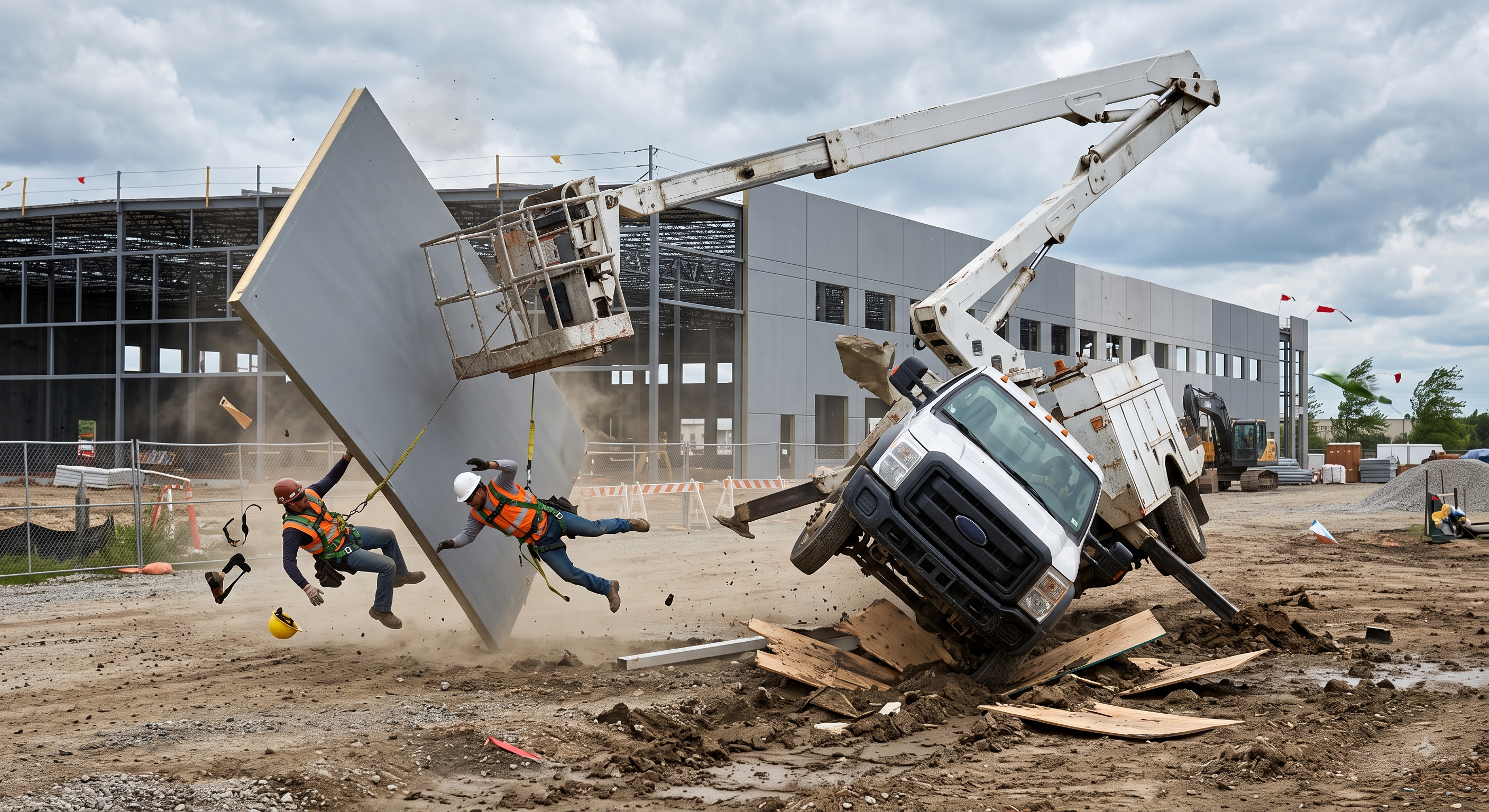
The original educational image is retained. It is not evidence of an actual incident or site suitability.
The scenario and record comparisons are fictional teaching examples, not records of real incidents, measurements, inspections, signatures or approvals.
| Item | Fictional scenario |
|---|---|
| Initial situation | Fictional example: installers approach a facade with a panel supported by a separately planned lifting system. |
| Changed condition | Wind increases while the crew is still aligning the panel and only some fixings are installed. |
| Failure path | Panel movement can load workers and basket sideways; premature lifting-release could leave the panel unsupported. |
| Possible outcome | The result could be trapping, falling material, loss of balance or machine instability. |
| Prevention barrier | Stop the alignment, keep the panel controlled by its planned supports and use the defined safe lowering or securing method. Do not drop it. |
Failure mechanisms
Outrigger reactions vary with configuration, reach and loading. Average truck weight divided by four is not a reliable pad design load. Check ground and pad capacity together, including voids, excavations, buried services and rainfall changes. A larger pad alone does not repair weak ground or a failing slab.
A broad panel adds wind area and may apply side load beyond the machine design. Remaining below the basket mass rating does not prove that an external load, rack or suction device is allowed. Consider panel lifting and installer access as separate systems unless the exact combined use is approved.
Fasteners transfer panel load to the building only after the required arrangement is installed and checked. The basket must not temporarily carry building loads or push the panel into alignment. Keep hands out of closing gaps, feet on the platform floor and the rescue route available.
Decision sequence
| Decision stage | What to verify |
|---|---|
| Known facts | The panel is aligned but the required fixings are not all verified. |
| Unresolved matters | Fixing engagement, temporary restraint and the wind condition remain unresolved. |
| Reason to hold | Releasing the lifting support would transfer load to an unconfirmed connection. |
| Required evidence | Check the fixing schedule, installed connections, temporary restraint and safe wind/handling conditions. |
| Restart decision | The designated person confirms secure support and authorises release according to the panel erection method. |
5. Conditional decisions and common errors
| Condition | Action | Evidence | Proceed when |
|---|---|---|---|
| Handling unapproved | Hold the lift; select an approved arrangement | Machine, attachment and panel documentation | Method approved |
| Ground uncertain | Keep boom stowed; assess support | Reactions, ground, pads and buried services | Support verified |
| Wind or movement | Stop alignment; secure or lower as planned | Work-height wind and panel restraint | Conditions restored |
| Fixings incomplete | Maintain planned panel support | Fixing sequence and installed connections | Fixings verified |
Similar situations, different decisions
The scenario and record comparisons are fictional teaching examples, not records of real incidents, measurements, inspections, signatures or approvals.
| Comparison | Situation A | Situation B |
|---|---|---|
| Capacity | Total mass is below rating: still check side load and panel area | Approved complete handling configuration: assess site conditions |
| Support | Outriggers look level: ground capacity remains unproven | Ground, reactions and pads verified for the actual configuration |
| Release | Panel appears aligned: keep lifting support | Required fixings and restraint checked: release may be authorised |
6. Roles and responsibilities
| Role | Responsibility |
|---|---|
| Supervisor | Confirm the access/lifting method, ground evidence, interfaces and stop criteria. |
| Operator | Inspect and set up the actual machine; control movement and keep its limits. |
| Panel installers | Maintain restraint, follow the fixing sequence and keep support until release. |
| Ground responder | Control the exclusion zone, maintain signals and remain able to use planned rescue controls. |
| Release authority | Check the installed connections and temporary restraint before authorising lifting-support release. |
The principal and employers coordinate the risk assessment and safe work procedures. These role labels allocate work; verify any qualifications and statutory appointments required for the actual Singapore activity. The receiving person must be given restrictions and unresolved defects before handover.
Record and handover perspective
| Stage | Record controls | Verification |
|---|---|---|
| Plan access and lifting | 1. Record model and attachment2. Record panel mass and area3. Record site ra and lift interface | 1. Panel mass and area2. Site RA and lift interface3. Rescue arrangement |
| Inspect and board | 1. Record inspection record2. Record gate and anchorage3. Record harness system | 1. Gate and anchorage2. Harness system3. Trained ground responder |
| Position at workface | 1. Record communication2. Record clearance to lines3. Record safe workface position | 1. Clearance to lines2. Safe workface position3. Reach and load |
| Present and restrain | 1. Record lift coordination2. Record panel restraint3. Record wind at work height | 1. Panel restraint2. Wind at work height3. Clear hand positions |
| Lower and clear | 1. Record panel secure2. Record route clear3. Record ground guidance | 1. Route clear2. Ground guidance3. Machine condition |
| Stow and depart | 1. Record stowed configuration2. Record pads and jacks secured3. Record road departure control | 1. Pads and jacks secured2. Road departure control3. Receiving person |
7. Hold points and record comparison
| Hold point | Evidence before release | Confirmation / approval |
|---|---|---|
| Start | Installing external cladding panels from a truck-mounted boom platform, with an independently planned panel lift or a specifically approved material-handling configuration. Includes setup, workface positioning, fixing, lowering and road departure. | |
| HP-1 Set ground and traffic | Ground evidence; Outrigger reactions; Pad layout and level; Exclusion boundary | |
| HP-2 Inspect and board | Inspection record; Gate and anchorage; Harness system; Trained ground responder | |
| HP-3 Fix and release | Fixing connections; Temporary supports; Tool containment; Release check | |
| HP-4 Stow and depart | Stowed configuration; Pads and jacks secured; Road departure control; Receiving person |
Complete after actual checks. Recheck after changes, defects or shift handover.
Record comparison examples
The scenario and record comparisons are fictional teaching examples, not records of real incidents, measurements, inspections, signatures or approvals.
The boxes are static record prompts, not interactive or saved approvals. A tick does not establish suitability or permission to restart. Record the evidence, person, time and unresolved issues; retain the change history.
| Record type | Insufficient record | Record checklist |
|---|---|---|
| Support | Ground looks firm | □ Ground evidence□ Outrigger reactions□ Pad arrangement□ Recheck after change |
| Handling | Load under SWL | □ Panel mass and area□ Approved attachment□ Total load and reach□ Wind limitations |
| Fixings | Panel installed | □ Fixing drawing□ Installed connections□ Temporary restraint□ Release authority |
| Rescue | Emergency ready | □ Ground responder□ Lowering controls□ Access and communication□ Fault-specific method |
Hold points are internal checks. Determine separately whether Singapore statutory or site permit requirements apply to this work. Leave confirmation, measurements and approval records blank until the authorised site process is completed.
8. Site checklist and emergency response
| Check item | Result | Person / action |
|---|---|---|
| □ Plan access and lifting: Model and attachment | ||
| □ Set ground and traffic: Ground evidence | ||
| □ Inspect and board: Inspection record | ||
| □ Position at workface: Communication | ||
| □ Present and restrain: Lift coordination | ||
| □ Fix and release: Fixing connections | ||
| □ Lower and clear: Panel secure | ||
| □ Stow and depart: Stowed configuration | ||
| □ Release / handover authority |
Stop work
Stop for ground movement, changing wind beyond the approved limits, unapproved panel handling, overload, loss of communication, a failed safety function or entry into the exclusion zone. Do not force a panel into place using the boom or release a loose panel to recover stability.
Emergency response
Use the rehearsed ground-control or rescue procedure appropriate to the fault and hazards. Keep people away from an unstable machine, live electrical contact or suspended panel. Call emergency services and the electricity operator where relevant; do not climb the boom or improvise a transfer.
9. Sources and review limits
Official public sources read for this Singapore edition on 2026-10-14. Guidance, statutory explanations and manufacturer limits have different roles; no source provider has approved this JSA.
| Source | Read scope and application limits |
|---|---|
| MOM — Risk management | Official explanation: employer, self-employed person and principal responsibilities; routine and non-routine risk assessment; hierarchy of controls; multidisciplinary assessment team. Official explanation of risk-management duties; no claim of reading the full linked statute. It does not specify task-specific equipment limits. Assess truck-mounted mewp panel installation with employers, principal and affected contractors; resolve the inputs in section 2. |
| MOM — When should my company review its risk assessment? | Review every three years, after significant changes, new machinery/substances/procedures, hazard-related injury or incident, and when assessment is inadequate. General review guidance. A review interval does not permit continued operation after a known hazard or change. Reassess this operation after changes, defects, incidents or an inadequate assessment; do not wait for a scheduled review. |
| MOM — Permit-to-Work Systems | Formal work authorisation and coordination; OPEC tripartite guidance and competent permit authority with authority to reject work. OPEC-focused guidance page; not evidence of a blanket statutory permit requirement for every task. Determine permits for this actual activity and workplace; distinguish the section 7 internal hold points from statutory or site permits. |
| WSH Council — Guide for Safe Use of Mobile Elevating Work Platforms (July 2022) | All seven PDF pages: task/site survey; selection; SWP, fall prevention and rescue planning; training/familiarisation/authorisation; pre-use checks; ground, harness anchor, occupancy/load, entrapment, no exiting at height, parking. Official guidance, not a statutory approval or site design. Full SS 616 and actual model manual were not reviewed. Use the guide to plan the truck-mounted access platform, operator familiarisation, designated harness anchorage, support, rescue and no-exit-at-height controls. Panel load transfer and fixing remain project/manufacturer design matters. |
The reviewed guide gives practical MEWP precautions; the full text of SS 616 and the actual equipment manual were not supplied or reviewed. No universal wind threshold, pad area multiplier or electrical approach distance is prescribed here. Confirm the applicable Singapore work-at-height, lifting, electrical and traffic provisions for the actual installation. Do not leave the platform at height.
Actual site measurements, equipment instructions, engineering checks and signed approval records were not supplied. A qualified person must resolve these before use.
10. PDF guidance and FAQ
PDF A covers basic task controls; B focuses on technical failures; C covers supervision, records and handover. The article has eight stages with four items per main cell; each PDF has six key stages with three items per main cell. P/S/R/A, measurements, confirmations and signatures remain blank for actual site assessment.
Content group ID
jsa-MEWP-working
Can the panel be hung from a basket rail?
Only use a material-handling arrangement expressly permitted for the machine and configuration. Otherwise use a separate suitable lifting system; rails are not improvised lifting points.
Does a normal wind rating cover a large panel?
No automatic conclusion follows. The machine, attachment and panel handling limits must all be met, including gusts and local effects at the work height.
Is a spotter permission to approach a live line?
No. Establish the applicable clearance or an authorised electrical safety arrangement with the responsible electricity operator. Account for every part of the machine, panel, tools and people.
Can workers drop the panel if the machine moves?
Do not adopt dropping as a recovery method. Plan controlled securing/lowering and rescue before work; stop and keep the danger area clear if stability is in doubt.
Has a professional verified or approved this document?
No. Public sources and editorial, layout and consistency checks were reviewed using AI. No site inspection or professional technical approval has been performed. Obtain appropriate professional review before use.
11. Revision history and authorship
AI-generated reference material; not professionally verified or approved. Before use, a qualified person must review and adapt it to applicable Singapore requirements, the actual equipment/site and approved safe work procedures.
This Singapore edition was adapted from the Korean original and its assigned US technical reference. Earlier source revisions are archival editorial history, not Singapore technical approval.
| Date | Edition | Change | Review status |
|---|---|---|---|
| 2026-08-18 | Korean source | Source editorial publication or revision; retained as provenance of the Korean edition. | Editorial record only; no professional technical approval recorded. |
| 2026-10-04 | Korean source v1.1 | Source editorial publication or revision; retained as provenance of the Korean edition. | Editorial record only; no professional technical approval recorded. |
| 2026-10-14 | 1.0 en-SG | Singapore legal scope, local planning, responsibility interfaces and SI terminology; new PDF A/B/C. | AI editorial and visual review only; no professional approval. |