This is reference content written and revised with AI. It has not been verified or approved by a professional. Review by a suitably qualified professional and site authorisation are required before use.
1. Legal and technical scope
Revision review: 2026-10-12. The direct current Ontario page returned an access error. Official indexed text supported the ventilation and competent-worker testing provisions, but did not establish the latest consolidation date. The source-currency statements below belong to the previous September 19 review and must be rechecked before use. Proprietary standards, site engineering and manufacturer documents have not been verified.
A. Ontario scope and terminology
This Canadian English guide addresses drill-and-blast excavation of civil tunnels on Ontario construction projects. O. Reg. 213/91, Construction Projects, contains general explosives requirements in sections 196–206 and underground requirements in Part IV. Part III concerns excavations; it is not the tunnel-specific part.
Section 243 excludes tunnels and shafts located at or used in connection with a mine from Part IV. Determine jurisdiction from the actual project. This guide must not be used as a substitute for a mining-specific assessment. O. Reg. 213/91
B. Applicable legislation
• Apply the Occupational Health and Safety Act and the construction requirements relevant to the work, equipment and underground conditions. The statutory term “constructor” has a specific role and should not automatically be replaced with terminology used in another province. Ontario OHSA
• Apply the federal Explosives Act and Explosives Regulations, 2013 to the relevant explosives activities. Check product authorization, acquisition, storage, security and transport requirements; these are separate from the appointment of Ontario's competent worker in charge of blasting. Explosives Act · Explosives Regulations
• Assess exposure and respiratory protection under Reg. 833, including its application provisions, and noise under O. Reg. 381/15. Do not treat P100 filters or double hearing protection as universal legal specifications for every task. Reg. 833 · Noise regulation
C. Standards and legal status
A CSA designation alone does not prove that a standard applies to this machine or operation. Identify the exact clause, edition and route by which a standard is required by legislation, a contract or an engineering specification.
Reg. 833 references CAN/CSA-Z94.4-18 for specified fit-test methods. The proprietary standard text was not reviewed in full. CSA M421 is not used here as evidence of a universal construction-site phone ban, nor is CSA B354 used to require all surveying from an elevating platform. Reg. 833, definitions and respiratory protection provisions
D. JSA, JHA and permit status
A JSA or JHA records task hazards and controls; it does not authorize departures from law. The proposed high-risk permit coordinates site releases.
Where a space meets the applicable confined-space definition and O. Reg. 632/05 applies, its entry-permit requirements are legal requirements, including section 10. A generic blasting permit does not replace them. Do not assume every tunnel is, or is not, a confined space. O. Reg. 632/05, sections 1–3 and 10
A risk score or permit cannot replace or waive statutory requirements, manufacturer procedures, inspections, engineering responsibilities or an unreleased hold point.
2. Scope and required inputs
A. Operating boundary
This JSA covers civil tunnelling at atmospheric pressure, from previous-round handover through face preparation, survey, jumbo drilling, explosives handling, firing authorization, controlled re-entry, mucking and handback.
Mine work, compressed-air work, unusual gas conditions and specialist misfire recovery require additional assessments. A change in scope suspends the affected release until the legal and technical basis is reviewed.
B. Required evidence
• Confirm project registration and notices, including the constructor's applicable notice under section 6 and the underground-work employer's notice under section 245. Record the required signed and sealed support documents and the submission status. A notice is not equivalent to government approval.
• Obtain the tunnel support design and, for a tunnel in sound rock, the engineer's written opinion required by section 307. Retain daily competent-worker inspection records and corrective actions.
• Verify the competent worker designated under section 196, posted identification, task competence, operator training and the supervision arrangements under section 197.
• Retain the current blast plan, previous-round records, hole-remnant and anomaly register, survey information, services and adjacent-working plans, product instructions and explosives inventory.
• Provide ventilation and monitoring arrangements, exposure criteria, rescue procedures, training and equipment checks, communications and suitable self-rescue respirators. Sections 264–268 contain specific tunnel-rescue requirements.
• If an internal combustion engine will operate in the tunnel, verify the Director's prior written consent required by section 316. Do not infer consent from equipment purchase or a contractor's approval. O. Reg. 213/91, sections 6, 196–197, 245, 264–268, 307 and 316
C. Open verification items
No model manuals, explosive-product instructions, site drawings, readings or signed approvals were supplied. Actual limits and release decisions remain to be verified. This article does not provide a blast design, charging specification or misfire-remediation procedure.
Detailed controls retained from the previous stage grouping
1. Review the roundand shift handover
Hazards and effects
- Retained explosives create premature-initiation risk.
- Unknown water, ground or adjacent-work conditions endanger access.
Failure factors
- Incomplete records conceal anomalous firing.
- Superseded drawings remain in use.
Technical and procedural controls
- Reconcile previous-round findings and current plans.
- Confirm competent-worker designation and the work boundary.
- Check notices, emergency readiness and any required permits or consents.
Site verification
- Heading, round, shift and document revisions.
- Unresolved hazards and named decision-makers.
- Rescue and communication readiness.
2. Assess entryand ground stability
Hazards and effects
- Gas exposure or oxygen deficiency incapacitates entrants.
- Unstable roof, walls or support cause crushing injuries.
Failure factors
- Elapsed time treated as clearance.
- Newly fractured rock overlooked after blasting.
Technical and procedural controls
- Use controlled atmospheric assessment before work entry.
- Apply the engineer's support requirements and competent-worker inspections.
- Restrict access until ground hazards are controlled.
Site verification
- Relevant air-test results and ventilation condition.
- Support drawings, inspection results and corrective actions.
- Safe approach and inspection positions.
3. Examine the faceand mark the pattern
Hazards and effects
- Hidden charged remnants may be drilled into.
- Surveyors face falls and moving equipment.
Failure factors
- Mud or dust prevents an adequate examination.
- Only collar locations are considered.
Technical and procedural controls
- Expose and examine the surface without disturbing suspect explosives.
- Record old holes and implement the section 5A restrictions.
- Choose suitable access and segregate the survey area.
Site verification
- Face examination and remnant register.
- Trajectory uncertainty and revised layout reviewed.
- Access equipment and lighting suitability.
4. Move and positionthe drill jumbo
Hazards and effects
- Vehicle collision or entrapment against the tunnel wall.
- Machine instability and hydraulic injection injuries.
Failure factors
- Blind spots, inadequate clearance or poor signals.
- Soft invert, defective braking or damaged hoses.
Technical and procedural controls
- Implement the traffic plan and signaller arrangements where needed.
- Use model-specific setup limits and support conditions.
- Check brakes, guards and stops; isolate equipment for repairs.
Site verification
- Route, refuge and pedestrian clearances.
- Model and manual revision; stabilizers where fitted.
- Inspection record and defect closure.
5. Drill thereleased pattern
Hazards and effects
- Drilling may intersect explosives or concealed services.
- Silica, noise and drill movement can injure workers.
Failure factors
- Drill deviation enters a restricted zone.
- Dust controls fail or simultaneous activities conflict.
Technical and procedural controls
- Maintain restrictions for loaded holes, remnants and simultaneous work.
- Stop for unexplained voids, unusual returns or suspect explosive material.
- Use engineered dust and noise controls with appropriate PPE.
Site verification
- Current pattern and prohibited areas.
- Logged anomalies and competent-worker decisions.
- Dust-control function and exposure assessment.
6. Transport andaccount for explosives
Hazards and effects
- Impact, fire or incompatible carriage creates explosion risk.
- Uncontrolled traffic or lost material compromises safety.
Failure factors
- Detonators travel with explosives contrary to applicable restrictions.
- Loads are unsecured or the route is obstructed.
Technical and procedural controls
- Implement sections 318–320 for the actual conveyance and route.
- Provide controlled passage, required segregation and suitable containers.
- Maintain custody and reconcile deliveries, use and returns.
Site verification
- Product condition and authorized storage arrangements.
- Conveyance, segregation, route and attendance checks.
- Inventory and delivery records.
7. Load undercompetent supervision
Hazards and effects
- Premature initiation exposes nearby workers.
- Blocked, damaged or water-affected holes contribute to misfires.
Failure factors
- Cartridges forced into an unsuitable hole.
- Incompatible initiation components or inappropriate tools.
Technical and procedural controls
- Follow the authorized plan and product instructions under the designated worker's supervision.
- Stop and resolve anomalous holes; use suitable non-sparking tools.
- Prevent prohibited overlapping drilling and charging.
Site verification
- Hole acceptance and plan revisions.
- Product, tools and system compatibility.
- Controlled access and interference assessment.
8. Verify the systemand clear affected areas
Hazards and effects
- Premature firing or partial initiation can injure workers.
- People remain in the blast area or beyond a blocked escape route.
Failure factors
- Incompatible test equipment or missing records.
- Guard posts or personnel checks are incomplete.
Technical and procedural controls
- Verify initiation arrangements against the applicable electrical-blasting provisions and manufacturer instructions.
- Account for people, guard approaches and check adjacent work.
- Implement the legally required warning and site clearance procedure.
Site verification
- System-specific verification record.
- Guard acknowledgements and personnel reconciliation.
- Warning coverage, refuges and means of escape.
9. Authorize firingand keep guards in place
Hazards and effects
- Flyrock, pressure and vibration cause injury or damage.
- Unauthorized access invalidates clearance.
Failure factors
- Changed conditions are not communicated.
- Initiation control is transferred informally.
Technical and procedural controls
- Keep the designated competent worker in control of blasting.
- Maintain barriers and safe positions throughout the firing window.
- Suspend firing if any release condition becomes uncertain.
Site verification
- Final clearance and authorization time.
- Access-control status and communication checks.
- Abnormal firing observations recorded.
10. Ventilate and makecontrolled post-blast checks
Hazards and effects
- CO, nitrogen oxides, oxygen deficiency or delayed initiation can kill entrants.
- Damaged ground or services create secondary hazards.
Failure factors
- A timer or apparent visibility substitutes for testing.
- The instrument lacks a required gas sensor.
Technical and procedural controls
- Observe the applicable waiting conditions and maintain exclusion.
- Use a protected inspection and sampling procedure.
- Escalate suspected misfires and require atmosphere, explosives and ground findings before handback.
Site verification
- Air delivery, duct integrity and sampling locations.
- Calibration, functional checks, readings and exposure criteria.
- Competent-worker findings and authorization.
11. Muck, supportand hand over
Hazards and effects
- Mucking may disturb retained explosives.
- Loose rock, traffic and airborne dust can injure workers.
Failure factors
- Conditions change as the muckpile is exposed.
- Restrictions are omitted from the next shift's records.
Technical and procedural controls
- Begin only within the released area and approved support sequence.
- Stop for suspect explosives or deteriorating ground.
- Update support, ventilation, hole-remnant and handover records.
Site verification
- Written handback and remaining exclusion zones.
- Dust suppression and traffic controls.
- Inventory reconciliation and next-shift acknowledgement.
3. Eight-stage JSA
PDF A covers basic task controls; B focuses on technical failures; C covers supervision, records and handover. The article has eight stages with four items per main cell; each PDF has six key stages with three items per main cell. P/S/R/A, measurements, confirmations and signatures remain blank for actual site assessment.
P/S/R/A: Complete only after actual site assessment using the site risk method.
| Job stage | Hazards and effects | Failure factors | Technical and procedural controls | Site verification | P | S | R | A |
|---|---|---|---|---|---|---|---|---|
| 1. Plan and handover | 1. Retained explosives2. Unknown ground3. Water inflow4. Unplanned access | 1. Missing round record2. Obsolete plan3. Unassigned duty4. Open anomaly | 1. Reconcile prior round2. Confirm legal scope3. Assign competent staff4. Keep anomalies isolated | 1. Round and heading2. Plan revision3. Appointments4. Open restrictions | ||||
| 2. Face and ground | 1. Falling rock2. Hidden remnants3. Unsafe atmosphere4. Survey exposure | 1. Mud conceals holes2. Support damage3. Unsafe approach4. Uncertain hole path | 1. Inspect from safe position2. Check support design3. Record suspect areas4. Restrict face access | 1. Ground inspection2. Remnant register3. Safe access route4. Engineering response | ||||
| 3. Jumbo setup | 1. Crushing2. Machine instability3. Hydraulic injection4. Service strike | 1. Blind approach2. Weak invert3. Defective brakes4. Damaged hoses | 1. Segregate pedestrians2. Check bearing surface3. Follow machine limits4. Isolate before repair | 1. Route and refuges2. Machine inspection3. Setup conditions4. Closed defects | ||||
| 4. Drilling controls | 1. Silica exposure2. Noise injury3. Moving drill parts4. Unexpected explosives | 1. Failed dust control2. Conflicting work3. Unexplained returns4. Hidden services | 1. Use released work area2. Maintain dust controls3. Stop on anomalies4. Prevent conflicting work | 1. Work boundary2. Dust-control function3. Exposure assessment4. Anomaly decisions | ||||
| 5. Specialist interface | 1. Premature initiation2. Fire exposure3. Lost material4. Unauthorized handling | 1. Unclear custody2. Product damage3. Ignition source4. Unqualified personnel | 1. Restrict to specialists2. Control ignition sources3. Secure material custody4. Keep other work excluded | 1. Competence records2. Product documentation3. Inventory record4. Exclusion boundary | ||||
| 6. Evacuate and guard | 1. Blast effects2. Trapped workers3. Unauthorized entry4. Uncontrolled rescue | 1. Incomplete headcount2. Blocked escape3. Lost communication4. Unguarded approach | 1. Account for all people2. Guard affected access3. Confirm warning coverage4. Suspend on uncertainty | 1. Headcount2. Guard acknowledgements3. Escape and refuge4. Communication test | ||||
| 7. Ventilate and test | 1. CO or nitrogen oxides2. Oxygen deficiency3. Delayed event4. Secondary rockfall | 1. Time used as clearance2. Missing gas sensor3. Damaged air duct4. Invalid instrument | 1. Maintain exclusion2. Verify delivered air3. Use safe sampling plan4. Limit inspection access | 1. Sensor suitability2. Time and location3. Actual readings4. Ventilation condition | ||||
| 8. Release and handback | 1. Suspected misfire2. Loose ground3. Mucking exposure4. Lost restrictions | 1. Informal release2. Unresolved anomaly3. Changing atmosphere4. Incomplete handover | 1. Do not disturb suspects2. Refer to specialists3. Integrate all findings4. Record limited release | 1. Explosives clearance2. Ground acceptance3. Atmosphere acceptance4. Signed scope and handover |
4. Fictional scenario and failure mechanisms
A. Fictional scenario adapted for Ontario
The following case is a fictional simulation for training and risk assessment. It does not represent an actual accident, a government investigation or an incident involving a particular company.
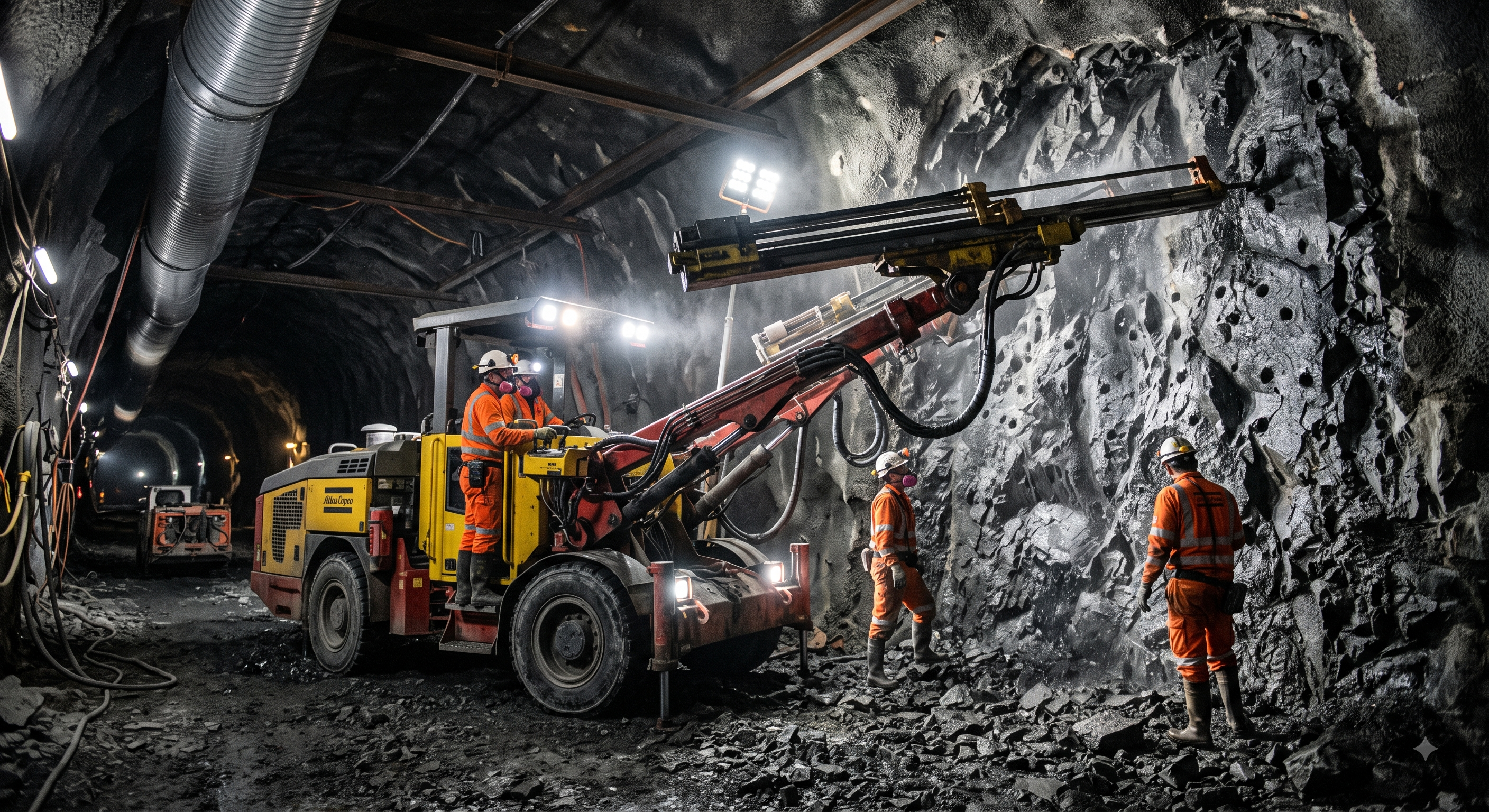
The original image URL is unchanged. The illustration does not establish the location, machine construction, failure mode or acceptability of the depicted practice.
B. Initial situation and deteriorating conditions
A fictional Ontario civil-tunnel crew is preparing the next round using a three-boom jumbo. A previous hole remnant is obscured by clay and fines. The prior round has an unresolved firing observation, but it is not carried into the new layout.
Overnight seepage increases and the sump becomes partly blocked, reducing footing quality and obscuring the face. Production pressure leads the crew to proceed without an adequate examination and release.
C. Plausible accident development
If a new drilling path intersects a retained charge or initiation component, contact could produce an unintended initiation. The outcome depends on the product, its condition, confinement and the contact mechanism; ignition or detonation cannot be proved from a generic energy equation.
A localized explosion could eject rock and fragments of the feed assembly, damage ventilation or power services and expose workers to pressure and toxic products. An operator and an assistant close to the drill could suffer severe or fatal injury. Uncontrolled rescue entry could create further casualties.
D. Rock mechanics and equipment loading
• Blasting changes the excavation boundary and confinement. Discontinuity orientation, persistence and water pressure affect potential wedge movement; intact-looking rock is not proof of stable ground.
• A support system must retain its intended load path as excavation advances. Installation defects, blast damage or a support sequence that leaves excessive unsupported ground can reduce that capacity.
• Jumbo stability depends on the actual machine configuration, contact reactions and invert conditions. A level reading does not prove adequate bearing capacity or stability under all boom positions.
• Pressure reflections, fragmentation and structural response depend on the charge and tunnel geometry. A failed feed assembly cannot be assumed to shear in a specific location or throw fragments in a predictable direction.
• No supplied structural model, product sensitivity data, pressure-time record or physical evidence establishes initiation energy, peak load or the sequence of failure. The source's simplified equations are therefore not used as calculations or proof of causation.
• Hydraulic pressure, electrical current and paint witness marks may support particular inspections, but none independently proves structural integrity, correct support installation or safe machine equilibrium.
E. Protective-barrier failures
| Protective barrier | Failure in this simulation | Resulting exposure | Required restoration evidence |
|---|---|---|---|
| Previous-round review |
| A hidden explosives hazard reached the next shift. |
|
| Face examination |
| Retained material could be intersected. |
|
| Separation and sequencing |
| Drilling could approach a loaded or uncertain hole. |
|
| Worker positioning |
| Additional exposure to fragments and mechanical movement. |
|
| Post-event control |
| Secondary gas or rockfall casualties. |
|
F. Lessons
Examination, exclusion, competent review and authorization are distinct barriers. No low risk score or clean-looking face proves a hole is free of explosives. This simulation makes no claim that Ontario authorities investigated the event or issued findings against a real employer.
5. Conditional decisions and common errors
| Condition | Action | Evidence | Proceed when |
|---|---|---|---|
| Suspected residue or misfire | Stop; isolate; refer to the designated specialist | Anomaly register and specialist decision | Affected area remains excluded until formally released |
| Ground or support changes | Suspend access and obtain technical reassessment | Updated inspection and support decision | Support and protected access accepted |
| Loss of warning or headcount | Suspend the operation and restore clearance controls | Headcount, guard replies and warning check | All people accounted for; approaches guarded |
| Elapsed time without valid air tests | Maintain exclusion and arrange safe testing | Relevant sensors, readings and ventilation checks | Air criteria met and inspection entry authorized |
| Production handback | Combine explosives, atmosphere and ground findings | Named release, boundary and remaining restrictions | All three findings accepted; scope signed |
A. Drill-hole remnants and simultaneous work
Section 204 requires predrilling examination. Its general restriction covers drilling 7.5 m or less from a hole being loaded or containing explosives; a separate restriction covers 150 mm or less from a previously charged or blasted hole or remnant unless adequate precautions establish that it is free of explosives.
Sections 204(3)–(6) contain a narrow engineered exception with additional conditions, not a general permission obtainable through a PTW. Section 322 separately prohibits simultaneous drilling or charging above or below one another on the same face, or 7.5 m or less apart measured horizontally. All applicable conditions must be satisfied together. O. Reg. 213/91, sections 204 and 322
Site application
• Do not use the 150 mm provision as permission to approach known or suspected explosive material.
• Even within the engineered exception, section 204(4) prohibits a permitted hole from being drilled one metre or less from another hole containing explosives. The exception also does not waive section 322.
• Evaluate the full relevant hole geometry, drill deviation and uncertainty.
• Expose the face by a safe method adequate for examination. These provisions do not establish universal high-pressure washing or require indiscriminate plugging of remnants.
• Isolate suspect areas and refer removal or recovery decisions to the designated competent worker under a specific lawful procedure. Do not excavate or flush a suspected charge as routine cleaning.
B. Explosives transport and initiation
Sections 318–320 set specific underground transport controls, including restrictions on passengers, other cargo and detonator carriage, and a maximum mechanical-haulage speed of 6 km/h in the circumstances of section 319. This is not a general site-vehicle speed limit.
Section 323 requires electrical firing for the covered underground work, subject to its stated block-holing exception. Do not transplant a shock-tube production method from another jurisdiction without resolving its legal basis. Select the actual system and manufacturer procedure against all applicable provisions. Sections 318–328
C. Clearance, interference and verification
Section 203 requires guards and checks on affected workers and escape routes, plus a siren warning clearly audible within a one-kilometre radius. That audible-warning radius is not a calculated blast danger radius. Determine the danger area from the actual risks.
Implement the blasting-mat requirement under section 201, applicable electrical safeguards and system-specific testing. Assess RF, stray current, static and lightning hazards using the actual product and environment; no universal CSA M421 phone distance is asserted.
Testing equipment must be specifically suitable for the identified initiation system. A general electrical tester or an “intrinsically safe” label alone does not establish compatibility with detonators or blasting circuits. Sections 201–203 and 323–328
D. Ventilation, waiting and re-entry
Section 327(1) requires workers in refuge to remain there for at least ten minutes after firing and a shot being heard. It is not a gas-clearance determination or a universal misfire waiting rule.
Sections 329–330 require fresh air and regular competent-worker testing of the atmosphere and mechanical ventilation. Suspected misfires must be reported and controlled under the applicable provisions and manufacturer instructions. This article supplies no recovery sequence. Sections 327–330
Re-entry evidence
• Use a written site procedure that identifies safe testing positions, sampling points, waiting conditions and authorization responsibilities.
• Measure oxygen, CO, NO2 and additional gases, including NO or flammable gases where identified by the assessment. Verify that the instrument actually contains the required sensors.
• Apply the Ontario exposure-limit framework and any applicable confined-space requirements; do not import BC's flammable-gas re-entry criterion. Distinguish instantaneous readings from TWA, short-term and ceiling criteria.
• Check calibration, functional response, cross-sensitivity, sampling-line delays and instrument range. Retain time- and location-specific results.
• Verify delivered ventilation, duct condition and recirculation; maintain testing as conditions change during mucking. A running fan or visible clearing is insufficient.
• Authorize production entry only after explosives, atmospheric and ground hazards are addressed. Reg. 833 · O. Reg. 632/05, where applicable
E. Ground control, equipment and exposure
Apply the support design, the engineer's rock-support opinion where required and daily competent-worker inspections under section 307. Use equipment inspections and model-specific limits; do not require elevating platforms for all survey tasks or invent hydraulic tests. Keep workers clear of boom motion and unsupported ground. O. Reg. 213/91, equipment and tunnel provisions
Select respiratory protection using measured or adequately assessed hazards, assigned protection, fit testing, training and maintenance. P100 is a particulate-filter classification, not a guarantee against CO, nitrogen oxides or oxygen deficiency.
Noise controls and hearing protection must match the actual exposure and device performance; double protection is not automatically mandatory for every task. Reg. 833 · O. Reg. 381/15 · CCOHS respirator selection
F. Changes and emergencies
Stop for suspected explosives, support movement, excessive inflow, ventilation failure, unreliable readings, electrical interference concerns or lost communication. Use the most restrictive compatible condition for the same hazard; do not compare unlike limits.
Maintain the required tunnel rescue capability, suitable self-rescuers and rehearsed procedures. Untrained workers must not enter an unknown atmosphere to attempt rescue.
6. Roles and responsibilities
A. Constructor and employers
The constructor coordinates project arrangements within its statutory duties. Employers retain their own duties for workers, equipment, training and assigned operations. Document notices and consents, simultaneous-work arrangements and the responsibilities for emergency and atmospheric controls.
B. Competent worker in charge of blasting operations
The employer responsible for blasting must make the designation required by section 196 and post the worker's name as required. The worker personally supervises the blasting operation.
Verify competence for the specific work; a BC certificate, training attendance or job title alone does not prove compliance with Ontario's requirements. O. Reg. 213/91, definition of competent worker and sections 196–197
C. Supervisors, engineers and monitoring personnel
• Supervisors coordinate the work, communicate restrictions and act on unsafe conditions. “Competent person” and “competent worker” must be matched to the legal duty being assigned.
• An appropriately authorized engineer supplies the engineering documents required for the actual project. Required documents must be signed and sealed in accordance with the regulation.
• The competent worker assigned to air and ventilation tests must know the equipment, hazards, limitations and safe testing method. Industrial-hygiene monitoring must also meet the competence requirements applicable under Reg. 833.
• Operators, signallers, guards and workers follow the approved sequence, report abnormalities and stop when control is lost. Construction regulation · Reg. 833, section 6
D. Credentials and language
Keep competence, training, employer designation, medical suitability where applicable, professional registration and any separately required licence distinct.
Deliver instructions in languages understood by the crew. Use Canadian English in this publication; provide a reviewed French or other-language operational briefing where needed for the actual workforce rather than assuming language needs from the province alone.
Supervision, records, handover
| Job stage | Hazards and effects | Failure factors | Technical and procedural controls | Site verification |
|---|---|---|---|---|
| Competence | 1. Wrong authority2. Unsafe decisions3. Untrained response | 1. Role assumed2. Credential expired3. No delegation | 1. Match role to legal duty2. Verify competence scope3. Record named deputies | 1. Appointments2. Training evidence3. Task authority |
| Document control | 1. Wrong work boundary2. Missed ground change3. Unresolved explosives | 1. Old plan used2. No change record3. Lost restriction | 1. Reconcile plan revisions2. Link open anomalies3. Brief each shift | 1. Revision register2. Anomaly owner3. Briefing record |
| Permit coordination | 1. Premature work2. Conflicting crews3. Unauthorized entry | 1. Generic approval2. Missing linked permit3. Unclear validity | 1. Separate release stages2. Check permit applicability3. Suspend on scope change | 1. Release scope2. Linked permits3. Validity and signatures |
| Monitoring quality | 1. Toxic exposure2. False reassurance3. Unsafe re-entry | 1. Wrong sensors2. No response test3. Untraceable sample | 1. Specify required gases2. Verify instrument status3. Record place and time | 1. Sensor and range2. Functional check3. Criteria and readings |
| Change control | 1. Loss of support2. Ventilation failure3. Uncontrolled traffic | 1. Change not reported2. No reassessment3. Pressure to restart | 1. Stop affected work2. Assign corrective action3. Revalidate releases | 1. Changed condition2. Action completion3. Authorized restart |
| Handover | 1. Missed suspected misfire2. Lost exclusion3. Rescue exposure | 1. Verbal handover only2. No receipt3. Undefined rescue lead | 1. Retain restrictions2. Obtain receiving sign-off3. Confirm rescue readiness | 1. Open-item register2. Receiving supervisor3. Rescue arrangements |
7. Hold points and record comparison
These are proposed site hold points. They supplement any legally required permit, consent, plan or inspection. Record the heading, round, scope, shift, validity period, linked documents and names, roles, times and signatures of the people releasing each stage.
| Hold point | Required release evidence | Responsible release function |
|---|---|---|
| HP1 — Begin the shift |
| Designated project authority and responsible employer |
| HP2 — Begin drilling |
| Supervisor with the competent worker in charge of blasting |
| HP3 — Begin loading |
| Competent worker in charge of blasting |
| HP4 — Authorize firing |
| Competent worker in charge of blasting |
| HP5 — Controlled post-blast checks |
| Responsible blasting and atmospheric-testing personnel |
| HP6 — Production handback |
| Responsible supervisor and competent worker in charge of blasting |
A. Additional confined-space permit
Where O. Reg. 632/05 applies, ensure the separate entry permit and required pre-shift verification satisfy section 10. Link the permit to the relevant assessment, plan, attendant, entry/exit record, testing and rescue arrangements. A generic “approved” checkbox cannot replace those requirements. Confined-space entry permits
B. Suspension and revalidation
Changed ground, equipment, initiation system, ventilation, workforce or work scope requires review of the affected releases. Scores, schedule pressure or a permit extension cannot waive unmet requirements.
Records needed for release
The scenario and record comparisons are fictional teaching examples, not records of real incidents, measurements, inspections, signatures or approvals.
The boxes are static record prompts, not interactive or saved approvals. A tick does not establish suitability or permission to restart. Record the evidence, person, time and unresolved issues; retain the change history.
| Record type | Insufficient record | Record checklist |
|---|---|---|
| Plan and handover | Plan checked | □ Round and heading□ Plan revision□ Appointments□ Open restrictions |
| Face and ground | Ground okay | □ Ground inspection□ Remnant register□ Safe access route□ Engineering response |
| Ventilate and test | Air clear | □ Sensor suitability□ Time and location□ Actual readings□ Ventilation condition |
| Release and handback | Work released | □ Explosives clearance□ Ground acceptance□ Atmosphere acceptance□ Signed scope and handover |
PDF-0 to PDF-4 are summary prompts, not the identifiers of the detailed hold points above. Apply every relevant detailed release; the PDF cannot combine them into one permission.
8. Site checklist and emergency response
A. Planning and authorization
• ☐ Non-mine construction scope and current drawings confirmed.
• ☐ Applicable project and underground notices completed; required consents available.
• ☐ Competent worker in charge designated and identified as required.
• ☐ Previous-round anomalies resolved or maintained under exclusion.
• ☐ Confined-space assessment and entry permit addressed where applicable.
B. Ground and machine
• ☐ Support design, engineer's opinion where required and inspection findings available.
• ☐ Face examined; remnants, utilities and nearby workings identified.
• ☐ Jumbo model, setup limits, bearing conditions and route checked.
• ☐ Brakes, hoses, cables, guards, lighting and stop controls serviceable.
• ☐ Drilling and charging restrictions incorporated into the sequence.
C. Explosives, exposure and entry
• ☐ Product documentation, storage permissions, conveyance and segregation verified.
• ☐ Initiation system and testing tools match the applicable rules and manufacturer instructions.
• ☐ Guards, warning coverage, escape routes and personnel accounting confirmed.
• ☐ Ventilation, relevant sensors, exposure criteria and safe sampling route ready.
• ☐ Respiratory and hearing protection selected for the actual exposure.
D. Emergency readiness and release
• ☐ Surface support, communications, rescue personnel and equipment verified.
• ☐ Suitable self-rescuers available and workers trained in their limitations.
• ☐ Waiting conditions and competent release responsibilities understood.
• ☐ Blank or failed checks remain open; no automatic risk acceptance.
9. Sources and review limits
Revision review: 2026-10-12. The direct current Ontario page returned an access error. Official indexed text supported the ventilation and competent-worker testing provisions, but did not establish the latest consolidation date. The source-currency statements below belong to the previous September 19 review and must be rechecked before use. Proprietary standards, site engineering and manufacturer documents have not been verified.
A. Source register
• Ontario O. Reg. 213/91 — Construction Projects: current text read directly, including sections 196–206 and Part IV. The consulted consolidation begins April 20, 2026, lists last amendment 116/26 and an e-Laws currency date of September 15, 2026.
• Ontario Reg. 833 — Control of Exposure to Biological or Chemical Agents: exposure limits, monitoring and respiratory protection. The consulted consolidation begins July 1, 2026, lists amendment 113/26 and currency to September 15, 2026.
• Ontario O. Reg. 632/05 — Confined Spaces: definitions, application, assessment, plan, permit, rescue and testing. The consulted current version begins July 1, 2016, with currency to September 15, 2026.
• Ontario O. Reg. 381/15 — Noise: exposure control, device selection and training; consulted current version from July 1, 2016, with currency to September 15, 2026.
• Federal Explosives Act and Explosives Regulations, 2013: the consulted regulations state currency to July 21, 2026 and last amendment May 3, 2024.
• Canada Gazette — SOR/2024-77: amendment text, including commencement provisions; registration and publication dates are distinct.
• Transportation of Dangerous Goods Regulations and SOR/2026-127: verify applicability to the actual shipment and mode. The latter instrument includes a twelve-month transition provision; this article does not select a transport-compliance option for the project.
• CCOHS — Respirator selection: supplementary technical guidance, not a replacement for Ontario law or manufacturer instructions.
B. Legal priority and compatibility
Apply relevant federal and Ontario legislation together with binding orders, permissions and project conditions. Identify standards incorporated by the applicable provision and their prescribed editions.
Follow the actual manufacturer's limitations and authorized engineering design without overriding law. Apply stricter compatible site or contractual controls where relevant. Resolve conflicts before work rather than mixing selected values from different jurisdictions or operating conditions.
C. Effective dates and verification limits
The law's currency date is not the access date. Some consolidated text includes editorial notes for future provisions; for example, the consulted construction regulation identifies protective-headwear amendments commencing July 1, 2027. They are not described here as already in force.
Check subsequent instruments, commencement dates and transitional provisions before use. No full-text verification of proprietary standards or specific machine and explosives manuals is claimed.
10. PDF guidance and FAQ
A. Proposed record fields
These are proposed integration requirements, not verified descriptions of existing platform capabilities.
• Jurisdiction CA-ON; publication language en-CA; non-mine classification; heading, chainage, round and shift.
• Applicable legislation, provision, effective date, transition status, incorporated standard edition and source-check date.
• Constructor and employer identification; competent-worker designation; responsibilities and competency evidence.
• Signed engineering documents, blast-plan revision, support inspections and required notices or consents.
• Equipment model and manual, explosives product and initiation system, hole-remnant and anomaly records.
• Ventilation checks, sensor details, calibration, test locations and times, exposure criteria and release records.
• Confined-space applicability decision and linked entry permit where required.
• Blank P, S, R and A fields until the site assessment is completed.
B. Proposed blocking logic
Suggest withholding “ready for release” status where competence evidence is missing, notices or consents are outstanding, a suspected misfire remains unresolved, monitoring is invalid or a hold point lacks an authorized signature.
Do not allow a software rule to create an exception to drilling restrictions or issue autonomous firing or re-entry permission.
C. Platform reference
Smart JSA Bridge is retained as the original workflow reference. Automated legal compliance, RF safety calculations, gas-clearance modelling and engineering approval have not been verified as implemented features.
PDF A covers basic task controls; B focuses on technical failures; C covers supervision, records and handover. The article has eight stages with four items per main cell; each PDF has six key stages with three items per main cell. P/S/R/A, measurements, confirmations and signatures remain blank for actual site assessment.
Does a waiting period alone permit re-entry?
No. Maintain exclusion until the applicable waiting conditions and the atmospheric, explosives and ground assessments support an authorized release.
What is the first response to suspected remnants?
Stop the affected work, withdraw without disturbing the material, guard the area and refer the issue to the designated competent specialist.
Does this summary replace the original hold points?
No. The detailed hold points in section 7 remain applicable. The PDF compresses them for reference and cannot waive a required release.
Which measurements must be recorded?
Record the actual required gases, instrument and sensor suitability, functional checks, sampling location and time, readings, criteria and the responsible person. Do not prefill results.
Has a professional verified or approved this document?
No. Public sources and editorial, layout and consistency checks were reviewed using AI. No site inspection or professional technical approval has been performed. Obtain appropriate professional review before use.
11. Revision history and authorship
This is reference content written and revised with AI. It has not been verified or approved by a professional. Review by a suitably qualified professional and site authorisation are required before use.
The previous article and its September 19, 2026 source-review record are retained as history. The former PDFs state Rev. 1 — 2026-09-19. This dated revision reorganizes the JSA and records; it is not a new full legal or professional approval.
| Date | Version | Change | Review status |
|---|---|---|---|
| 2026-09-19 | Rev. 1 / Rev. 01 | Original preserved | No professional approval |
| 2026-10-12 | 2026.10.12 | Decisions, records, JSA and PDFs revised | No professional approval |
Retained Ontario non-mine scope, distinct constructor and employer duties, statutory notices, conditional confined-space requirements, ground support, exposure controls and all original hold points. Reorganized eleven stage groups into eight summary stages while retaining the detailed controls. Added concrete release conditions, sixteen record prompts, synchronized FAQ and three aligned PDF perspectives. No explosive design or misfire recovery procedure is supplied.
A. Draft status
This is a technical draft generated through the automated engineering-content workflow for Smart JSA Bridge. It is intended for site adaptation and review, not as a completed work authorization.
B. Professional authorship and approval
Without verifiable signatures and review records, it has not been established as written, reviewed or approved by an engineer, safety professional, manufacturer or government authority. No such status is implied by the tables, legal references or FAQ data.
C. Physical inspection limitations
The system has not physically inspected the tunnel, ground support, machine, explosives, ventilation or actual working conditions. No site measurements, product-specific assessment or signed engineering review was supplied with the original article.
D. Documents it cannot replace
This draft does not replace legal advice, manufacturer procedures, structural calculations, statutory inspection reports, qualifications, a site risk assessment or work approval. It also does not establish that proposed platform functions have been implemented.
E. Review and approval before use
Persons with the qualifications, competence and authority appropriate to Ontario and the actual project must verify the applicable law, equipment, products, site conditions and procedures, resolve all open items and approve the operational documents before use.
F. Actual professional review record
Any review actually performed must be separately documented with:
• Reviewer name and organization.
• Qualifications and formal delegation of authority.
• Review scope.
• Equipment and documents reviewed.
• Review date and signature.
• Limitations and exclusions.
• Required revisions.
• Conditions under which approval remains valid.
No completed professional review record was supplied.
Legal and source verification date: September 19, 2026. See section 9 for the sources' stated currency dates and verification limits. Recheck the law, commencement and transition provisions, standards, manufacturer documents and site conditions before use.