This is reference content written and revised with AI. It has not been verified or approved by a professional. Review by a suitably qualified professional and site authorisation are required before use.
Revision: the master JSA is organised into eight stages with four prompts in each main cell. Short conditional release criteria and sixteen record prompts separate evidence from approval. Three six-stage PDFs use task, technical-failure and supervision viewpoints; actual evaluation fields remain blank. Valid prior explanations, sources and history are retained. This is an editorial revision, not professional technical verification.
1. Legal and technical scope
Review update, 12 October 2026: the entries below identify the official material rechecked for this revision and its specific scope. Earlier source notes and dates are retained as revision history; they do not mean that every cited provision was reverified today. Full paid standards, actual equipment manuals, site calculations and approvals were not supplied or verified. Resolve their current applicability with a qualified reviewer before use.
| Source | Scope and limitations |
|---|---|
| WorkSafeBC — Part 22 | Non-mine underground-work scope, ventilation/testing and section 22.79 re-entry requirements were reviewed. The ten-minute minimum is only one condition: atmospheric testing and the other applicable restrictions still govern. Ground and specialist release are separate gates. |
| WorkSafeBC — Part 21 | The current page was consulted for employer control, certification and records. Detailed firing, wiring and misfire-recovery operations are outside this safety analysis. |
A. Jurisdiction and language
This Canadian English guide concerns drill-and-blast excavation of civil tunnels in British Columbia under WorkSafeBC jurisdiction. Part 22 applies to qualifying underground workings that are not mines. Confirm the actual legal classification before using this JSA; project descriptions such as “hydroelectric tunnel” do not decide jurisdiction by themselves. BC OHS Regulation, Part 22, section 22.2
B. Applicable legal framework
• Apply the Workers Compensation Act and relevant OHS Regulation requirements, including Part 21 for blasting and Part 22 for underground workings. Parts addressing exposure, noise, PPE, equipment and electrical safety remain relevant. WorkSafeBC legislation and regulation
• The federal Explosives Act and Explosives Regulations, 2013 address authorized explosives and regulated activities, including acquisition, storage and transport. Determine the required permissions for the particular activity; an explosives storage licence is not a provincial blaster's certificate. Explosives Act · Explosives Regulations, Parts 2, 3, 6, 9 and 11
• Check dangerous-goods transport duties separately for the proposed route and mode. Underground handling controls do not establish compliance for public-road transport. Transportation of Dangerous Goods Regulations
C. Standards and manufacturer documents
Section 22.76 expressly references CAN/CSA-M421-93 for the blasting line. This is a specific incorporation, not a general instruction to apply the newest M421 edition to every activity or to impose one phone exclusion distance. Section 8.33 references CAN/CSA-Z94.4-18 for respirator selection; the amendment took effect on April 1, 2026. Other clauses may identify different editions. Verify the exact provision, equipment category and incorporated edition. Paid CSA standards were not reviewed in full for this article. Part 22 · Part 8, respiratory protection
D. Status of the JSA and permit
“JSA” and “JHA” describe task hazard analysis. The high-risk work permit proposed here is a site control record, not a substitute for a statutory approval, blaster certification or a required written procedure. A risk score or permit cannot waive legislation, manufacturer limits, inspections, engineering responsibilities or an unreleased hold point. Additional permit requirements must be identified from the actual project activities and conditions.
2. Scope and required inputs
This revision is a safety analysis for authorised tunnel work. It covers the specialist plan, competence, custody, ignition-source restrictions, exclusion and evacuation, ventilation, atmospheric testing, ground stability and documented re-entry. Explosive formulations, charge calculations, detonator wiring, initiation-system construction, detailed blast patterns and misfire dismantling are outside this content. A suspected misfire means continued exclusion and referral to the authorised specialist, not a general-worker recovery task. Elapsed time alone never releases entry.
A. Operating scope
This assessment covers planning, face release, survey, jumbo movement, drilling, explosives delivery, loading, clearance, firing authorization, controlled post-blast assessment and handback. It assumes a non-gassy civil heading at atmospheric pressure. Gassy workings, compressed-air work, mine development, underwater blasting and exceptional misfire recovery require additional specialist assessments before work proceeds.
B. Required project evidence
• Document jurisdiction, notices, regulatory correspondence, the preconstruction meeting and applicable approvals. Part 22 includes specific preconstruction, notification, record and ventilation-design approval duties; do not describe a filed notice as approval. Sections 22.5–22.7 and 22.16
• Retain current ground-support and excavation designs, geological observations, surveys, nearby services and workings, water-inflow controls, and the authorized blast plan with revision identification.
• Retain the Underground Record, blasting log, previous-round outcomes, unresolved-hole register, explosives inventory, applicable storage permissions and product documentation.
• Verify the blaster's certificate and permitted scope; record the designated blaster of record, underground working supervisor, trained equipment operators and persons assigned to atmospheric testing.
• Provide model-specific manuals, inspection and maintenance records, exposure-control arrangements, respiratory protection records, personnel-accounting arrangements and rehearsed emergency procedures.
C. Missing evidence
No equipment model, blast design, ventilation calculations, site readings or signed approvals accompany this article. Their absence is an open verification item. The table below does not release work.
3. Eight-stage JSA
| Job stage | Hazards and effects | Failure factors | Technical and procedural controls | Site verification | P | S | R | A |
|---|---|---|---|---|---|---|---|---|
| 1. Plan and handover | 1. Unreleased heading2. Unfound misfire3. Water inflow4. Lost emergency access | 1. Previous status omitted2. Specialist authority unclear3. Changed ground ignored4. No personnel count | 1. Review previous-round status2. Verify competent roles3. Review ground and water4. Plan escape and accounting | 1. Handover and restrictions2. Competence and permits3. Ground and water review4. Emergency and count plan | ||||
| 2. Inspect protected | 1. Rockfall at face2. Oxygen or gas hazard3. Falling support4. Unknown old hole | 1. Unprotected approach2. No valid air assessment3. Support defect ignored4. Face status unconfirmed | 1. Inspect from protected place2. Assess air before access3. Secure ground by design4. Refer suspect holes to blaster | 1. Ground inspection record2. Air results and instrument3. Support acceptance4. Specialist face clearance | ||||
| 3. Set drill jumbo | 1. Crushed by boom2. Vehicle collision3. Electrical contact4. Hose or cable damage | 1. Shared travel route2. Weak standing area3. Unprotected services4. Controls not checked | 1. Separate plant and people2. Check footing and stabilisers3. Protect feeds and services4. Test controls per manual | 1. Route and exclusion2. Plant standing check3. Service and cable condition4. Communication and stop test | ||||
| 4. Drill and stop | 1. Rotating rod entanglement2. Dust and noise exposure3. Ground change4. Stored energy injury | 1. Entry near moving rods2. Dust control ineffective3. Unexpected void or water4. Maintenance without isolation | 1. Exclude rotating equipment2. Control dust and exposure3. Stop for ground anomalies4. Isolate before intervention | 1. Drill-zone inspection2. Exposure-control records3. Ground-change report4. Isolation and restart check | ||||
| 5. Specialist handover | 1. Unauthorised explosive work2. Uncontrolled ignition source3. Lost material custody4. Conflicting nearby work | 1. Qualifications not checked2. Unapproved work interface3. Custody record incomplete4. Other trades remain | 1. Hand over to licensed team2. Control ignition sources3. Maintain specialist custody4. Suspend conflicting work | 1. Specialist authorisation2. Ignition-control check3. Custody and area record4. Interface release | ||||
| 6. Clear and secure | 1. Person in danger area2. Public enters zone3. Missed warning4. Premature return | 1. Count not reconciled2. Access unguarded3. Failed communication4. Authority unclear | 1. Verify evacuation and count2. Guard defined boundaries3. Check warning communication4. Keep control with specialist | 1. Evacuation record2. Boundary and guard check3. Communication confirmation4. Specialist decision record | ||||
| 7. Ventilate and assess | 1. Toxic post-event fumes2. Oxygen hazard3. Gas in blind heading4. Tester enters danger | 1. Time used as clearance2. Damaged ventilation duct3. Unrepresentative sampling4. Unprotected testing route | 1. Keep general access closed2. Restore planned ventilation3. Use competent air assessment4. Plan protected restricted checks | 1. Ventilation status2. Air results and location3. Instrument verification4. Restricted-entry authority | ||||
| 8. Inspect and release | 1. Loose rock or support2. Suspected misfire3. Loader strikes worker4. Hazard passed to next shift | 1. Visual check only2. Unresolved suspect material3. Shared mucking route4. Release not recorded | 1. Obtain specialist clearance2. Keep suspect area isolated3. Inspect ground and traffic4. Record next-task release | 1. Ground and support record2. Misfire-status handover3. Traffic and air checks4. Release and restrictions |
PDF A covers basic task controls; B focuses on technical failures; C covers supervision, records and handover. The article has eight stages with four items per main cell; each PDF has six key stages with three items per main cell. P/S/R/A, measurements, confirmations and signatures remain blank for actual site assessment.
4. Fictional scenario and failure mechanisms
A. Fictional training scenario
The following case is a fictional simulation for training and risk assessment. It does not represent an actual accident, a government investigation or an incident involving a particular company.
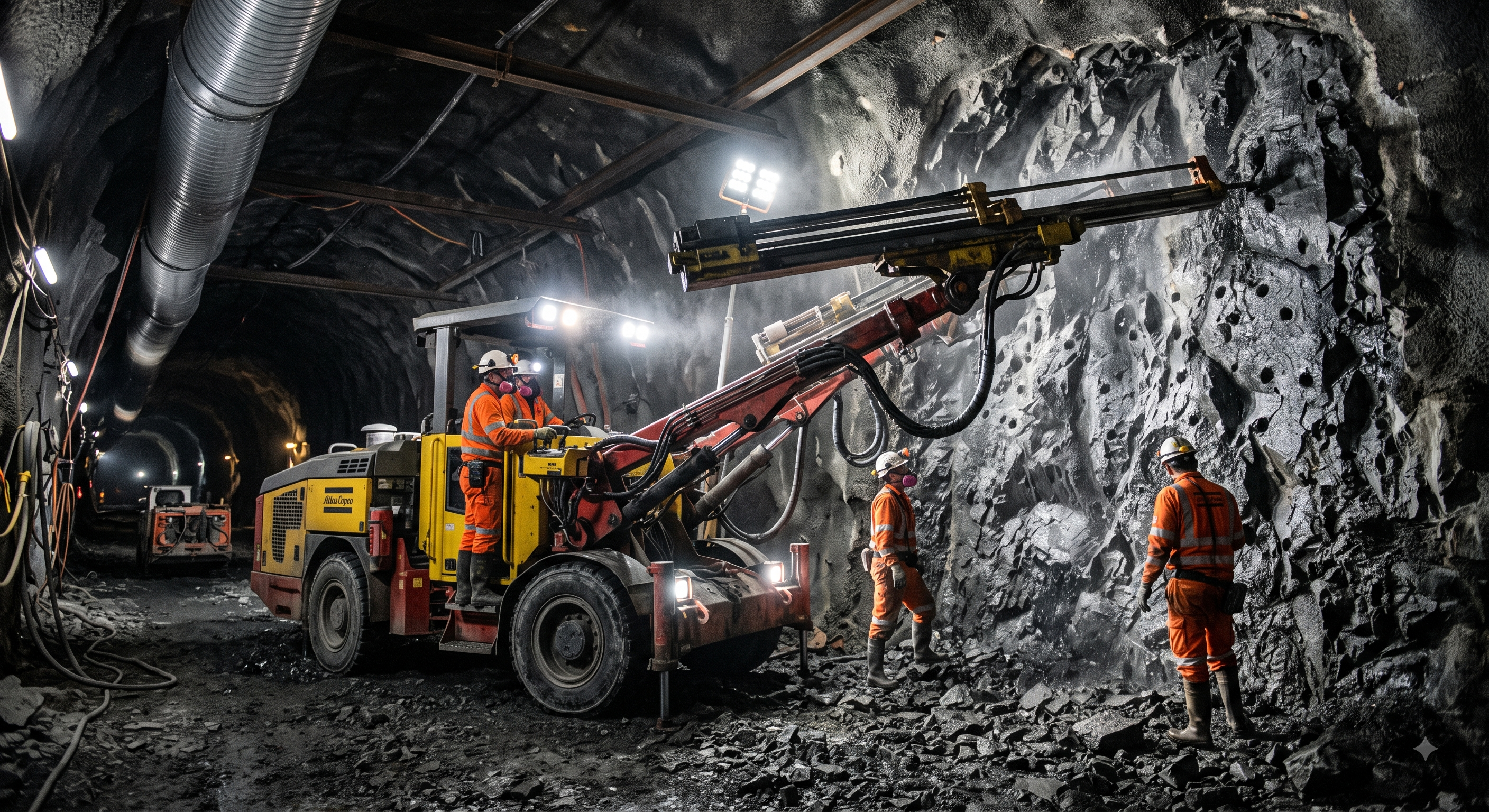
The original image URL is retained. The illustration is not evidence of an accident, an accurate equipment drawing or an approved work method.
B. Initial situation and changing conditions
In a fictional BC diversion-tunnel project, a night crew prepares the next round with a three-boom jumbo. An earlier round has left a hole remnant obscured by dust and wet clay. The previous-round record contains an unresolved observation, but the handover does not connect it to the face layout. Rising seepage and a partially obstructed sump worsen visibility and footing. The crew treats survey marks as evidence that the whole drilling area has been released.
C. Hypothesized failure sequence and consequences
A new hole could intersect retained explosive material or an initiation component if the old trajectory is unknown. Mechanical contact could then cause an unintended initiation, depending on the product, condition and confinement. This is a plausible hazard sequence, not a proved initiation threshold.
A local explosion could propel rock and machine fragments, damage a boom or feed assembly, rupture services and impair ventilation. An operator and a nearby assistant could suffer severe or fatal injuries. Secondary rockfall and contaminated air could endanger rescuers.
D. Structural and mechanical analysis
• Excavation and blasting alter confinement around the opening. Joint orientation, discontinuity persistence, water pressure and support condition influence whether wedges can detach. An apparently intact face does not establish stable ground behind it.
• Loading on a jumbo depends on geometry, boom position, ground contact and the actual pressure-time history. A damaged feed assembly might bend, detach or remain attached; its failure mode cannot be selected from the illustration.
• In a confined heading, reflected pressure and fragment paths depend on tunnel geometry, obstructions and ventilation connections. An open-air distance assumption cannot establish a safe underground refuge.
• The source article's impact-energy and detonation-pressure equations do not establish whether the particular explosive will initiate, what pressure reaches a worker, or which component fails first. Product sensitivity data, charge condition, geometry, dynamic analysis and physical evidence would be needed. No numerical initiation or structural-failure prediction is asserted here.
• A level indicator, hydraulic gauge, ammeter or paint witness mark cannot independently demonstrate ground-support capacity, machine stability or structural integrity.
E. Failed protective barriers
| Barrier | Failure in the simulation | Consequence | Evidence needed before restoring work |
|---|---|---|---|
| Previous-round handover |
| Hidden uncertainty entered the next round. |
|
| Face examination |
| The drilling path could intersect a retained charge. |
|
| Drilling separation |
| Nominal offset gave false confidence. |
|
| Personnel protection |
| More people were exposed to fragments and moving equipment. |
|
| Recovery control |
| Secondary casualties became possible. |
|
F. Core lesson
Separate detection, exclusion, specialist resolution and authorization. A wet face, a completed checklist or a low risk score does not prove the absence of explosives. No WorkSafeBC investigation or finding of deliberate misconduct is claimed for this simulation.
5. Conditional decisions and common errors
| Condition | Action | Evidence | Proceed when |
|---|---|---|---|
| Air or ground not released | Restrict entry; arrange protected assessment of ventilation, atmosphere and support. | Representative gas readings, instrument checks and ground inspection. | Atmosphere and ground accepted for entry. |
| Drill jam or damaged hose | Stop and isolate; use the competent maintenance procedure. | Energy-isolation check, defect disposition and equipment inspection. | Defect resolved; guards and isolation checks complete. |
| Unreconciled person count | Maintain exclusion and locate everyone through the control system. | Entry/exit count, guard reports and clear escape routes. | Everyone accounted for; exclusion secured. |
| Suspected misfire or abnormal result | Keep the area closed; refer to the authorised specialist and preserve handover. | Specialist disposition, atmosphere and ground checks, release record. | Specialist release and all re-entry conditions satisfied. |
A. Bootlegs, loaded holes and face preparation
Section 21.42 requires exposure and examination of the drilling surface and control of loose material. It does not prescribe universal high-pressure washing or plugging of every bootleg.
Section 21.43 prohibits drilling within 15 cm of any part of a bootleg and within 6 m of any part of a hole containing explosives, subject to its stated exceptions. The specialized section 21.76.1 must not be treated as ordinary production-drilling permission. A suspected charge requires isolation and blaster control. Measure relevant separation along the possible hole paths, not just between collars. Part 21, sections 21.42–21.43 and 21.76.1
B. Initiation systems, interference and testing
Electric, electronic and non-electric systems have different vulnerabilities and verification methods. Section 21.61 distinguishes the IME radio-frequency guide for electric detonators from manufacturer distances for electronic detonators and electric igniters, and supplies conditional default distances where separation has not otherwise been determined. Do not invent a common 30–100 m zone.
Sections 21.63 and 21.63.1 distinguish resistance testing from electronic signal-integrity confirmation. An ordinary multimeter or an “intrinsically safe” label alone does not establish suitability for a detonator system. Part 21, sections 21.58–21.64
C. Ventilation and re-entry
For this BC scope, section 22.79 requires a minimum ten-minute interval plus testing: CO and NO2 must meet the applicable exposure limits, oxygen must be at least 19.5%, and flammable substances must be below 20% LEL.
These conditions do not waive misfire restrictions, other exposure limits or task-specific ignition controls. A suspected misfire invokes section 21.73 and relevant manufacturer waiting requirements. Record the applicable event from which a waiting period starts. Section 22.79 · Section 21.73
Underground-specific requirements
• Section 22.78 requires an effective water spray (atomizer) in every development heading at the blast. This is a different requirement from predrilling face cleaning.
• Section 22.75 requires the specified Fume Class 1 rating for underground explosives unless prior written Board approval is obtained for another rating. Verify the actual product and any approval; a product being authorized federally does not by itself resolve this provincial requirement. Sections 22.75 and 22.78
Site implementation
• Develop a sampling route that protects the tester; verify the route, face, recesses and other relevant locations without entering an unassessed atmosphere.
• Select sensors for CO, NO2, oxygen and flammable hazards, plus NO or other contaminants where the assessment identifies them. A standard four-gas instrument does not necessarily measure NO2 or NO.
• Record sensor ranges, calibration and functional checks, sampling delays, cross-sensitivities, readings and alarm settings. Identify the applicable TWA, short-term and ceiling criteria separately.
• Check delivered airflow, damaged ducting, recirculation and portal conditions. Neither a running fan nor a calculated dilution time establishes safe entry.
• Complete the controlled blaster examination and ground assessment before production handback. Atmospheric clearance alone is insufficient.
D. Ground, equipment and exposure
Adopt support and equipment limits from the applicable design and actual model manual. Mechanized scaling and elevating platforms may be appropriate, but are not universal requirements for every survey task. Do not add improvised hydraulic tests or modify protective structures.
Prioritize wet drilling or suitable capture, ventilation, equipment maintenance and exposure monitoring. Select hearing protection from the noise assessment; specify dual protection only where justified. A P100 filter alone does not remove CO or nitrogen oxides or supply oxygen. WorkSafeBC respiratory protection requirements · CCOHS respirator selection
E. Change and emergency controls
Suspend work for suspected explosives, support movement, abnormal inflow, ventilation loss, defective monitoring, lightning-related risk, loss of communication or unauthorized entry. Apply the most restrictive compatible requirements for the same hazard and operating condition. Do not numerically compare unrelated thresholds.
Rescue must follow the site plan using trained, equipped personnel; ordinary respirators do not authorize entry into an unknown atmosphere.
6. Roles and responsibilities
A. Owner, prime contractor and employers
Establish applicable notices and approvals, coordinate simultaneous work, provide safe equipment and exposure controls, and resource rescue arrangements. Assign responsibilities without transferring statutory duties through a permit signature.
B. Underground working supervisor
Verify eligibility and appointment under section 22.12, coordinate underground activities, communicate restrictions and maintain the required records. The appointment is distinct from blaster certification. Sections 22.12–22.12.1
C. Blaster of record
Verify a valid certificate issued by or acceptable to WorkSafeBC and a scope covering the work. Control the blasting operation, required tests, clearance, misfire decisions, records and release. Do not describe every helper as independently certified solely because they work under supervision. Part 21, certification and responsibilities
D. Engineering, monitoring and operating personnel
• The appropriately authorized professional engineer is responsible for the engineering work actually commissioned and within their competence.
• A qualified atmospheric tester needs relevant knowledge, training and experience; this article does not create a universal “certified competent person” credential.
• Operators, signallers, guards and workers must understand their assigned tasks, limitations, stop signals and emergency arrangements.
• Keep training, practical competence, medical suitability where applicable, employer authorization, blaster certification and professional registration as separate records. Provide briefings in languages workers understand.
Supervision, records, handover
| Job stage | Technical and procedural controls | Site verification |
|---|---|---|
| Plan ownership | 1. Verify assigned authority2. Review previous-round status3. Plan escape and accounting | 1. Handover and restrictions2. Competence and permits3. Ground and water review |
| Team and equipment | 1. Record equipment evidence2. Separate plant and people3. Test controls per manual | 1. Route and exclusion2. Plant standing check3. Service and cable condition |
| Stage release | 1. Hold stage release2. Hand over to licensed team3. Suspend conflicting work | 1. Specialist authorisation2. Ignition-control check3. Custody and area record |
| Energy control | 1. Record energy controls2. Exclude rotating equipment3. Isolate before intervention | 1. Drill-zone inspection2. Exposure-control records3. Ground-change report |
| Inspection closure | 1. Close inspection defects2. Keep general access closed3. Plan protected restricted checks | 1. Ventilation status2. Air results and location3. Instrument verification |
| Shift handover | 1. Transmit limits and issues2. Obtain specialist clearance3. Record next-task release | 1. Ground and support record2. Misfire-status handover3. Traffic and air checks |
7. Hold points and record comparison
The following hold points are proposed site controls. Record the project, heading, round, shift, permit validity, linked plans, issuer, acceptor and signatures. The permit cannot supply a statutory exemption.
| Hold point | Evidence required for release | Responsible release function |
|---|---|---|
| HP1 — Start the shift |
| Employer's designated authority and underground working supervisor |
| HP2 — Begin production drilling |
| Underground working supervisor with blaster confirmation of explosives-related restrictions |
| HP3 — Begin loading |
| Blaster of record |
| HP4 — Authorize firing |
| Blaster of record |
| HP5 — Controlled post-blast assessment |
| Blaster of record and designated atmospheric-testing authority |
| HP6 — Return to production |
| Blaster of record and underground working supervisor within their respective duties |
Suspend and revalidate affected hold points after changes to conditions, personnel, design or equipment. “Accepted risk” does not release an unmet prerequisite.
Record comparison examples
The scenario and record comparisons are fictional teaching examples, not records of real incidents, measurements, inspections, signatures or approvals.
The boxes are static record prompts, not interactive or saved approvals. A tick does not establish suitability or permission to restart. Record the evidence, person, time and unresolved issues; retain the change history.
| Record type | Insufficient record | Record checklist |
|---|---|---|
| Plan and handover | “OK” | □ Handover and restrictions□ Competence and permits□ Ground and water review□ Emergency and count plan |
| Drill and stop | “OK” | □ Drill-zone inspection□ Exposure-control records□ Ground-change report□ Isolation and restart check |
| Clear and secure | “OK” | □ Evacuation record□ Boundary and guard check□ Communication confirmation□ Specialist decision record |
| Inspect and release | “OK” | □ Ground and support record□ Misfire-status handover□ Traffic and air checks□ Release and restrictions |
8. Site checklist and emergency response
A. Planning and people
• ☐ Correct heading, jurisdiction, round and current document revisions.
• ☐ Valid appointments, blaster certificate scope, operator competence and understandable briefing.
• ☐ Previous-round anomalies resolved or positively excluded.
• ☐ Emergency contacts, surface attendance, personnel accounting, rescue resources and suitable self-rescuers verified.
B. Ground and equipment
• ☐ Ground inspected, support requirements implemented and face release recorded.
• ☐ Hole remnants, utilities, possible breakthroughs and water hazards identified.
• ☐ Jumbo route, operating clearances, ground bearing and model limits verified.
• ☐ Brakes, guards, hoses, cables, lighting and stop controls serviceable.
C. Explosives and clearance
• ☐ Product authorization, condition, custody and required storage permissions checked.
• ☐ Manufacturer procedures and initiation-specific interference controls available.
• ☐ Guards, warnings, adjacent-work coordination and refuge locations confirmed.
• ☐ Waiting rules, testing equipment, exposure criteria and release authorities specified.
D. Stop conditions
• ☐ Workers know that uncertainty about a charge, unsafe ground or an invalid gas reading means stop and escalate.
• ☐ No unchecked item is treated as completed; no acceptance decision is generated automatically.
9. Sources and review limits
Review update, 12 October 2026: the entries below identify the official material rechecked for this revision and its specific scope. Earlier source notes and dates are retained as revision history; they do not mean that every cited provision was reverified today. Full paid standards, actual equipment manuals, site calculations and approvals were not supplied or verified. Resolve their current applicability with a qualified reviewer before use.
| Source | Scope and limitations |
|---|---|
| WorkSafeBC — Part 22 | Non-mine underground-work scope, ventilation/testing and section 22.79 re-entry requirements were reviewed. The ten-minute minimum is only one condition: atmospheric testing and the other applicable restrictions still govern. Ground and specialist release are separate gates. |
| WorkSafeBC — Part 21 | The current page was consulted for employer control, certification and records. Detailed firing, wiring and misfire-recovery operations are outside this safety analysis. |
A. Source register
• BC Laws — OHS Regulation: consolidated law; the version consulted states currency to September 15, 2026.
• BC Laws — Part 21: blasting roles, drilling restrictions, initiation, warnings, misfires and post-blast controls.
• BC Laws — Part 22: non-mine application, notices, supervision, ventilation, ground control and underground explosives.
• WorkSafeBC — Part 8: PPE and respiratory protection.
• WorkSafeBC — Part 5 policies and exposure limits: consult current substance entries and exposure-period definitions; the consulted exposure-limit policy lists an effective date of September 3, 2026.
• Federal Explosives Act and Explosives Regulations, 2013: the consulted regulations state currency to July 21, 2026 and last amendment May 3, 2024.
• Canada Gazette — SOR/2024-77: amendment instrument; distinguish registration, publication and commencement provisions.
• Transportation of Dangerous Goods Regulations: check the actual transport operation. SOR/2026-127 includes a twelve-month transitional provision; do not mix selected requirements from alternative regimes without checking the provision.
• CCOHS — Respirator selection: technical guidance, not a substitute for BC law or product instructions.
B. Application and conflicts
Apply relevant federal and provincial law together with binding orders, approvals and permit conditions. Apply the editions and clauses of standards incorporated by those requirements.
Manufacturer limits and approved engineering documents govern the actual equipment and work configuration; they cannot authorize a legal breach. Contractual or site controls may be stricter where compatible. If requirements conflict, suspend the affected task and obtain competent resolution rather than selecting a convenient number.
C. Currency limits
The access date is not the effective date of every provision. Consolidation dates can lag the day of access. Check subsequent amendments, commencement provisions and transition arrangements before operational use.
No proposed amendment or future standard edition is treated as automatically in force. No full-text verification of proprietary standards or model manuals is claimed.
10. PDF guidance and FAQ
PDF A covers basic task controls; B focuses on technical failures; C covers supervision, records and handover. The article has eight stages with four items per main cell; each PDF has six key stages with three items per main cell. P/S/R/A, measurements, confirmations and signatures remain blank for actual site assessment.
The three PDF sheets are complementary extracts, not a complete work sequence. Apply all eight body stages and the applicable site procedure. PDF HP-0 to HP-4 are worksheet labels: match each to its event, evidence and responsible authority, not to the same number in a different permit or table. An omitted PDF stage is not permission to omit its controls.
A. Proposed data structure
The following are suggested integration requirements. Their implementation in Smart JSA Bridge has not been verified.
• Jurisdiction CA-BC; language en-CA; non-mine classification; heading, chainage, round and shift identifiers.
• Legal source, clause, incorporated standard edition, commencement date, verification date and applicability decision.
• Equipment model, manual revision, product and initiation-system identity, approved plans and restrictions.
• Hole-remnant register, abnormal-hole observations, explosives reconciliation and handover records.
• Ventilation checks, sensor identities, gas readings, sampling times, exposure periods and signed releases.
• Individual competency records, assigned authority, hold-point evidence and permit validity.
• P, S, R and A left blank pending assessment; no preselected acceptance value.
B. Proposed blocking rules
Suggest preventing a “ready for release” status when evidence is missing, credentials are outside scope, a suspected misfire remains unresolved, monitoring is invalid, or a hold point is unsigned.
A software status must never imply autonomous authority to fire, authorize re-entry or certify statutory compliance.
C. Platform reference
Smart JSA Bridge may be used as a document-workflow reference. This article does not verify automatic RF calculations, gas-clearance modelling, equipment certification or one-click legal compliance.
Does this tunnel blasting JSA apply to BC mines?
No. This guide addresses non-mine civil underground workings within the application of BC OHS Regulation Part 22. Mine work requires a separate assessment of the Mines Act and the applicable mining code.
Does the BC bootleg clearance rule make drilling near unexploded charges safe?
No. Bootlegs and holes containing explosives are subject to distinct restrictions. Suspected explosives require work to stop and the blaster of record to control the area; a collar measurement cannot establish safe separation from the full hole.
Is elapsed waiting time enough to allow post-blast re-entry?
No. The applicable waiting conditions, atmospheric testing, misfire assessment, ground-control checks and authorization must all be satisfied. Suspected misfires impose additional restrictions.
Can a P100 particulate filter protect against all blast fumes?
No. A P100 particulate filter alone does not protect against carbon monoxide, nitrogen oxides or oxygen deficiency. Respiratory protection must match the assessed hazards and does not replace safe ventilation and re-entry controls.
Does a completed JSA or work permit authorize blasting?
No. These records support site controls but do not replace required qualifications, legal approvals, manufacturer procedures, inspections or release of hold points by authorized people.
Has a professional verified or approved this document?
No. Public sources and editorial, layout and consistency checks were reviewed using AI. No site inspection or professional technical approval has been performed. Obtain appropriate professional review before use.
11. Revision history and authorship
A. Document status
This is a technical draft generated through the automated engineering-content workflow for Smart JSA Bridge. It is not a completed site JSA, a blast design or permission to conduct work.
B. Authorship and approval
In the absence of verifiable signatures and review records, this document has not been established as written, reviewed or approved by an engineer, safety professional, manufacturer or government authority. No such approval is implied by its title, tables or structured data.
C. Inspection limitations
The system has not physically inspected the equipment, tunnel, support system, explosives, ventilation installation or actual site conditions. No field measurements, structural calculations, signed technical review or manufacturer assessment were supplied for this article.
D. Documents it does not replace
It does not replace legal advice, manufacturer procedures, structural calculations, statutory inspection reports, qualifications, the site risk assessment or work authorization. It does not establish that an unverified platform feature exists.
E. Required review before use
Persons with appropriate BC qualifications, competence and authority must review the actual task, resolve missing information and approve the applicable site documents before use. Make all limits traceable to law, product instructions, approved engineering documents or an explicitly identified site assessment.
F. Actual professional review record
Any review actually performed must be recorded separately with:
• Reviewer name and organization.
• Qualifications and formal delegation of authority.
• Review scope.
• Equipment and documents reviewed.
• Review date and signature.
• Limitations and exclusions.
• Required revisions.
• Conditions under which approval remains valid.
No completed professional review record was provided with the source content.
Legal and source verification date: September 19, 2026. The sources' stated currency dates and verification limitations are recorded in section 9. Recheck current law, applicable amendments, standards, manufacturer instructions and site conditions before use.
2026-10-12 · v1.1
Revision: the master JSA is organised into eight stages with four prompts in each main cell. Short conditional release criteria and sixteen record prompts separate evidence from approval. Three six-stage PDFs use task, technical-failure and supervision viewpoints; actual evaluation fields remain blank. Valid prior explanations, sources and history are retained. This is an editorial revision, not professional technical verification.
This is reference content written and revised with AI. It has not been verified or approved by a professional. Review by a suitably qualified professional and site authorisation are required before use.
This revision is a safety analysis for authorised tunnel work. It covers the specialist plan, competence, custody, ignition-source restrictions, exclusion and evacuation, ventilation, atmospheric testing, ground stability and documented re-entry. Explosive formulations, charge calculations, detonator wiring, initiation-system construction, detailed blast patterns and misfire dismantling are outside this content. A suspected misfire means continued exclusion and referral to the authorised specialist, not a general-worker recovery task. Elapsed time alone never releases entry.