This revision covers deciding whether entry can be avoided, isolation, atmosphere testing, ventilation and rescue setup, controlled tank cleaning, evacuation, re-entry review and restoration. It applies to an assessed tank, pit or manhole with identified contents and connected processes.
A clear hatch reading does not establish safe entry or rescue
This is reference content written and revised with AI. It has not been verified or approved by a professional. Review by a suitably qualified professional and site authorisation are required before use.
Stop work
Withdraw for any alarm, symptoms, communication loss, ventilation failure, unexpected inflow or isolation change. The attendant remains outside, maintains accountability and prevents unauthorized entry; no unplanned rescue entry.
1. Legal and technical scope
| Basis | Application limits |
|---|---|
| CCOHS · Confined-space programme | Official page opened. BC example only; CCOHS guidance is not a Canada-wide regulation. |
| HSE · Technical support | Foreign technical guidance; not Canadian law. |
Canada: first identify federal, provincial or territorial jurisdiction. CCOHS is technical guidance and British Columbia provisions are a provincial example. Paid CSA Z271, Z91, Z1006 and Z259 texts were not read; the title is not a conformity finding.
Do not treat COHSR Part XI as applying to every Canadian workplace. The programme must address hazard assessment, isolation, testing, entry roles and rescue under the responsible jurisdiction.
2. Scope and required inputs
Included scope
This revision covers deciding whether entry can be avoided, isolation, atmosphere testing, ventilation and rescue setup, controlled tank cleaning, evacuation, re-entry review and restoration. It applies to an assessed tank, pit or manhole with identified contents and connected processes.
Separate review
Hot work, inert-atmosphere entry, diving, structural alteration and entry into an unknown or immediately dangerous atmosphere need separate specialist arrangements. This reference is not an entry permit or authorization to enter.
| Required input | What to verify |
|---|---|
| Plan entry | Contents and safety data · Space classification · Entry method · Rescue route |
| Isolate energy | Isolation register · Zero-energy evidence · Line identity · Residual pressure |
| Test atmosphere | Detector identity · Locations and times · Limits and readings · Calibration status |
| Prepare entry | Rescue rehearsal · Airflow effectiveness · Access protection · Equipment suitability |
| Close and hand over | Exit and tool register · Restoration authority · Closure inspection · Waste handover |
Do not copy universal gas limits, 20 air changes per hour, a fixed duct distance, 24 V safety guarantee or a 5,000 lb tripod rating. Set limits for all relevant substances and the applicable jurisdiction. A four-gas instrument may miss solvents or other contaminants. A bump test checks response; calibration verifies and adjusts measurement performance.
Select chemical, eye, hearing, footwear and respiratory protection for the task and actual atmosphere. Filtering respirators do not supply oxygen and are unsuitable for oxygen deficiency or unknown/IDLH conditions. Retrieval equipment must fit the opening, obstructions, entrant and rescue load; a tripod alone does not prove rescue is feasible.
3. Eight-stage JSA
| Job stage | Hazards and effects | Failure factors | Technical and procedural controls | Site verification | P | S | R | A |
|---|---|---|---|---|---|---|---|---|
| 1. Plan entry | 1. Toxic atmosphere2. Unnecessary entry3. Unexpected inflow4. Rescue delay | 1. Contents unknown2. Remote option skipped3. Connected process live4. Access too narrow | 1. Identify stored substances2. Prefer no-entry cleaning3. Map all connections4. Plan credible rescue | 1. Contents and safety data2. Space classification3. Entry method4. Rescue route | ||||
| 2. Isolate energy | 1. Liquid engulfment2. Agitator start3. Gas ingress4. Stored pressure | 1. Wrong pipe isolated2. Control circuit only3. Leaking barrier4. Trapped energy | 1. Verify isolation scheme2. Lock energy sources3. Prove effective barriers4. Drain and depressurise | 1. Isolation register2. Zero-energy evidence3. Line identity4. Residual pressure | ||||
| 3. Test atmosphere | 1. Oxygen deficiency2. Toxic exposure3. Flammable atmosphere4. False safe reading | 1. Wrong sensors2. Hatch-only sample3. Sample lag ignored4. Failed detector | 1. Select relevant sensors2. Sample remote zones3. Allow sample response4. Bump-test and calibrate | 1. Detector identity2. Locations and times3. Limits and readings4. Calibration status | ||||
| 4. Prepare entry | 1. Rescue obstruction2. Ventilation failure3. Fall at hatch4. Ignition source | 1. Rig does not fit2. Polluted air intake3. Unguarded opening4. Wrong electrical rating | 1. Verify retrieval route2. Supply clean ventilation3. Guard access opening4. Select suitable equipment | 1. Rescue rehearsal2. Airflow effectiveness3. Access protection4. Equipment suitability | ||||
| 5. Enter and clean | 1. Sludge gas release2. Water-jet injury3. Slip and entanglement4. Heat or chemical stress | 1. Deposit disturbed2. Damaged hose3. Trailing lines4. PPE unsuitable | 1. Monitor during cleaning2. Control jet and hoses3. Keep escape path clear4. Apply exposure controls | 1. Live atmospheric trend2. Hose and trigger check3. Entrant count4. PPE and work/rest plan | ||||
| 6. Evacuate on alarm | 1. Rapid incapacitation2. Rescuer exposure3. Blocked exit4. Lost communication | 1. Delayed withdrawal2. Unplanned entry rescue3. Hose across exit4. Attendant absent | 1. Withdraw on alarm2. Call designated rescue3. Use safe non-entry recovery4. Prevent unplanned entry | 1. Alarm and person location2. Accountability check3. Recovery feasibility4. Rescue activation | ||||
| 7. Reassess changes | 1. Re-entry into hazard2. New contaminant3. Re-energisation4. Monitor blind spot | 1. Old permit reused2. New cleaning agent3. Isolation disturbed4. Baffle area untested | 1. Suspend prior authorisation2. Assess changed process3. Recheck isolation4. Retest affected zones | 1. Cause of interruption2. Updated risk assessment3. New readings4. Fresh entry authority | ||||
| 8. Close and hand over | 1. Person left inside2. Premature restart3. Open manhole4. Waste exposure | 1. Headcount mismatch2. Lock removed early3. Cover unsecured4. Residue unlabelled | 1. Account for all people2. Control restoration steps3. Secure access cover4. Transfer waste safely | 1. Exit and tool register2. Restoration authority3. Closure inspection4. Waste handover |
PDF A covers basic task controls; B focuses on technical failures; C covers supervision, records and handover. The article has eight stages with four items per main cell; each PDF has six key stages with three items per main cell. P/S/R/A, measurements, confirmations and signatures remain blank for actual site assessment.
4. Fictional scenario and failure mechanisms
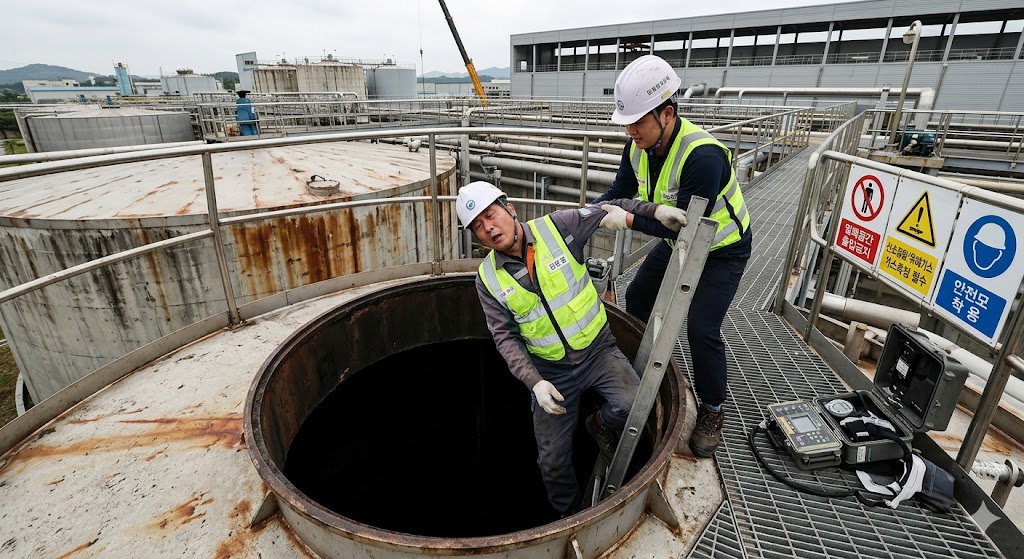
Retained educational illustration; not evidence of an actual incident or site suitability. Its creation method, including possible AI use, has not been verified.
The scenario and record comparisons are fictional teaching examples, not records of real incidents, measurements, inspections, signatures or approvals.
| Item | Fictional scenario |
|---|---|
| Initial situation | A drained tank is opened for sludge removal and appears odorless. |
| Changed condition | Only the hatch level has been sampled; deposits remain behind an internal baffle. |
| Failure path | Gas at the work zone, isolation integrity and the casualty extraction route are unknown. |
| Possible outcome | Keep people outside; review sampling, isolation and realistic rescue access. |
| Prevention barrier | Entry can be considered only after all defined conditions are evidenced and authorized; cleaning itself requires ongoing monitoring. |
Failure mechanisms
Drainage and lack of odor do not prove a breathable atmosphere. Deposits or a cleaning product may introduce hazards as work progresses.
Density alone does not predict where gases remain: geometry, heat, airflow and mixing affect distribution. Sample likely accumulation and working zones with adequate response time.
Ventilation controls atmosphere but does not isolate inflow or moving equipment. Isolations require identification, verification and control against unauthorized restoration.
Decision sequence
| Decision stage | What to verify |
|---|---|
| Known facts | Identify the substances, connections and actual space geometry. |
| Unresolved matters | List unmeasured zones, unproven barriers and rescue restrictions. |
| Reason to hold | Keep entry on hold until the gaps are resolved. |
| Required evidence | Record representative readings, effective isolation and a rescue demonstration. |
| Restart decision | Authorize the defined entry and stop on alarm, ventilation loss or any changed condition. |
5. Conditional decisions and common errors
| Condition | Action | Evidence | Proceed when |
|---|---|---|---|
| Missing sample zone | Hold entry; sample remote and working zones | Detector, response time, locations and readings | All relevant zones assessed |
| Unproven isolation | Hold entry; verify barriers and stored energy | Isolation register and verification results | Isolation proven |
| Gas alarm or lost airflow | Evacuate; investigate and retest | Cause, restored controls and new readings | Fresh entry conditions met |
| Changed cleaning product | Suspend permit; reassess exposure and equipment | Safety data, limits and revised method | New hazards controlled |
Similar situations, different decisions
The scenario and record comparisons are fictional teaching examples, not records of real incidents, measurements, inspections, signatures or approvals.
| Comparison | Situation A | Situation B |
|---|---|---|
| Tank drained | Assumed safe because liquid is gone | Deposits, connections and atmosphere assessed |
| Detector reads normal | One reading at the hatch | Relevant sensors and representative work-zone readings |
| Rescue kit present | Tripod stored beside a narrow baffled opening | Trained team and demonstrated compatible recovery route |
6. Roles and responsibilities
| Role | Responsibility |
|---|---|
| Plan entry | Assign entry supervisor · Review no-entry option · Coordinate contractors |
| Isolate energy | Authorise isolation plan · Witness barrier checks · Control lock ownership |
| Test atmosphere | Assign competent tester · Set substance-specific limits · Review sampling coverage |
| Prepare entry | Verify rescue availability · Release entry permit · Assign dedicated attendant |
| Reassess changes | Cancel interrupted permit · Review changed conditions · Authorise retesting |
| Close and hand over | Reconcile entry register · Authorise restoration · Transfer waste records |
Supervision, records, handover
| Job stage | Technical and procedural controls | Site verification |
|---|---|---|
| Plan entry | 1. Assign entry supervisor2. Review no-entry option3. Coordinate contractors | 1. Contents and safety data2. Space classification3. Entry method |
| Isolate energy | 1. Authorise isolation plan2. Witness barrier checks3. Control lock ownership | 1. Isolation register2. Zero-energy evidence3. Line identity |
| Test atmosphere | 1. Assign competent tester2. Set substance-specific limits3. Review sampling coverage | 1. Detector identity2. Locations and times3. Limits and readings |
| Prepare entry | 1. Verify rescue availability2. Release entry permit3. Assign dedicated attendant | 1. Rescue rehearsal2. Airflow effectiveness3. Access protection |
| Reassess changes | 1. Cancel interrupted permit2. Review changed conditions3. Authorise retesting | 1. Cause of interruption2. Updated risk assessment3. New readings |
| Close and hand over | 1. Reconcile entry register2. Authorise restoration3. Transfer waste records | 1. Exit and tool register2. Restoration authority3. Closure inspection |
7. Hold points and record comparison
| Hold point | Evidence before release | Confirmation / approval |
|---|---|---|
| Start | This revision covers deciding whether entry can be avoided, isolation, atmosphere testing, ventilation and rescue setup, controlled tank cleaning, evacuation, re-entry review and restoration. It applies to an assessed tank, pit or manhole with identified contents and connected processes. | |
| HP-1 Isolate energy | Isolation register · Zero-energy evidence · Line identity · Residual pressure | |
| HP-2 Test atmosphere | Detector identity · Locations and times · Limits and readings · Calibration status | |
| HP-3 Prepare entry | Rescue rehearsal · Airflow effectiveness · Access protection · Equipment suitability | |
| HP-4 Reassess changes | Cause of interruption · Updated risk assessment · New readings · Fresh entry authority |
Complete after actual checks. Recheck after changes, defects or shift handover.
Record comparison examples
The scenario and record comparisons are fictional teaching examples, not records of real incidents, measurements, inspections, signatures or approvals.
The boxes are static record prompts, not interactive or saved approvals. A tick does not establish suitability or permission to restart. Record the evidence, person, time and unresolved issues; retain the change history.
| Record type | Insufficient record | Record checklist |
|---|---|---|
| Isolate energy | Checked. | □ Isolation register□ Zero-energy evidence□ Line identity□ Residual pressure |
| Test atmosphere | Checked. | □ Detector identity□ Locations and times□ Limits and readings□ Calibration status |
| Prepare entry | Checked. | □ Rescue rehearsal□ Airflow effectiveness□ Access protection□ Equipment suitability |
| Close and hand over | Checked. | □ Exit and tool register□ Restoration authority□ Closure inspection□ Waste handover |
8. Site checklist and emergency response
| Check item | Result | Person / action |
|---|---|---|
| □ Plan entry: Contents and safety data | ||
| □ Isolate energy: Isolation register | ||
| □ Test atmosphere: Detector identity | ||
| □ Prepare entry: Rescue rehearsal | ||
| □ Enter and clean: Live atmospheric trend | ||
| □ Evacuate on alarm: Alarm and person location | ||
| □ Reassess changes: Cause of interruption | ||
| □ Close and hand over: Exit and tool register | ||
| □ Release / handover authority |
Stop work
Withdraw for any alarm, symptoms, communication loss, ventilation failure, unexpected inflow or isolation change. The attendant remains outside, maintains accountability and prevents unauthorized entry; no unplanned rescue entry.
Emergency response
Activate the designated rescue service and use non-entry retrieval only when the assessed route makes it safe and effective. Entry rescue requires the trained, equipped rescue team and suitable respiratory protection. An unconscious casualty is not a reason for an unprotected coworker to enter.
9. Sources and review limits
2026-10-12
| Source | Scope and limitations |
|---|---|
| CCOHS · Confined-space programme | Official page opened. BC example only; CCOHS guidance is not a Canada-wide regulation. |
| HSE · Technical support | Foreign technical guidance; not Canadian law. |
This is reference content written and revised with AI. It has not been verified or approved by a professional. Review by a suitably qualified professional and site authorisation are required before use.
10. PDF guidance and FAQ
PDF A covers basic task controls; B focuses on technical failures; C covers supervision, records and handover. The article has eight stages with four items per main cell; each PDF has six key stages with three items per main cell. P/S/R/A, measurements, confirmations and signatures remain blank for actual site assessment.
Content group ID
jsa-tank-cleaning
What work does this reference cover?
This revision covers deciding whether entry can be avoided, isolation, atmosphere testing, ventilation and rescue setup, controlled tank cleaning, evacuation, re-entry review and restoration. It applies to an assessed tank, pit or manhole with identified contents and connected processes.
Do the headline numbers prove the site is safe?
Do not copy universal gas limits, 20 air changes per hour, a fixed duct distance, 24 V safety guarantee or a 5,000 lb tripod rating. Set limits for all relevant substances and the applicable jurisdiction. A four-gas instrument may miss solvents or other contaminants. A bump test checks response; calibration verifies and adjusts measurement performance.
Which personal protection is needed?
Select chemical, eye, hearing, footwear and respiratory protection for the task and actual atmosphere. Filtering respirators do not supply oxygen and are unsuitable for oxygen deficiency or unknown/IDLH conditions. Retrieval equipment must fit the opening, obstructions, entrant and rescue load; a tripod alone does not prove rescue is feasible.
What happens if rescue is required?
Activate the designated rescue service and use non-entry retrieval only when the assessed route makes it safe and effective. Entry rescue requires the trained, equipped rescue team and suitable respiratory protection. An unconscious casualty is not a reason for an unprotected coworker to enter.
Has a professional verified or approved this document?
No. Public sources and editorial, layout and consistency checks were reviewed using AI. No site inspection or professional technical approval has been performed. Obtain appropriate professional review before use.
11. Revision history and authorship
This is reference content written and revised with AI. It has not been verified or approved by a professional. Review by a suitably qualified professional and site authorisation are required before use.
| Date | Version | Change | Review status |
|---|---|---|---|
| 2026-09-12 | Original version unmarked | Original preserved | No professional approval |
| 2026-10-12 | 2026.10.12 | Decisions, records, JSA and PDFs revised | No professional approval |
Removed invented incident measurements, guaranteed physiological outcomes and unsupported expert approval. Corrected universal ventilation/electrical/retrieval values, mixed exposure limits and the claim that every double-block-and-bleed isolation is legally forbidden. Actual isolation acceptability remains a task- and jurisdiction-specific decision; all actual results and signatures are blank.