A running fan and a normal reading at the hatch do not establish conditions beyond an elbow. First assess whether inspection can be completed from outside. Where entry is necessary, connect isolation evidence, representative atmospheric tests, rescue feasibility and the entry decision to the same pipe boundary.
Plan entry → Isolate lines → Prepare access → Test atmosphere → Ventilate and permit → Work and monitor → Stop and rescue → Close and hand over
This is reference content written and revised with AI. It has not been verified or approved by a professional. Review by a suitably qualified professional and site authorisation are required before use.
Stop work
Stop and withdraw on a gas alarm, symptoms, failed ventilation, lost communication, isolation doubt or an unplanned change. Do not reset a detector and treat silence as permission to return.
1. Legal and technical scope
| Basis | Application limits |
|---|---|
| CCOHS: atmospheric testing | Official agency guidance and jurisdiction comparison reviewed; verify the applicable legal text before use. |
| Ontario O. Reg. 632/05 | Direct access failed (403); not represented as a fully reviewed provincial text. |
| CCOHS: confined space program | Official program guidance reviewed for role, hazard and emergency planning scope. |
Canada: identify federal, provincial or territorial jurisdiction before setting the permit and exposure criteria. CCOHS describes differing requirements, not a single national limit. Ontario O. Reg. 632/05 is an example only; its direct page returned 403. CSA Z1006, Z460, Z259 and ASME B31.3 were not read in full. The original 20 air changes per hour and universal gas thresholds are not adopted.
2. Scope and required inputs
Included scope
Planning, isolation, protected access, remote sampling, ventilation, permitted inspection, continuous monitoring, emergency withdrawal and closure of a pipe confined space.
Separate review
Hot work, inert-atmosphere entry, asbestos removal, chemical cleaning and complex entry rescue need separate specialist assessment. Elevated access and heavy blinds require their own fall and lifting controls.
| Required input | What to verify |
|---|---|
| Plan entry | Pipe identity · Task limits · SDS and drawings · Rescue geometry |
| Isolate lines | Isolation points · Zero energy evidence · Lock ownership · Blind register |
| Prepare access | Access protection · Rescue clearance · Equipment suitability · Communication test |
| Test atmosphere | Instrument identity · Sampling locations · Time and conditions · Results and limits |
| Ventilate and permit | Air path · Power continuity · Retest record · Permit and rescue |
| Close and hand over | Physical headcount · Closure inspection · Permit cancellation · Operations handover |
No site survey, readings, equipment manual or rescue trial was supplied. Set alarm limits, sample delay, ventilation capacity, electrical suitability, respiratory protection and flange assembly requirements from the applicable rules and actual equipment. A filter respirator cannot supply missing oxygen. Never ventilate with pure oxygen.
3. Eight-stage JSA
| Job stage | Hazards and effects | Failure factors | Technical and procedural controls | Site verification | P | S | R | A |
|---|---|---|---|---|---|---|---|---|
| 1. Plan entry | 1. Oxygen depletion2. Toxic exposure3. Restricted escape4. Adjacent operations | 1. Unknown service2. Wrong boundary3. Unmapped branches4. Unplanned hot work | 1. Avoid entry first2. Review service history3. Map connected lines4. Define permit scope | 1. Pipe identity2. Task limits3. SDS and drawings4. Rescue geometry | ||||
| 2. Isolate lines | 1. Fluid ingress2. Stored pressure3. Unexpected motion4. Heavy blind injury | 1. Passing valve2. Hidden connection3. Residual energy4. Unsupported flange | 1. Isolate all sources2. Depressurise safely3. Verify blind schedule4. Support heavy parts | 1. Isolation points2. Zero energy evidence3. Lock ownership4. Blind register | ||||
| 3. Prepare access | 1. Falls at opening2. Dropped objects3. Delayed rescue4. Ignition sources | 1. Unsafe platform2. Blocked exit3. Wrong rescue rig4. Unsuitable lighting | 1. Guard the opening2. Protect access route3. Prove rescue method4. Select rated equipment | 1. Access protection2. Rescue clearance3. Equipment suitability4. Communication test | ||||
| 4. Test atmosphere | 1. Oxygen deficiency2. Toxic gas pockets3. Flammable mixture4. False safe reading | 1. Wrong sensor2. Blocked sample hose3. Short sample time4. Missed dead leg | 1. Test from outside2. Check instrument response3. Allow hose delay4. Sample full work route | 1. Instrument identity2. Sampling locations3. Time and conditions4. Results and limits | ||||
| 5. Ventilate and permit | 1. Residual gas2. Exhaust ingress3. Oxygen enrichment4. Uncontrolled entry | 1. Duct short circuit2. Dirty intake air3. Fan interruption4. Incomplete permit | 1. Use clean air2. Reach work zones3. Retest after purging4. Authorise only if ready | 1. Air path2. Power continuity3. Retest record4. Permit and rescue | ||||
| 6. Work and monitor | 1. Gas release from sludge2. Heat and fatigue3. Cuts and ignition4. Loss of contact | 1. Changed task2. Damaged cable3. Sensor alarm4. Attendant distracted | 1. Monitor continuously2. Maintain outside watch3. Keep exit clear4. Stop at any change | 1. Entrant log2. Detector trends3. Contact continuity4. Task remains in scope | ||||
| 7. Stop and rescue | 1. Rapid incapacitation2. Secondary casualties3. Entrapment at bends4. Unsafe re-entry | 1. Alarm ignored2. Unplanned rescue entry3. Snagged retrieval4. Reset without review | 1. Evacuate on alarm2. Call planned rescue3. No impulsive entry4. Reassess before return | 1. Everyone accounted2. Cause investigated3. Rescue access ready4. New entry decision | ||||
| 8. Close and hand over | 1. Person sealed inside2. Tools left inside3. Premature energising4. Open hatch falls | 1. Incomplete headcount2. Uncontrolled de-isolation3. Wrong gasket4. Lost shift records | 1. Reconcile all exits2. Inventory tools3. Close to design4. Release isolation formally | 1. Physical headcount2. Closure inspection3. Permit cancellation4. Operations handover |
PDF A covers basic task controls; B focuses on technical failures; C covers supervision, records and handover. The article has eight stages with four items per main cell; each PDF has six key stages with three items per main cell. P/S/R/A, measurements, confirmations and signatures remain blank for actual site assessment.
4. Fictional scenario and failure mechanisms
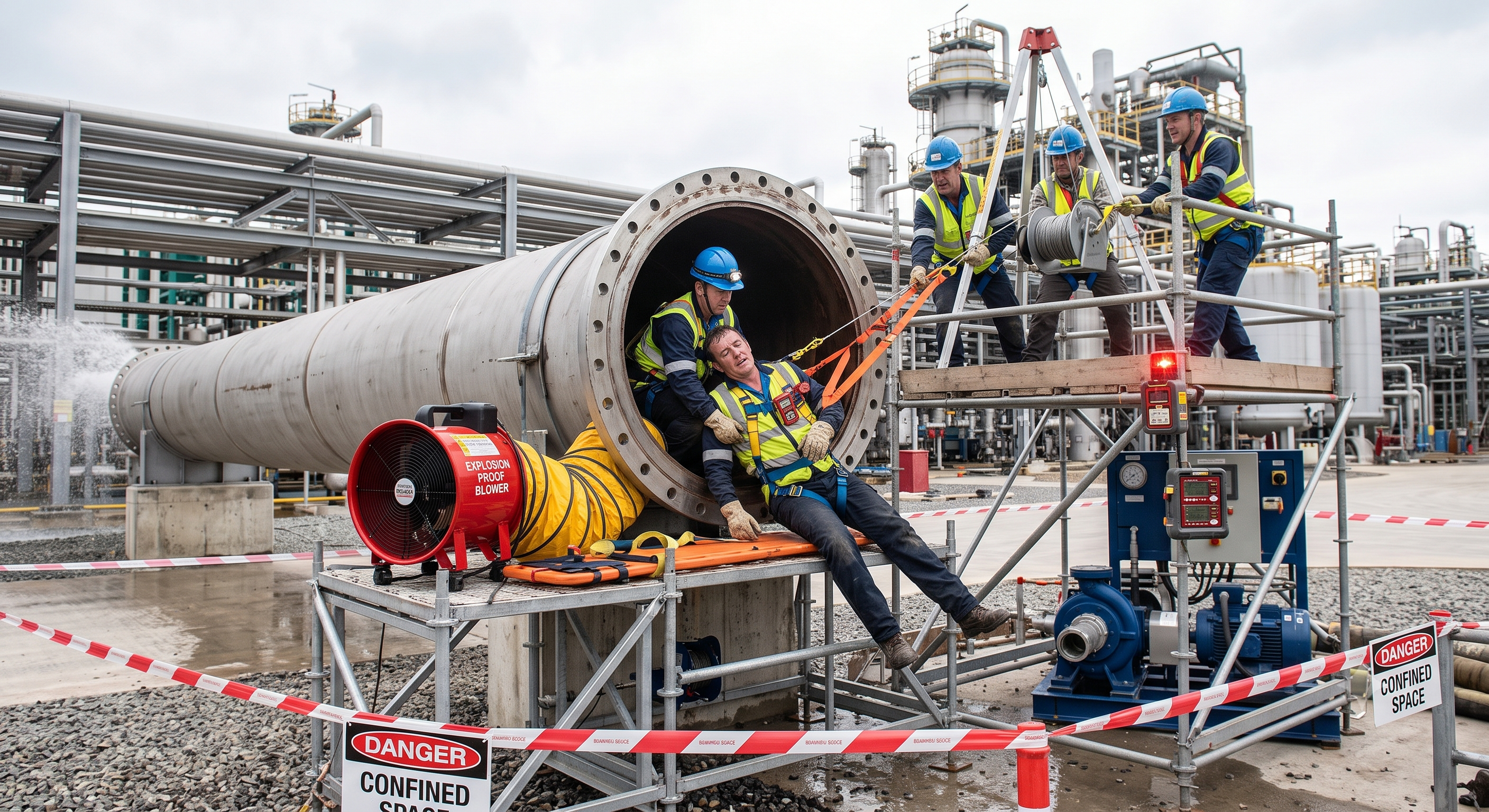
The original educational image is retained. It is not evidence of an actual incident or site suitability.
The scenario and record comparisons are fictional teaching examples, not records of real incidents, measurements, inspections, signatures or approvals.
| Item | Fictional scenario |
|---|---|
| Initial situation | A short internal weld inspection is proposed while a fan runs at the opening. |
| Changed condition | An adjacent nitrogen operation is discovered; no evidence covers the branch beyond the bend. |
| Failure path | A passing valve and short-circuited airflow could leave the work zone oxygen deficient. |
| Possible outcome | The entrant could become unable to escape; a straight pull might snag at the elbow. |
| Prevention barrier | Hold entry, verify isolation, sample the actual route and demonstrate a workable rescue arrangement. |
Failure mechanisms
Nitrogen displaces oxygen; it does not reliably collect at the bottom simply because it is nitrogen. Temperature, release location, airflow, mixing and pipe geometry affect distribution. Test upper, middle and lower locations plus branches and the travel route; one hatch reading cannot represent the whole volume.
A pumped instrument displays the gas reaching its sensor, not the gas at the far end at that instant. Leaks, blocked filters, incompatible tubing and insufficient transport or response time can produce misleading results. Verify the complete sampling train and the manufacturer’s requirements; a response check is distinct from calibration.
A fan can circulate air between nearby inlet and outlet while a dead leg remains poorly swept. Verify clean intake air, duct position and representative measurements; fan run time or a generic air-change rate alone does not prove safety. Ignition protection and electrical shock protection are separate selection questions.
A tripod at an opening does not prove retrieval through a horizontal bend. Assess body clearance, line snagging, anchor loads and rescuer access before entry. If the proposed method cannot retrieve an incapacitated person, entry remains on hold. Never send an unprotected attendant inside.
Decision sequence
| Decision stage | What to verify |
|---|---|
| Known facts | Fan operation and the proposed inspection route are known. |
| Unresolved matters | Isolation integrity, remote atmosphere and retrieval passage remain unknown. |
| Reason to hold | Neither elapsed ventilation time nor a normal hatch reading resolves these gaps. |
| Required evidence | Obtain boundary verification, a mapped gas record, equipment checks and a rescue demonstration appropriate to the geometry. |
| Restart decision | A designated entry authority reviews all conditions; alarms, breaks or changed work trigger reassessment before re-entry. |
5. Conditional decisions and common errors
| Condition | Action | Evidence | Proceed when |
|---|---|---|---|
| Missing test | Keep entry closed | Mapped results and instrument response | Atmosphere assessed |
| Fan failure | Withdraw entrants | Restored airflow and new tests | Conditions re-established |
| Lost contact | Withdraw safely | Working contact and attendant | Contact restored |
| Changed task | Suspend permit | New hazards and controls | Scope reassessed |
Similar situations, different decisions
The scenario and record comparisons are fictional teaching examples, not records of real incidents, measurements, inspections, signatures or approvals.
| Comparison | Situation A | Situation B |
|---|---|---|
| Gas test | A normal value at the opening covers only that location and time. | Mapped readings cover the work route, dead legs and changing conditions. |
| Ventilation | A running motor proves only that the fan is operating. | Verified air path plus repeated tests demonstrate the assessed zone conditions. |
| Rescue | A winch is present but the bend has not been checked. | The planned recovery path and trained rescue capability have been verified. |
6. Roles and responsibilities
| Role | Responsibility |
|---|---|
| Work supervisor | Avoid entry first · Review service history · Map connected lines · Define permit scope |
| Technical reviewer | Test from outside · Check instrument response · Allow hose delay · Sample full work route |
| Work crew | Monitor continuously · Maintain outside watch · Keep exit clear · Stop at any change |
| Inspector / assessor | Isolate all sources · Depressurise safely · Verify blind schedule · Support heavy parts |
| Release / handover authority | Reconcile all exits · Inventory tools · Close to design · Release isolation formally |
Supervision, records, handover
| Job stage | Technical and procedural controls | Site verification |
|---|---|---|
| Review Plan entry | 1. Record: Pipe identity2. Record: Task limits3. Record: SDS and drawings | 1. Rescue geometry2. Map connected lines3. Define permit scope |
| Review Isolate lines | 1. Record: Isolation points2. Record: Zero energy evidence3. Record: Lock ownership | 1. Blind register2. Verify blind schedule3. Support heavy parts |
| Review Test atmosphere | 1. Record: Instrument identity2. Record: Sampling locations3. Record: Time and conditions | 1. Results and limits2. Allow hose delay3. Sample full work route |
| Review Ventilate and permit | 1. Record: Air path2. Record: Power continuity3. Record: Retest record | 1. Permit and rescue2. Retest after purging3. Authorise only if ready |
| Review Stop and rescue | 1. Record: Everyone accounted2. Record: Cause investigated3. Record: Rescue access ready | 1. New entry decision2. No impulsive entry3. Reassess before return |
| Review Close and hand over | 1. Record: Physical headcount2. Record: Closure inspection3. Record: Permit cancellation | 1. Operations handover2. Close to design3. Release isolation formally |
7. Hold points and record comparison
| Hold point | Evidence before release | Confirmation / approval |
|---|---|---|
| Start | Planning, isolation, protected access, remote sampling, ventilation, permitted inspection, continuous monitoring, emergency withdrawal and closure of a pipe confined space. | |
| HP-1 Isolate lines | Isolation points · Zero energy evidence · Lock ownership · Blind register | |
| HP-2 Test atmosphere | Instrument identity · Sampling locations · Time and conditions · Results and limits | |
| HP-3 Ventilate and permit | Air path · Power continuity · Retest record · Permit and rescue | |
| HP-4 Close and hand over | Physical headcount · Closure inspection · Permit cancellation · Operations handover |
Complete after actual checks. Recheck after changes, defects or shift handover.
Record comparison examples
The scenario and record comparisons are fictional teaching examples, not records of real incidents, measurements, inspections, signatures or approvals.
The boxes are static record prompts, not interactive or saved approvals. A tick does not establish suitability or permission to restart. Record the evidence, person, time and unresolved issues; retain the change history.
| Record type | Insufficient record | Record checklist |
|---|---|---|
| Gas record | Air OK | □ Instrument and sensor identity□ Location and sample delay□ Time, ventilation and results□ Applicable limits and decision |
| Isolation | Valve shut | □ Pipe and connection map□ Blind and lock identifiers□ Residual energy verification□ Responsible person and change record |
| Rescue | Tripod ready | □ Horizontal bends and clearance□ Rig and anchor suitability□ Team, communication and access□ Trial limits and unresolved obstacles |
| Closure | Job finished | □ Named entrants and physical count□ Tool and temporary equipment inventory□ Closure and isolation status□ Permit closure and operations handover |
8. Site checklist and emergency response
| Check item | Result | Person / action |
|---|---|---|
| □ Plan entry: Pipe identity | ||
| □ Isolate lines: Isolation points | ||
| □ Prepare access: Access protection | ||
| □ Test atmosphere: Instrument identity | ||
| □ Ventilate and permit: Air path | ||
| □ Work and monitor: Entrant log | ||
| □ Stop and rescue: Everyone accounted | ||
| □ Close and hand over: Physical headcount | ||
| □ Release / handover authority |
Stop work
Stop and withdraw on a gas alarm, symptoms, failed ventilation, lost communication, isolation doubt or an unplanned change. Do not reset a detector and treat silence as permission to return.
Emergency response
The attendant raises the alarm, accounts for entrants and activates the prepared rescue plan from outside. Use non-entry retrieval only where the assessed arrangement is suitable; summon trained, equipped rescuers when entry rescue is needed. Keep others out and provide first aid only from a safe position within training.
9. Sources and review limits
2026-10-08
| Source | Scope and limitations |
|---|---|
| CCOHS: atmospheric testing | Official agency guidance and jurisdiction comparison reviewed; verify the applicable legal text before use. |
| Ontario O. Reg. 632/05 | Direct access failed (403); not represented as a fully reviewed provincial text. |
| CCOHS: confined space program | Official program guidance reviewed for role, hazard and emergency planning scope. |
This is reference content written and revised with AI. It has not been verified or approved by a professional. Review by a suitably qualified professional and site authorisation are required before use.
10. PDF guidance and FAQ
PDF A covers basic task controls; B focuses on technical failures; C covers supervision, records and handover. The article has eight stages with four items per main cell; each PDF has six key stages with three items per main cell. P/S/R/A, measurements, confirmations and signatures remain blank for actual site assessment.
Content group ID
jsa-confined-space
Does a short inspection need the same preparation?
Duration does not remove atmospheric or rescue hazards. Assess a non-entry method first; if entry remains necessary, complete the applicable entry arrangements.
Is a clear hatch reading enough?
No. Record representative points along the travel and work route, including branches, with the sampling delay and changing conditions considered.
Does a low-voltage lamp prove explosion protection?
No. Select both electrical protection and hazardous-area suitability for the assessed location and equipment.
Can work restart when the alarm stops?
No. Withdraw, investigate, restore controls, retest and obtain the required fresh entry decision.
Has a professional verified or approved this document?
No. Public sources and editorial, layout and consistency checks were reviewed using AI. No site inspection or professional technical approval has been performed. Obtain appropriate professional review before use.
11. Revision history and authorship
This is reference content written and revised with AI. It has not been verified or approved by a professional. Review by a suitably qualified professional and site authorisation are required before use.
| Date | Version | Change | Review status |
|---|---|---|---|
| 2026-09-13 | Original version unmarked | Original preserved | No professional approval |
| 2026-10-08 | 1.1 | Decisions, records, JSA and PDFs revised | No professional approval |
Retained remote gas testing, ventilation, positive isolation, outside attendance, suitable lighting, headcount and controlled closure. Replaced unverified accident names, times, readings and professional-validation claims with a fictional decision exercise. Corrected nitrogen settling and automatic detonation claims; removed universal 24 V, tripod, gas-limit and flange-torque prescriptions. Original references and wording remain in the recovery copy, not as current approvals. Canada: identify federal, provincial or territorial jurisdiction before setting the permit and exposure criteria. CCOHS describes differing requirements, not a single national limit. Ontario O. Reg. 632/05 is an example only; its direct page returned 403. CSA Z1006, Z460, Z259 and ASME B31.3 were not read in full. The original 20 air changes per hour and universal gas thresholds are not adopted.