A level pump is not proof of adequate ground support, and stopping the hydraulic drive is not proof that a blocked delivery line is pressure-free. Treat setup, priming, interruption and cleanout as separate release decisions.
A level pump is not proof of adequate ground support, and stopping the hydraulic drive is not proof that a blocked delivery line is pressure-free
This is reference content written and revised with AI. It has not been verified or approved by a professional. Review by a suitably qualified professional and site authorisation are required before use.
Stop work
Stop for support settlement, loss of communication, unknown power-line clearance, hose surge, damaged couplings, formwork movement or failed guarding. Do not force a blockage out by increasing pressure.
1. Legal and technical scope
| Basis | Application limits |
|---|---|
| WorkSafeBC - OHS Regulation Part 20 | BC regulatory example: concrete pumps, incorporated standards and certification; verify equipment manufacture date and applicable clauses. |
| WorkSafeBC - Concrete pumpers | BC operator certificate requirement and technical resources; provincial scope only. |
| WorkSafe Queensland - Hose whip | Foreign technical reference on hose whip and cleanout, not Canadian law. |
Canada: requirements vary by province, territory and the applicable jurisdiction. British Columbia OHS Regulation Part 20 is reviewed as a provincial example, including 20.26.3 standards and 20.26.6 operator certification. It is not presented as a Canadian nationwide rule or an Alberta approval.
2. Scope and required inputs
Included scope
Site access, outrigger support, boom and line setup, mixer interface, priming, placement, interruption, cleaning and handover.
Separate review
Geotechnical design, electrical isolation, formwork design, structural repair and compressed-air cleaning require specific competent planning and the actual equipment instructions. This reference does not replace the site work method.
| Required input | What to verify |
|---|---|
| Support | Maximum outrigger reactions, ground assessment, pad design and setup envelope. |
| Line | Pump, pipe, coupling and hose compatibility, wear limits and isolation method. |
| Pour | Formwork release, placement sequence/rate, protected access and communications. |
| Closeout | Cleaning method, pressure verification, waste route and defect handover. |
No actual model manual, geotechnical report, formwork design or paid standard full text was supplied. There is no universal 3 m clearance, compulsory two-person hose restraint, or permission to clean with compressed air in this article. Prefer a safer cleaning method permitted by the manufacturer; if air is unavoidable, use a specifically reviewed procedure, secured outlet, capture device and exclusion, with hose/reducer removal as required by the equipment method.
3. Eight-stage JSA
| Job stage | Hazards and effects | Failure factors | Technical and procedural controls | Site verification | P | S | R | A |
|---|---|---|---|---|---|---|---|---|
| 1. Set up | 1. Overturning2. Crushing3. Support collapse4. Traffic strike | 1. Unknown soil2. Weak pad3. Wrong setup4. Trench nearby | 1. Assess ground2. Size support pads3. Use approved setup4. Separate traffic | 1. Reaction and ground2. Pad capacity3. Boom envelope4. Level and location | ||||
| 2. Deploy boom | 1. Electrocution2. Boom strike3. Falling line4. Trapped worker | 1. Unknown clearance2. Blind movement3. Loose clamp4. Damaged pipe | 1. Confirm electrical zone2. Exclude swing area3. Check line assembly4. Use agreed signals | 1. Supply conditions2. Full movement path3. Clamps and pins4. Pipe compatibility | ||||
| 3. Feed hopper | 1. Reversing strike2. Entanglement3. Concrete burns4. Air ingestion | 1. Blind reversing2. Open grate3. Low hopper level4. Blocked access | 1. Separate people2. Keep grate guarded3. Maintain feed level4. Provide wash facilities | 1. Traffic route2. Guard and interlock3. Emergency stop4. Wash-water access | ||||
| 4. Prime/restart | 1. Hose whip2. Ejected concrete3. Edge fall4. Impact injury | 1. Trapped air2. Fast startup3. Stretched hose4. Blocked line | 1. Clear hose zone2. Start as instructed3. Keep hose near vertical4. Stop on abnormal flow | 1. Exclusion in place2. Line state reviewed3. Communication tested4. Protected standing area | ||||
| 5. Place/vibrate | 1. Formwork failure2. Skin burns3. Electric shock4. Trip or fall | 1. Excess pour rate2. Wet cement contact3. Damaged lead4. Open edge | 1. Follow pour plan2. Protect skin and eyes3. Use electrical protection4. Maintain guardrails | 1. Rate and sequence2. Formwork observations3. Electrical inspection4. Edges and openings | ||||
| 6. Handle faults | 1. Pressure release2. Boom instability3. Hose whip4. Crushing | 1. Forced blockage2. Continued settlement3. Unknown line state4. Unsafe access | 1. Stop and exclude2. Isolate as specified3. Review ground separately4. Use competent procedure | 1. Affected section2. Energy isolation3. Support reassessment4. Restart authority | ||||
| 7. Clean line | 1. Projectile strike2. Residual pressure3. Chemical burns4. Unplanned movement | 1. Clamp opened early2. Gravity head3. Unsafe air cleaning4. Outlet unrestrained | 1. Prefer safer method2. Verify line pressure3. Secure discharge zone4. Collect washout waste | 1. Cleaning method2. Pressure evidence3. Capture arrangement4. People accounted for | ||||
| 8. Fold/handover | 1. Boom strike2. Outrigger crush3. Delayed failure4. Slips | 1. Traffic intrusion2. Wrong fold order3. Defect hidden4. Waste remaining | 1. Follow fold sequence2. Keep zone clear3. Record and isolate defects4. Handover restrictions | 1. Boom travel position2. Support withdrawal3. Defect ownership4. Area left safe |
PDF A covers basic task controls; B focuses on technical failures; C covers supervision, records and handover. The article has eight stages with four items per main cell; each PDF has six key stages with three items per main cell. P/S/R/A, measurements, confirmations and signatures remain blank for actual site assessment.
4. Fictional scenario and failure mechanisms
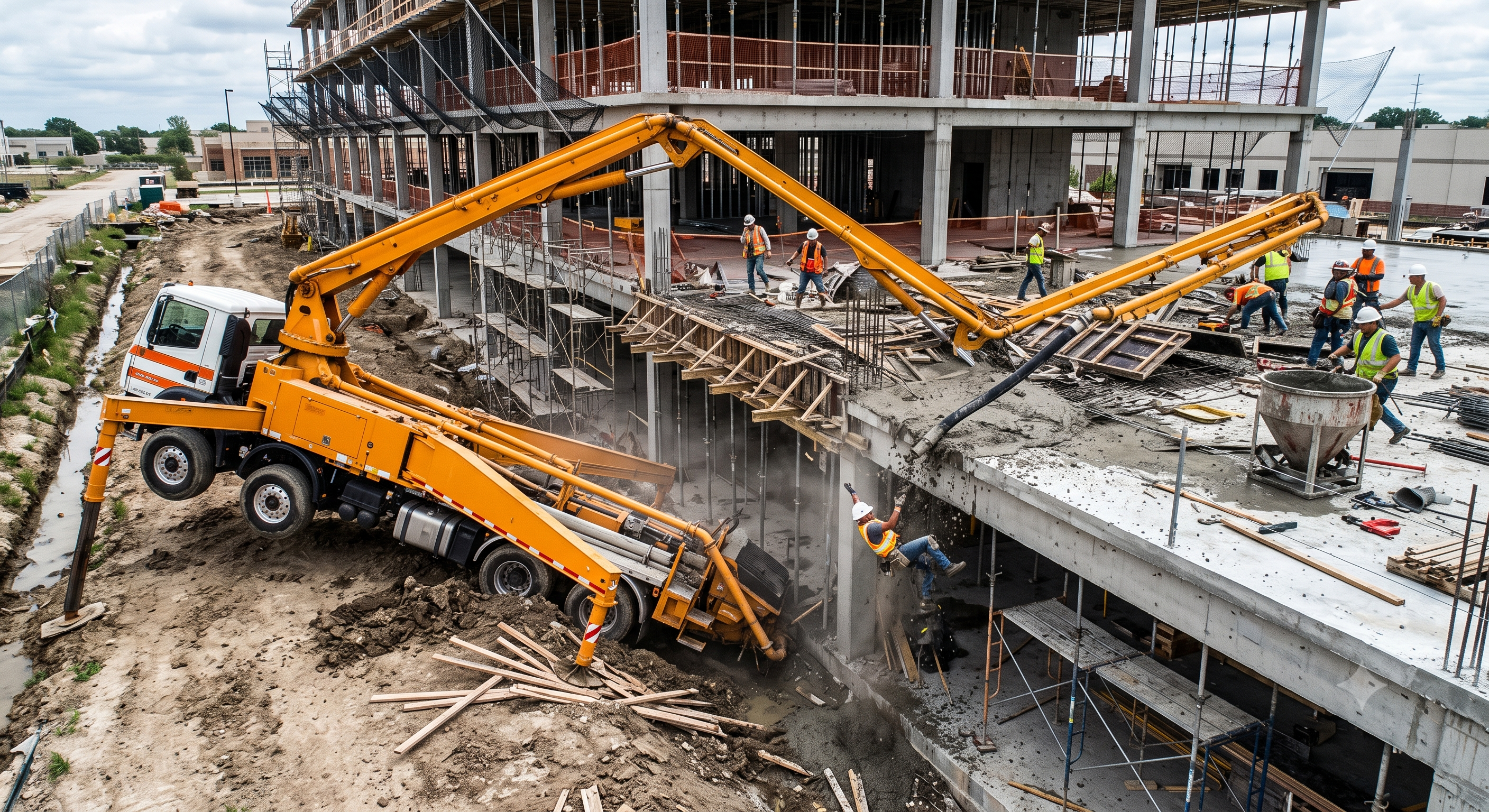
The original educational image is retained. It is not evidence of an actual incident or site suitability.
The scenario and record comparisons are fictional teaching examples, not records of real incidents, measurements, inspections, signatures or approvals.
| Item | Fictional scenario |
|---|---|
| Initial situation | A pump is set beside a recently backfilled service trench. |
| Changed condition | One support begins settling while the line delivery becomes irregular. |
| Failure path | The crew proposes continuing the pour and increasing pressure to clear a suspected blockage. |
| Possible outcome | Loss of support and sudden air discharge can cause separate overturning and hose-whip events. |
| Prevention barrier | Stop, clear the danger area and review ground support and line state independently. |
Failure mechanisms
Support pressure depends on the actual outrigger reaction and effective loaded pad area, together with pad strength and underlying soil. A level reading or large-looking timber does not establish bearing capacity near a trench or void. Boom configuration changes the reactions.
Air trapped in concrete lines stores energy. Low hopper level, interruption or a blockage may admit or trap air; increasing pressure can make sudden release more violent. Keep people clear during priming and restart and follow the manufacturer’s controlled method. Holding the hose with more people is not an engineered restraint.
Hydraulic pressure and concrete-side trapped pressure are different. Stopping or reversing the pump does not prove every isolated section is depressurised. Before opening a coupling, use the specified verification procedure, account for gravity head and keep out of the discharge path.
Rapid or uneven placement can exceed formwork limits even when the pump is operating normally. A formwork observer needs a protected location, communications and authority to stop; do not station anyone beneath a suspected failing pour.
Decision sequence
| Decision stage | What to verify |
|---|---|
| Known facts | Settlement and irregular delivery have been reported; no measurements are assumed. |
| Unresolved matters | The support reaction, ground condition, blockage location and trapped pressure remain unresolved. |
| Reason to hold | Continued boom motion or pressure escalation could worsen two independent hazards. |
| Required evidence | Obtain support assessment and configuration checks, then the equipment-specific isolation and blockage procedure; record both streams separately. |
| Restart decision | Restart only after competent checks close both issues, formwork and access remain suitable, and the designated supervisor authorises the revised sequence. |
5. Conditional decisions and common errors
| Condition | Action | Evidence | Proceed when |
|---|---|---|---|
| Support settles | Stop and exclude | Ground and pad review | Support verified |
| Air or blockage | Stop; clear hose zone | Line-state checks | Controlled restart |
| Formwork moves | Stop placement | Design-led inspection | Formwork released |
| Line cleaning | Isolate and secure | Approved cleanout plan | Energy controlled |
Similar situations, different decisions
The scenario and record comparisons are fictional teaching examples, not records of real incidents, measurements, inspections, signatures or approvals.
| Comparison | Situation A | Situation B |
|---|---|---|
| Level | Truck appears level: geometry only. | Reactions, ground and pad capacity are checked for the boom envelope. |
| Pressure | Hydraulic gauge falls to zero. | Each relevant delivery section is verified safe under the specified method. |
| Restart | Flow returns during a trial. | Air, access, support and formwork conditions are reviewed before people return. |
6. Roles and responsibilities
| Role | Responsibility |
|---|---|
| Work supervisor | Coordinate delivery traffic, exclusion and stop signals. |
| Technical reviewer | Review support, boom envelope and formwork interfaces. |
| Work crew | Maintain hopper level, controlled pumping and protected access. |
| Inspector / assessor | Record actual inspections, defects and pressure checks without assumed results. |
| Release / handover authority | Release only the reviewed work scope and pass on unresolved restrictions. |
Supervision, records, handover
| Job stage | Technical and procedural controls | Site verification |
|---|---|---|
| Set up | 1. Assign support review2. Record setup limits3. Release the location | 1. Reaction and ground2. Pad capacity3. Boom envelope |
| Feed hopper | 1. Control mixer queue2. Assign stop signal3. Record guard checks | 1. Traffic route2. Guard and interlock3. Emergency stop |
| Prime/restart | 1. Brief restart zone2. Confirm line status3. Authorise slow start | 1. Exclusion in place2. Line state reviewed3. Communication tested |
| Handle faults | 1. Freeze affected work2. Assign fault checks3. Record restart decision | 1. Affected section2. Energy isolation3. Support reassessment |
| Clean line | 1. Agree cleanout method2. Control exclusion3. Record energy checks | 1. Cleaning method2. Pressure evidence3. Capture arrangement |
| Fold/handover | 1. Define handover scope2. Assign defect owner3. Retain restrictions | 1. Boom travel position2. Support withdrawal3. Defect ownership |
7. Hold points and record comparison
| Hold point | Evidence before release | Confirmation / approval |
|---|---|---|
| Start | Site access, outrigger support, boom and line setup, mixer interface, priming, placement, interruption, cleaning and handover. | |
| HP-1 Set up | Reaction and ground · Pad capacity · Boom envelope · Level and location | |
| HP-2 Prime/restart | Exclusion in place · Line state reviewed · Communication tested · Protected standing area | |
| HP-3 Clean line | Cleaning method · Pressure evidence · Capture arrangement · People accounted for | |
| HP-4 Fold/handover | Boom travel position · Support withdrawal · Defect ownership · Area left safe |
Complete after actual checks. Recheck after changes, defects or shift handover.
Record comparison examples
The scenario and record comparisons are fictional teaching examples, not records of real incidents, measurements, inspections, signatures or approvals.
The boxes are static record prompts, not interactive or saved approvals. A tick does not establish suitability or permission to restart. Record the evidence, person, time and unresolved issues; retain the change history.
| Record type | Insufficient record | Record checklist |
|---|---|---|
| Support | Pads fitted | □ Pump/configuration ID□ Reaction and ground basis□ Pad size and strength□ Checker and time |
| Line | Pressure off | □ Affected line section□ Isolation method□ Pressure verification□ Person and result |
| Placement | Pour OK | □ Formwork release reference□ Rate and sequence limits□ Observation and changes□ Stop signal owner |
| Handover | Washed out | □ Cleaning method and boundary□ Defects and isolation state□ Waste disposition□ Recipient and restrictions |
8. Site checklist and emergency response
| Check item | Result | Person / action |
|---|---|---|
| □ Set up: Reaction and ground | ||
| □ Deploy boom: Supply conditions | ||
| □ Feed hopper: Traffic route | ||
| □ Prime/restart: Exclusion in place | ||
| □ Place/vibrate: Rate and sequence | ||
| □ Handle faults: Affected section | ||
| □ Clean line: Cleaning method | ||
| □ Fold/handover: Boom travel position | ||
| □ Release / handover authority |
Stop work
Stop for support settlement, loss of communication, unknown power-line clearance, hose surge, damaged couplings, formwork movement or failed guarding. Do not force a blockage out by increasing pressure.
Emergency response
Stop the operation from a safe position, exclude the boom and discharge danger zones and activate the site emergency plan. Do not approach potentially energised plant or a suspended unstable boom. Arrange specialist rescue and electrical authority response as applicable.
9. Sources and review limits
2026-10-08
| Source | Scope and limitations |
|---|---|
| WorkSafeBC - OHS Regulation Part 20 | BC regulatory example: concrete pumps, incorporated standards and certification; verify equipment manufacture date and applicable clauses. |
| WorkSafeBC - Concrete pumpers | BC operator certificate requirement and technical resources; provincial scope only. |
| WorkSafe Queensland - Hose whip | Foreign technical reference on hose whip and cleanout, not Canadian law. |
This is reference content written and revised with AI. It has not been verified or approved by a professional. Review by a suitably qualified professional and site authorisation are required before use.
10. PDF guidance and FAQ
PDF A covers basic task controls; B focuses on technical failures; C covers supervision, records and handover. The article has eight stages with four items per main cell; each PDF has six key stages with three items per main cell. P/S/R/A, measurements, confirmations and signatures remain blank for actual site assessment.
Content group ID
jsa-concrete-placing
Decision sequence?
Obtain support assessment and configuration checks, then the equipment-specific isolation and blockage procedure; record both streams separately.
Proceed when?
Restart only after competent checks close both issues, formwork and access remain suitable, and the designated supervisor authorises the revised sequence.
Separate review?
Geotechnical design, electrical isolation, formwork design, structural repair and compressed-air cleaning require specific competent planning and the actual equipment instructions. This reference does not replace the site work method.
Scope and limitations?
No actual model manual, geotechnical report, formwork design or paid standard full text was supplied. There is no universal 3 m clearance, compulsory two-person hose restraint, or permission to clean with compressed air in this article. Prefer a safer cleaning method permitted by the manufacturer; if air is unavoidable, use a specifically reviewed procedure, secured outlet, capture device and exclusion, with hose/reducer removal as required by the equipment method.
Has a professional verified or approved this document?
No. Public sources and editorial, layout and consistency checks were reviewed using AI. No site inspection or professional technical approval has been performed. Obtain appropriate professional review before use.
11. Revision history and authorship
This is reference content written and revised with AI. It has not been verified or approved by a professional. Review by a suitably qualified professional and site authorisation are required before use.
| Date | Version | Change | Review status |
|---|---|---|---|
| 2026-09-13 | Original version unmarked | Original preserved | No professional approval |
| 2026-10-08 | 1.1 | Decisions, records, JSA and PDFs revised | No professional approval |
Retained ground and pad checks, electrical clearance, traffic control, hopper guarding, hose-whip precautions, formwork limits, edge protection, electrical protection and safe cleanout. Removed automatic compliance claims, universal clearances and two-person hose restraint. Separated drive isolation from concrete-line depressurisation; cleaning is a planned controlled task, not routine air blowout. Replaced the unsupported Alberta investigation and numeric near-miss details with an explicit fictional teaching scenario. Removed the claim that an outrigger interlock can physically prevent rollover. CSA Z151 and CSA C22.3 full texts were not reviewed; the original nationwide 3 m/50 kV statement is not retained as a rule.